
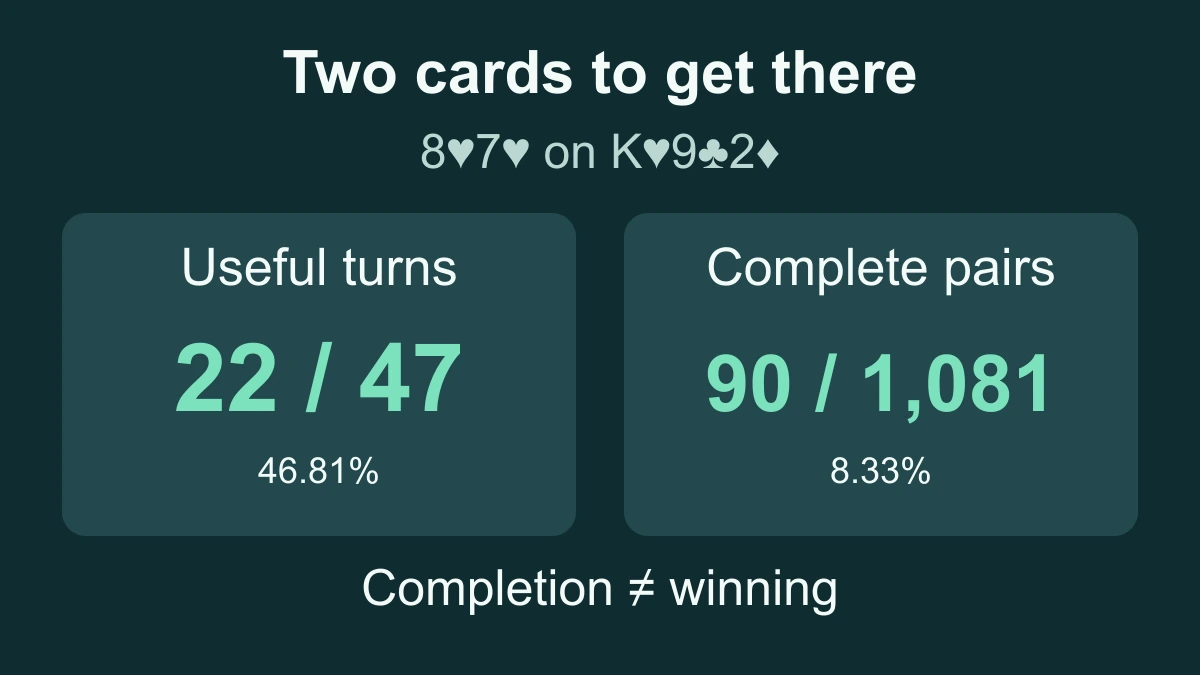
A backdoor draw needs help on both the turn and river. On the flop, three hearts across your hole cards and the board are a backdoor flush draw, not a nine-out flush draw. The next heart creates a draw; a second one completes the flush.
Map the turns before treating that potential as a reason to continue. With 8♥7♥ on K♥9♣2♦, 22 of 47 unseen turn cards create a one-card straight or flush draw. Yet only 90 of 1,081 equally likely two-card runouts complete either formation: 8.33%. Creating a draw is much more common than finishing one. That 8.33% assumes you see both remaining board cards; it is neither showdown equity nor a flop-call threshold.
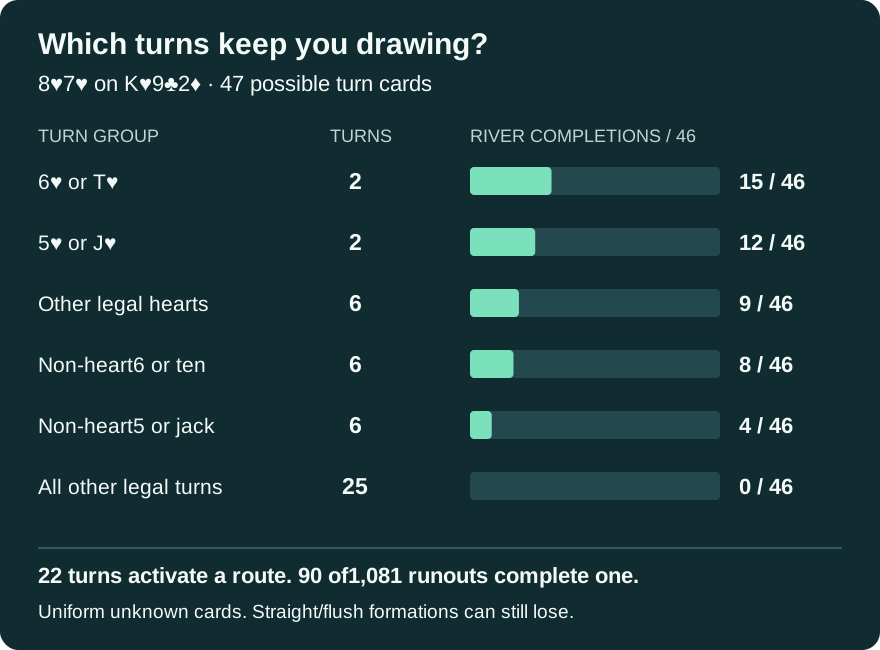
The original turn map below shows where those numbers come from. It is a synthetic Hold’em card-counting example, not a solver recommendation to call, bet or raise.
What “runner-runner” asks the deck to do
Hold’em lets you choose your best five cards from two hole cards and five community cards; the turn and river arrive separately. See the official PokerStars Hold’em rules. A runner-runner, or backdoor, completion requires both remaining board cards to contribute to the target hand.
With our 8♥7♥ and K♥9♣2♦ flop, no single turn card completes either target. A straight or flush is present only after two suitable runners. A 6♣ creates an open-ended straight draw: a 5 or ten on the river completes it. A 5♣ creates a gutshot: only a 6 completes the straight. A 3♥ creates a flush draw. A 3♣ leaves neither target reachable with one river card.
This is why “two suited hole cards” does not always mean a backdoor flush draw. If the flop has none of that suit, even two matching runners leave only four cards of the suit among your seven. You need three across your hole cards and the flop to reach five with two cards.
A complete turn map for two backdoor draws
We condition only on Hero’s two cards and the three flop cards. We assume a uniformly shuffled standard deck, with no information beyond those five known cards. Every remaining card is equally likely in each unknown location. There are 47 possible turns and, after each turn, 46 possible rivers. Unknown opposing hands, folds and burn cards are integrated out; we do not infer their contents from betting.
All rows use 8♥7♥ on K♥9♣2♦. T means ten; J means jack. “Completion cards” counts distinct rivers making at least one five-card straight or flush, not cards guaranteed to win. Scroll the table horizontally on a narrow screen.
| Turn cards | Number | Draw after the turn | Completion cards / 46 |
|---|---|---|---|
| 6♥ or T♥ | 2 | Flush + open-ended straight | 15 / 46 (32.61%) |
| 5♥ or J♥ | 2 | Flush + gutshot | 12 / 46 (26.09%) |
| 2♥, 3♥, 4♥, 9♥, Q♥, A♥ | 6 | Flush only | 9 / 46 (19.57%) |
| Non-heart 6 or ten | 6 | Open-ended straight only | 8 / 46 (17.39%) |
| Non-heart 5 or jack | 6 | Gutshot only | 4 / 46 (8.70%) |
| Every other legal turn | 25 | Neither target remains reachable | 0 / 46 (0%) |
For the 6♥ turn, the nine remaining hearts and eight straight-completing cards overlap at 5♥ and T♥. Count those two once: 9 + 8 − 2 = 15. The same principle gives 9 + 4 − 1 = 12 after 5♥.
The 22 active turns are 10 hearts plus 16 cards of ranks 5, 6, ten and jack, minus the four hearts counted in both groups. The other 25 turns do not mean the hand has zero equity. Pairing an 8 or 7 might matter against an opponent; our map tracks only straights and flushes.
This graphic summarizes the table. Scroll horizontally to read it at full size on a narrow screen.
Why the two backdoors add up to 8.33%, not 8.60%
The familiar backdoor-flush calculation is (10 / 47) × (9 / 46) = 4.16%. Ten unknown hearts can arrive first, followed by nine. Unlike an ordinary flush draw, a non-heart turn ends this route entirely. Multiplying a fixed number of immediate outs by four misses that two-step requirement.
For the combined calculation, count unordered turn–river pairs. There are C(47, 2) = 47 × 46 / 2 = 1,081 pairs. Each pair represents two equally likely orders, so treating them as unordered does not change the final-completion probability.
- Flush: choose any two of the ten remaining hearts: C(10, 2) = 45 pairs.
- Straight: the rank pairs 5–6, 6–T or T–J complete a straight. Each has four choices of each rank: 3 × 4 × 4 = 48 pairs.
- Both: 5♥–6♥, 6♥–T♥ and T♥–J♥ appear in both counts: three pairs.
Therefore P(straight or flush) = (45 + 48 − 3) / 1,081 = 8.33%. Simply adding the separate 4.16% and 4.44% figures double-counts those three completions.
“Both” here means a five-card straight and a different five-card flush can each be selected from the seven cards. It does not mean a straight flush. The 9♣ breaks the suited sequence in all three overlaps.
You can cross-check the result from the turn table: (2 × 15) + (2 × 12) + (6 × 9) + (6 × 8) + (6 × 4) = 180 successful ordered runouts. Dividing by 47 × 46 gives the same 8.33%.
What changes when you know an opponent’s cards?
The 47-card model describes a particular information state. If two specific opposing cards are exposed, there are 45 unknown cards instead. With zero hearts exposed, the flush count is 45 / 990 = 4.55%; with one heart, it is 36 / 990 = 3.64%; with two hearts, it is 28 / 990 = 2.83%. Exposing two non-hearts raises the flush-completion percentage because it removes cards that could make this route fail. Here 990 = C(45, 2), and the numerators choose two from ten, nine or eight remaining hearts.
Those are separate conditional calculations. Do not remove two arbitrary cards merely because an opponent exists. If you assign a range from the action, the calculation must average over compatible hands with their stated weights; the three exposed-heart percentages are not substitutes for that calculation. The contents of that range also matter for who wins.
A completed flush that loses: Keep 8♥7♥ on K♥9♣2♦, expose A♥Q♥ for the opponent, then deal 6♥ and 5♥. Hero makes K♥8♥7♥6♥5♥. The opponent makes A♥K♥Q♥6♥5♥ and wins with the higher flush, following the standard high-card comparison for flushes. The runner-runner route succeeded; the showdown did not.
Completion frequency is consequently different from equity against a hand or range. Equity can include wins with pairs or unimproved cards and shares from ties, while excluding completed draws that lose. Neither number alone supplies the EV of an earlier betting decision.
Use the map to ask a better study question
PokerStars’ semi-bluff lesson includes backdoor draws among possible candidates when other factors align. That is a reason to examine the full situation, not to call any flop bet because a hand can improve.
In an off-table review, write down the specific turns before checking a solution. For this hand: “A non-heart 6 gives me eight straight-completing rivers; 6♥ gives me fifteen straight-or-flush completions; 3♣ gives neither.” Then record the position, effective stack, pot, bet size and opponent range. The turn map is a checklist of possible continuations, not a frequency for betting them. Ask whether the available actions make sense under those conditions and whether reaching the river costs more chips.
For that next step, use GTO Gecko to study a comparable available flop scenario off-table, comparing its action frequencies and EV estimates before inspecting different turns. The current official listing, checked September 5, 2026, describes precomputed flop and turn study. GTO Gecko and this blog share the GTO Solutions team. This article’s exact fixture and turn map are independent calculations; we do not claim that the app contains this particular scenario.
Download the full map and reproduce the counts
Our 47-turn CSV and 1,081-runout CSV retain every card-level result. Download the exact totals, Python generator, independent Node verifier, method and reproduction instructions, and integrity manifest. Save the diagram source alongside them for the full package.
The enumeration is exact for one constructed 52-card Hold’em fixture, with both future board cards seen. It uses no random sampling and makes no claim about action-conditioned ranges, betting EV, optimal bluff frequency, stacks, rake, payouts or app output. Change the known cards or assumptions before applying these counts to a different hand.