
If every intervening reveal and your eventual prize are sampled uniformly without replacement from the same fixed finite pool, waiting to redeem one earned token cannot change its original expected value or jackpot probability. This remains true even when your timing rule reacts to past public reveals, provided you commit before seeing the selected envelope, must redeem by a finite deadline and will still have a prize to draw.
Waiting can still change the conditional answer. If somebody else removes a small prize, the mean of the remaining pool rises. If they remove the jackpot, its probability becomes zero. You learn which branch occurred only after accepting the risk of every branch. That is why a reveal can change today's number without making waiting better yesterday.
We prove the result below, then check a deliberately adaptive rule by enumerating all 720 possible labeled three-envelope prefixes of a disclosed synthetic pool. The rule selected every envelope exactly 72 times, reproducing the original payout distribution and its $300 mean.
Disclosure: GTO Gecko publishes this article and hosts a downloadable Mystery Bounty calculator and guide on its Resources page. The pool, timing rule, diagram and code below were created independently for this article. They do not describe an actual tournament, test an app or recommend a poker action.
The answer in three lines
- Before another reveal: draw now and any predictable timing rule—one committed using only earlier reveals—have the same payout distribution when every draw uses the stated fair pool.
- After another reveal: recalculate from the prizes that remain; the conditional mean and jackpot odds may move sharply.
- At the table: event rules, deadlines and time away from play can make immediate redemption operationally better even when envelope EV is unchanged.
First Check the Tournament's Actual Draw Rules
There is no universal mystery-bounty procedure. PokerStars' published explainer distinguishes automatic online reveals from live events where the player may decide when to pull a bounty. Its separate draw-timing article records professionals giving conflicting answers about whether they would pull immediately or wait. That disagreement is about live logistics and intuition; it is not a proof that the payout distribution changes.
The 2026 WSOP tournament rules allow mystery-bounty selection to be run manually or through software and note that some draws award a predetermined amount while others can award access to another mystery draw. A published 2026 WSOP Event #63 structure also says bounties begin on Day 2 and that prize redemption cannot start before 4 p.m. Those details matter: an automatic reveal leaves no timing decision, a nested draw is not the simple list of cash values used below, and a redemption window can override your preferred schedule.
Before applying any formula, confirm all five conditions:
- The stated remaining pool is fixed except for prizes removed by draws.
- Every intervening reveal and your eventual draw are conditionally uniform from that same pool.
- Each revealed prize is removed without replacement.
- Your token remains valid, and you must redeem while a prize is still available.
- You commit before seeing the selected envelope, using only earlier reveals and any independent private randomness.
If any condition fails, use the operator's rules rather than this model.
A Synthetic 10-Envelope Pool
Our example has ten labeled envelopes. The values are constructed to make both the updates and the verification easy to audit; they are not copied from a real event.
| Prize | Count | Pool value | Chance on one draw |
|---|---|---|---|
| $100 | 4 | $400 | 40% |
| $200 | 2 | $400 | 20% |
| $300 | 1 | $300 | 10% |
| $400 | 1 | $400 | 10% |
| $500 | 1 | $500 | 10% |
| $1,000 | 1 | $1,000 | 10% |
| Total | 10 | $3,000 | 100% |
The expected payout is the pool total divided by the number of envelopes:
E[next bounty] = $3,000 / 10 = $300
That $300 mean is not a prediction that you will receive $300. The median is $200, the most common payout is $100, and 60% of envelopes pay $100 or $200. The $1,000 envelope pulls the average upward. Expected value describes the long-run average of this model, not its typical single outcome.
What One Reveal Does to the Remaining Pool
Let S be the total value of the current pool, N its number of envelopes and x the prize another player reveals. The updated mean is:
new mean = (S - x) / (N - 1)
In this pool, removing anything below $300 raises the mean; removing anything above $300 lowers it. Removing exactly $300 leaves it unchanged.
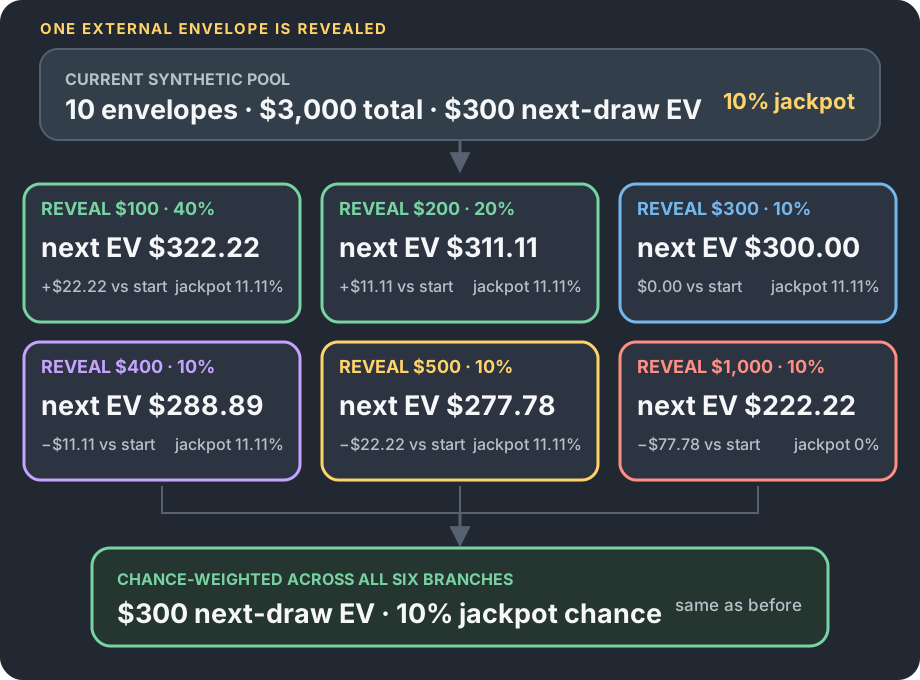
The table contains the same values as the diagram. On a narrow screen, scroll horizontally.
| Revealed prize | Branch chance | Remaining total | Next-draw mean | Change | Jackpot chance |
|---|---|---|---|---|---|
| $100 | 40% | $2,900 | $322.22 | +$22.22 | 11.11% |
| $200 | 20% | $2,800 | $311.11 | +$11.11 | 11.11% |
| $300 | 10% | $2,700 | $300.00 | $0.00 | 11.11% |
| $400 | 10% | $2,600 | $288.89 | −$11.11 | 11.11% |
| $500 | 10% | $2,500 | $277.78 | −$22.22 | 11.11% |
| $1,000 | 10% | $2,000 | $222.22 | −$77.78 | 0% |
| Chance-weighted result | 100% | — | $300.00 | $0.00 | 10.00% |
The tempting branch is the 40% chance that somebody removes $100, lifting your conditional mean to $322.22. Waiting also accepts a 10% branch where somebody removes the $1,000 jackpot, dropping the next mean to $222.22 and its jackpot chance to zero. The weighted average includes both.
Why No Predictable Timing Rule Beats the Pool
The mean calculation is only one part of the result. The stronger statement is that a valid timing rule preserves the entire marginal payout distribution, including jackpot odds.
Choose any payout class—for example, the $1,000 jackpot. Suppose R of the N remaining envelopes are in that class, so its current share is R / N. After another fair reveal:
- with probability
R / N, that reveal is in the class and its new share is(R - 1) / (N - 1); - with probability
(N - R) / N, it is outside the class and the new share isR / (N - 1).
Multiply each new share by its branch probability and add them. The result simplifies to R / N. In probability language, the remaining share of every payout class is a martingale: its next expected value, given everything already revealed, equals its current value.
Now let your redemption time be any bounded rule that uses only past reveals. When the rule stops, your fair draw has the current remaining distribution. The bounded optional-stopping result says the expected share of each payout class is still its starting share. Because this is true separately for $100, $200, $300, $400, $500 and $1,000, your complete ex-ante payout distribution—not merely its mean—stays the same.
The restrictions do real work. The conclusion does not cover seeing or marking the next envelope, redeeming only on branches where a token remains valid, waiting until no prize is available, or an unbounded process with no guaranteed stopping point.
For a simple counterexample, imagine only $100 and $1,000 remain. If you could inspect the first prize and accept it only when it is $1,000—otherwise reject it and take the second—you would guarantee $1,000. That is why a valid timing rule must commit before the selected prize is revealed.
Exact Check of an Adaptive Draw Rule
To make the theorem concrete, we tested a rule that really does react to what it sees:
- Allow one other envelope to be opened.
- If that reveal is $300 or less, redeem next.
- If it is above $300, allow one more external reveal, then redeem immediately after it.
This rule tries to capture the attractive low-prize-removal branches while delaying after an unattractive high-prize removal. It still cannot choose which first reveal occurs.
We labeled the ten envelopes and enumerated every ordered first-three prefix: 10 × 9 × 8 = 720 equally likely cases. When the policy stops in position two, the unused third position remains in the enumeration so every prefix keeps equal weight. The selected envelope was:
- $100 in 288 cases (40%);
- $200 in 144 cases (20%);
- $300, $400, $500 and $1,000 in 72 cases each (10% apiece).
Equivalently, each of the ten labeled envelopes was selected exactly 72 times. The verified mean is therefore (72 × $3,000) / 720 = $300, and the jackpot appears in 72 of 720 cases, or 10%. The adaptive rule did not improve either number.
| Policy | Information used | Expected payout | Jackpot chance |
|---|---|---|---|
| Redeem now | None | $300 | 10% |
| Wait exactly one reveal | One reveal; no reaction | $300 | 10% |
| Adaptive rule above | Up to two past reveals | $300 | 10% |
If You Have Several Tokens, Calculate the Batch You Can Draw Now
The single-token proof does not automatically settle every adaptive plan involving several accumulated tokens. A simpler question does have an exact answer: if you redeem k tokens immediately from the stated current pool, without replacement, the expected total is:
E[k immediate draws] = k × S / N
If J of the N remaining prizes meet or exceed a threshold, the chance of hitting at least one of them in k immediate draws is:
1 - C(N - J, k) / C(N, k)
In the synthetic pool, three prizes are at least $400 and one is the $1,000 jackpot:
| Tokens drawn now | Expected total | Chance of at least one $400+ prize | Jackpot chance |
|---|---|---|---|
| 1 | $300 | 30.00% | 10.00% |
| 2 | $600 | 53.33% | 20.00% |
| 3 | $900 | 70.83% | 30.00% |
| 4 | $1,200 | 83.33% | 40.00% |
Those are batch-at-this-moment results, not a theorem about every multi-token strategy. Pool-specific limits, token expiration, shared draws and rules about redeeming multiple tokens can change the decision.
The Bounty Draw Is Not the Poker Decision
This study begins after a player has already earned a token. It says nothing about the probability of earning one. Deciding whether to call, shove or chase an elimination can depend on:
- whether you cover the opponent and which player receives the bounty in a split pot;
- ranges, showdown equity, fold equity and side-pot rules;
- stack utility, payout pressure and Independent Chip Model effects;
- whether bounty eligibility starts on a later day or phase;
- the value of time, missed hands and leaving the table to join a redemption queue.
Our PKO bounty-value guide owns the earlier call-or-fold branch accounting, including coverage, immediate bounty cash and progressive-transfer assumptions. The ICM guide explains why tournament chips and cash are not interchangeable, while the late-registration study separates entry-timing mechanisms. The envelope calculation here should be one clean input, not a substitute for any of those problems.
Operationally, immediate redemption often has the simpler risk profile: you avoid forgetting a token, missing a deadline, misplacing a card or discovering that the event has stopped processing claims. Waiting can also cost hands if redemption requires leaving the table. None of those effects changes the fair envelope distribution; they change the real-world decision around it.
Download the Pool, Results and Code
The evidence bundle is designed to be checked without trusting the prose. The CSV defines every labeled envelope. The generator evaluates the formulas and all 720 labeled prefixes. The JavaScript verifier reconstructs the enumeration independently and checks the generated study.
- Synthetic labeled pool (CSV)
- Inputs, formulas, policy counts and exact outputs (JSON)
- Primary generator (Python)
- Independent verifier (JavaScript)
Download all four files into one folder. Run python mystery-bounty-draw-timing-generator.py, then node mystery-bounty-draw-timing-verifier.mjs. Both use only their language's standard library. The machine-readable output records integer-dollar inputs, exact fractions and exact prefix counts before producing rounded display values, so the visible $322.22-style figures do not feed back into the calculations.
To test a live structure, replace the synthetic rows with the operator's current remaining counts and prize values. Confirm the draw mechanism first; the Mystery Bounty calculator and guide in Resources can help organize the same remaining-pool inputs for off-table study.
Limits of This Result
- Fair finite pool: every intervening reveal and the eventual selected prize must be conditionally uniform from the same fixed pool and removed without replacement.
- One guaranteed draw: the general timing proof here follows one valid token that must be redeemed before a finite deadline with a prize still available.
- No advance information: a rule may react to public history but cannot inspect, mark or predict the next envelope.
- Cash payout only: the proof does not value missed hands, travel, queues, taxes, exchange rates or non-cash prizes.
- No hand strategy: it does not model cover probability, eliminations, ranges, ICM or the chance of earning a token.
- Synthetic example: the $3,000 pool is an audit fixture, not an estimate of any current or historical tournament.
If the event uses software-generated prizes, nested draws, expiring tokens or a rule that changes eligibility over time, obtain the actual mechanism before treating the remaining-prize list as a uniform envelope pool.
Mystery Bounty Draw Timing FAQ
- Should I draw my mystery bounty immediately?
- When every intervening reveal and the eventual prize are uniform draws without replacement from one fixed pool, drawing now and any bounded predictable timing rule have the same ex-ante payout distribution. Immediate redemption can still be preferable because of event deadlines, queues, card security or missed hands.
- Does waiting improve my chance of the top mystery bounty?
- No under the stated model. In the synthetic pool the jackpot starts at 10%. After one other reveal it becomes 0% if the jackpot was removed and 11.11% otherwise; before seeing the branch, those possibilities weight back to 10%.
- Why does the remaining average change if waiting has no advantage?
- The remaining average is conditional on what was revealed. Removing a below-average prize raises it and removing an above-average prize lowers it. Waiting exposes you to both changes; it cannot choose the favorable reveal in advance.
- Is expected value the payout I should expect most often?
- No. The synthetic pool's mean is $300, but its median is $200 and its most common payout is $100. A large top prize can make the mean much higher than the typical outcome.
- How do I calculate the chance of a large prize with several tokens?
- For
kimmediate draws, ifJofNprizes meet your threshold, use1 - C(N - J, k) / C(N, k). Recalculate from the current pool and do not extend that batch formula to an adaptive multi-token policy without a separate proof. - Does this prove when I should chase a mystery bounty?
- No. The analysis starts after the token is earned. Chasing one requires ranges, cover and elimination probabilities, side-pot rules, stack utility and sometimes ICM. Those are separate from the random draw's payout distribution.
Primary Sources and Method Files
- PokerStars Learn: How Mystery Bounty tournaments work — operator explanation of online and live draw mechanics, accessed September 1, 2026.
- PokerStars Learn: When should you pull your bounties? — published player perspectives on live redemption timing, accessed September 1, 2026.
- 2026 WSOP Tournament Rules, mystery-bounty draw provisions on pages 8–9 — accessed September 1, 2026.
- 2026 WSOP Tournament Structures, Event #63 provisions on pages 71–72 — accessed September 1, 2026.
- Article study output, generator and independent verifier — generated and checked September 1, 2026.