
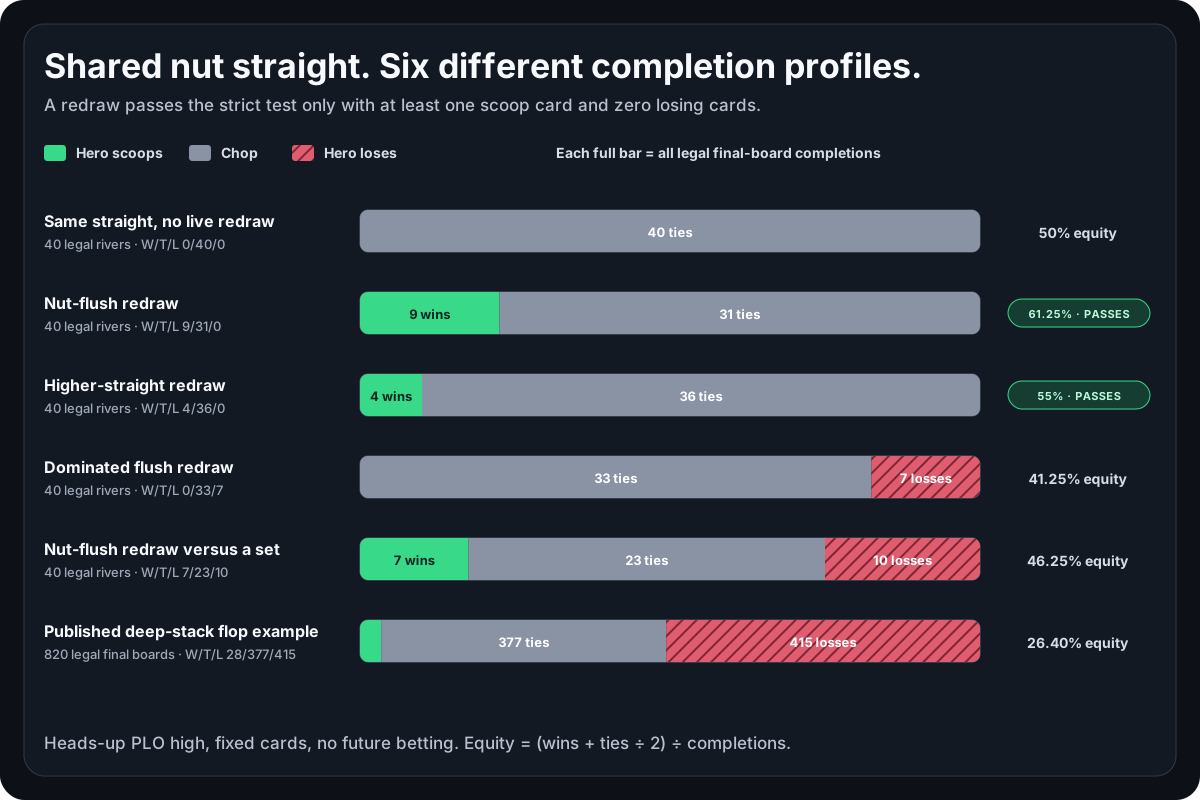
A redraw while sharing the nuts is not automatically a PLO freeroll. In the strict showdown test used here, both players hold the same current nut straight, Hero can scoop on at least one legal completion, and Hero cannot lose on any legal completion. With J-T on 9♠ 8♠ 7♦ 2♣, adding A♠ K♠ passes that test: Hero wins on 9 of 40 rivers, chops 31, loses none, and owns 61.25% equity.
Change only the opponent’s side cards to pocket deuces—which also make a set using the board deuce—and the label fails. Hero still holds the nut-flush redraw, but now wins 7 rivers, chops 23, and loses 10. The resulting 46.25% equity is below half. “I have the same nuts plus a redraw” is therefore not a complete diagnosis.
Scope and disclosure: this article covers heads-up four-card PLO high with fixed visible cards, a standard 52-card deck, and no future betting. GTO Solutions AS publishes this site and PLO Gecko. The casebook is open exhaustive enumeration, not product output, a solver strategy, or an outcome promise.
The Strict Three-Part PLO Freeroll Test
- Tied now: both players’ best legal five-card hands are identical in rank.
- A scoop exists: at least one legal final-board completion makes Hero win outright.
- No loss exists: no legal completion makes Hero lose.
A locked chop passes the first and third conditions but fails the second. A redraw that is dominated, or one facing a full-house counter-redraw, fails the third. Poker writing sometimes uses “freeroll” more loosely for a player who has a large one-sided advantage while sharing a made hand. The strict definition above is operational: anyone can test it completion by completion.
The underlying Omaha rule matters. The current PokerStars Omaha rules, checked September 4, 2026, require exactly two of four hole cards and exactly three board cards. They also state that identical hands divide the pot. Our evaluator enforces those constraints for every row.
Showdown equity = (Hero wins + ties ÷ 2) ÷ legal completions
Scoop probability and equity are different numbers. The A♠ K♠ case scoops 9/40 rivers, or 22.5%, yet its equity is 61.25% because each of the 31 chops returns half the pot.
Six Exact Same-Nut-Straight Profiles
Every row begins with both players holding the current highest possible straight. Each starting board is unpaired and contains at most two cards of one suit, so no full house, quads, flush, or straight flush is available; in these six states, the nut straight is also the current overall nuts. The first five start on the turn, where twelve cards are known and 40 rivers remain. The sixth reproduces a published flop matchup, where eleven cards are known and C(41,2) = 820 unordered final boards remain. Suits are fixed; these are physical-card examples, not averages over hand classes.
Narrow screen? Scroll the table horizontally to inspect the cards and every outcome count.
| Profile | Board | Hero | Villain | Completions | W/T/L | Equity | Strict result |
|---|---|---|---|---|---|---|---|
| Locked chop | 9♠ 8♠ 7♦ 2♣ | J♥ T♥ A♣ K♦ | J♦ T♦ 3♣ 4♣ | 40 rivers | 0 / 40 / 0 | 50% | Not a freeroll |
| Nut-flush redraw | 9♠ 8♠ 7♦ 2♣ | J♥ T♥ A♠ K♠ | J♦ T♦ 3♣ 4♣ | 40 rivers | 9 / 31 / 0 | 61.25% | True freeroll |
| Higher-straight redraw | T♠ 8♠ 7♦ 2♣ | Q♥ 9♥ J♣ 3♦ | J♦ 9♦ 4♣ 5♣ | 40 rivers | 4 / 36 / 0 | 55% | True freeroll |
| Dominated flush redraw | 9♠ 8♠ 7♦ 2♣ | J♥ T♥ 5♠ 3♠ | J♦ T♦ A♠ K♠ | 40 rivers | 0 / 33 / 7 | 41.25% | Not a freeroll |
| Nut-flush redraw vs set | 9♠ 8♠ 7♦ 2♣ | J♥ T♥ A♠ K♠ | J♦ T♦ 2♦ 2♥ | 40 rivers | 7 / 23 / 10 | 46.25% | Not a freeroll |
| Published flop example | 9♥ 8♦ 7♦ | A♣ A♠ J♦ T♣ | K♦ Q♦ J♥ T♥ | 820 final boards | 28 / 377 / 415 | 26.40% | Not a strict freeroll |
Narrow screen? Scroll the chart horizontally to compare all six completion profiles.
Why Nine Spades Create a True Freeroll
On 9♠ 8♠ 7♦ 2♣, both players use J-T with 9-8-7 for a jack-high straight, the current nut straight. Hero’s A♠ K♠ cannot form a flush yet because an Omaha hand must use three board cards. Any spade river supplies that third board spade.
There are 13 spades in the deck. Four are known—9♠, 8♠, A♠, and K♠—so nine remain. Each gives Hero an ace-high flush; none gives Villain a better hand. The other 31 rivers preserve the shared straight or an equal improvement. That is the clean 9 wins, 31 ties, 0 losses partition.
A Side Card Can Freeroll Without a Flush Draw
On T♠ 8♠ 7♦ 2♣, both players’ J-9 makes the jack-high nut straight. Hero also holds Q♥. A remaining jack lets Hero use Q-9 with J-T-8 from the board for a queen-high straight. A remaining nine lets Hero use Q-J with T-9-8. One jack and one nine already sit in each player’s hand, leaving two of each: four scoop rivers.
No river makes Villain win, so 4/36/0 is a true freeroll with 55% equity. This example is useful because it removes the visual cue of a flush draw. The test is about the full completion tree, not the draw’s name.
Two Ways a Redraw Fails
The opponent owns the better version
Give Hero 5♠ 3♠ and Villain A♠ K♠ on the original 9♠ 8♠ 7♦ 2♣ board. Six spades are known, leaving seven. Every one of those seven rivers now makes both players a flush, and Villain’s ace-high flush wins. The 33 non-spades chop. Hero has a redraw in ordinary language, but the exact profile is 0/33/7 and 41.25% equity.
A different redraw beats your best cards
Return A♠ K♠ to Hero, but give Villain J♦ T♦ 2♦ 2♥. The paired side cards turn every remaining board-pairing river into at least a full house: three nines, three eights, three sevens, and the last deuce, for ten losses. Nine spades are nominal flush rivers, but 7♠ and 2♠ also pair the board; Villain’s full house or quads beats the flush. Hero therefore has only seven wins, alongside 23 chops and ten losses.
This is the casebook’s central correction. Counting your own scoop cards is only half the job. You must also enumerate the opponent’s better redraws and the overlaps where one river completes both.
The Current PokerStars Example, Recounted Exactly
A current PokerStars PLO strategy article, checked September 4, 2026, illustrates a “freeroll situation” on 9♥ 8♦ 7♦. Hero has A♣ A♠ J♦ T♣ and Villain has K♦ Q♦ J♥ T♥. Both currently make the jack-high nut straight. PokerStars describes the K-Q-J-T hand—our Villain—as the freerolling side; our ledger keeps the A-A-J-T hand as Hero to match the source’s displayed 26.40% perspective.
PokerStars reports the result per 1,000: Hero wins 34, ties 460, and Villain wins 506, giving Hero 26.40% equity. Our exhaustive count over the exact finite sample space is 28 wins, 377 ties, and 415 losses across 820 final boards. Scaled to 1,000, those values are 34.146, 459.756, and 506.098—respectively 34, 460, and 506 after whole-number rounding.
The agreement is a useful external check, but the terminology is looser than our operational definition. From Villain’s perspective, the exact partition is 415 wins, 377 ties, and 28 losses, or 73.60% equity. Those 28 losses mean neither side passes the zero-loss test. This is also a flop state with two cards to come, not one of the five turn demonstrations.
How to Audit a Same-Nuts PLO Spot
- Build the current hand legally. Name the exact two hole cards and three board cards each player uses. Confirm that the shared straight is actually the nuts.
- Mark your scoop completions. Count physical cards, not only ranks, and subtract every visible blocker from both four-card hands.
- Mark every loss. Look for a higher flush, higher straight, board pair, full house, quads, and any counter-redraw created by side cards.
- Resolve overlaps. A card such as 7♠ can complete your flush and the opponent’s full house. Award the final hand, not the first draw you noticed.
- Keep showdown equity separate from action EV. Ranges, position, stack-to-pot ratio, bet size, future actions, fold equity, and rake are absent from a fixed-card river ledger.
For flop wraps and the difference between nut and dirty outs, continue with the PLO wraps guide. For the conceptual boundary between equity and expected value, use poker equity explained.
Method, Independent Check, and Downloads
The JavaScript generator constructs a standard 52-card deck, checks collision-free inputs, verifies that both players share the board’s highest possible straight, and evaluates every legal completion using exactly two hole and three board cards. There is no random seed or sampling error. The 40-card turn rows and 820-board flop row each partition completely into wins, ties, and losses.
The separate Python reimplementation does not import the JavaScript evaluator. It parses cards, evaluates five-card hands, applies the Omaha construction rule, recomputes the nut-straight ceiling, and reconciles every outcome, display card, hand category, and best-five construction across all 1,020 CSV rows. Its frozen run passed 8,263 checks with assertion checks enabled. Agreement is evidence that two implementations reproduce the declared model; it is not peer review or certification of arbitrary PLO software.
- Question, rules, data dictionary, reproduction commands, and limitations
- Frozen case inputs and expected results (JSON)
- Machine-readable case summary (JSON)
- All 1,020 completion-level outcomes (CSV)
- Primary JavaScript generator and separate Python reimplementation
- Frozen verification report and SHA-256 manifest
What the Casebook Does Not Decide
- Not a strategy node: fixed cards and equal completion likelihoods do not supply ranges, frequencies, position, stack depth, or a betting tree.
- Not action EV: 61.25% showdown equity does not by itself tell you whether to check, bet, call, raise, or fold.
- Not multiway: extra hands change card removal, scoop paths, and pot shares.
- Not every Omaha variant: the cases use four-card PLO high, not PLO5, PLO6, Omaha Hi/Lo, wild cards, or a nonstandard deck.
- Not a population estimate: six diagnostic examples do not measure how often freerolls occur in play.
The current US App Store and Google Play listings for PLO Gecko, checked September 4, 2026, describe PLO4 and PLO5 study and training. Use it for the workflows stated in those listings, or start with our broader PLO learning path. This article did not install or test the app, and the open casebook does not establish that an app contains these six exact states.
Frequently Asked Questions
- What is a nut-straight freeroll in PLO?
- In this article’s strict showdown definition, both players share the current nut straight, Hero has at least one way to scoop, and Hero has no way to lose over all legal final-board completions. This is different from a freeroll tournament, where entry does not require the usual buy-in.
- Is every redraw to the shared nuts a freeroll?
- No. A lower flush draw can be dominated, and a nut-flush draw can still lose to full-house or quads counter-redraws. Enumerate both players’ winning cards and resolve overlaps.
- Can you hold the current nuts and have less than 50% equity?
- Yes. In the pair-counter-redraw case, both players share the nut straight, but Hero has 46.25% equity. In the dominated-flush case, Hero has 41.25%.
- Why are there 40 rivers on the turn?
- Twelve cards are known: four board cards and eight hole cards. Removing them from a 52-card deck leaves 40 distinct river cards.
- Why are there 820 final boards on the flop?
- Eleven cards are known, leaving 41. With no future betting, turn-river order does not change the final showdown, so there are C(41,2) = 820 equally likely unordered pairs.
- Does a freeroll mean I should always raise?
- No. The label describes a fixed-card showdown completion tree. An action still depends on ranges, pot size, remaining stacks, future betting, fold equity, position, and rake.
Sources
- PokerStars, How to Play Omaha Poker. Rules for four hole cards, exactly two hole cards plus three board cards, a 52-card deck, and split identical hands. Accessed September 4, 2026.
- PokerStars Learn, PLO: Six Common Mistakes. Published June 24, 2026; fixed-card comparison and per-1,000 outcomes. Accessed September 4, 2026.
- GTO Gecko, PLO freeroll casebook evidence bundle. Generated and independently checked September 4, 2026.
- PLO Gecko, US App Store listing and Google Play listing. Product context accessed September 4, 2026.