
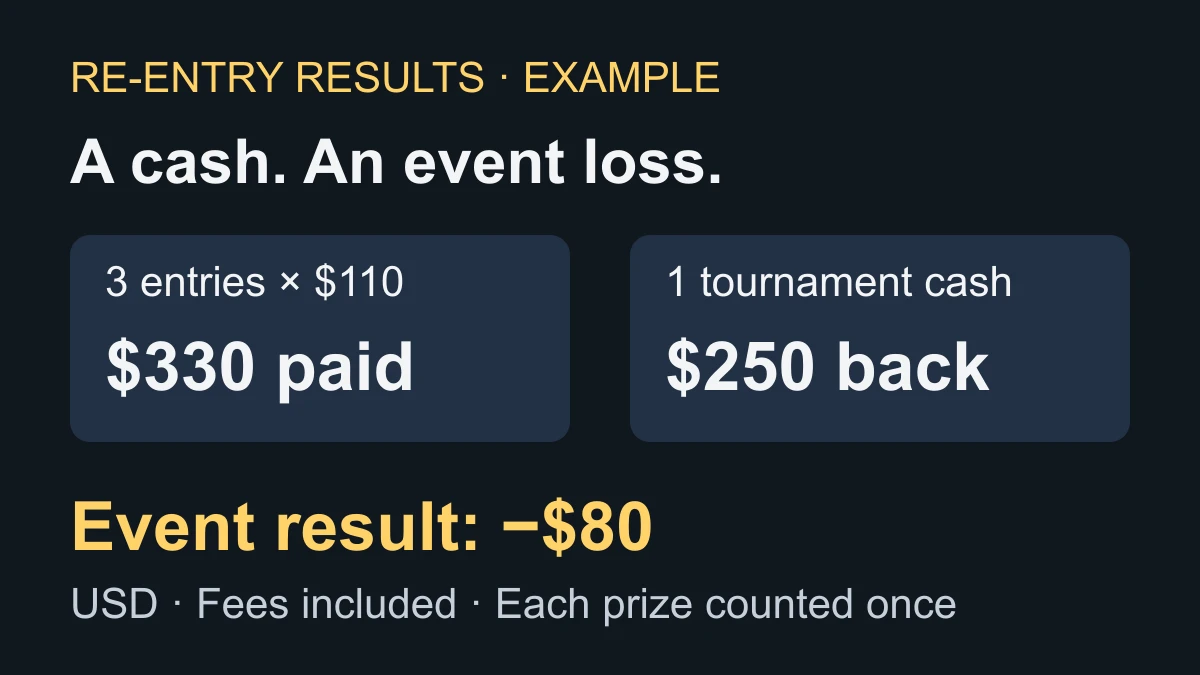
A tournament cash can still leave you with an event loss. To find the net result, subtract every entry cost, including fees, from the event's total prize receipts. Divide that net by the total entry cost to calculate ROI. A $250 cash after three $110 entries leaves a net result of −$80, not +$140.
Start with the charges, not just the finishing position. A results page may show one finish while your payment history contains several paid entries, commonly called bullets. This guide uses six invented entry receipts and three completed events to show how to reconcile the two. Download the entry ledger and event ledger to follow the arithmetic.
Define an entry before calculating ROI
Under PokerStars' re-entry rules, a player can enter again after elimination, within the event's registration window and limits. Check the event's own rules. One tournament entered three times is one event and three paid entries in the ledger below.
Our examples cover self-funded cash entries into completed, non-bounty tournaments, all in US dollars. Each event has one settled cash prize for the player, which may be zero. They exclude tickets, staking, swaps, refunds, rebuys, add-ons, bounties, travel, taxes, currency conversion and phased formats that can pay a player more than once. Those require additional records and explicit accounting conventions; they are not zero-cost items to silently omit.
Record the prize-pool contribution and operator fee separately when the receipt provides that split. A receipt for $100 plus a $10 fee costs $110. If a lobby already lists an inclusive $110 total, do not add the $10 again. The amount paid is the control total.
Use one table for charges and another for prizes
Give each event a stable identifier. Under it, give every entry a unique receipt or entry identifier. Put each entry's charge in the entry table; put the event's settled prize in the event table once.
Event A: the cash that did not cover the entries
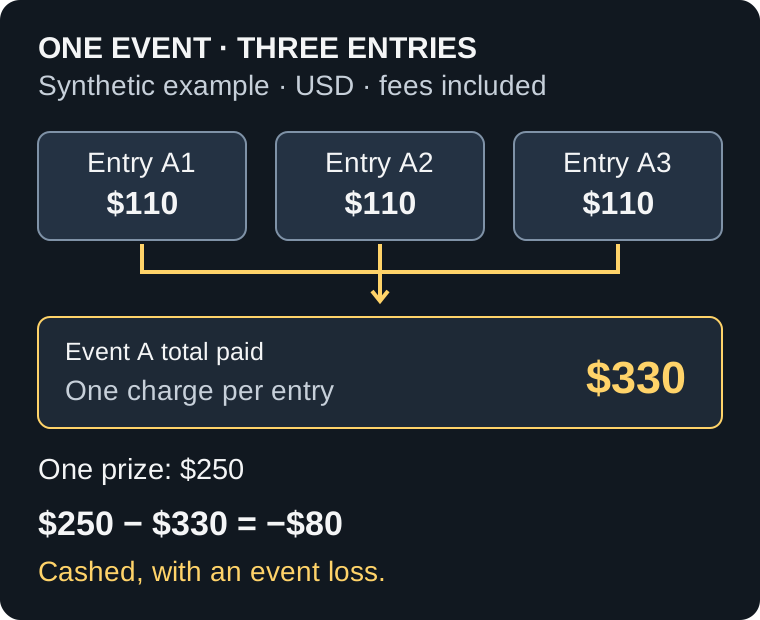
Entry A1: $100 + $10. Entry A2: $100 + $10. Entry A3: $100 + $10. Each is a separate payment for the same event. The first two entries ended without a prize; the third ended with a $250 cash.
Event cost: $110 + $110 + $110 = $330.
Net result: $250 − $330 = −$80.
Event ROI: −$80 / $330 × 100 = approximately −24.24%.
If you join the $250 event prize onto all three entry rows and then sum that column, you get $750 of supposed receipts from a single $250 payout. Aggregate the charges by event first, then attach the one event prize. If your system instead records prizes by entry, assign this prize only to the surviving entry and check that the event total still equals $250.
Reconcile the complete set before reading the percentage
The synthetic ledger has three events and six entries. Every entry includes a fee; every prize is counted once. The table uses dollars, and ROI is rounded only for display.
On a narrow screen, scroll the table horizontally to see the ROI column.
| Event | Entries | Paid | Prize | Net | ROI |
|---|---|---|---|---|---|
| A | 3 × $110 | $330 | $250 | −$80 | −24.24% |
| B | 1 × $55 | $55 | $0 | −$55 | −100.00% |
| C | 2 × $220 | $440 | $800 | +$360 | +81.82% |
| Total | 6 entries | $825 | $1,050 | +$225 | +27.27% |
Total realized entry-cost ROI = (sum of settled prizes − sum of all entry costs) / sum of all entry costs × 100. Here that is ($1,050 − $825) / $825 × 100 = approximately 27.27%. It describes this constructed completed set. It does not estimate the reader's long-run return or justify another entry.
Use four checks before accepting the result:
- Match the entry list against your original payment and registration records. Internal agreement cannot prove that no receipt was omitted.
- Each event identifier and each entry identifier appears once in its own table. Every entry belongs to a listed event.
- The sum of the six receipt totals equals the sum of the three event costs: $825.
- Match prizes to payout confirmations. Here they sum to $1,050, and $825 + $225 = $1,050. No event prize is multiplied by its entry count.
Keep losing entries and zero-prize events in the same declared set as the cashes. For an ongoing event, record the payments but leave its result unsettled. Do not replace a pending prize with zero or include an unfinished event in this completed-event ROI.
When total entry cost is unknown, leave ROI unresolved
A displayed finish does not prove how much a particular player paid. SharkScope's current FAQ explains that on some networks it estimates individual rebuy or re-entry expenses when actual counts are unavailable. That is a documented data limitation, not evidence that every result is wrong. Check which costs your source knows, estimates or omits.
Suppose you know Event A paid $250 and each entry cost $110, but you have verified only that there were between one and three entries. One entry would mean +$140; two would mean +$30; three would mean −$80. The sign is unresolved until the count is known. Store that uncertainty and look for the missing receipts. Do not turn a blank into one entry or a zero-dollar fee.
A verified total event charge can establish cost even if the entry count is missing. Likewise, if the fee is included in a verified total charge, its missing breakdown does not stop you calculating the total cost. Missing cost and missing detail about an already-known cost are different problems. The supplied dataset has complete splits for inspection, not because every personal ledger needs that exact schema.
Label what the denominator counts
Two of the three synthetic events have a cash, but only two of the six individual entries finish with a prize. “66.67% of events cashed” and “33.33% of entries cashed” describe different denominators. Name the denominator when exporting or comparing a result. Another database may group entries differently.
Also distinguish total ROI from an unweighted mean of event ROIs. SharkScope distinguishes its average and total ROI statistics. For our event units, the unweighted mean is approximately −14.14%, while total ROI is +27.27%. The unweighted mean gives the $55 event the same weight as the $440 event. Total ROI answers how the combined dollars paid performed. Check the label before comparing your ledger with a tracker.
Keep the results ledger separate from decision study
This calculation tells you what the completed entries cost and returned. It does not tell you whether a re-entry or a particular hand was a good decision. Our bankroll guide addresses reserve planning; the ICM explainer covers how tournament stacks and payouts enter a decision model.
For separate off-table decision study, ICM Trainer offers available precomputed tournament scenarios with stack and payout context. It is made by GTO Solutions, the team behind GTO Gecko. The downloadable ledger is an independent article resource, not an ICM Trainer tracking feature.
Sources checked September 6, 2026. All events and receipts are invented, with no player records or performance estimates. Download the exact results, method and reproduction instructions and independent checker. The checker tests the published fixtures and intentionally rejects other datasets. It cannot find real receipts you have not supplied.