
A river block bet is a deliberate small lead by the out-of-position player. It can beat checking when worse hands call the small bet, those hands would often check back, and the opponent's raise branch is not costly enough to erase the extra value. It fails when calls are too strong, worse hands fold, or raises force too much of the betting range to surrender.
The name is misleading if you take it literally. A small lead proposes a lower first price and changes the response tree. It does not cap the pot: the in-position player can still fold, call, or raise.
PokerStars Learn's April 9, 2026 guide uses 20%–33% pot as a current educational convention for this idea. That is not a rule. The defensible size depends on the board, action history, stack, ranges, rake, and other sizes allowed in the tree.
Scope: the compact model below covers one fixed hand in a heads-up no-limit Hold'em river tree. It allows check-fold/check-call or bet-fold/bet-call against one opponent bet or raise size. It excludes check-raises, river three-bets, multiple response sizes, side pots, and new rake. For a range, choose the best response for each combination first, then weight legal hand pairs; do not apply one best response to pooled range-average equity.
Compare Two Trees, Not Two Slogans
“Bet small for thin value” is not enough analysis. Neither is “check to control the pot.” The decision is between two complete trees:
- After checking, the opponent can check back or bet. If they bet, you can fold or call.
- After leading, the opponent can fold, call, or raise. If they raise, you can fold or call. The chips lost when you bet-fold still count in the original decision.
The labels describe different things. A donk bet describes leading into the previous aggressor. A probe bet depends on a previous-street check-back. A block bet describes a usually small river lead's strategic role. One bet can fit more than one label, but no label settles its EV. It also has nothing to do with holding a blocker card, although card removal can shape the betting range.
What a Small River Lead Can Gain
- Calls from hands that would check back. This is the cleanest thin-value case. A medium-strength hand turns a missed value opportunity into a call from worse.
- A different response tree. After a check, the opponent may bet a polarized range for a larger size. After a small lead, some hands call, some fold, and only a subset raises. The new response range can be easier or harder to face; the tree decides.
- Cheap folds from better hands. On the river, folding a worse hand does not deny future equity—there is no next card. A bluffing small lead earns its keep only by folding hands that currently win at showdown.
A zero-equity bluff risking 25 chips to win 100 breaks even at 25 / (100 + 25) = 20% folds when every non-fold response loses the 25 and there is no further profitable branch. That is a restricted break-even result, not a recommended frequency.
The Branch-Complete EV Model
Let P be the pot before the river decision. Measure chip EV from that decision point, with prior contributions treated as sunk and any earlier rake already removed.
After checking
EV(check) = c × e_checkback × P + (1 − c) × max[0, e_vs_bet × (P + 2x) − x]
c is the opponent's check-back probability, x is their bet, and the maximum chooses between folding for zero and calling.
After leading b
EV(lead) = f × P + k × [e_vs_call × (P + 2b) − b] + r × max[−b, e_vs_raise × (P + 2y) − y]
The opponent folds with probability f, calls with k, and raises with r, so f + k + r = 1. y is the opponent's total raise-to amount, not the extra chips above your lead.
The four equities are conditional on four different response ranges. The range that checks back is not the range that calls a lead, and neither is the range that raises. Plugging one pooled showdown-equity number into every branch can make a good line look bad—or hide a losing line.
A 100-Chip Worked Example
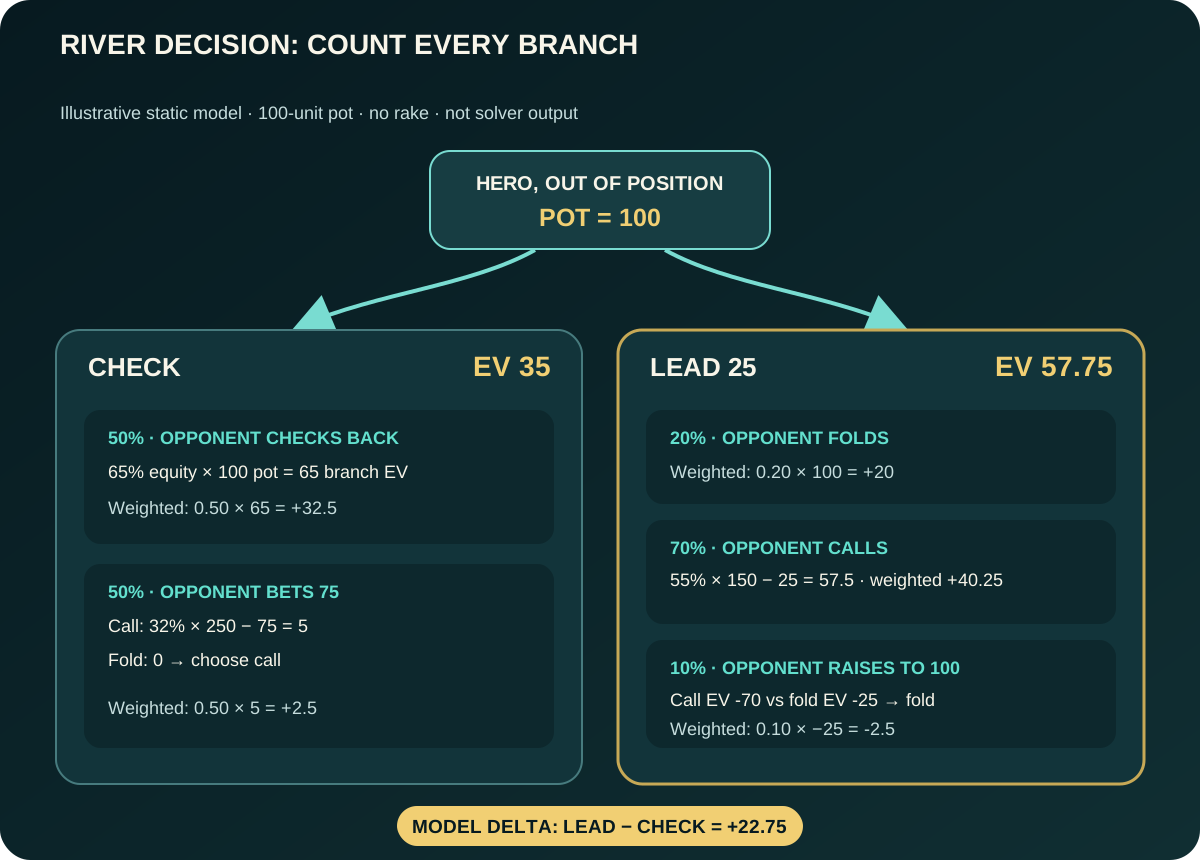
Consider a synthetic heads-up river model: a 100-chip pot, a medium-strength made hand out of position, a 25-chip lead, and a 100-chip total raise-to size. These assumptions expose the arithmetic; they are not observed player frequencies or solver output.
If you check, the opponent checks back 50% of the time. Your 65% equity against that branch contributes 0.50 × 0.65 × 100 = 32.50 chips. The opponent bets 75 the other 50%; your 32% equity makes calling worth 0.32 × 250 − 75 = 5, contributing another 2.50. EV(check) is 35 chips.
| Opponent response | Probability | Hero branch decision and payoff | Weighted contribution |
|---|---|---|---|
| Fold | 20% | Win the 100-chip pot | +20.00 |
| Call | 70% | 55% equity: 0.55 × 150 − 25 = 57.50 | +40.25 |
| Raise to 100 | 10% | Fold and lose the 25-chip lead | −2.50 |
| Total | 100% | EV(lead) | +57.75 |
Under these inputs, leading gains 57.75 − 35 = 22.75 chips over checking. The source of the gain is visible: the calling branch contains enough worse hands, while the raise branch is uncommon enough that bet-folding does not consume the value. Change those inputs and the conclusion can reverse.
Where the Conclusion Flips
This sensitivity table is also synthetic, not solver output. It holds the check line at 35 chips, the lead at 25, folds at 20%, and equity versus a raise at 10%, so Hero folds to each raise to 100. As raise frequency rises, call frequency falls to keep all responses at 100%. Only equity against callers and raise frequency vary.
| Equity versus calls | Raise 5% | Raise 15% | Raise 25% | Raise 35% |
|---|---|---|---|---|
| 25% | −6.88 | −10.63 | −14.38 | −18.13 |
| 35% | +4.38 | −0.88 | −6.13 | −11.38 |
| 45% | +15.63 | +8.88 | +2.13 | −4.63 |
| 55% | +26.88 | +18.63 | +10.38 | +2.13 |
Read across for the cost of more raises and down for the value of a weaker calling range. At 35% equity versus calls, a 5% raise rate leaves the lead ahead; 15% makes it slightly worse. “I can get called” is incomplete: which hands call, and what does the rest of the range do?
What to Do When the Block Bet Is Raised
Suppose you lead 25 into 100 and the opponent raises to 100 total. Calling costs another 75, and the final pot after you call is 300. At the response node, you need:
equity needed = (raise-to − lead) / (pot + 2 × raise-to) = 75 / 300 = 25%
Equivalently, folding returns −25 from the original decision point; calling returns equity × 300 − 100. Call when the latter is at least −25. The first 25 chips are sunk at the response node, but they do not vanish from the original lead's EV.
A pure zero-equity raise to 100 risks the full 100 to win the 125-chip pot already out there. It needs Hero to fold 100 / 225 = 44.44% of the time. In that stripped-down model, continuing at least 55.56% denies an automatic-profit pure bluff. This is not a universal minimum-defense target: value raises, showdown equity, several sizes, rake, and river three-bets change the solution.
Against a strategic raiser, a robust small-bet range cannot contain only marginal bet-folds. It needs stronger continues alongside selected bluffs and thin value; the exact mix is node-specific. Use polarized and merged range concepts as vocabulary, not as a substitute for opening the response tree.
A Bounded Current-Engine Observation
Constructed solver snapshot, not a population recommendation. On September 4, 2026, the publisher of this article ran one author-constructed heads-up river node—using the same rank runout as the cited PokerStars example—through GTO Gecko's then-current solving service. The pot was 100, effective river stacks were 300, and the board was J♠4♦2♣A♥8♠. We supplied explicitly listed, equally weighted ranges of 39 OOP and 40 IP physical combinations and a fixed action tree.
The service returned three root actions. After card-removal conditioning and weighting all 1,365 legal OOP–IP hand pairs in its two-decimal per-combination dump, the range checked 69.56%, bet 25 for 23.95%, and shoved 300 for 6.49%. Three retained responses were byte-identical. The response did not expose a deployment revision or independent exploitability certificate, so we report what the service returned—not a claim that this proves equilibrium accuracy.
This bounded result shows that a small lead can appear alongside checks and a larger bet in one fully specified model. It does not prescribe these frequencies for another board, range, stack, rake, action menu, or opponent, and it is not a claim that the public solution library contains this constructed node. The sanitized input, per-combination root output, and collision-weighted aggregation are public. The EV table above is a separate sensitivity model, not solver output.
When to Look for the Bet—and When to Reject It
| Small lead becomes more plausible | Checking becomes more plausible |
|---|---|
| Worse bluff-catchers can call small but would check back. | Worse hands mostly fold while better hands call. |
| The checking branch faces an awkward larger, polarized bet. | Checking captures nearly the same showdown value without opening a costly raise branch. |
| Your range retains enough strong hands to continue against raises. | Your small-bet range lacks credible continues and can be pressured. |
| A bluff candidate folds enough hands that currently win. | The opponent's continue range is too strong for the amount risked. |
| Removal effects improve the intended call or fold target. | The copied size came from a different board, range, or action history. |
Multiway pots, payout pressure, and a different rake treatment move the decision outside this simple heads-up chip-EV model. Exploit adjustments also need a read or sample. If a particular opponent calls too wide and rarely raises, thin value improves. If that opponent bluff-raises too often, hands clearing the call threshold gain value while weak bet-folds lose value. Those are conditional deductions, not claims about a stake or player pool.
When you are in position and can check behind, the decision changes. Our river top-pair study after a turn check-back compares another value bet with taking showdown, using actual reached ranges and conditional river models.
A Five-Step Block-Bet Study Drill
- Freeze the node. Record positions, board, action history, pot, effective stack, rake treatment, and available river sizes.
- Compare the two roots. Write down check EV and small-lead EV for the range and for the hand you are studying.
- Open every response. Record fold, call, and raise frequencies. Confirm they sum to 100%, then inspect the selected range in each branch.
- Audit the raise plan. Calculate the call threshold from the actual total raise-to size. Mark bet-folds and bet-calls combination by combination.
- Change one input. Add or remove one size, alter one range assumption, or change the river card. If the conclusion moves, identify the branch that caused it.
The current US Apple App Store and Google Play listings describe GTO Gecko as an educational product for reviewing precomputed preflop and postflop ranges or strategies, practicing decisions with feedback, and tracking study progress. Use a comparable library node for this drill; do not assume the consumer product contains this constructed research node or accepts arbitrary inputs.
Disclosure: GTO Solutions AS publishes both this article and GTO Gecko. The constructed engine snapshot supports one specified observation; it is not an outcome promise or evidence that studying it improves poker results.
Common Block-Bet Mistakes
- Treating the name as protection. The opponent still owns a raise button.
- Counting calls without conditioning the range. A high call rate is bad if the callers are mostly better hands.
- Using one equity number everywhere. Check-backs, calls, bets, and raises are selected ranges.
- Betting only medium hands. A face-up bet-fold range invites an aggressive response.
- Copying 25% or 33% mechanically. Sizing changes both the price offered and the raise tree. See our broader poker bet-sizing guide.
- Ignoring the alternative. A small lead can be profitable and still lose to checking; compare the two EVs.
River Block-Bet FAQ
- Is every small out-of-position river bet a block bet?
- No. “Block bet” is most useful when the small lead is chosen to improve on the check branch, commonly through thin value or a low-risk bluff. Another small bet may simply be an ordinary value size.
- What size is a block bet?
- There is no universal cutoff. Sizes around 20%–33% pot appear in current educational usage, but the available tree and ranges decide whether 25%, 40%, or no lead is best.
- Is bet-folding the river always weak?
- No. Folding can be correct when your equity against the raising range is below the call threshold. The strategic leak is building a whole small-bet range that cannot defend, not folding one hand that lacks enough equity.
- Is a block bet the same as a donk bet?
- Not necessarily. “Donk bet” describes action order relative to the previous aggressor. “Block bet” describes the role and usually small size of a river lead. The same action can be both.
- Does the engine snapshot prove I should block bet that board?
- No. It shows that one constructed range pair and one restricted action tree used the 25-chip option. Reproduce your node, inspect the response ranges, and test whether the result survives reasonable changes.
Sources, Data, and Reproduction
- PokerStars Learn, “A Guide to Block Betting the River”, April 9, 2026; and “Considering if Betting Smaller is Better”, October 24, 2025. These establish current public terminology, not this article's calculations. Accessed September 4, 2026.
- Apple App Store, GTO Gecko: Poker Study; Google Play, GTO Gecko: Poker Study. Product descriptions accessed September 4, 2026.
- GTO Gecko, branch-complete model and assumptions (JSON), sensitivity rows (CSV), sanitized solver snapshot (JSON), and independent standard-library checker (Python). Generated September 4, 2026.
The Node generator and independent Python checker recompute all terminal payoffs, the 16 sensitivity cells, the 20%/44.44%/25% thresholds, legal card-collision counts, and the range-weighted root frequencies. Download the four data files into one folder and run python river-block-bet-verifier.py. Passing confirms internal consistency with the declared inputs; it cannot prove that the toy response frequencies occur in play or independently certify a private solving service.