
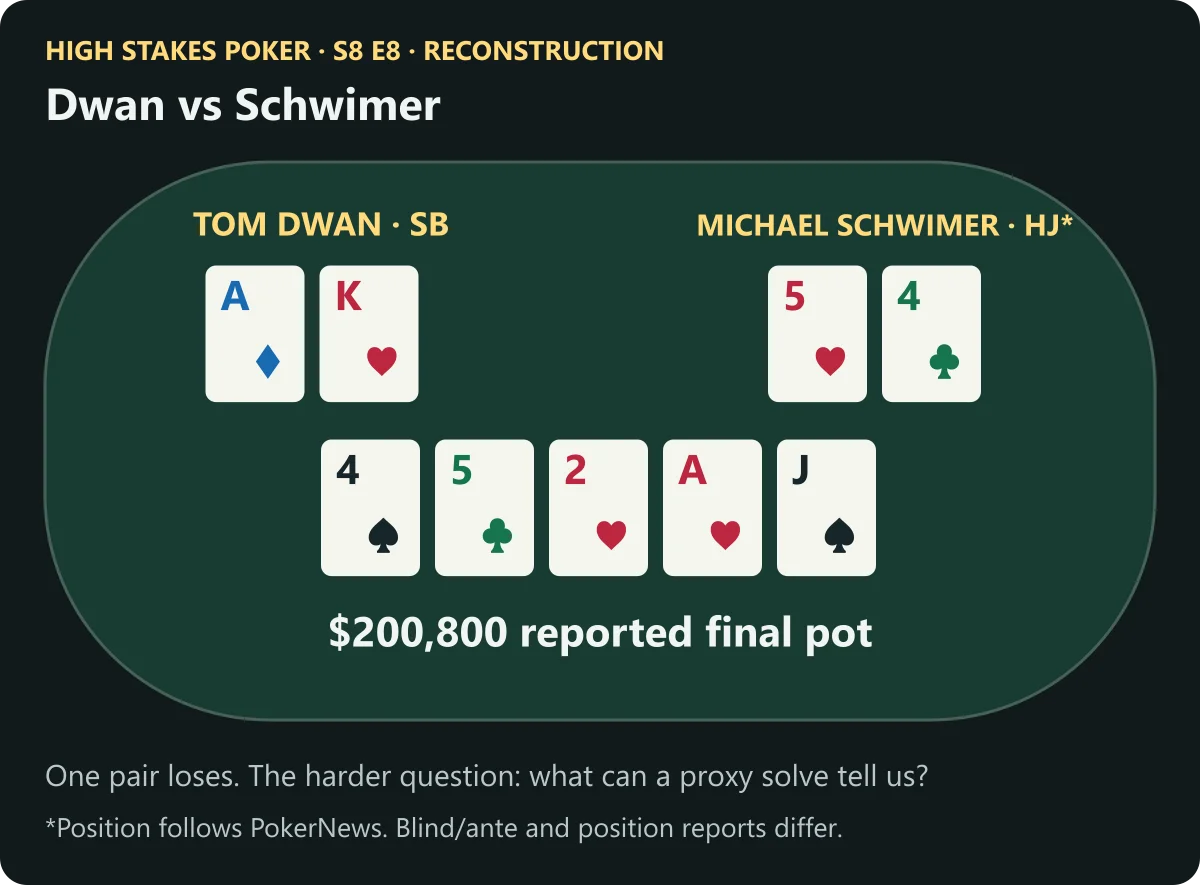
Tom Dwan’s ace-king lost a reported $200,800 pot to Michael Schwimer’s five-four offsuit. The closest retrieved solver model frequently checks his ace-king on the turn—but cannot give us a trustworthy verdict on the whole hand. The reason appears before the flop: Schwimer’s exact starting hand never opens in that model. A solver can still teach us something here, provided we keep the real hand, the matched decisions, and the changed assumptions visible.
We reconstructed this hand from High Stakes Poker, Season 8, Episode 8, using contemporary reporting, then queried real preflop and GTO Gecko postflop solutions. Below are the cards, a range grid, the closest available betting branches, and the river price. This is an analysis of a played cash-game hand through an approximate model, not a fresh solve of the televised game.
Disclosure: GTO Solutions AS publishes GTO Gecko and this article. Database extracts and sources checked September 5, 2026. Graphics are original reconstructions.
Scroll the diagram horizontally on a narrow screen for readable labels.
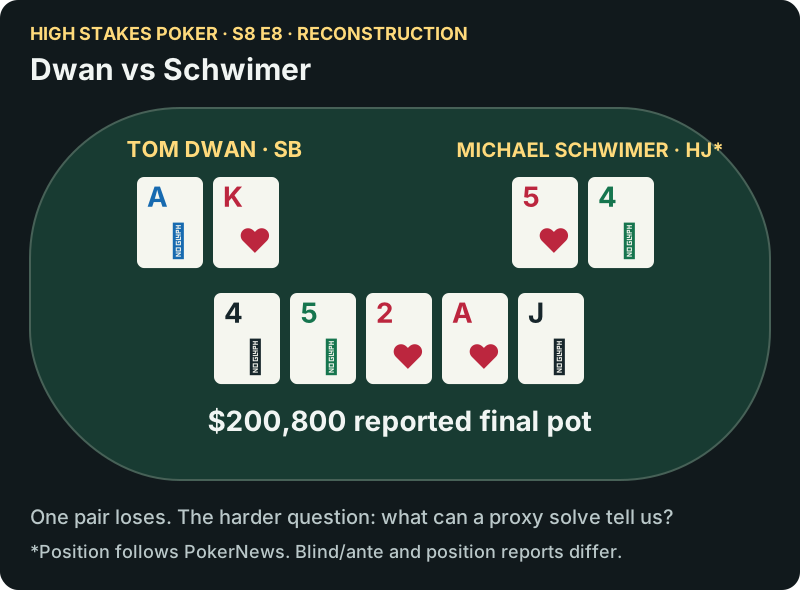
The hand: ace-king meets an unexpected two pair
Schwimer had reloaded to about $100,000. We follow the small-blind and hijack position labels in the PokerNews episode recap; Poker.org’s hand report supplies the hole-card suits and $54,800 river pot. Dwan held A♦K♥; Schwimer held 5♥4♣.
Scroll the diagram horizontally on a narrow screen for readable labels.
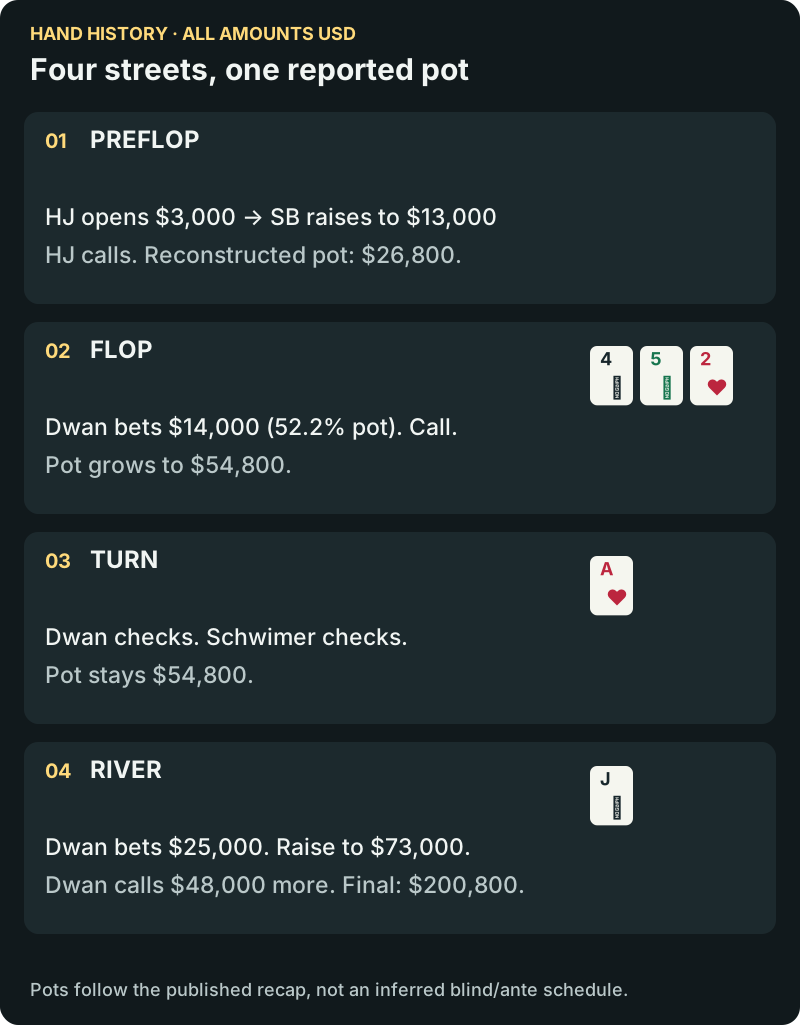
Complete hand history in text
Scroll horizontally on narrow screens to read all columns.
| Street / board | Dwan, SB · AdKh | Schwimer, HJ · 5h4c |
|---|---|---|
| Preflop | Three-bets to $13,000 | Opens $3,000; calls $10,000 more |
| Flop 4♠ 5♣ 2♥ | Bets $14,000 | Calls $14,000 |
| Turn A♥ | Checks | Checks |
| River J♠ | Bets $25,000; calls $48,000 more | Raises all-in to $73,000 |
The completed board is 4♠ 5♣ 2♥ A♥ J♠. Schwimer’s two pair beats Dwan’s pair of aces. That outcome settles who won; it does not tell us which decisions were profitable against the ranges each player expected.
A source discrepancy worth keeping visible
The episode-level PokerNews description lists $200/$400/$800 with an $800 third-blind ante. That schedule does not reconcile with this hand’s reported pots under the stated positions. Poker.org describes $200/$400. We use the reported $54,800 river pot and $200,800 final pot, reconstructing the flop pot as $54,800 − 2 × $14,000 = $26,800; we do not invent the missing blind/ante explanation.
Bart Hanson’s separate reconstruction also labels Schwimer as the cutoff in narration. We test that alternative below. The official PokerGO episode is the original broadcast; its subscription-gated footage was not independently reviewed for this article.
Choose the model by structure, then show the differences
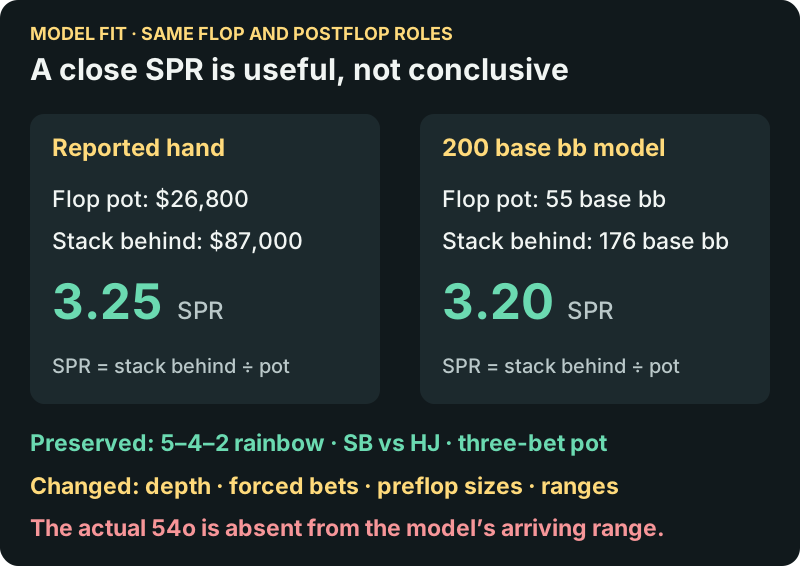
We found the same 5–4–2 rainbow flop in the GTO Gecko 200-base-big-blind, eight-seat straddle, SB-versus-HJ three-bet-pot library. Here “base big blind” means the blind before the straddle: the model uses 0.5/1/2 blinds, so 200 base bb equals 100 straddles. This is the closest structural comparison among the configurations we checked, not a claim that the actual hand had that forced-bet structure.
Scroll the diagram horizontally on a narrow screen for readable labels.
Scroll horizontally on narrow screens to read all columns.
| Parameter | Reported hand / reconstruction | Selected model |
|---|---|---|
| Game roles | SB versus HJ, following PokerNews | SB versus HJ, heads-up postflop |
| Starting effective stack | About $100,000; 250 × the reported $400 big blind | 200 base bb; 100 straddles |
| Forced bets | Sources differ; not reconciled | 0.5 / 1 / 2 blinds; 0.5bb ante each × 8 |
| Preflop sizes | Open $3,000; three-bet to $13,000 | Open 6bb; three-bet to 24bb |
| Flop pot / stack behind | $26,800 / $87,000 | 55bb / 176bb |
| Rake | Not established | 4%, capped at 2 base bb |
| Flop / turn | 4♠ 5♣ 2♥ / A♥ | Identical after consistent suit relabel |
| Opponent’s exact 54o | Present in the reported hand | Zero preflop arrival; absent postflop |
The appeal is the stack-to-pot ratio (SPR): $87,000 behind divided by the reconstructed $26,800 flop pot is 3.25; the stored model has 176 bb behind and a 55 bb pot, or 3.20. A 150bb unstraddled live model we also checked has an SPR of 5.91; the 100bb straddle version has 1.38. Matching the postflop geometry makes the 200bb model useful, even though it does not make the preflop ranges interchangeable. See how straddles change action order and effective depth.
We preserve the actual suits through a complete relabeling: clubs→spades, spades→hearts, hearts→diamonds, diamonds→clubs. The database board is therefore 5♠ 4♥ 2♦, its turn A♦, and Dwan’s combination A♣K♦. Every card changes consistently. That differs fundamentally from replacing only Schwimer’s offsuit hand with a suited one; our solver suit-frequency guide explains why.
Preflop: the most important mismatch is 54o
In the corresponding preflop library, the hijack folds 54o 100% when first in. After a modeled 6bb open, the small blind’s AKo three-bets to 24bb about 93.85%, calls 6.12%, and jams 0.03%. Dwan’s aggressive action therefore fits this nearby model, with a different raise size.
Schwimer’s subsequent call cannot be graded honestly by clicking an off-range 54o cell. Its arrival weight at the modeled three-bet decision is zero: the model never opened it. That is a limitation of this comparison, not proof that the live opponent could not hold it.
Scroll the diagram horizontally on a narrow screen for readable labels.
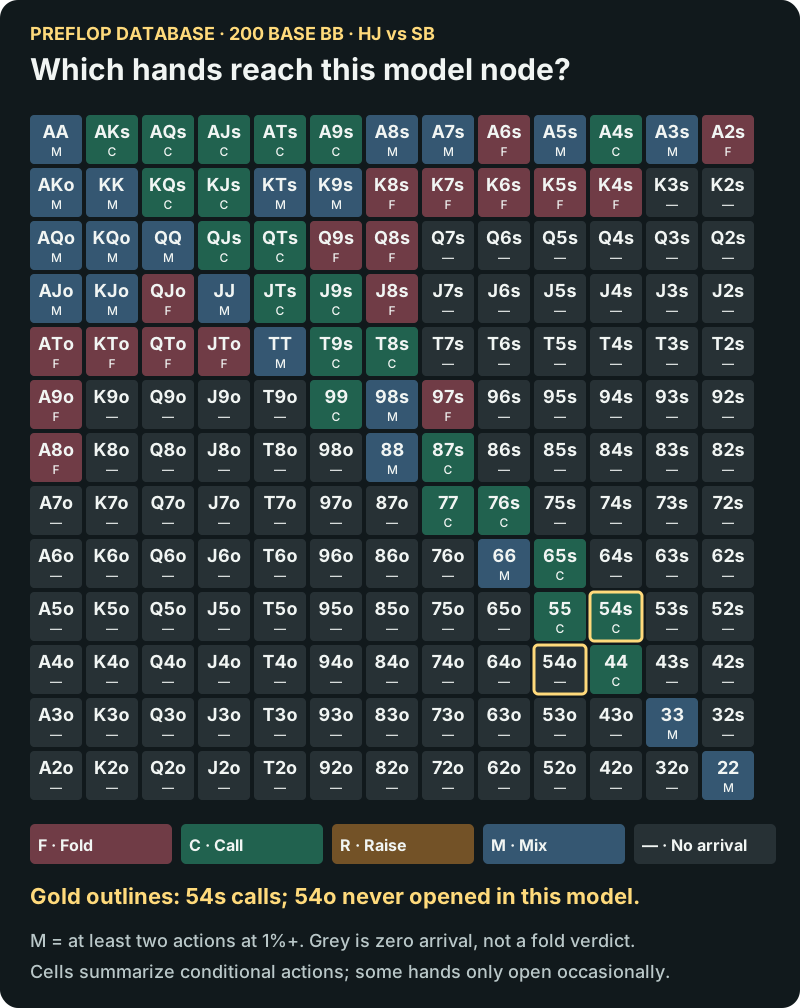
Read the grid conditionally. It describes the hijack’s response after opening to 6bb and facing the small blind’s raise to 24bb. F means fold, C call, R raise, and M a mix with at least two actions at 1% or more. A dash means no arrival. Colored cells can represent hands that only opened occasionally; they do not mean every listed hand always reaches this node.
Accessible text version of the 13×13 grid
F fold; C call; R raise; M mixed; — no arrival. Scroll horizontally to read the entire grid.
| Rank | A | K | Q | J | T | 9 | 8 | 7 | 6 | 5 | 4 | 3 | 2 |
|---|---|---|---|---|---|---|---|---|---|---|---|---|---|
| A | AA M | AKs C | AQs C | AJs C | ATs C | A9s C | A8s M | A7s M | A6s F | A5s M | A4s C | A3s M | A2s F |
| K | AKo M | KK M | KQs C | KJs C | KTs M | K9s M | K8s F | K7s F | K6s F | K5s F | K4s F | K3s — | K2s — |
| Q | AQo M | KQo M | QQ M | QJs C | QTs C | Q9s F | Q8s F | Q7s — | Q6s — | Q5s — | Q4s — | Q3s — | Q2s — |
| J | AJo M | KJo M | QJo F | JJ M | JTs C | J9s C | J8s F | J7s — | J6s — | J5s — | J4s — | J3s — | J2s — |
| T | ATo F | KTo F | QTo F | JTo F | TT M | T9s C | T8s C | T7s — | T6s — | T5s — | T4s — | T3s — | T2s — |
| 9 | A9o F | K9o — | Q9o — | J9o — | T9o — | 99 C | 98s M | 97s F | 96s — | 95s — | 94s — | 93s — | 92s — |
| 8 | A8o F | K8o — | Q8o — | J8o — | T8o — | 98o — | 88 M | 87s C | 86s — | 85s — | 84s — | 83s — | 82s — |
| 7 | A7o — | K7o — | Q7o — | J7o — | T7o — | 97o — | 87o — | 77 C | 76s C | 75s — | 74s — | 73s — | 72s — |
| 6 | A6o — | K6o — | Q6o — | J6o — | T6o — | 96o — | 86o — | 76o — | 66 M | 65s C | 64s — | 63s — | 62s — |
| 5 | A5o — | K5o — | Q5o — | J5o — | T5o — | 95o — | 85o — | 75o — | 65o — | 55 C | 54s C | 53s — | 52s — |
| 4 | A4o — | K4o — | Q4o — | J4o — | T4o — | 94o — | 84o — | 74o — | 64o — | 54o — | 44 C | 43s — | 42s — |
| 3 | A3o — | K3o — | Q3o — | J3o — | T3o — | 93o — | 83o — | 73o — | 63o — | 53o — | 43o — | 33 M | 32s — |
| 2 | A2o — | K2o — | Q2o — | J2o — | T2o — | 92o — | 82o — | 72o — | 62o — | 52o — | 42o — | 32o — | 22 M |
Across the arriving range, weighting physical combinations and their preflop reach gives approximately 41.13% fold, 53.40% call, 3.11% four-bet to 52.8bb, and 2.37% jam. These are range averages, not 54o’s strategy.
There is a useful comparison hand: 54s. At 200 base bb it opens about 99.72% and calls the modeled three-bet 100%. At 100 base bb it opens only 0.05%. Depth matters substantially inside this database. Suitedness also matters: 54s is a deliberate analogy for studying two pair, never a replacement for Schwimer’s actual 54o.
Flop: Dwan’s half-pot bet is one of several options
Dwan’s $14,000 bet is 52.2% of the reconstructed $26,800 pot. The closest offered size is 27.5 into 55 base bb: exactly half pot. We select that existing branch rather than pretending the library solved a 52.2% bet.
Scroll the diagram horizontally on a narrow screen for readable labels.
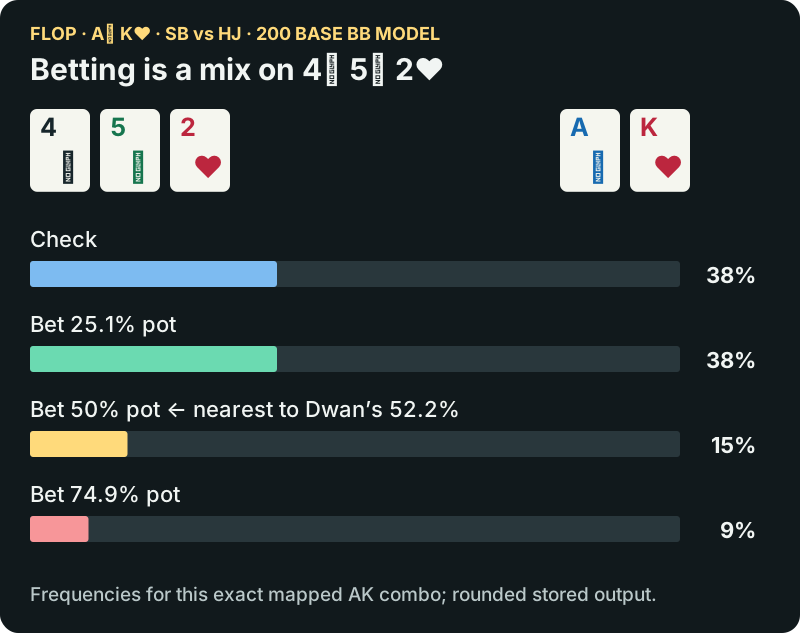
For Dwan’s exact mapped ace-king combination, the stored mix is 38% check, 38% bet about quarter pot, 15% bet half pot, and 9% bet about three-quarter pot. The played bet has a clear counterpart, but it is not the model’s only action. These are rounded numerical outputs within a restricted betting tree; the retrieved export does not provide a convergence certificate that would justify treating each percentage point as exact.
For the two legal suited 54 combinations, the modeled response to half pot is approximately always call after normalizing the rounded export. That gives us an example of two pair retaining a calling line. It does not supply a frequency for 5♥4♣, which is absent from the postflop range.
Turn: the model checks ace-king and bets suited two pair
Follow that half-pot-bet/call branch and deal the actual ace turn. Dwan’s exact combination checks about 77%. Its alternatives are a 20%-pot bet at 13%, a 46.2%-pot bet at 8%, and a remaining-stack shove at 2%. The played check appears frequently in this proxy, despite ace-king improving from ace-high to top pair. This frequency is against the model’s opponent range, which excludes 54o. A wider real range could change Dwan’s strategy too; the result does not validate his decision against Schwimer.
Scroll the diagram horizontally on a narrow screen for readable labels.
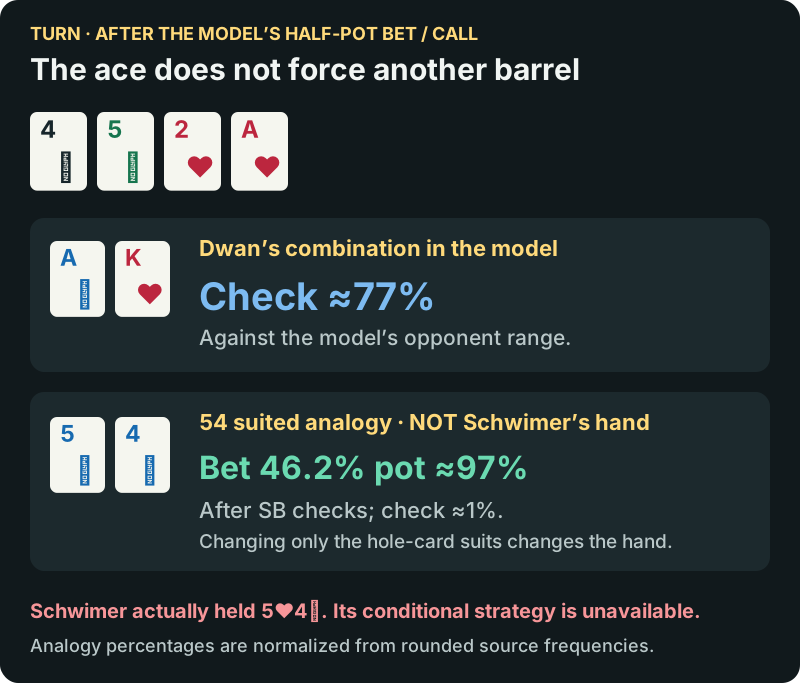
After the small blind checks, the suited-two-pair analogies behave differently from Schwimer’s played check-back. Both put about 97% on a 50.8bb bet into 110bb, approximately 46.2% pot, and only about 1% on checking in the rounded export. That small residual is not evidence of a precisely calibrated checking frequency. We show 5♦4♦ in the graphic; 5♥4♥ is the other legal suited analogy. On this board the latter has a heart flush draw, so they are not identical combinations even though this betting summary is similar.
This is the strongest teaching contrast in the hand: improving to top pair does not automatically make the out-of-position player bet, and having position with two pair does not automatically make checking attractive. The model’s strategies depend on both ranges and the previous betting branch. We cannot attach its suited-hand check frequency—or an EV loss—to Schwimer’s actual offsuit check.
How sensitive is that turn result?
Two small checks make the approximation more informative. First, changing the earlier flop size changes which hands arrive at the turn. Second, changing the reported opener from hijack to cutoff changes the starting ranges.
Scroll horizontally on narrow screens to read all columns.
| Opener model | Earlier flop bet | Turn check frequency |
|---|---|---|
| HJ, 200 base bb | 25.1% pot | ≈30% |
| HJ, 200 base bb | 50% pot — main comparison | ≈77% |
| HJ, 200 base bb | 74.9% pot | ≈96% |
| CO, 200 base bb | 50% pot — position check | ≈90% |
The HJ checks of 30%, 77%, and 96% come from three different conditional turn ranges, not a smooth sizing formula. Do not interpolate them to manufacture an exact answer for Dwan’s 52.2% flop bet. Under the alternative CO label, the closest half-pot branch checks about 90%; 54o still folds 100% first in, and AKo still mostly three-bets from the small blind (96.14%). The central limitations survive the position change, while exact frequencies move.
River: a price we can calculate, a verdict we cannot
The retrieved flop and turn files end at river-entry states. We did not obtain a river solution for this hand, rebuild the opponents’ ranges, or run a custom river solve. Consequently, neither Dwan’s river bet nor his call gets a solver approval stamp here.
Scroll the diagram horizontally on a narrow screen for readable labels.
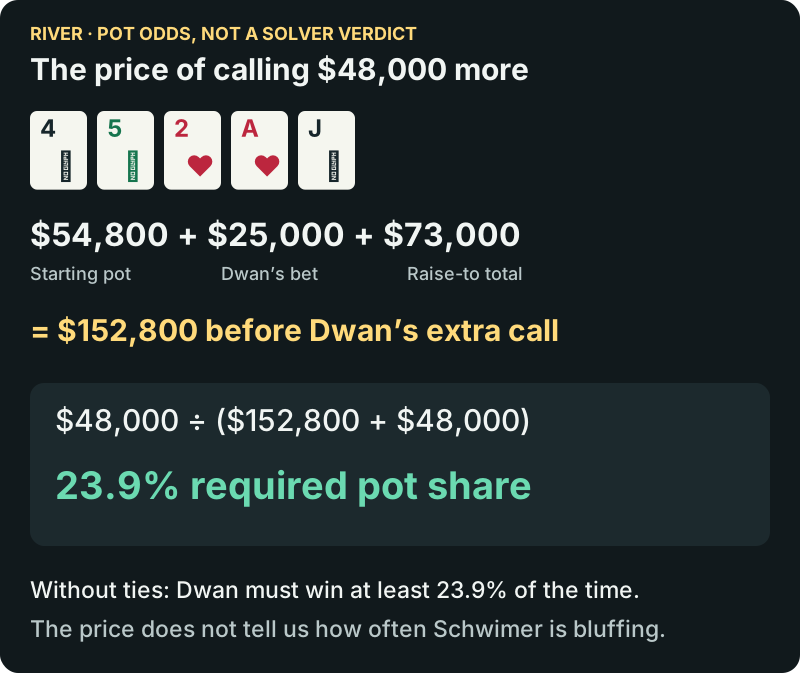
The $73,000 is Schwimer’s total river raise, so Dwan owes $48,000 after his own $25,000 bet. The break-even pot share is $48,000 / $200,800 = 23.9%, using reported pots and ignoring any unreported deductions. With no ties, that is the win rate required for calling to break even relative to folding.
That number does not measure Schwimer’s bluff frequency. It is the hurdle for Dwan’s hand against the whole raising range, including any worse made hands or split pots. Five-four beats ace-king at this showdown. That alone does not establish whether Schwimer intended the raise for value or as a bluff, and one revealed hand cannot tell us the composition of the range Dwan faced. Calling this a solver mistake from the showdown alone would skip the very question we need to answer.
What to take into your own hand review
Use the nearest node to ask a narrower question. In this hand, we can study a mixed ace-king flop bet and a frequent ace-turn check in a model with a closely matched SPR. We can contrast that with suited two pair’s turn betting. We cannot turn those pieces into an exact grade for an opponent who entered with an excluded hand.
To study this comparison in GTO Gecko, look for the cash/straddle 200bb, SB-versus-HJ three-bet configuration and the 5–4–2 rainbow flop. The relevant database branch is half-pot bet/call followed by the ace turn. Check the full ranges before focusing on one combination. The guide to how GTO Gecko solutions are made explains why solved assumptions matter; the GTO Gecko web app is the next step for studying the available scenarios.
Method and evidence
Preflop figures were extracted from a separate precomputed preflop database, and postflop figures from the GTO Gecko stored solution library, on September 5, 2026. These are separate extracts of corresponding configurations, not a newly solved, perfectly continuous full-hand tree. The postflop library’s own ranges determine its outputs. We used the standard equilibrium files, with no player-type adjustment or node locking.
All quoted frequencies are conditional on reaching the named model decision. The postflop export rounds probabilities to two decimals; where they total 99% or 101%, we normalize by their sum and report approximate values. Preflop range averages use six combinations for pairs, four for suited hands, twelve for offsuit hands, and the stored arrival weights. The categorical grid suppresses zero-arrival cells. The model uses 4% rake capped at 2 base bb; actual rake and the disputed forced-bet schedule are not established.
The public methodology and source note, selected-results table, and categorical grid data document the displayed analysis. Full proprietary solution trees and private access details are not reproduced. The reported hand is sourced near its reconstruction; every solver percentage above comes from the scoped database extracts, not from the commentators’ assessments.