
A live straddle changes three things before you choose a hand: the price to enter, the opening action order, and the stack depth measured against the largest live blind. It does not have one universal ruleset. Ask which seat may straddle, how much, who acts first, whether the straddler acts last, whether re-straddles are allowed, and what the minimum raise is. Only then should you convert the stack and study a matching strategy.
This guide turns those questions into a rule card and a reproducible stack-to-pot-ratio (SPR) ledger. Its action maps use one named profile—the 2026 WSOP Live-Action cash-game rules. The 5/10 calculations are constructed chip examples, not observed hands or solver output. Use the map and verifier only for off-table study: Rule 21 of the same WSOP document prohibits real-time assistance during live hands.
What Is a Poker Straddle?
A straddle is an extra blind bet made before the player has looked at their cards. A current PokerStars rules explainer describes the common UTG version as an optional third blind, usually posted by the player to the left of the big blind. That is a useful definition, not a promise that every room uses that position, amount, or action order.
The word live matters. In a ruleset that treats the straddle as live, its chips count toward that player's preflop action and the player may retain an option when action returns. Exactly which option and when action returns are house-rule questions. A button straddle, a Mississippi-style straddle, a mandatory straddle, and a chain of re-straddles should not be silently treated as the same game.
Write the House Rule Before the Range
Use this eight-field card before converting a stack or opening a chart:
- Game and stakes: no-limit, pot-limit, or fixed-limit; blinds; and any antes.
- Eligible seat: UTG, Button, another seat, or more than one option.
- Amount: fixed, a multiple of the big blind, or a permitted range.
- Timing and priority: when it must be declared and which straddle wins if two are offered.
- First actor: the first seat to act in the opening betting round.
- Last-action right: whether the straddler keeps an option to raise when action returns.
- Re-straddles: eligible seats, sequence, size, and cap.
- Minimum raise: the minimum legal total after the final live blind.
Leave an unknown field blank and ask the dealer or floor. Do not fill it from a different casino's page. The following current first-party pages demonstrate why.
Narrow screen? Scroll horizontally to compare every rule field.
| Profile | Position and size | Opening action | Re-straddle | What remains unknown here |
|---|---|---|---|---|
| WSOP Live-Action 2026 | UTG or Button; Button takes precedence; default 2× BB; no Button straddle in limit games | Immediately left of the straddle first; straddler last with an option to raise | Game-specific limits | Anything changed by the table placard |
| MUSASHI Shibuya page | UTG posts first; successive re-straddles double through Button | Not stated on the cited page | Permitted through Button | First actor, last action, minimum raise, and cap details |
| SEED house rules | Straddles are not adopted | No straddled strategy applies | ||
The 2026 WSOP Live-Action rules confirm the first row and state that the minimum raise following a live straddle is twice the straddle amount. In that profile, 5/10 with a 20 straddle therefore has a first minimum raise-to of 40 unless the table placard says otherwise. The current MUSASHI Shibuya house-rule page confirms its UTG-to-Button re-straddle chain, but the cited text does not define the missing action fields. The current SEED house rules explicitly do not adopt straddles. These are examples of real rule divergence, not a ranking of rooms.
Scope warning: the official 2026 WSOP event page publishes Live-Action and tournament rules as separate documents. The cited straddle rule governs the Live-Action cash games; the tournament document does not supply it. Do not use this article as permission to straddle in a bracelet event or another tournament.
Who Acts First After a Straddle?
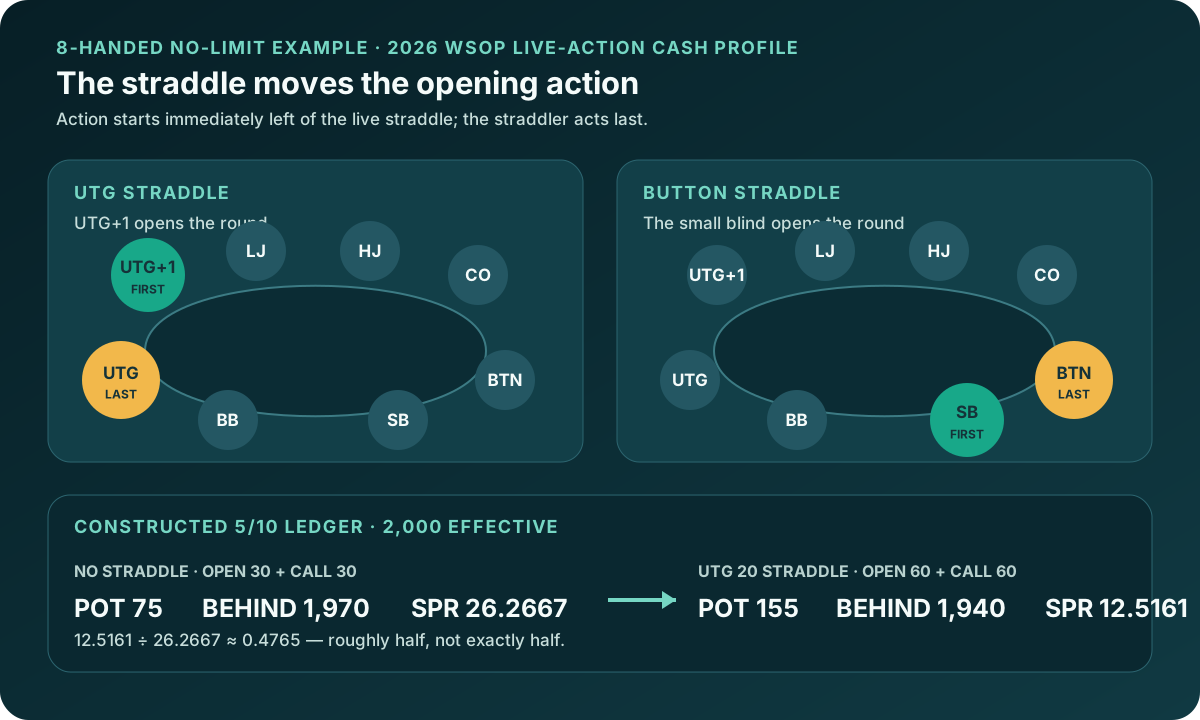
Under the named WSOP 2026 profile, opening-round action starts immediately to the left of the straddle, proceeds clockwise, and reaches the straddler last. On the eight-handed no-limit table modeled here, the two permitted locations therefore produce different maps. Button straddles are not permitted in limit games under the same rule.
UTG straddle
UTG+1 first → LJ → HJ → CO → BTN → SB → BB → UTG straddler last
Button straddle
SB first → BB → UTG → UTG+1 → LJ → HJ → CO → Button straddler last
The button example is the trap. Without a straddle, UTG normally opens the preflop round. In this profile, a Button straddle moves first action to the small blind. Postflop positional order is not rewritten by the preflop straddle: the first active player left of the Button acts first, and the Button remains last when still in the hand. Our position guide covers that ordinary postflop ordering.
Narrow screen? Scroll the diagram horizontally to view both action maps and the SPR ledger.
Convert Effective Stack Into Straddle Units
Suppose the effective starting stack before forced bets is D chips and the largest live blind is S chips. The mechanical starting depth is:
effective depth in straddle units = D / S
At 5/10 with a 20 straddle, a 2,000-chip effective starting stack is still 200 big blinds in bookkeeping terms, but it is 100 straddle units. The player who posted that 20 has 1,980, or 99 straddle units, behind before facing any voluntary action. If a legal final re-straddle were 40, the same pre-posting stack would be 50 units of that largest live blind. This conversion is necessary, but it is not sufficient to call the game “the same as ordinary 100bb” or “the same as ordinary 50bb.” Dead blinds, antes, first action, last-action rights, minimum raises, rake, and ranges can all differ.
Narrow screen? Scroll horizontally to see every depth column.
| Starting stack | Largest live blind | Mechanical depth |
|---|---|---|
| 100 BB | 2 BB straddle | 50 straddle units |
| 150 BB | 2 BB straddle | 75 straddle units |
| 200 BB | 2 BB straddle | 100 straddle units |
| 200 BB | 4 BB final live blind | 50 largest-blind units |
A 5/10 Straddle Does Not Merely Halve the Flop SPR
Now compare two constructed eight-handed hands. Both begin 5/10 with 2,000 effective stacks, have one opener and one caller, and reach the flop heads-up. Every other player folds. There are no antes, uncalled chips, rake, or drop. We define flop SPR as the smaller active stack behind divided by the pot at the start of the flop.
Narrow screen? Scroll horizontally to audit every pot component.
| Case | Open and call | Flop pot | Stack behind | Flop SPR |
|---|---|---|---|---|
| No straddle | UTG+1 opens to 30; CO calls 30 | 5 + 10 + 30 + 30 = 75 | 2,000 − 30 = 1,970 | 26.2667 |
| UTG straddles 20 | UTG+1 opens to 60; CO calls 60 | 5 + 10 + 20 + 60 + 60 = 155 | 2,000 − 60 = 1,940 | 12.5161 |
The displayed ratio is 12.5161 / 26.2667 ≈ 0.4765; using the unrounded fractions gives the same four-decimal result. Starting depth expressed in the largest-live-blind unit changes from 200 BB to 100 straddle units, yet the exact flop SPR is not simply 26.2667 divided by two. Both sides of the ratio change: the forced pot contains the small blind, big blind, and straddle, while a three-unit open leaves 97 straddle units behind instead of 197 big blinds.
This comparison holds the open at three units of the relevant live blind: 30 without a straddle and 60 after the 20 straddle. It does not say either size or range is optimal. If the real game adds an ante, uses a different open, takes a drop, allows more callers, or keeps the straddler in the hand, rebuild the ledger.
Four Mistakes the Rule Card Prevents
- Calling a 2,000 stack “200bb deep” and stopping there. Record both 200 BB and 100 straddle units; the latter normalizes the stack to the new largest live blind.
- Assuming UTG always acts first. Under the cited Button-straddle profile, the small blind acts first in the opening round.
- Importing another room's re-straddle or raise rule. A page that confirms “UTG through Button” still does not answer every action-right field.
- Studying an ordinary 100bb tree as if it were identical. Similar unit depth does not make the forced pot, positions, rake, or ranges identical.
How to Match the Rule to a Study Spot
First, copy the eight rule fields and express every amount in both BB and largest-live-blind units. Then record table size, effective stack, ante, rake, positions, and permitted preflop actions. Only compare a study configuration after those inputs match closely enough for the question you are asking.
GTO Gecko's current official product page lists straddle, ante, and rake variants in its precomputed preflop library. The official configuration page documents an eight-handed straddle-plus-ante cash setup at 200bb. Access depends on the paid plan, and that configuration must not be generalized to every room, stack, rake schedule, pot type, or arbitrary hand. Use a comparable solved spot to study how ranges respond to the stated inputs; do not relabel a different tree.
The current Japanese App Store listing describes GTO Gecko as an adult educational product with precomputed outputs, action frequencies, EV estimates, guided simulated practice, and plan-dependent libraries. It does not connect to live gambling or promise results.
Disclosure: GTO Solutions AS publishes this article and GTO Gecko. The rule comparison and constructed arithmetic are educational evidence, not a claim that a product contains the example hand or that study changes gambling outcomes.
Straddle Rules FAQ
- Is a poker straddle always twice the big blind?
- No. Twice the big blind is a common default and is the default in the cited WSOP 2026 profile unless otherwise specified. House rules or a table placard can define another amount.
- Who acts first after an UTG straddle?
- Under the cited WSOP profile, the player immediately left of the straddle acts first, so UTG+1 opens the action and the UTG straddler acts last. Confirm the local rule before relying on that order.
- Who acts first after a Button straddle?
- Under the cited WSOP profile, the small blind acts first and the Button straddler acts last in the opening round. Other rooms may ban Button straddles or use another procedure.
- Does a 2× straddle turn 200bb into 100bb?
- It turns the stack into 100 units of the straddle mechanically. It does not reproduce an ordinary 100bb game because the forced chips, action order, ante, rake, and available ranges may differ.
- How do I calculate SPR in a straddled pot?
- Add every chip actually in the pot at the start of the flop, including blinds and the straddle, then divide the smaller active stack behind by that pot. Do not count folded forced bets twice or omit them.
Sources, Data, and Reproduction
The rule pages below were re-opened on September 4, 2026. The JSON records the exact cited fields, explicit unknowns, both action maps, unit conversions, and all inputs and outputs for the 5/10 comparison. The JavaScript generator is tested against an independent Python implementation; neither program supplies strategy ranges.
- WSOP Live-Action Rules 2026 — rule 22 for position, priority, action order, default size, raise option, and game-specific limits.
- MUSASHI Shibuya current house-rule page — confirms its UTG-to-Button doubling sequence; it is not used to infer unstated action rights.
- SEED current house rules — confirms that this room does not adopt straddles.
- Public cases and rule-field ledger (JSON).
- Independent arithmetic verifier (Python).
The practical sequence is rule first, unit conversion second, pot ledger third, strategy last. If one house-rule field is missing, preserve the uncertainty instead of importing a familiar answer.