

A solid preflop strategy is the foundation of every winning poker player's game. Without a clear poker preflop chart guiding your decisions, you are making expensive guesses every hand. The good news: modern solvers have mapped out exactly which hands to open from every position. This guide gives you those GTO opening ranges, explains how to read them, and shows you how to adapt them to different game formats.
What Are Preflop Charts?
A preflop chart is a visual reference that tells you which hands to play and how to play them before the flop, based on your position at the table. The most common format is a 13x13 grid (called a range matrix) that maps every possible two-card starting hand combination.
These charts are derived from game theory optimal (GTO) solutions, meaning they represent the mathematically balanced strategy that cannot be exploited. When you follow a GTO preflop chart, you ensure your opening ranges are neither too tight nor too loose from any seat.
Preflop charts typically show you three pieces of information:
- Which hands to raise: Your open-raising range from each position
- Which hands to fold: Everything outside the raising range
- Mixed-frequency hands: Hands that are sometimes raised and sometimes folded, shown as partial shading or percentages
Learning these charts well enough to use them automatically is where the real edge is. Folding one bad hand preflop does not matter much. Folding it correctly across thousands of hands adds up fast.
One warning before you start memorizing: check that your chart set is complete. Charts that only cover raise-first-in from a few positions leave you guessing in the spots that decide sessions, like facing a 3-bet or defending the blinds at 40bb. A usable set covers every position, multiple stack depths, and your responses to raises, not just your opens.
6-Max GTO Opening Ranges by Position
The ranges below are for a standard 100bb 6-max cash game when the action folds to you. The short version: UTG opens roughly 18% of hands, the Hijack 22%, the Cutoff 28%, the Button 43%, and the Small Blind plays around 40-48% through a mix of raises and limps. Each step closer to the Button adds hands.
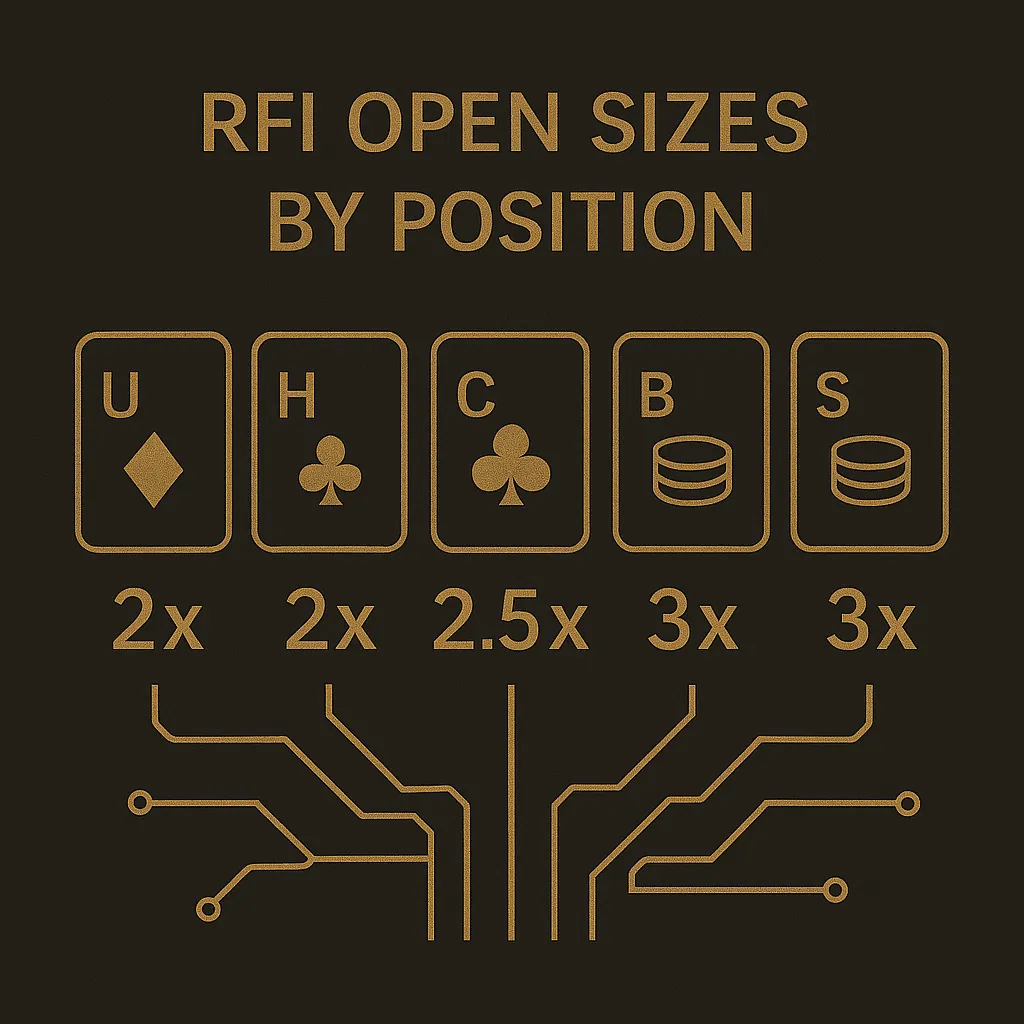
Open sizing is not uniform either. Many solver libraries use smaller opens of 2-2.5x from early and middle position and go up to 3x from the Button and Small Blind, where you are attacking the blinds directly. The hand compositions below stay broadly stable across those sizings, so learn the ranges first and fine-tune the sizing to your game.
UTG (Under the Gun) - ~18% of Hands
UTG is the tightest position because five players still act behind you. You need hands strong enough to withstand 3-bets and play profitably out of position against late-position callers.
UTG Opening Range
- Pairs: 22+
- Suited broadway: A2s+, K9s+, Q9s+, J9s+, T9s
- Offsuit broadway: ATo+, KJo+, QJo
- Suited connectors: 87s, 76s, 65s
Notice the emphasis on high-card strength. Hands like A♠5♠ make the cut because of their nut flush potential and wheel straight draws, but A♦8♣ offsuit does not. From UTG, suitedness matters enormously because it adds roughly 3-4% equity to your hand.
HJ (Hijack) - ~22% of Hands
With one fewer player behind you, the Hijack can open a few more hands than UTG. The additions are mostly suited hands and some weaker offsuit broadways.
HJ Additions Over UTG
- Suited: K8s, Q8s, J8s, T8s, 97s, 86s, 75s, 54s
- Offsuit: ATo (full frequency now), KTo, QTo
The Hijack is where your range starts to include more speculative suited hands. Cards like 9♥7♥ and 8♦6♦ play well postflop when they connect, and there are fewer players left to wake up with a premium hand.
CO (Cutoff) - ~28% of Hands
The Cutoff is a powerful stealing position. Only the Button and blinds remain, and you will have position postflop against the blinds if they call.
CO Additions Over HJ
- Suited: K7s-K5s, Q7s, J7s, 64s, 53s
- Offsuit: A9o-A8o, KTo (full frequency), QTo (full frequency), J9o, T9o
From the Cutoff, you are opening almost every suited ace, most suited kings, and a wide array of suited connectors and one-gappers. Offsuit hands expand to include more ace-x and broadway combinations. This is where many players are still too tight; if you are folding A♣8♥ offsuit from the Cutoff, you are leaving money on the table.
BTN (Button) - ~43% of Hands
The Button is the most profitable seat in poker. You act last on every postflop street, and only two players (the blinds) remain to contest the pot. Solver solutions show a wide open-raising range here.
BTN Opening Range Highlights
- All pairs: 22+
- All suited aces: A2s+
- Suited kings: K2s+
- Suited queens: Q2s+
- Suited jacks: J4s+
- Suited connectors: Down to 43s
- Offsuit broadway: A2o+, K5o+, Q8o+, J8o+, T8o+, 98o
From the Button, you are raising nearly half of all hands dealt to you. Hands like Q♠4♠ and 5♥4♥ are standard opens. The combination of positional advantage and only needing to get through two opponents makes this range highly profitable. If you are only opening 25-30% from the Button, you are playing far too tight.
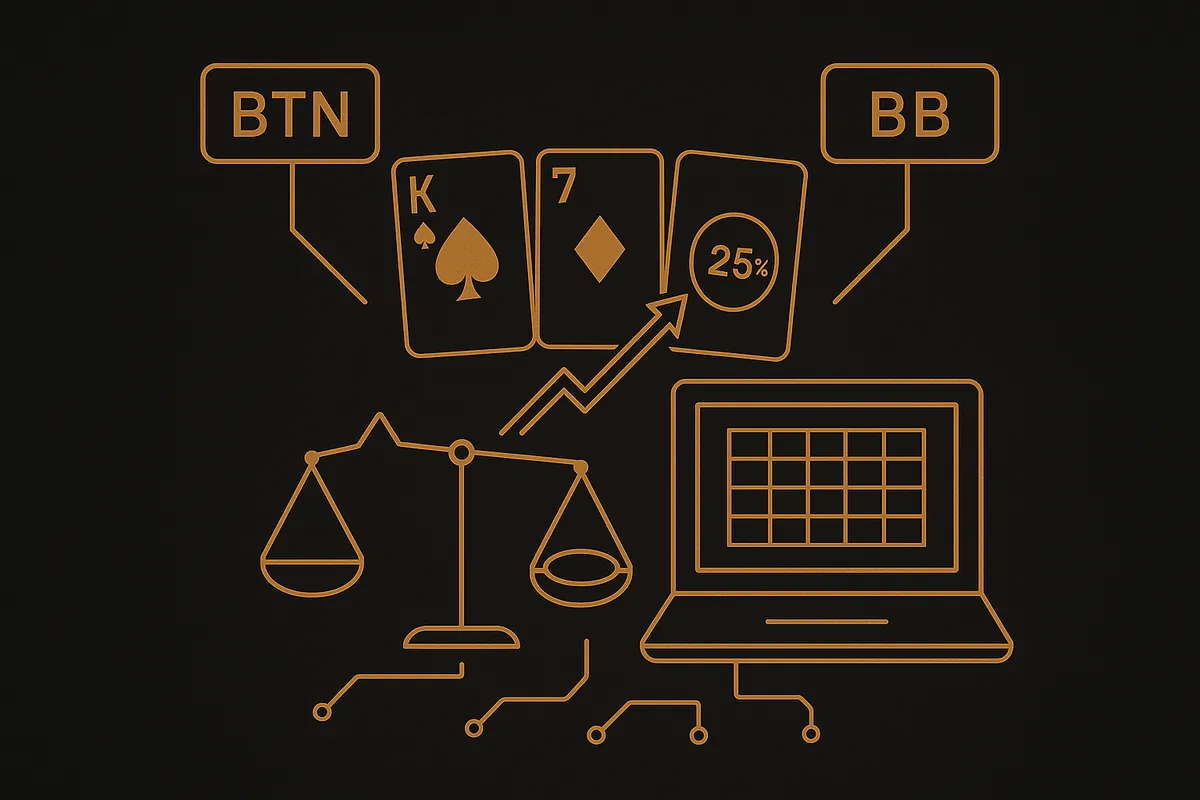
Button vs Big Blind is the single most common heads-up matchup in 6-max, which makes it the highest-value preflop battle to study. Your wide Button range carries through to postflop, where frequent small continuation bets pressure the Big Blind's capped calling range.
SB (Small Blind) - ~40% Open-Raise or ~48% Total (Including Limp)
The Small Blind is unique. When action folds to you, you are in a heads-up pot against the Big Blind. Modern solvers recommend a strategy that mixes open-raising with some limping (completing the small blind).
SB vs BB Strategy
- Raise to 3x: Strong hands you want to build a pot with (premium pairs, strong aces, suited broadways) and polarized bluffs
- Limp: Medium-strength suited hands that play better in a smaller pot (suited connectors, weak suited aces, small pairs)
- Fold: The worst offsuit hands with poor postflop playability
A common mistake from the SB is raising too small or limping too much. When you do raise, use a larger sizing (3x) to deny the Big Blind favorable pot odds. Your raising range should be polarized: strong hands for value and weaker hands with good playability as bluffs. Hands in the middle, such as 8♦6♦ or 5♣4♣, often work best as limps because they play poorly in inflated pots out of position.
BB (Big Blind) - Defense, Not Opening
The Big Blind does not have an opening range in the traditional sense. Instead, you are defending against raises from other positions. Your defense frequency depends on who opened and from where:
- vs SB raise: Defend ~65-70% (3-bet or call). You are getting excellent pot odds and only one player to beat.
- vs BTN raise: Defend ~45-50%. Wide range, but you are out of position.
- vs CO raise: Defend ~38-42%. Tighter since their range is stronger.
- vs HJ/UTG raise: Defend ~28-35%. Early position opens are tight, so you need stronger hands to continue.
Your defense includes both calling and 3-betting. A balanced BB defense uses 3-bets with premiums and select bluffs, while calling with hands that have good postflop equity but are not strong enough to 3-bet. For more on leveraging 3-bets as the big blind facing a raise and a call, see our guide on squeeze play strategy.
How to Read a Range Matrix
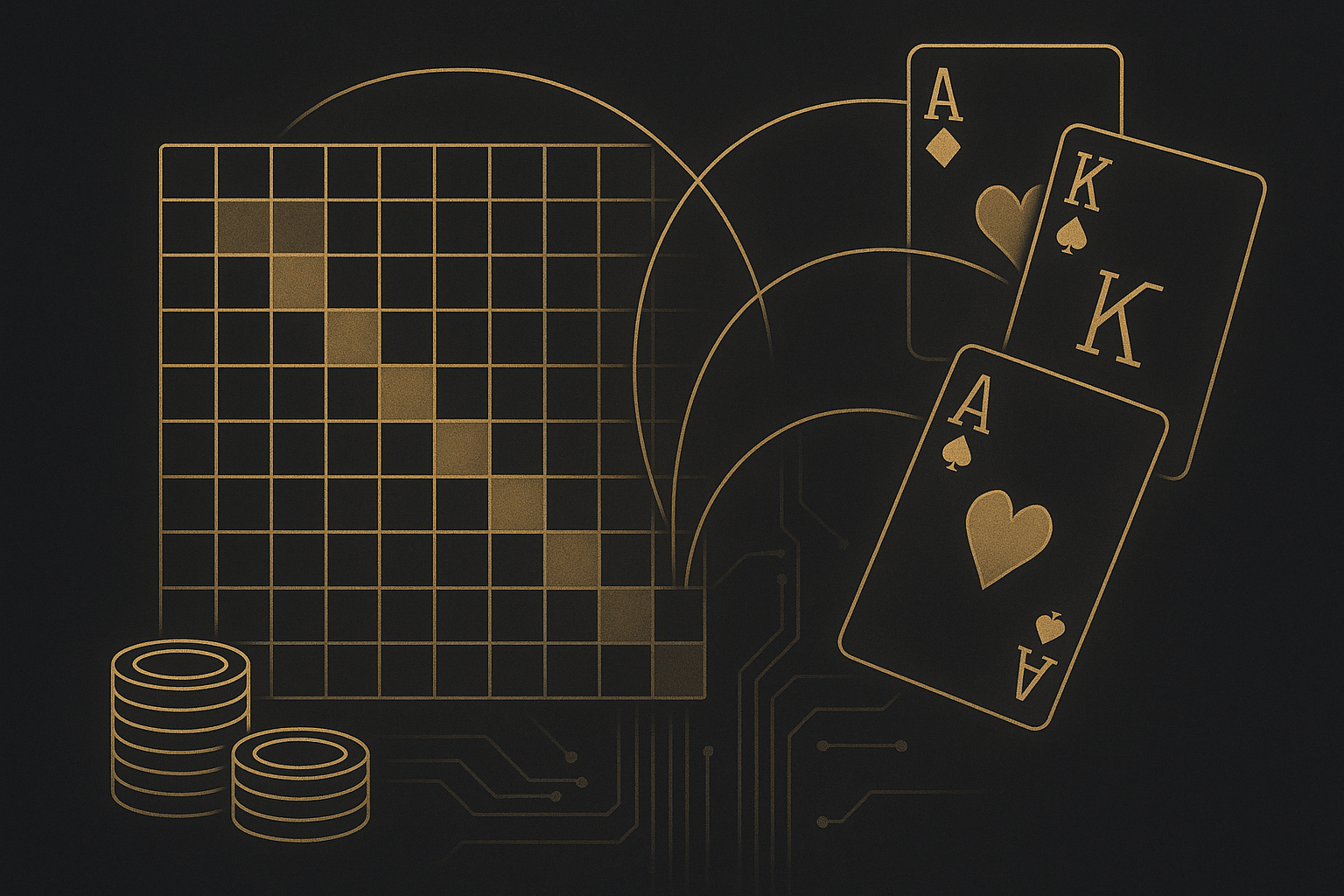
A range matrix is the standard 13x13 grid used to display all 169 unique starting hand combinations. Pocket pairs run down the diagonal, suited hands sit above it, and offsuit hands sit below it, with colors marking each action. Understanding this grid is essential for working with any poker preflop chart.
Grid Layout
The matrix works as follows:
- Diagonal (top-left to bottom-right): Pocket pairs (AA, KK, QQ, ... 22)
- Above the diagonal: Suited hands. For example, AKs is in the row for A, column for K, above the diagonal.
- Below the diagonal: Offsuit hands. AKo is in the row for K, column for A, below the diagonal.
Color Coding
Most range charts use color to indicate actions:
- Green or blue: Raise (open-raise or 3-bet)
- Yellow or orange: Call
- Red or gray: Fold
- Mixed colors or gradients: Hands played with mixed frequencies (e.g., raise 60%, fold 40%)
Suited vs Offsuit: Why It Matters
You will notice that suited hands appear in ranges far more often than their offsuit counterparts. There are two reasons for this:
Suited vs Offsuit: K9 Example
- K♠9♠ (suited): Opens from UTG in most solver solutions. Has flush potential, which adds ~3-4% equity and better nut potential.
- K♠9♥ (offsuit): Folds from UTG. Without flush draws, the hand is too weak to play profitably out of position against five opponents.
Understanding combo counting also helps here: there are 4 suited combos of any non-pair hand (one per suit) but 12 offsuit combos. This means offsuit hands make up a larger portion of your range by raw hand count, even when fewer offsuit hand types are included.
Mixed Frequencies
Solvers rarely use pure strategies for every hand. Borderline hands are often played with mixed frequencies. For example, a solver might say "open K♥7♥ from the HJ 65% of the time and fold 35%." In practice, most players simplify these to pure actions: open it if your table is passive, fold it if aggressive players are behind you.
Adjusting Preflop Ranges for Different Formats
The 6-max cash game ranges above are the baseline. Different formats require specific adjustments.
Cash Games (Full Ring / 9-Max)
At a 9-handed table, UTG is significantly tighter because there are eight players behind you instead of five. Full ring adjustments include:
- UTG opens ~12-13% instead of 18%
- Middle positions (MP, LJ) exist as intermediate positions opening roughly 15-20%
- Button and Cutoff ranges remain similar to 6-max
- Blind defense tightens slightly because early position opens carry more strength
Tournament Play
Tournament ranges shift based on stack depth and ICM pressure:
- Deep stacked (60bb+): Play close to cash game ranges. Speculative suited connectors and small pairs gain value for their implied odds.
- Medium stacked (25-60bb): Tighten speculative hands; focus on high-card strength. Suited connectors lose value without deep implied odds.
- Short stacked (15-25bb): Switch to a push/fold or raise/fold strategy. Preflop charts for this stack depth look very different, with hands ranked primarily by raw equity.
- ICM spots (bubble, final table): Tighten significantly from early positions but widen stealing ranges from late position against medium stacks who cannot afford to call.
Short-Handed and Heads-Up
In short-handed formats (3-4 players) and heads-up play, ranges expand dramatically:
- Heads-up Button: Opens 70-85% of hands. Almost any two cards have enough equity to raise.
- 3-handed: The "UTG" position opens approximately 30-35%, closer to a 6-max Cutoff range.
- 4-handed: Ranges fall between 6-max and 3-handed adjustments.
The key principle: fewer opponents means wider ranges across all positions. Every player removed from the table adds hands to your opening range.
How Do MTT Preflop Ranges Differ From Cash Games?
MTT preflop ranges are wider and use smaller raises than cash game ranges. Antes add dead money that justifies opening roughly 3-5% more hands per position, usually for 2-2.3x instead of 2.5-3x. But shallower stacks cut speculative hands, and ICM pressure tightens calling ranges near pay jumps. Cash ranges stay fixed at 100bb with none of that.
| Factor | 100bb Cash | MTT |
|---|---|---|
| Antes | Rare | Standard from early-mid stages |
| Typical open size | 2.5x-3x | 2x-2.3x |
| Stack depth | Constant 100bb | Mostly 15-40bb |
| Chip value | Linear (chips = money) | Non-linear (ICM) |
| Speculative hands | Strong (deep implied odds) | Weaker as stacks shrink |
Antes are the biggest structural difference. With a big blind ante in the pot, every steal attempt targets roughly 2.5bb of dead money instead of 1.5bb, so opens that lose money in a cash game become clearly profitable. The Big Blind responds in kind: against a min-raise with antes, defending over 60% of hands is standard because the pot odds are so good.
Stack depth pulls the other way. At 25bb, hands like 5♥4♥ and small pairs lose most of their implied odds, while high-card offsuit hands like KJo and A9o gain value because they dominate the wider ranges in play. Below 15bb, much of your chart collapses into jam-or-fold decisions, which is its own study area; our short-stack strategy guide covers it in depth.
Then there is ICM. In a tournament, chips you lose are worth more than chips you win, so ICM pressure tightens your calling ranges against all-ins and widens your shoving ranges against medium stacks that cannot afford to call. The effect peaks on the bubble and at final tables, where a chip-EV chart can be badly wrong. GTO Gecko's Elite tiers include ICM-aware MTT ranges plus a range-compare view, so you can see exactly where the chip-EV and ICM charts split for the same spot.
Common Preflop Mistakes
Even experienced players make systematic preflop errors. Here are the five most costly ones and how to fix them.
- Playing the same range from every position. This is the most fundamental error. A hand like K♦T♣ offsuit is a clear fold from UTG but a standard open from the Cutoff. If you do not adjust by position, you are bleeding money from early seats and leaving it on the table from late seats. Study position strategy until adjusting feels automatic.
- Opening too tight from the Button. Many players treat the Button like a middle position, opening only 25-30% of hands. The solver says 43%. That gap represents a massive amount of lost profit from blind stealing and postflop positional advantage. Force yourself to open wider and track the results.
- Ignoring suited vs offsuit distinctions. Players who open K9o from UTG because they "would open K9s" are confusing two very different hands. Suitedness changes your equity, your nut potential, and your postflop playability. Treat suited and offsuit as separate hands.
- Defending the Big Blind too loosely or too tightly. Some players call every raise from the BB because of pot odds; others fold everything but premiums. Both extremes lose money. Your defense frequency should vary based on the opener's position. Against a UTG raise, folding 65-70% is correct. Against a Button raise, folding more than 55% is too much.
- Not adjusting to table dynamics. GTO charts are a baseline, not a prison. If the player to your left 3-bets 15% of hands, tighten your opening range from the positions they attack. If the blinds fold 80% of the time, widen your steals. Use the chart as your starting point, then adjust based on your opponents' ranges.
Preflop Chart FAQ
What percentage of hands should you play preflop?
Around 20-25% of all hands dealt in a 6-max cash game, but the number varies sharply by seat: roughly 18% from UTG, 22% from the Hijack, 28% from the Cutoff, 43% from the Button, and 40-48% from the Small Blind. Playing one fixed percentage from every position is a leak, not a style.
Are preflop charts allowed when playing online poker?
Rules differ by site. PokerStars permits some limited basic reference material under defined conditions, while GGPoker's published policy says charts of any kind are prohibited during play. Check the current house policy and keep your study separate from active play. Our guide to poker solvers and real-time assistance compares both policies and explains the safer boundary.
Should I memorize an entire preflop chart?
You do not need to memorize every cell perfectly. Focus on learning the approximate percentage of hands you open from each position (e.g., 18% UTG, 28% CO, 43% BTN) and the general categories of hands included. With practice, the borderline decisions become intuitive. Tools like GTO Gecko let you drill these ranges interactively until they stick.
Are preflop charts the same for all stakes?
The GTO baseline is the same regardless of stakes. However, at lower stakes where opponents make more mistakes, you can profitably deviate. For instance, you might tighten up from early position at a loose-passive table (where you will get called by multiple players) and widen from late position against players who fold their blinds too often. The chart gives you the optimal baseline; exploitative adjustments come on top.
How do preflop charts change with different stack sizes?
At 100bb (the standard for most cash games), the charts in this article apply directly. As stacks get shorter, speculative hands like small pairs and suited connectors lose value because you cannot win large enough pots postflop to justify the preflop investment. At 20-30bb, your strategy shifts toward jamming or folding with a range based primarily on raw hand equity rather than playability.
Where can I practice with accurate GTO preflop ranges?
The most effective way to internalize ranges is through repetition against solver-derived solutions. You can browse GTO Gecko's complete preflop range library free — every position, stack depth, and pot type across Cash, MTT, and Spin & Go, with no credit card required — then drill those same spots in the trainer to see exactly where your decisions deviate. The preflop trainer guide gives you a focused 15-minute routine, while the poker solver guide covers custom scenarios.
Build Your Preflop Foundation
A strong preflop game is non-negotiable for anyone serious about poker. The ranges in this guide give you a solver-approved framework for every position at a 6-max table. But reading about ranges and actually playing them correctly under pressure are two different things.
The path to preflop mastery is straightforward: study the charts, practice them in low-stress environments, review your sessions to catch leaks, and repeat. Pay special attention to the positions where you deviate most from GTO, those are where your biggest gains hide.
If you want to accelerate that process, open the preflop trainer on GTO Gecko and drill the exact ranges from this guide. The trainer tracks your accuracy by position, re-serves the spots you misplay, and pairs every range with full postflop solutions so you can check your work past the flop too. Your preflop decisions set the stage for everything that follows. Get them right, and the rest of your game improves by default.