

Hand-for-hand poker means every table completes one designated hand, then waits until the other tables finish theirs before another hand begins. If two players bust in that synchronized batch, there is no universal tiebreak: the 2026 WSOP rules tie same-batch bustouts from different tables, while the PokerStars platform rules rank them by their chip counts at the start of the hand—even across tables. The tournament's governing terms, published rules, and authorized decision-maker control.
“Same hand” here means the same synchronized batch, not the same wall-clock second. A fast table can finish and wait while a slower table is still playing; eliminations at both tables can still belong to one hand-for-hand round.
Scope: this is a current rule-profile comparison, not a universal ruling or payout promise. Poker TDA procedures, WSOP event rules, and PokerStars online-platform rules have different authority and scope. Confirm the structure sheet and house rules where you play.
How One Hand-for-Hand Batch Works
- Staff or the platform starts hand-for-hand play. Under the cited live profiles, tables finish the hand already in progress and then hold.
- Each active table plays one designated hand. The hands need not start or finish at exactly the same time.
- A finished table waits. It cannot begin an extra hand while another table is still resolving action.
- Staff or the platform resolves eliminations and payouts for the batch. The rule profile determines whether same-batch bustouts tie or are ordered.
- The next batch begins only after release. This repeats until the event reaches the stated threshold.
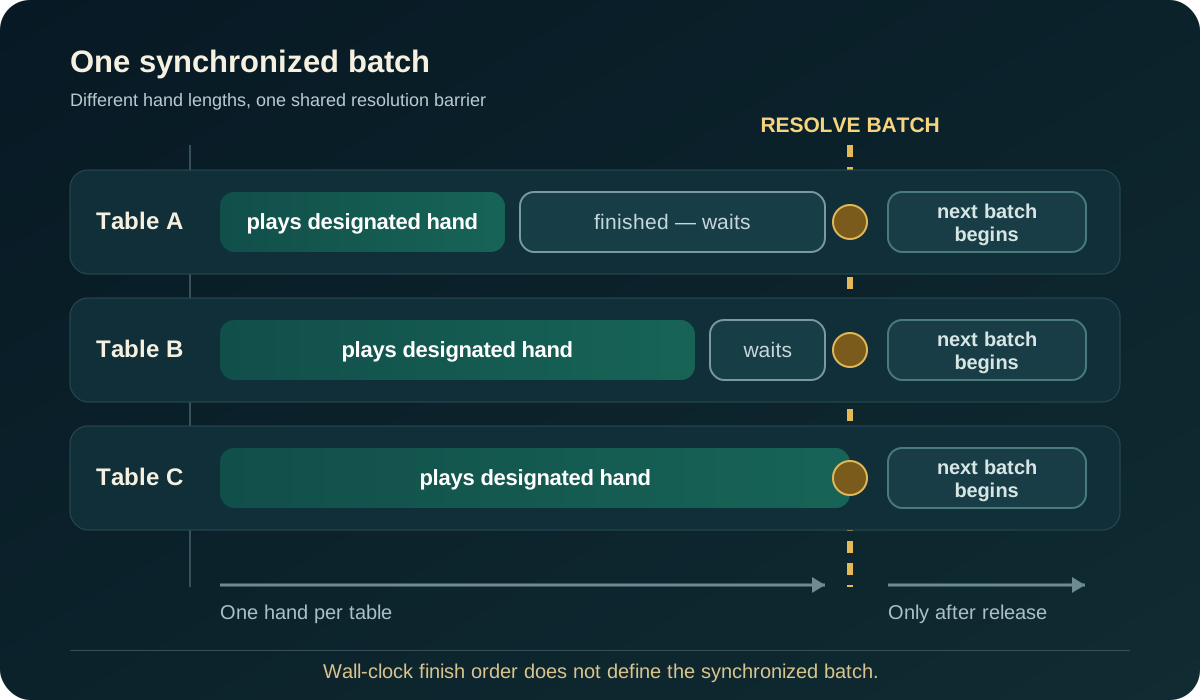
The mechanism limits a structural advantage. Without synchronization, a table playing more hands can expose its players to more blinds and more elimination chances while a slow table waits. Hand-for-hand equalizes the number of designated hands; it does not guarantee that every player faces identical positions, decision time, or risk.
The Announcement Hand Can Already Count for Payouts
Do not assume eligibility begins with the first freshly dealt synchronized hand. Poker TDA 2024 Recommended Procedure 8 and WSOP Rule 126 both start payout eligibility at the hand-for-hand announcement, while the tables finish their current hands.
Poker TDA's explicit boundary example
A tournament pays 50 places. There are 52 players when hand-for-hand is announced, and three players bust during the hands already in progress. RP-8 says all three share the 50th-place payout.
That example answers eligibility and sharing at one boundary. It does not publish a general TDA algorithm for ranking every same-batch bustout. For a different event, record the announcement, table numbers, starting stacks, and paid places, then apply the event's own placement rule.
WSOP, Poker TDA, and PokerStars Use Different Profiles
| Question | Poker TDA 2024 RP-8 | WSOP 2026 Rule 126 | PokerStars platform Rules 2.2–2.3 |
|---|---|---|---|
| What is synchronized? | Tables finish the announcement hand, then use hand-for-hand procedure | One hand per table, then play suspends until the next batch | A table finishing first waits for the other table(s) |
| Different tables, same batch | General placement order not stated in RP-8 | Tie for the place finish | Rank by starting stack |
| Same table, unequal starting stacks | General placement order not stated in RP-8 | Higher starting stack gets the higher finish | Higher starting stack gets the higher finish |
| Equal starting stacks | Not stated in RP-8 | No further tiebreak stated in the cited clause | Tie; prizes due are distributed equally |
| Clock treatment | Maximum 3 minutes per hand; 2 recommended where possible | Exactly 2 minutes per hand, including the announcement hand | Not stated on the cited rules page |
| Where it applies | Recommended procedure for adopting tournaments | Events governed by the 2026 WSOP rules | Tournaments on the PokerStars platform |
The narrow scope in the last row matters. PokerStars opens its page by saying the rules apply to tournaments on its platform, complement its General Terms, and yield to those terms if the two conflict. Do not automatically transplant Rules 2.2–2.3 into a PokerStars-branded live event. Likewise, the TDA document says its procedures supplement house rules; it does not make RP-8 the law of every card room.
The trigger can differ too. WSOP Rule 126 describes hand-for-hand near first money. PokerStars Rule 2.3 says its platform may use the procedure at certain stages, including where upcoming prizes jump significantly. The lobby, structure sheet, or authorized announcement defines the actual boundary.
Worked Case: Two Players Bust at Different Tables
Suppose staff announces hand-for-hand with 101 players remaining and 100 places paid. In that hand already in progress—the announcement hand and first synchronized batch:
- Player A starts with 120,000 chips and busts at Table 12.
- Player B starts with 40,000 chips and busts at Table 18.
- The two pots finish several minutes apart, but both belong to the same batch.
| Profile | Result | What did not decide it? |
|---|---|---|
| WSOP 2026 | Both cash at this boundary. A and B tie for the place finish because they busted at different tables in the same hand-for-hand hand, and Rule 126 makes qualifying busters eligible for a share of the paid place(s). | A's larger starting stack and the wall-clock order |
| PokerStars platform | A cashes; B does not. A finishes 100th and B 101st because 120,000 was greater than 40,000 at the start of the synchronized hand. | Different table numbers and wall-clock order |
| Poker TDA RP-8 alone | Cannot be determined from RP-8 alone. Use the event's placement rule or authorized decision-maker. | No missing rule should be invented |
Those cash outcomes are specific to the stated 101-left/100-paid facts. Under WSOP, the cited text establishes the tie and payout eligibility but does not print a complete arithmetic recipe for every number of paid places and every prize structure. Under PokerStars, Rule 2.2 says equal starting stacks tie and any prizes due to those players are distributed equally. Keep those statements attached to their own profiles.
Worked Case: Two Players Bust at the Same Table
Move both players to Table 12 and keep the same starting stacks. Under both WSOP Rule 126-b and PokerStars Rule 2.2, Player A receives the higher finish because A began the hand with 120,000 and B with 40,000.
The comparison point is the start of the hand. It is not who lost the last pot first, who held the stronger final hand, who had more chips one street earlier, or whose cards the dealer exposed first. Side-pot sequencing can determine who wins chips, but once both players are eliminated, the cited placement rules look back to their starting counts.
If the WSOP players began with exactly equal stacks at the same table, Rule 126-b supplies no further tiebreak in its text. The safe answer is not to borrow PokerStars' equal-stack language; it is to ask the WSOP floor or consult the event-specific instruction.
Does the Tournament Clock Stop?
Not in the simple sense of “bubble time is frozen.” WSOP Rule 126 assigns exactly two minutes to each hand-for-hand hand, regardless of its actual duration, beginning with the hand in progress when the announcement is made. If two counted hands finish, four minutes come off the tournament clock. Blinds continue to rise when new levels are reached.
Poker TDA RP-8 instead sets a maximum deduction of three minutes per hand and recommends two minutes per hand where possible. It also says blinds continue increasing as time elapses off the clock. Those are not competing descriptions of one universal timer; they are different profiles.
This makes stack context dynamic. A stack that was 12 big blinds at the announcement can be fewer big blinds after a level change even if only a small number of hands were dealt. Our big-blind-ante stack worksheet explains why both big blinds and orbit cost should be recorded when antes matter.
Why Do Dealers Hold All-In Cards Face Down?
During hand-for-hand play, WSOP Rule 126-g and Poker TDA RP-8-F instruct dealers to keep players' cards face down after an all-in and call and not deal more cards until instructed. Staff can then coordinate the reveal and runouts across tables instead of broadcasting one table's result while action continues elsewhere.
This is a procedural hold, not a change to hand rankings or pot eligibility. Protect your cards, follow dealer instructions, and let the floor release play. A spectator's report from another table is not a substitute for the official resolution.
Does Hand-for-Hand Eliminate Stalling?
It removes the reward from making your whole table play fewer designated hands than another table, because every table must clear the same batch barrier. It does not make every slow decision harmless. A player can still delay the entire field or abuse a decision clock.
WSOP Rule 80 expressly allows officials to put an intentional staller on a clock and says deliberately burning time banks to ladder can lead to a reduced clock or a penalty. Hand-for-hand is therefore a synchronization mechanism, not permission to delay. Players should act in a normal, timely way and call the floor when the procedure is unclear.
For a different timing question—who starts a limit on one player’s decision—see calling the clock versus a shot clock.
A Five-Field Record for a Disputed Double Bust
Before debating who cashed, write down the facts the governing profile actually uses:
- Authority: the event name, structure sheet, house rule, and rule version.
- Eligibility point: whether the bust occurred in the announcement hand or a later synchronized batch.
- Batch and table: which designated hand and whether the players were at the same table.
- Starting stacks: the official counts recorded at the start of that hand; ask the floor or check the lobby record if a count is disputed.
- Payout boundary: players remaining, places paid, and the paid places crossed by the eliminations.
Do not substitute the time shown on a livestream, the order social media reported the busts, or end-of-hand pot sizes. If a required fact is disputed, preserve the record and ask the floor. Tournament officials can inspect information unavailable to a player or article.
A Live Example: Three Tables, Two Payouts
A December 2025 PokerStars report from the EPT Prague Main Event describes three players busting from three different tables in one hand-for-hand batch. The live event treated them as tied and split the two available payouts among all three.
That is an observed live-event resolution, not authority for another tournament. It also shows why the operator's name is not enough to choose a rule profile: this EPT report describes a cross-table tie, while the current PokerStars platform rules compare synchronized bustouts by starting stack. Check the rule attached to the event itself.
After the Ruling: What to Study
Placement is an event-administration question; Independent Chip Model (ICM) study begins only after the payout state is known. Once staff confirm who remains, which prizes are locked, the new stacks, and the next blind level, you can study how the bubble changes ranges with our ICM introduction or the satellite endgame guide.
For structured off-table practice, ICM Trainer on the App Store and Google Play currently describe 504 precomputed solutions across 310 stack profiles for 3–9-handed tournament situations, with full preflop trees and pairwise bubble-factor context. It is a study tool: it does not connect to poker clients or supply real-time play assistance. Disclosure: ICM Trainer and GTO Gecko are published by GTO Solutions AS.
Sources, Evidence, and Method
- Poker Tournament Directors Association, 2024 Rules Version 1.0, Recommended Procedure 8. Accessed September 4, 2026.
- World Series of Poker, 2026 WSOP Tournament Rules, Rule 80 on printed page 18 and Rule 126 on printed pages 27–28. Accessed September 4, 2026.
- PokerStars, Tournament Rules, platform scope and Rules 2.2–2.3. Accessed September 4, 2026.
- Howard Swains, PokerStars, “EPT Prague: Tournament mechanics explained”, December 11, 2025 event report. Accessed September 4, 2026.
- Apple App Store, ICM Trainer: Push/Fold Poker, Version 1.1.0; and Google Play, ICM Trainer listing. Accessed September 4, 2026.
Reproduce the comparison
Ten fixed cases cover the TDA announcement example, WSOP and PokerStars double bustouts, equal stacks, clocks, and the all-in hold. Two cases deliberately answer “source silent.” The website generator and a standalone Python checker calculate the expected rows separately and reject changes to pinned source-derived inputs and descriptors.
- Profiles, inputs, expected outcomes, and limitations (JSON)
- Flat case results (CSV)
- Independent standard-library checker (Python)
- Reproduction steps and boundaries
Method: we compared each profile at the same decision boundaries, separated printed examples from derived comparisons, and marked unsupported cases as source-silent. Passing the checker proves that the bundle agrees with the ten declared cases; it does not prove that a tournament adopted a profile. Sources can change after the access date, so the governing event or platform rule remains authoritative.
TDA rules used by permission of the Poker TDA, Copyright 2026, http://www.pokertda.com, All rights reserved.