
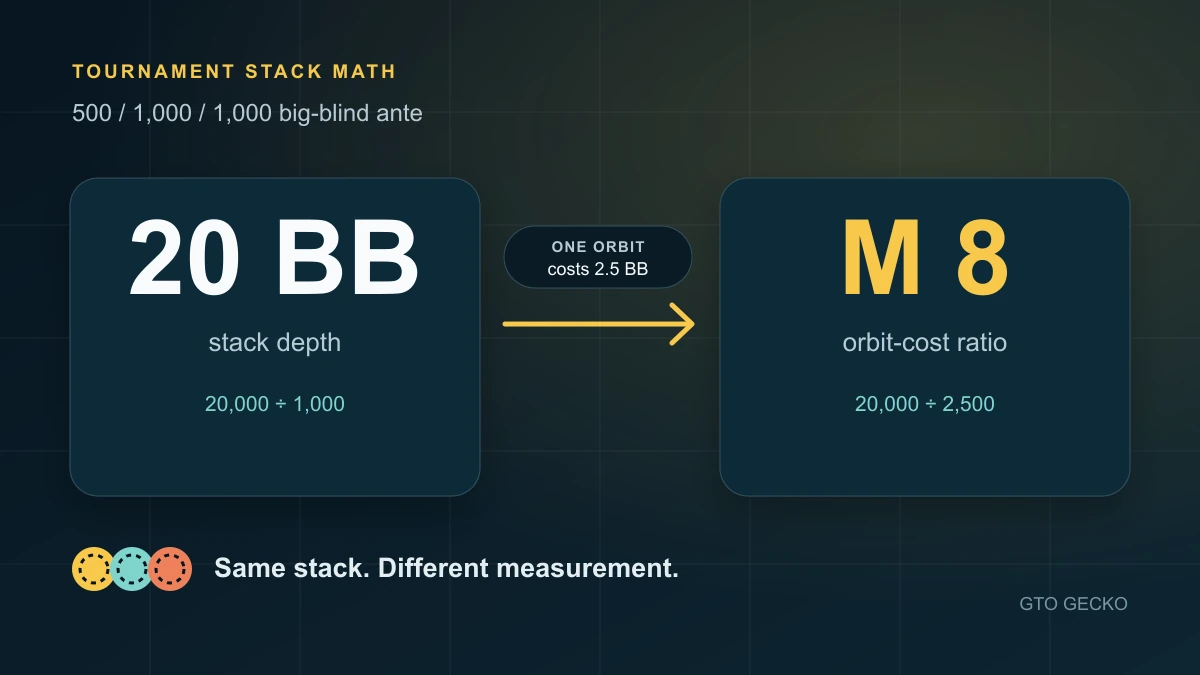
At 500/1,000 with a 1,000 big-blind ante, a 20,000-chip stack is still 20 big blinds. It also has an M ratio of 8, because one unchanged orbit costs 500 + 1,000 + 1,000 = 2,500 chips. If you are the big blind next, you will have 18,000 chips—18 BB—physically behind after posting both forced bets.
BB depth, M, and chips behind answer different questions: blind size, scheduled orbit cost, and what remains after this hand’s posts. One starting stack can therefore be 20 BB, M 8, and 18 BB behind without contradiction.
The Standard 1 BB BBA in Four Lines
stack in BB = stack / big blindorbit cost = small blind + big blind + BBA- With a 0.5 BB small blind and 1 BB BBA,
orbit cost = 2.5 BB. - Therefore
M = stack in BB / 2.5: 20 BB becomes M 8, not an 8 BB stack.
Scope and disclosure: this is a direct-formula forced-bet calculator, not a push-fold chart or an action recommendation. GTO Solutions AS publishes this site and ICM Trainer, which appears later as an optional study path. The formulas, tables, code, and chart are editorial artifacts; they do not use app telemetry or player results.
Interactive · direct formula · local only
Big-Blind Ante and M Calculator
Enter the stack before this hand’s forced bets. Choose the actual ante format from the tournament structure.
JavaScript is required to enable the controls. The reference tables below remain available.
Calculated M 8.00, stack 20.00 big blinds, orbit cost 2.50 big blinds.
20.00 BB stays 20.00 BB. The ante changes the full-orbit cost to 2.50 BB, so M is 8.00.
20,000 / (500 + 1,000 + 1,000) = 8.00
- Stack depth
- Full-orbit forced cost
- M ratio
- Behind after next BB + ante
Across 8 unchanged hands, this 1,000-chip BBA has the same total ante cost as 125 chips per player per hand.
M assumes the blinds, ante, table size, and your seat’s obligations stay unchanged for a complete orbit. It is not an action recommendation or a literal hand-by-hand countdown.
Three Numbers, Three Different Jobs
The BBA is deducted when posted, but it does not enter the pre-posting BB conversion. If stack is S and the big blind is B:
stack in BB = S / B
A 20,000 stack at a 1,000 big blind is 20 BB before posts. The ante changes the scheduled orbit cost and starting dead money, not that label.
“Hero has 20 BB before posting” means 20,000 total chips here. Posting the 1,000 live blind and 1,000 ante leaves 18,000 behind; because the blind is live, 19,000 remains available for live betting. “20 BB behind” may instead exclude posts already on the table. Check the convention before reproducing a solve.
How to Calculate M With a Big-Blind Ante
M compares a tournament stack with the compulsory chips one seat is scheduled to pay over a complete rotation. The term was popularized in Dan Harrington and Bill Robertie’s Harrington on Hold’em: Volume II. This page defines the numerator as the player’s total stack before the current hand’s forced bets. That convention is important: Kevin Desmond’s MIT OpenCourseWare lecture, for example, teaches the same blinds-plus-antes denominator but uses effective stack as its numerator. Preserve the stated numerator when comparing an M value from another source.
Let s be the small blind measured in BB, and let a be the big-blind ante measured in BB. A seat pays the small blind once, the big blind once, and the single BBA once in a complete stable orbit:
BBA orbit cost in BB = s + 1 + a
M = stack in BB / (s + 1 + a)
For the common s = 0.5 and a = 1 structure, the denominator is 2.5 BB. The shortcut is exact under those inputs:
M = stack in BB / 2.5 = stack in BB × 0.4
A current schedule where the shortcut changes
The official 2026 World Series of Poker page links the current bracelet-event structures. Its published all-events structure document includes levels such as 100/200 with a 200 BBA, where the 2.5 BB divisor works, and 1,000/1,500 with a 1,500 BBA, where it does not. In the latter level, the small blind is two-thirds of a big blind, so the denominator is 2/3 + 1 + 1 ≈ 2.667 BB. A 20 BB stack has M 7.5 using the unrounded 8/3 divisor.
A structure can instead use a partial BBA, no early ante, or different short-handed procedures. Read all three forced-bet columns rather than assuming 2.5.
| Stack | Full-orbit cost | M | Behind if posting BB + BBA next |
|---|---|---|---|
| 5 BB | 2.5 BB | 2 | 3 BB |
| 7.5 BB | 2.5 BB | 3 | 5.5 BB |
| 10 BB | 2.5 BB | 4 | 8 BB |
| 12.5 BB | 2.5 BB | 5 | 10.5 BB |
| 15 BB | 2.5 BB | 6 | 13 BB |
| 20 BB | 2.5 BB | 8 | 18 BB |
| 25 BB | 2.5 BB | 10 | 23 BB |
| 30 BB | 2.5 BB | 12 | 28 BB |
| 40 BB | 2.5 BB | 16 | 38 BB |
| 50 BB | 2.5 BB | 20 | 48 BB |
The last column answers only how much remains behind after the next big blind and BBA. It assumes the quoted stack includes and can cover both posts.
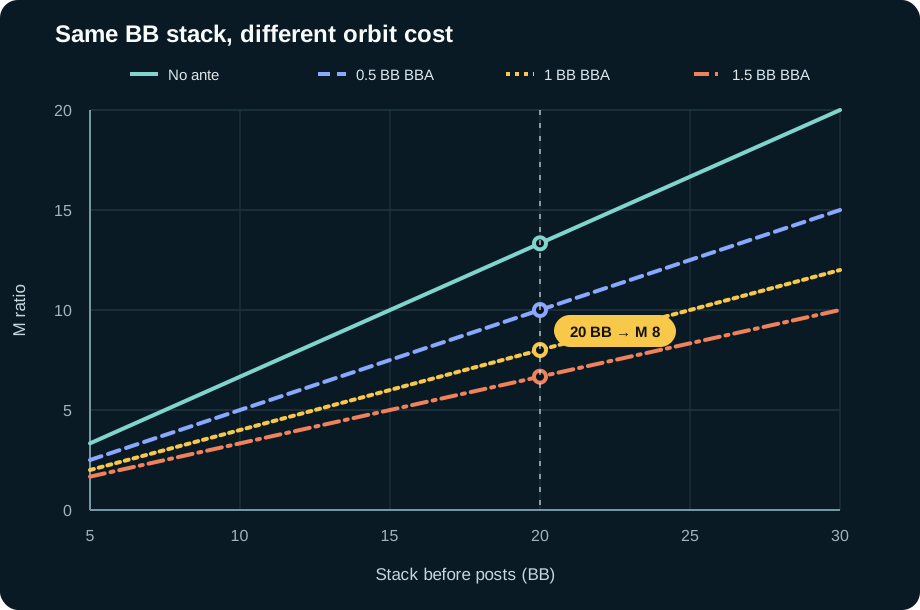
How Ante Format and Table Size Interact
Fixed big-blind ante
After a stable eight-handed rotation, every seat has paid one BBA, one big blind, and one small blind. The same obligations arrive over six hands at a six-handed table.
That is why s + 1 + a has no player count: table size changes when the obligations arrive, not their scheduled cost per stable orbit. Poker TDA’s public 2024 Recommended Procedure 11 recommends a single-payer BBA, big-blind-first calculation, and no short-handed ante reduction. It is guidance, not every cardroom’s rule.
Per-player ante
With a traditional ante, each of N players posts p BB per hand, so each seat pays N × p across a complete orbit:
per-player-ante orbit cost in BB = s + 1 + N × p
M = stack in BB / (s + 1 + N × p)
An eight-handed 0.125 BB ante contributes 1 BB in total each hand, matching the scheduled orbit cost of a 1 BB BBA. At six-handed, the same per-player ante totals only 0.75 BB, so the denominator falls to 2.25 BB.
| Players | BBA orbit cost | BBA M | Per-player orbit cost | Per-player M |
|---|---|---|---|---|
| 2 | 2.5 BB | 8.00 | 1.75 BB | 11.43 |
| 6 | 2.5 BB | 8.00 | 2.25 BB | 8.89 |
| 8 | 2.5 BB | 8.00 | 2.50 BB | 8.00 |
| 9 | 2.5 BB | 8.00 | 2.625 BB | 7.62 |
| 10 | 2.5 BB | 8.00 | 2.75 BB | 7.27 |
So 1 BB BBA equals 0.125 BB per player only at eight-handed; its six-handed equal-share equivalent is 1/6 BB.
What If the Big Blind Cannot Cover the Ante?
Suppose the blinds are 500/1,000 with a 1,000 BBA and the next big blind has only 1,500 chips. There is not enough to post both obligations in full. Under Poker TDA’s recommended big-blind-first calculation, 1,000 goes to the live big blind and the remaining 500 goes to the ante.
The scheduled M is still 1,500 / 2,500 = 0.6, although the stack cannot fund a normal orbit. The calculator shows the TDA-recommended split only in BBA mode. Operators can use other priority, reduction, or all-in procedures, so the published structure and tournament director control the hand.
M Is a Measurement, Not a Strategy Model
- Stack in BB normalizes a player’s chips to the current big blind.
- Chips behind excludes chips already posted on this hand.
- Effective stack is bounded by the stacks that can contest each other in the hand; in multiway pots, the relevant amount can differ by opponent.
- M normalizes one stack to scheduled forced cost over a complete orbit.
- ICM maps a tournament’s full stack distribution and payouts to modeled prize equity.
M does not know cards, position, ranges, payouts, blind timing, or other stacks. A solver may label a spot by pre-posting BB depth, chips behind, or starting pot; use its convention instead of substituting M.
This page therefore attaches no shove range to an M row. For decisions, start with the relevant short-stack framework and exact game tree. On bubbles and final tables, our ICM guide covers payout pressure.
Where ICM Trainer fits
ICM Trainer is a mobile study app from this site’s publisher. Its current Apple and Google Play listings describe versioned precomputed ICM scenarios, preflop tree browsing, payout/stack context, and pairwise bubble factors. Use this calculator for BB/M bookkeeping; use an ICM model when payouts and other stacks matter.
Five Counting Errors—and a Better Hand Record
- Subtracting the BBA before reporting BB depth. A 20,000 pre-posting stack at a 1,000 big blind is 20 BB. Say “19 BB after the ante” only if the timing is explicit.
- Calling M a stack in BB. M 8 under a 1 BB BBA does not mean the player has 8 BB; the standard example has 20 BB.
- Multiplying a fixed BBA by table size. The table pays one BBA per hand, not one per player. Multiplying by eight would count the same orbit eight times.
- Ignoring table size for per-player antes. Here the table really does post
N × anteeach hand. - Treating M as a clock. Your seat, a level increase, a table break, a hand-for-hand batch, or a changed ante can make the literal number of hands very different. Our hand-by-hand blind-increase ledger shows how the same current ratio can lead to different scheduled posts across seats.
A compact study note avoids all five errors by preserving raw values before normalizing them:
Example record
8-handed · 500/1,000 · BBA 1,000 · stack 20,000 before posts · Hero BB next
- Stack depth: 20 BB before posts.
- Orbit cost: 2.5 BB under unchanged blinds and BBA.
- M: 8.
- Next hand: 18 BB behind after posting; 1 BB is live and 1 BB is ante.
For a hand review, also record the other stacks, payouts, positions, blind time remaining, and whether the quoted stack includes the current posts. Retaining those facts is more useful than keeping one ratio and discarding the structure.
Download and Verify the Reference Data
The public bundle contains 40 conversions across four BBA sizes and 18 ante-format rows for two through ten players. Its standalone Node.js verifier recomputes every orbit cost and M, checks JSON/CSV parity, and checks fixed-BBA table-size invariance.
- Formula, assumptions, and all reference rows (JSON)
- 40 big-blind-ante conversions (CSV)
- 18 BBA-versus-per-player-ante rows (CSV)
- Independent reference verifier (Node.js)
Download the four files into one folder and run node bba-m-verifier.mjs. The verifier checks publication data, not a cardroom’s procedures. You still need the actual structure sheet and house rule as inputs.
Limits of the Model
- Blinds, antes, and table size are held fixed for a modeled complete orbit.
- A table break, dead button, missed blind, level change, or heads-up transition can interrupt the rotation.
- Some operators reduce or reprioritize the BBA; the TDA procedure is a recommendation, not a universal law.
- M measures compulsory chip cost, not time, number of playable hands, tournament equity, or decision EV.
- The static reference table assumes a 0.5 BB small blind and 1 BB BBA. Use the calculator for another structure.
- The calculator covers blind games with either a single-payer BBA or an equal per-player ante. Button antes, bring-ins, and other forced-bet systems are not modeled here; derive their orbit cost from the actual posting rules.
Big-Blind Ante and M FAQ
- Do I multiply the big-blind ante by the number of players?
- No. One player posts one BBA each hand. Across a stable complete orbit, each seat pays it once. Multiply by player count only for a per-player ante that every seat posts on every hand.
- Does M tell me how many hands I have left?
- No. M is a continuous stack-to-orbit-cost ratio. Position, table size, blind timing, stack changes, and posting rules determine the literal number of hands.
- Should I use BB depth or M for a solver?
- Use the exact convention and the stack, blind, ante, position, and payout inputs that the specific solution declares. M is a summary, not a substitute for its game definition.
Sources
- Poker Tournament Directors Association, 2024 Poker TDA Rules and Recommended Procedures, especially RP-11 on BBA format, big-blind-first calculation, and no ante reduction. Accessed September 3, 2026.
- World Series of Poker, 2026 WSOP event page and bracelet-event structure document. Accessed September 3, 2026.
- Kevin Desmond, “Introduction to Poker Theory”, MIT OpenCourseWare 15.S50 lecture, 2015. Accessed September 3, 2026.
- Dan Harrington and Bill Robertie, Harrington on Hold’em: Volume II — The Endgame, Two Plus Two Publishing. Bibliographic record accessed September 3, 2026.
- Apple App Store, ICM Trainer; Google Play, ICM Trainer. Accessed September 3, 2026.
- GTO Gecko, BBA and M reference model, conversion grid, ante-format comparison, and independent verifier. Generated and accessed September 3, 2026.