
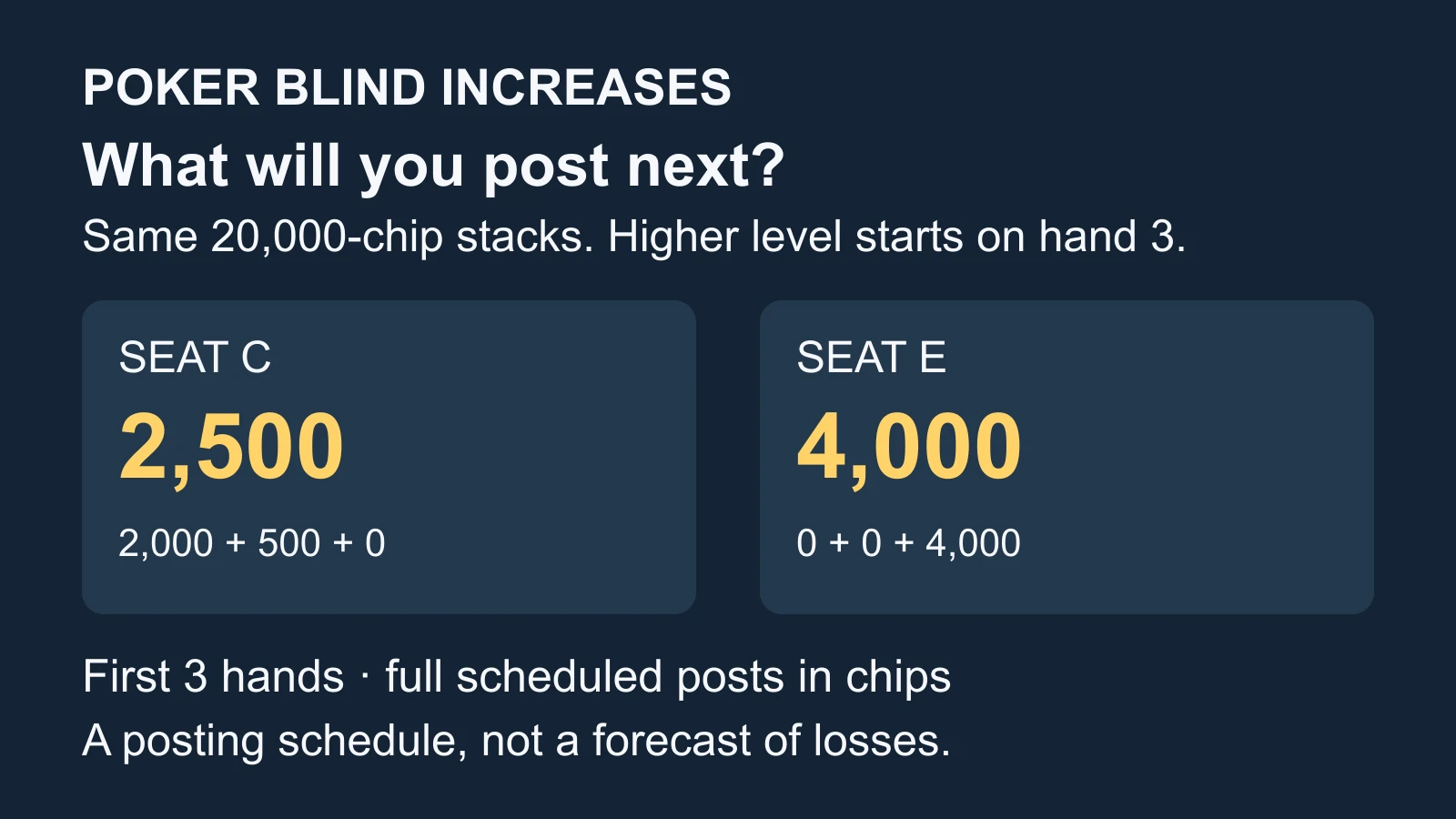
Two equally sized stacks can face different scheduled posts over the next few hands. To work out what you are scheduled to post next, follow the button hand by hand and apply the blind level that belongs to each hand. Your current stack in big blinds cannot supply that timeline.
In the constructed six-handed example below, C and E both start with 20,000 chips: 20 big blinds (BB) and M 8 at the current level. Yet over the first three displayed hands, C is scheduled to post 2,500 chips and E 4,000 chips. Move the increase one hand later and E’s total becomes 2,000, reversing which seat posts more.
These are gross compulsory posts for off-table study, not predicted losses, remaining stacks or instructions to shove. The distinction matters even if a player makes no voluntary investment: a big blind can receive a walk and collect the pot.
Fix the seats and the level-change hand
Take six occupied seats in clockwise order: A, B, C, D, E, F. The button is at A on displayed hand 1. B posts the small blind; C posts the big blind and the big-blind ante (BBA). Everyone stays in the same seat, nobody enters or leaves, and every scheduled post can be paid in full. The button advances one seat each hand.
This uses the ordinary full-table arrangement in the official PokerStars Hold’em rules: the small blind is immediately clockwise from the button, followed by the big blind. Table balancing and broken-table seating, eliminations and the transition to heads-up require their own button treatment; they are outside this ledger.
Two declared levels
- Hands 1–2: small blind 500, big blind 1,000, BBA 1,000.
- Hands 3–6: small blind 1,000, big blind 2,000, BBA 2,000.
Only the big blind pays the ante. It is additional to the live blind, rather than extra betting credit. The higher level begins with hand 3 by assumption.
The WSOP’s original big-blind-ante explanation distinguishes the live blind from the dead ante. We use that distinction here, without assuming every event uses this particular ante schedule.
Do not turn “two minutes left” into “exactly two hands left.” Hand duration is unknown. For a review, establish which hand actually used the new level; for a hypothetical comparison, preserve more than one possible boundary.
Under Poker TDA’s currently published 2024 rules, Rule 23, a level change announced by the floor or clock audio applies to the next hand. A hand begins at the first riffle, shuffler-button push or dealer push, rather than necessarily when the first card reaches a player. The rule also covers a level change during a dealer push and a mistaken old-level hand after substantial action. Use the event’s ruling for those cases. This example starts with an already resolved boundary.
Follow C and E through the first three hands
C pays the old big blind plus ante on hand 1, then the old small blind on hand 2. E reaches the big blind on hand 3, when both the blind and ante have doubled.
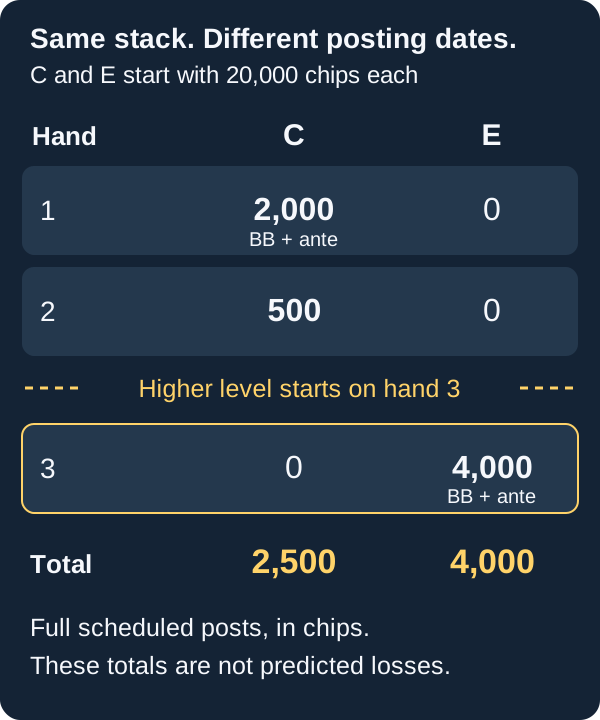
The complete six-hand trace makes the seat movement inspectable. All amounts below are chips; the “BB + ante” column separates the two obligations.
On a narrow screen, scroll horizontally to inspect every column.
| Hand | Button | SB post | BB + ante | C posts | E posts |
|---|---|---|---|---|---|
| 1 | A | B: 500 | C: 1,000 + 1,000 | 2,000 | 0 |
| 2 | B | C: 500 | D: 1,000 + 1,000 | 500 | 0 |
| 3 · new level | C | D: 1,000 | E: 2,000 + 2,000 | 0 | 4,000 |
| 4 | D | E: 1,000 | F: 2,000 + 2,000 | 0 | 1,000 |
| 5 | E | F: 1,000 | A: 2,000 + 2,000 | 0 | 0 |
| 6 | F | A: 1,000 | B: 2,000 + 2,000 | 0 | 0 |
Across all six hands, C’s scheduled total is still 2,500, while E’s reaches 5,000. Both pay one small blind, one big blind and one BBA. The difference is the level at which those posts occur. If the old level remained in effect for all six hands, every seat would instead post 2,500.
That is why an unchanged-orbit measure and a finite posting timeline answer different questions. Use the BB and M explanation for the static conversion; use the event sequence when the rates can change during the rotation.
Build your own hand-indexed ledger
Keep chips as the unit while assembling the events. For each displayed hand:
- Mark the button, then identify the next two clockwise seats as the small and big blinds.
- Read that hand’s small blind, big blind and ante from its assigned level. Charge the BBA only to the big-blind seat.
- Add each seat’s posts over the chosen number of hands. Keep the individual rows so the total can be checked.
The endpoint is part of the question: “next three hands” and “next full rotation” need not give the same comparison. Do not replace an uncertain level-change hand with a single confident total.
Test the boundary instead of guessing it
Keep the seats and amounts fixed. Compare three possible first hands at the higher level:
| Higher level starts | C: first 3 hands | E: first 3 hands |
|---|---|---|
| Hand 2 | 3,000 | 4,000 |
| Hand 3 | 2,500 | 4,000 |
| Hand 4 | 2,500 | 2,000 |
Scroll horizontally if needed. These are alternative schedules, not equally likely outcomes.
The hand-2 change reaches C’s small blind. The hand-3 versus hand-4 change determines which level applies to E’s big blind and ante. A one-hand shift can therefore change both the total and the ordering between seats. The downloadable data contains every boundary from hand 1 through hand 7; hand 7 leaves all six displayed hands at the old level.
Why the total is not your cost of folding
Subtracting scheduled posts from 20,000 gives only a bookkeeping subtotal with pot receipts and voluntary contributions omitted. It does not predict the stack after those hands. A player can win back posted chips, collect others’ chips, invest more, or be eliminated before a later scheduled turn.
Nor does posting more in three hands prove that a current shove is preferable. That decision also depends on cards, available actions, opponents’ responses, the resulting stacks and tournament prizes. Our short-stack guide covers the broader decision context; this ledger supplies no opening, calling or shoving range.
Future game simulation (FGS) is a different kind of calculation. ICMIZER’s primary explanation describes accounting for upcoming blinds and positions when evaluating tournament decisions. Listing the posts is not an FGS solve: our program has no hole cards, strategy tree or prize-equity calculation. For the static prize-value model, see the ICM introduction.
Reproduce the schedule and use it in study
Download the method and run instructions, input schedule, Python generator and independent verifier. The 252-row event ledger, 42 seat summaries and combined JSON results preserve the exact chip arithmetic across seven alternative schedules. The 252 rows are seat-hand records, not 252 played hands. No sampling or random seed is involved.
The published example has six players; the generator accepts three to nine fixed seats. It assumes full payment and one BBA payer per hand. It does not handle a short all-in ante, a table break, dead-button transition, heads-up play, changing attendance or disputed timing. If one of those changes the posting order, rebuild the event list from the applicable procedure rather than extending this trace.
For further tournament study, use ICM Trainer to explore available precomputed tournament scenarios and compare their stack and ante assumptions. Its role here is separate scenario study; the posting ledger is an article resource. GTO Solutions makes ICM Trainer and publishes this site. The official US listing and supporting sources were checked September 7, 2026.