
You have aces on the button, heads-up, with 10 big blinds. Shoving commits your stack immediately; limping adds half a blind. After a limp, this particular model gives the big blind a check-or-shove menu, with no smaller raise. Which opening action earns more?
In this library’s 10bb solution, aces limp 100%. The stored limp EV is 4.509bb versus 3.405bb for a shove: a 1.103bb difference. The independent all-in check below supports the shove value. That does not make limping a universal premium-pair rule.
The useful lesson is to keep the small opening actions in the comparison, even with a premium pair and a short stack. These are solver-library outputs for specified heads-up models. Our range explanations are interpretations of the saved policies; original convergence records are unavailable. The broader depth test also uncovered unreliable continuations, so we separate the 10bb example from the unvalidated deeper comparisons.
Aces on the button, 10bb deep
Heads-up NLHE, equal 10bb starting stacks before blinds, no ante, no rake. BTN posts 0.5bb and acts first; BB posts 1bb. Limp adds 0.5bb; min-raise adds 1.5bb; shove adds 9.5bb.
Modeled setup, not a played hand history. A♠A♥ illustrates the aggregate AA class. Chips are illustrative; the labels give the amounts.
Read the table as text
Heads-up NLHE, equal 10bb starting stacks before blinds, no ante, no rake. BTN posts 0.5bb and acts first; BB posts 1bb. Limp adds 0.5bb; min-raise adds 1.5bb; shove adds 9.5bb. Pot: 1.5 bb.
- BTN / SB (dealer): 9.5 bb behind; 0.5 bb committed this street; Next to act; cards: A♠, A♥.
- BB: 9 bb behind; 1 bb committed this street; Posted big blind; cards: face down, face down.
At 10bb, the expensive choice is the shove
On a narrow screen, scroll the table to compare all three actions. EV is in bb, relative to folding at this decision.
| Stack / hand | Limp to 1bb | Raise to 2bb response not validated | Open shove | |||
|---|---|---|---|---|---|---|
| Freq. % | EV bb | Freq. % | EV bb | Freq. % | EV bb | |
| 10bb · AA | 100.00 | 4.50857 | 0.00 | 4.49810 | 0.00 | 3.40522 |
| 10bb · KK | 99.95 | 3.98362 | 0.05 | 3.98045 | 0.00 | 2.97717 |
| 10bb · QQ | 100.00 | 3.61700 | 0.00 | 3.59836 | 0.00 | 2.70154 |
The shove is to the listed starting stack. Fold is available with 0bb EV and 0% frequency for these hands. The min-raise column is diagnostic output from a flagged response branch. Frequencies are stored action mixes, not advice to copy every decimal.
The stored shove EV for aces, kings and queens is about a big blind below their limp EV here. The table also records the min-raise output, but that branch needs caution: the whole button range uses it only 0.0119%, and the BB response contains material frequency/EV disagreements. We do not use those small numerical gaps to certify min-raising as an equivalent strategy.
The held-out 8bb model supplies a useful check. All three pairs also limp 100%; their limp EV exceeds shove EV by 0.649–0.706bb. The 8bb min-raise branch is also barely used and fails the response check. We keep its values out of the strategic comparison. Neither model establishes a precise depth where a switch becomes necessary.
The pattern has a precedent: PokerStars’ heads-up button guide includes premium-pair limps around 10bb and more raising at deeper stacks. This study tests that idea in our current library rather than treating the guide’s depth bands as exact rules.
The limp still gives the big blind room to act
At 10bb, the button limps 62.48% of its starting combinations. That limp range includes nearly all 18 combinations of QQ–AA, but those premiums account for only 2.17% of its weighted combination mass. A limp does not reveal a premium pair.
Scroll the range sideways if needed. Use the hand selector for a larger frequency view.
10bb: BTN/SB opening strategy
All 1,326 starting combinations enter this player’s decision. Colors show the conditional action mix; they do not show equity.
Hover or tap a hand. Use arrow keys in the grid. Suited above the diagonal; offsuit below.
Owned preflop library, retrieved September 30, 2026. No achieved-convergence record supplied. Hatched = outside range · ? = missing data
Against the limp, this tree gives the big blind two meaningful choices: check or shove. It does not offer a small isolation raise. The BB checks 56.61% and shoves 43.39% of its own marginal range. With A♠A♥ specifically removed, the compatible shove share is 38.83%.
Scroll the range sideways if needed. Use the hand selector for a larger frequency view.
10bb: BB responds to the limp
All 1,326 starting combinations enter this player’s decision. Colors show the conditional action mix; they do not show equity.
Hover or tap a hand. Use arrow keys in the grid. Suited above the diagonal; offsuit below.
Owned preflop library, retrieved September 30, 2026. No achieved-convergence record supplied. Hatched = outside range · ? = missing data
This supplies one concrete route for value: a limp can face a shove while keeping weaker hands in the overall limping range. With aces, BTN calls that shove 100% in the export. The checked-pot continuation also contributes to limp EV; the response frequency alone cannot explain the entire difference.
The response menu matters. GTO Wizard’s short-stack heads-up isolation analysis also separates the stronger 10bb limp range from the deeper setup. Its solutions are context for the question, not a replication of our numbers.
How the two all-in routes differ
When BTN open-shoves, BB calls 36.43% of its marginal range. Remove A♠A♥, and that call share becomes 31.18%. Compare it with the 38.83% compatible shove share after a limp: the stored responses put aces all-in more often preflop after limping.
Scroll the range sideways if needed. Use the hand selector for a larger frequency view.
10bb: BB responds to an open shove
The same 1,326 BB starting combinations now face a 10bb open shove. This policy is conditioned on the button’s whole shoving range.
Hover or tap a hand. Use arrow keys in the grid. Suited above the diagonal; offsuit below.
Owned preflop library, retrieved September 30, 2026. No achieved-convergence record supplied. Hatched = outside range · ? = missing data
| BTN action | BB continues all-in | Weighted combos | Share |
|---|---|---|---|
| Limp to 1bb | BB shoves to 10bb | 475.7072 | 38.83% |
| Shove to 10bb | BB calls to 10bb | 382.0064 | 31.18% |
The 7.65-percentage-point difference is derived from exact compatible combinations, with each BB policy held as exported. These are two native response policies to different actions and ranges. The comparison describes what happens in the saved model; it is not a causal experiment with one fixed opponent range. It also does not establish a human tendency to attack limps.
A study habit to take from this hand
Study cue: with a premium pair heads-up, compare limp, small raise and shove before defaulting to an all-in. In these short no-ante models, limping can retain substantial value. Recheck each hand and tree as depth changes; do not turn the 10bb example into “always limp aces.”
For a short exercise, hide the frequencies in the 10bb table. Compare limp and shove for each pair using the EV columns, then uncover the mixes. Explain why the flagged response prevents confidently ranking the min-raise. Finally, inspect KQo in the two BB grids: how does its response change when facing a limp instead of a shove?
For the wider format, read our Spin & Go strategy guide. In GTO Gecko, use the study views described in the official app listing to compare available frequencies and EV estimates for the chosen setup and plan. The app requires a paid plan; library access depends on the plan. Match the player count, ante and allowed actions before comparing your own example.
Aces already raise at nearby depths
The opening mix changes quickly. At 12bb, AA raises 62.53%; at 15bb, it raises 100%. Yet its stored limp shortfall is just 0.00043bb and 0.00838bb respectively. Those tiny gaps do not justify treating a pure-looking frequency as an inflexible rule.
At 20bb, AA raises 100% while QQ limps 52.51%. The QQ limp and small-raise values differ by only 0.00038bb. Hand rank affects the mixture, but the frequency change can look much larger than the EV difference.
Observed frequencies only. The deeper response-tree problems below prevent treating this chart as a validated recipe or an EV ranking.
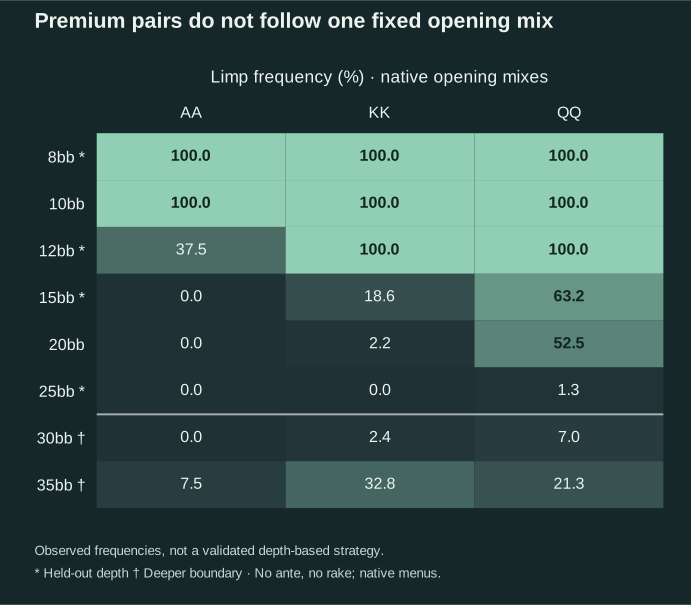
Observed limp frequencies
8bb · held out
AA · limp 100.00%
KK · limp 100.00%
QQ · limp 100.00%
10bb · discovery
AA · limp 100.00%
KK · limp 99.95%
QQ · limp 100.00%
12bb · held out
AA · limp 37.47%
KK · limp 100.00%
QQ · limp 100.00%
15bb · held out
AA · limp 0.00%
KK · limp 18.59%
QQ · limp 63.23%
20bb · discovery
AA · limp 0.00%
KK · limp 2.22%
QQ · limp 52.51%
25bb · held out
AA · limp 0.00%
KK · limp 0.00%
QQ · limp 1.28%
30bb · deeper boundary
AA · limp 0.00%
KK · limp 2.39%
QQ · limp 7.05%
35bb · deeper boundary
AA · limp 7.50%
KK · limp 32.84%
QQ · limp 21.32%
Exact frequencies behind the chart
| Depth | AA | KK | |
|---|---|---|---|
| 8bb | 100.00 | 100.00 | 100.00 |
| 10bb | 100.00 | 99.95 | 100.00 |
| 12bb | 37.47 | 100.00 | 100.00 |
| 15bb | 0.00 | 18.59 | 63.23 |
| 20bb | 0.00 | 2.22 | 52.51 |
| 25bb | 0.00 | 0.00 | 1.28 |
| 30bb | 0.00 | 2.39 | 7.05 |
| 35bb | 7.50 | 32.84 | 21.32 |
The six primary depths were 8, 10, 12, 15, 20 and 25bb. We explored 10/20bb first and held out 8/12/15/25bb, then checked 30/35bb separately. The requested 40bb model was unavailable. Exact frequencies and selected action values are preserved in the public data with their validation status.
Why the 25bb result remains a research boundary
The predeclared shortcut test asked whether limping every QQ–AA hand at the six primary depths came within 0.1bb of the best stored action. The raw arithmetic passes 17 of 18 rows. Its apparent exception is 25bb AA: raise EV 6.09967bb versus limp EV 5.95176bb, a 0.14791bb gap.
We do not treat that gap as a validated recommendation. Aces never limp in the saved 25bb opening strategy. When we follow what would happen if they did, they frequently reraise to 7bb after BB raises to 3bb. That reaches a response node with material frequency/EV disagreements. A branch can be almost unused in the original strategy and still matter to the shortcut being tested.
For AA specifically, that flagged branch is reached in 17.74% of deals after the hypothetical limp—not merely the tiny share suggested by the original full strategy. A separate all-in check also failed to reproduce the 25bb AA open-shove EV closely enough. The deeper raw values therefore remain diagnostic output, not a certified counterexample to limping. The broader automatic-limp hypothesis is unresolved; its simple 17/18 arithmetic score does not settle it.
The stored frequency pattern is not a one-way ladder either: at 35bb, AA limps 7.50% and KK limps 32.84%, up from zero for both at 25bb. Native ranges and permitted reraises change together across these trees. We cannot isolate a pure stack-size effect.
What this study can and cannot establish
We retrieved eight equal-stack heads-up chip-EV configurations on September 30, 2026, with blinds of 0.5/1bb, no ante and catalog rake of zero. Six depths—8, 10, 12, 15, 20 and 25bb—form the primary study; 30 and 35bb are deeper boundaries. The requested 40bb configuration was absent and was not filled in. TT and JJ are separate neighboring-hand checks.
The hypothesis was frozen after exploring 10 and 20bb. The remaining four primary depths were held out. These related stack models are not independent real-world observations. We inspected 78 decision nodes and reconstructed each player’s action reach; hand-class masses use six pair, four suited and twelve offsuit combinations.
The audit found 204 later actions played at least 5% whose EV was more than 0.1bb below another stored action; none occurred at the opening nodes. At 10bb, all 13 flags are in the response to the rarely used min-raise. The 10bb limp, shove and limp-then-shove response nodes pass this particular check. Passing it is not a convergence certificate or proof that every continuation is accurate.
We checked the 10bb shove EV independently by enumerating the compatible opponent combinations and sampling one million five-card boards per hero pair with a fixed seed. The recalculated means for AA/KK/QQ were 3.403/2.981/2.701bb; each stored value fell within its Monte Carlo 95% interval. A separate evaluator agreed on 1,000 sampled showdowns. These checks validate the all-in calculation against the supplied calling policy, not that the policy is an equilibrium. The sampling intervals are not error bars for the original solver.
We did not independently re-solve the postflop continuation inside limp EV. All quoted action values therefore remain conditional on this library and its native menu. At 10bb that menu permits BB to check or shove after a limp, with no small isolation raise; adding that option would define a different experiment.
Original solver version, achieved convergence and postflop abstraction are unavailable. The EV differences describe individual actions against stored continuations; they do not measure the cost of changing an entire strategy or how an opponent would adapt. Do not transfer these no-ante, chip-EV results to ICM, bounties, cash rake or multiway pots.
We use 0.02bb as a discussion threshold for near-ties, not as a claim of numerical accuracy. For the broader raw shortcut test, the 0.05/0.1/0.2bb screens pass 15/17/18 of 18 rows respectively; none resolves the continuation defects. See our study of rounding and opponent adaptation for why local EV differences cannot certify a complete simplified policy. The full selected values, native action menus and denominators are in the public study notes. Our header is AI-generated editorial artwork; the figures and tables use the saved numerical data.