
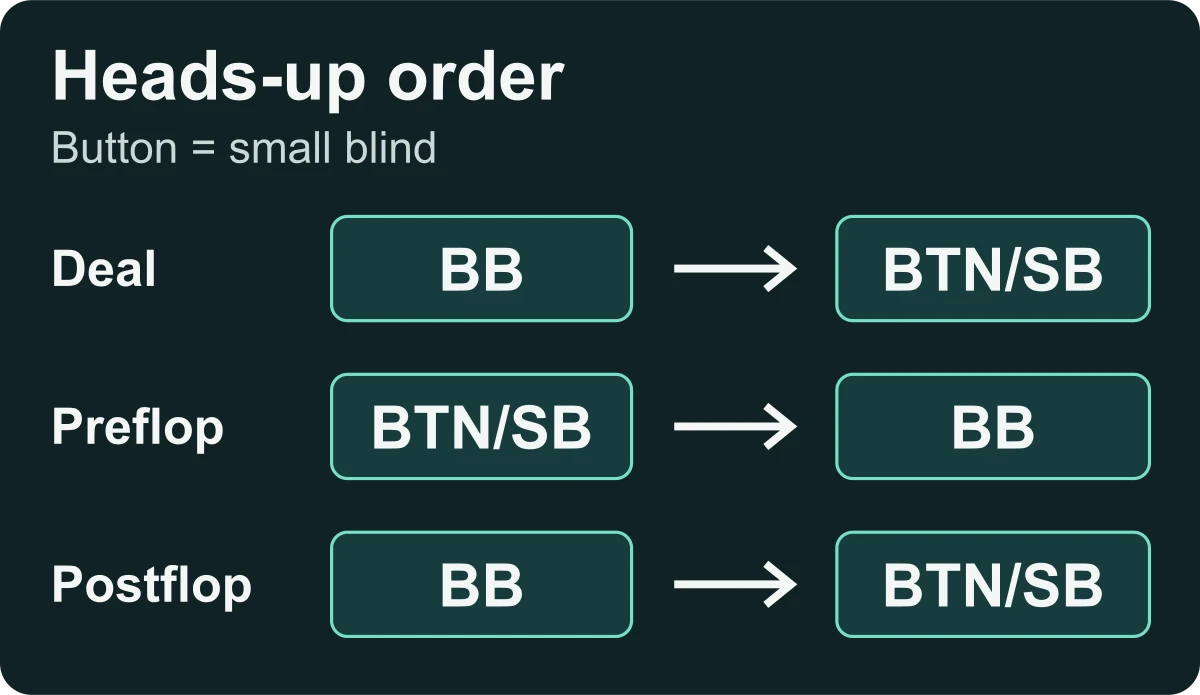
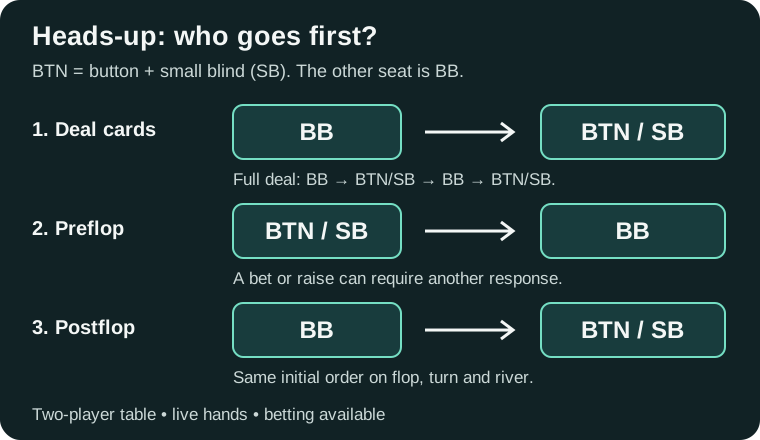
In heads-up Hold’em, the button posts the small blind. The other player posts the big blind. The button acts first before the flop and last on the flop, turn and river. Dealing starts with the big blind, so receiving the first card and taking the first preflop action belong to different players.
The first hand after a tournament drops from three players to two needs one extra check: which survivor should post the next big blind? Moving the button mechanically to the next occupied seat can get that hand wrong. The three-case table below makes the transition explicit.
Keep deal order separate from action order
The Poker TDA’s published 2024 rules, Rule 34B, put the heads-up small blind on the button and give that seat the last card of the initial deal. PokerStars’ heads-up guide also confirms the change from first action preflop to last action on later streets.
BTN means button, SB small blind and BB big blind. Scroll horizontally on a narrow screen if needed. Both players still have cards and chips available for betting.
| Stage | First | Then |
|---|---|---|
| Initial hole-card deal | BB receives a card | BTN/SB receives a card; repeat once |
| Preflop action | BTN/SB | BB responds |
| Flop, turn or river action | BB | BTN/SB responds |
“First” identifies who acts first on that street; it does not mean each player acts only once. A bet or raise may require another response. If someone folds, the hand ends. Once an all-in has closed betting, subsequent board cards create no further betting decisions.
Posting the small blind is not a preflop call. In a synthetic heads-up hand with 100/200 blinds, no ante and 5,000 chips each before posting, the BTN/SB has posted 100 against the BB’s 200. To call, the button adds 100; checking is not an option while facing that difference. If the button calls, the BB may check or raise. If both reach the flop with betting still available, the BB acts first there, regardless of who raised preflop.
The diagram restates the order table. On small screens it can be scrolled horizontally.
From three players to two: the three elimination cases
Our example starts with seats A, B and C in clockwise order. In the hand just completed, A had the button, B posted the small blind and C posted the big blind. Assume normal uninterrupted rotation before that hand, one elimination, full blinds and no seat moves or earlier button irregularity. Both survivors can post and have chips left to act.
Robert’s Rules of Poker, version 11, section 4 rule 3, assigns the initial heads-up button to the survivor who posted the big blind most recently. TDA Rule 34B additionally says the button may need adjustment to prevent a player posting the big blind on consecutive hands when heads-up starts. We use that stated transition convention here; confirm the rules of the event you are playing.
Read each row as a separate possible outcome of the same three-handed setup. Scroll horizontally if needed.
| Player eliminated | Next BTN/SB | Next BB | Why this survivor gets the button |
|---|---|---|---|
| A (button) | C | B | C just posted the BB. |
| B (small blind) | C | A | C just posted the BB. |
| C (big blind) | B | A | B posted the BB more recently than A. |
The third row is the easy one to misread. C is gone, so “give the last big blind the button” cannot mean handing it to C’s empty seat. Look back through the normal rotation: B was the big blind one hand before C, and A was the big blind before B. Of the two survivors, B is the more recent big blind. B therefore posts the small blind again, this time with the button.
In the first row, advancing the old button from A straight to B would instead make C the big blind twice consecutively. Place the next BB at B and the heads-up BTN/SB at C. Once the first heads-up hand is correctly assigned, the two survivors exchange roles on each following hand.
Completed rehearsal, with C eliminated: “First heads-up hand: B has BTN/SB, A has BB. Deal A–B–A–B. B acts first preflop. If they reach a flop with betting available, A acts first. Next hand: A has BTN/SB and B has BB.”
Two players in a pot does not move the button
Compare that transition with a three-player table where A, on the button, simply folds. B and C can play a heads-up pot, but A remains in the game for the next hand. B stays the small blind without the button. On the flop, B acts before C.
For a study note, compare the small-blind role in the two setups:
- Three players dealt in, button folds: the SB is not the button and acts first postflop.
- Two-player table: the SB is the button and acts last postflop.
Write “two-player table” or “two players left in this hand” at the top of a review. The word “heads-up” alone can conceal the distinction. Our position guide explains the strategic role of acting after an opponent; the transition table here only establishes who occupies each role.
A short practice check before studying ranges
Use three slips labeled A, B and C and a button marker. Set up the previous hand shown above, remove one seat, and write the next BTN/SB and BB without looking at the table. Then write four deal recipients, the first preflop actor and the first flop actor. Repeat with each different elimination.
Check the individual labels rather than awarding yourself a vague “I know heads-up” score. For example, after B is eliminated, the correct first deal recipient is A, but the correct first preflop actor is C. Getting one right does not establish the other. If you miss a label, redo that case before adding hands or bet sizes.
For the strategy that follows, see our Spin & Go guide’s heads-up section. If rules and hand strength still need work, the poker learning checkpoints offer a broader starting point. This reference supplies no opening range, shove threshold or claim about which hand to play.
For one concrete opening decision, our 10bb heads-up aces study compares limping with shoving, shows both response ranges, and explains the model’s limits.
For continued off-table learning, River’s official App Store listing describes short interactive lessons that progress from poker fundamentals into range and postflop concepts. River is part of GTO Solutions, the team publishing this article. The transition ledger here is our own teaching aid; we are not claiming that River teaches or validates these exact cases.
Downloads, rule scope and limits
The public ledger expands these three distinct role cases across three rotations of A/B/C. For each it lists the first heads-up hand and two subsequent hands: nine labeled cases and 27 hand rows. Those are constructed coverage checks, not a sample of real tournaments. No random seed or simulated cards are involved.
Download the transition CSV, structured casebook, Python generator, independent Node verifier, reproduction instructions and file checksums. The generator traces recent big-blind history; the verifier uses a separate three-case role table. Agreement checks the implementation of our declared convention, not every possible house rule.
Cash-table departures, re-entry, table balancing, prior dead buttons and simultaneous eliminations need their own context. Do not apply the three-seat shortcut when its history assumptions are missing. For a live placement error, call staff promptly: TDA Rule 34A treats errors discovered before and after substantial action differently. This article does not adjudicate a hand already in progress or cover showdown order.
Rules and official product sources checked September 5, 2026. The TDA page currently publishes its 2024 version; Robert’s Rules is cited specifically as version 11. Follow the rules adopted by your event.