
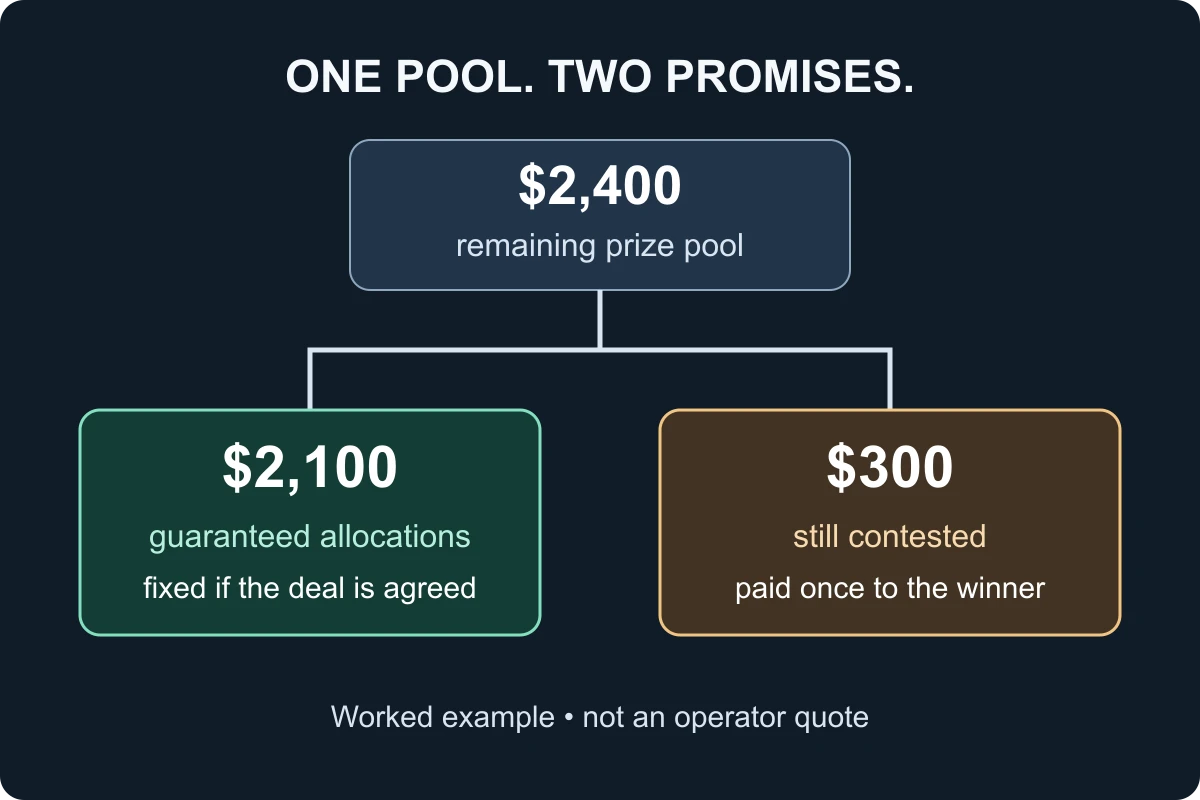
If an ICM deal leaves money for the winner, the quoted guarantee and the winner prize are separate amounts. In a worksheet that removes the reserve from first place, calculate ICM on the reduced payout ladder. The winner later receives their agreed guarantee plus the reserved prize; the other players receive their guarantees.
That distinction matters even when the arithmetic looks balanced. Reducing everybody's original ICM value by the same percentage can produce the right total while allocating it differently. This guide gives you a reproducible way to inspect the quote, using a synthetic three-player example rather than a real deal or a recommendation to accept one.
First identify what remains contested
A deal can settle only part of the prize pool. PokerStars' tournament rules, section 8, allow money to remain for first place or other finishes and describe ICM figures based on payouts after money left in play is removed. The current deal help page also says play continues until a winner is determined.
Those pages do not specify every deduction and rounding convention for every event. Confirm the event's reserve, the finishes that receive it, and how it changes the payout inputs. The examples below explicitly subtract a winner-only reserve from the original first prize. They are not a claim that every operator computes its quote this way.
Here, guaranteed means fixed by the agreed deal regardless of the player's eventual finish. It does not mean the operator transfers the money immediately. Nor do you add the original finishing prize again: the deal replaces the original allocation of the money being chopped.
A $300 winner prize changes the guarantees
Three players remain with 60,000, 25,000 and 15,000 chips. The remaining prizes are $1,200, $750 and $450, a total of $2,400. Set aside $300 from first place. The ladder used to calculate the guaranteed ICM allocations becomes $900, $750 and $450, totaling $2,100.
We use the Malmuth–Harville ICM model: a player's first-place probability is their chip share; after assigning that finish, remove that stack and apply the same rule to the remaining players. Summing all six finishing orders gives the table below. These are model probabilities, not measured chances of winning. The recursion is documented in Juho Kim's ICM paper, section II; our ICM introduction explains the basic calculation.
On a narrow screen, scroll horizontally to compare the three amounts. The guaranteed column totals $2,100; the expected-contingent column totals $300.
| Player / chips | Original ICM value | Guarantee if agreed | ICM expected share of $300 |
|---|---|---|---|
| A / 60,000 | $991.76 | $811.76 | $180.00 |
| B / 25,000 | $763.24 | $688.24 | $75.00 |
| C / 15,000 | $645.00 | $600.00 | $45.00 |
Player A's ICM first-place probability is 60%, so removing $300 from first place reduces A's guaranteed allocation by 0.60 × $300 = $180. B's reduction is $75 and C's is $45. Each player's reduction reflects their model share of that particular prize.
A does not receive $180 of the reserve automatically. With the displayed guarantees agreed, A receives $1,111.76 if A wins and $811.76 otherwise. The three possible settlements make the distinction visible:
On a narrow screen, scroll horizontally to compare every player's final payment.
| Winner | A receives | B receives | C receives |
|---|---|---|---|
| A | $1,111.76 | $688.24 | $600.00 |
| B | $811.76 | $988.24 | $600.00 |
| C | $811.76 | $688.24 | $900.00 |
Every row totals $2,400. Second versus third makes no payment difference in this winner-only-reserve fixture.
Why a proportional haircut gives a different deal
The reserve is 12.5% of the $2,400 pool. It may seem natural to retain 87.5% of every player's original ICM value. That produces guarantees of $867.79 for A, $667.83 for B and $564.38 for C, after rounding.
Those numbers also total $2,100. Yet A's guarantee is about $56.03 higher than in the adjusted-ladder calculation, while B and C receive less. The reason is precise: multiplying every ICM value by 87.5% is equivalent to scaling every finish's payout by 87.5%. It is not equivalent to subtracting $300 solely from first place.
This does not make a voluntarily agreed alternative split invalid. It means the label “ICM with $300 left for first” is not enough to identify the formula. Ask which payout ladder and deduction method produced the guarantees.
The identity is about expectation, not certainty
At the same ICM stack snapshot:
Original ICM value = adjusted-ladder guarantee + ICM expected value of the reserved prizes.
For a first-place-only reserve R, the expected reserved value is the player's chip share × R.
The identity follows because an expected payout is a probability-weighted sum. Splitting each finish's payout into a reduced payout and a reserved part splits that sum in the same way. Our downloadable calculation checks the equality with exact fractions.
It does not establish that playing on is equally attractive to every person, or that ICM predicts the actual outcome distribution. Skill, position and blind levels are absent from this model. A deal can also change incentives. The algebra holds with the probabilities fixed; it does not prove that the real continuation keeps those probabilities.
If money remains for second place too
Keep the same stacks and original prizes, but reserve $300 for first and $100 for second. The adjusted ladder is now $900, $650, $450. The calculated guarantees are A $781.18, B $646.32 and C $572.50, totaling $2,000 after rounding.
A finishes second in the model through two routes: B is assigned first place and the model selects A next, or C is assigned first place and the model selects A next. The probability is (25/100 × 60/75) + (15/100 × 60/85) = 26/85, approximately 30.59%.
A's reduction is therefore $180 plus $100 × 26/85, or $210.588235…, which rounds to $210.59. Subtracting the independently rounded displayed amounts ($991.76 − $781.18) gives $210.58 instead. This one-cent difference is display rounding, not a missing payout. The winner receives $300 extra and the runner-up $100 extra. Neither bonus belongs in every player's guaranteed total.
Our fixtures keep the adjusted ladder nonnegative and in descending order. If a proposed reserve changes that ordering or exceeds a listed prize, stop and clarify the operator's actual inputs. Do not silently reorder finishes or substitute a different formula.
A worksheet for checking a deal quote
- Freeze the inputs. Record all remaining stacks and the original remaining payouts in one currency.
- List each contested award. Write the amount and the finish that receives it. Keep bounties or other awards outside this worksheet unless their treatment is explicitly specified.
- Record the calculation ladder. Confirm exactly where each reserve was deducted. Reproduce the proposed guarantee using that ladder.
- Reconcile the whole pool. Sum all agreed guarantees, then add each contested award once. Compare with the money being distributed.
- Write each actual outcome. “Guarantee plus $300 if first” is clearer than a single number mixing guaranteed cash and expected value.
- Resolve the final cents. Display rounding can differ from settlement rounding. Confirm final guarantees and how any residual cent is assigned before relying on the quote.
For an off-table exercise, cover the guarantee column, calculate the $300 reserve's effect, then explain why the proportional haircut disagrees even though both totals reconcile. For studying playing decisions under a tournament payout ladder, continue with the final-table ICM strategy guide.
Continue studying tournament payouts
ICM Trainer, part of the same GTO Solutions portfolio as GTO Gecko, supports off-table study of available precomputed preflop scenarios with stack and payout context, as described in its official store listing. Use it to study how tournament context changes available decisions. This article's deal worksheet is an independent calculation; it is not ICM Trainer output or a claim that the app calculates deals or accepts holdback inputs.
Method, downloads and limits
The exact JSON results retain all six finishing orders and their rational probabilities for each of three reserve vectors. The nine-row CSV contains the allocation comparisons. Reproduce them with the standard-library Python generator, then run the independent JavaScript verifier. Instructions and checksums are in the method note and artifact manifest.
This is deterministic model arithmetic, with no random sample, seed, app telemetry or real tournament observations. Dollar figures are synthetic and rounded independently for display; exact fractions govern the mathematical comparisons. Taxes, fees, prior payments, bounties, noncash awards and negotiated adjustments are excluded. No hand ranges, betting actions or gambling outcomes are recommended.
Rules, mathematical sources and official product evidence checked September 5, 2026. Event procedures and product features can change; verify the specific event's quote and current official product information.