
You open the button with A♠ 6♠. Both blinds call, then check 7♠ 6♥ 2♦. In the heads-up version of this spot, the stored strategy bets your second pair 82% of the time. With both blinds in, it checks every time.
“Check more multiway” gets that example right. It gets the next one wrong: J♥ 4♥ on J♠ 4♠ 2♥ checks 30% heads-up and never checks three-way. The adjustment depends on which hand you are moving into the checked range.
We tested a heads-up c-bet mix using the action values stored for the corresponding three-player spot. The average gaps were modest, but some hands needed opposite adjustments. These are comparisons of stored solver outputs, not measured results from human play. Some later blind responses disagree with their stored EVs, and achieved convergence is unavailable. The calculations are reproducible; they cannot certify the cost of copying an entire strategy. The range explanations are our interpretation.
A♠ 6♠ after both blinds check
100bb six-handed cash. BTN opens to 2.5bb; SB and BB call. Flop 7♠ 6♥ 2♦. Each blind has only a check in this stored model.
Swipe the poker table sideways to see every seat.
Native three-way library setup. Pot 7.5bb before further betting; every active player has 97.5bb behind. Chip stacks are illustrative. Chips are illustrative; the labels are the amounts.
Read the table as text
100bb six-handed cash. BTN opens to 2.5bb; SB and BB call. Flop 7♠ 6♥ 2♦. Each blind has only a check in this stored model. Pot: 7.5 bb. Board: 7s, 6h, 2d.
- UTG: 100 bb behind; 0 bb committed this street; Fold preflop; folded; cards: face down, face down.
- HJ: 100 bb behind; 0 bb committed this street; Fold preflop; folded; cards: face down, face down.
- CO: 100 bb behind; 0 bb committed this street; Fold preflop; folded; cards: face down, face down.
- BTN (dealer): 97.5 bb behind; 0 bb committed this street; Check or c-bet; next to act; cards: A♠, 6♠.
- SB: 97.5 bb behind; 0 bb committed this street; Forced check; cards: face down, face down.
- BB: 97.5 bb behind; 0 bb committed this street; Forced check; cards: face down, face down.
One caller’s strategy in a two-caller pot
The paired setups are six-handed, 100bb cash games with a 2.5bb open. Heads-up, the SB folds and the BB calls: 5.5bb reaches the flop. Three-way, both blinds call: the pot is 7.5bb. Every active player has 97.5bb behind. The library is catalogued with 5% rake capped at 4bb.
Each blind has only a check before the opener acts in these files. That is a restriction of the tree, not evidence that donk bets never belong in multiway poker. The available bets are about one-third and three-quarters pot: 1.8/4.1bb heads-up and 2.5/5.6bb three-way.
For each exact hand, we copied the heads-up check/small/large frequencies to the matching three-way actions, then evaluated that mix using the three-way action EVs. We did not copy the old bet amounts or compare absolute EVs between different-sized pots.
On a narrow screen, swipe sideways to see every column.
| Model / pot | Large bet | Small bet | Check | |||
|---|---|---|---|---|---|---|
| Frequency | EV (bb) | Frequency | EV (bb) | Frequency | EV (bb) | |
| Heads-up5.5bb pot Bets 4.1 / 1.8bb | 59.0% | 4.317 | 23.0% | 4.285 | 18.0% | 4.310 |
| Three-way7.5bb pot Bets 5.6 / 2.5bb | 0.0% | 2.551 | 0.0% | 3.032 | 100.0% | 3.028 |
For A♠ 6♠, the copied mix puts 59% on the 5.6bb bet, 23% on 2.5bb and 18% on checking. Its value is 0.59 × 2.551 + 0.23 × 3.032 + 0.18 × 3.028 = 2.747bb. The highest stored action value is 3.032bb, leaving a 0.285bb local gap.
Checking and the small bet differ by only 0.004bb here. The frequent large bet creates most of this calculated gap; the pure-looking check frequency does not establish a meaningful advantage over betting small.
The overall change is clear; the gaps are uneven
Across the twelve chosen rainbow flops, BTN’s c-bet frequency falls from an equal-board mean of 52.7% heads-up to 34.1% three-way. It falls on every board, including all eight held out before analysis.
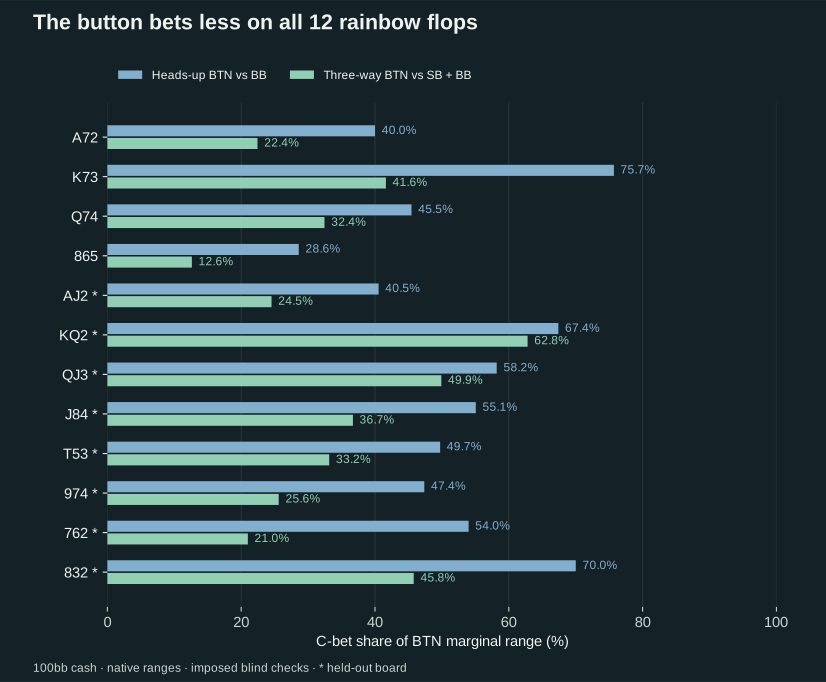
On a narrow screen, swipe sideways to see every column.
| Flop | HU c-bet | 3-way c-bet | Mean gap | Range with gap >0.1bb |
|---|---|---|---|---|
| A♠ 7♥ 2♦ | 40.0% | 22.4% | 0.026 | 3.9% |
| K♠ 7♥ 3♦ | 75.7% | 41.6% | 0.025 | 4.5% |
| Q♠ 7♥ 4♦ | 45.5% | 32.4% | 0.022 | 1.2% |
| 8♠ 6♥ 5♦ | 28.6% | 12.6% | 0.019 | 2.3% |
| A♠ J♥ 2♦ * | 40.5% | 24.5% | 0.018 | 0.2% |
| K♠ Q♥ 2♦ * | 67.4% | 62.8% | 0.023 | 0.9% |
| Q♠ J♥ 3♦ * | 58.2% | 49.9% | 0.023 | 2.1% |
| J♠ 8♥ 4♦ * | 55.1% | 36.7% | 0.033 | 3.6% |
| T♠ 5♥ 3♦ * | 49.7% | 33.2% | 0.027 | 2.6% |
| 9♠ 7♥ 4♦ * | 47.4% | 25.6% | 0.033 | 3.4% |
| 7♠ 6♥ 2♦ * | 54.0% | 21.0% | 0.038 | 4.2% |
| 8♠ 3♥ 2♦ * | 70.0% | 45.8% | 0.026 | 5.3% |
There are 7,053 positive-reach exact hand/board rows in the primary test, including 4,706 held out. The equal-board mean copied-mix gap is 0.026bb. Eleven of twelve boards meet the predeclared screen: at least 95% of BTN’s marginal range has a gap no larger than 0.1bb. The held-out 8♠ 3♥ 2♦ board narrowly misses it, at 5.3% above the cutoff. That one failure rejects the all-board hypothesis. The eleven passing arithmetic screens are not eleven guarantees that a heads-up strategy is safe to reuse.
That verdict depends on the tolerance. Using 0.05bb instead makes all twelve boards fail the same 95% screen; using 0.2bb makes all twelve pass. Those are editorial study thresholds, not universal definitions of a mistake or error bounds for the solver. We also varied the rounded input frequencies and EVs within ordinary rounding bounds: the 8♠ 3♥ 2♦ failure remained. This checks rounding sensitivity, not convergence.
The ranges behind second pair’s check
BTN has the same entering range in each matched pair. The opponents change. On 7♠ 6♥ 2♦, BB’s heads-up range contains 379.17 weighted combinations; its native three-way range contains 267.10. SB adds a separate 74.24-combo range. Neither blind is represented by a copy of the other’s range.
On a narrow screen, swipe sideways to see every column.
| Player / model | Weighted combos | Two pair+ | One pair | Unpaired |
|---|---|---|---|---|
| BTN, either model | 553.71 | 2.0% | 27.6% | 70.4% |
| BB, heads-up | 379.17 | 2.7% | 27.5% | 69.8% |
| SB, three-way | 74.24 | 6.5% | 28.1% | 65.4% |
| BB, three-way | 267.10 | 4.0% | 31.7% | 64.4% |
These counts provide context for the change. They do not establish why the strategy changes: adding SB also changes BB’s range, the pot and the absolute bet sizes. The two-pair-or-better shares are defined by the made hand on this flop, not by eventual winning probability.
BTN c-bet mix: one caller
553.71 weighted combinations. Colors show each class’s conditional action mix; entry weight is separate.
Swipe the grid sideways to see all hands, or use “Find a hand” above.
Hover or tap a hand. Use arrow keys in the grid. Suited above the diagonal; offsuit below.
Stored cash library, retrieved September 29, 2026. Both blinds have an imposed check in the three-way tree. Hatched = outside range · ? = missing data
BTN c-bet mix: two callers
553.71 weighted combinations. Colors show each class’s conditional action mix; entry weight is separate.
Swipe the grid sideways to see all hands, or use “Find a hand” above.
Hover or tap a hand. Use arrow keys in the grid. Suited above the diagonal; offsuit below.
Stored cash library, retrieved September 29, 2026. Both blinds have an imposed check in the three-way tree. Hatched = outside range · ? = missing data
The next three grids show the opponents entering the flop decision. Their green cells mean the class is present; they do not mean every hand calls a bet. Use the inspector to compare entry weights. A full green cell can have a small entry weight; presence and frequency are different quantities.
SB entering range: three-way
74.24 weighted combinations. Filled cells mark presence, not strength or calling frequency. Inspect entry weights below.
Swipe the grid sideways to see all hands, or use “Find a hand” above.
Hover or tap a hand. Use arrow keys in the grid. Suited above the diagonal; offsuit below.
Stored cash library, retrieved September 29, 2026. Both blinds have an imposed check in the three-way tree. Hatched = outside range · ? = missing data
BB entering range: heads-up
379.17 weighted combinations. Filled cells mark presence, not strength or calling frequency. Inspect entry weights below.
Swipe the grid sideways to see all hands, or use “Find a hand” above.
Hover or tap a hand. Use arrow keys in the grid. Suited above the diagonal; offsuit below.
Stored cash library, retrieved September 29, 2026. Both blinds have an imposed check in the three-way tree. Hatched = outside range · ? = missing data
BB entering range: three-way
267.10 weighted combinations. Filled cells mark presence, not strength or calling frequency. Inspect entry weights below.
Swipe the grid sideways to see all hands, or use “Find a hand” above.
Hover or tap a hand. Use arrow keys in the grid. Suited above the diagonal; offsuit below.
Stored cash library, retrieved September 29, 2026. Both blinds have an imposed check in the three-way tree. Hatched = outside range · ? = missing data
The hand that needs less checking
On the two-tone J♠ 4♠ 2♥ boundary board, J♥ 4♥ has top two pair. Copying its heads-up mix checks 30% of the time. The three-way export puts it entirely into bets, split between the two sizes.
On a narrow screen, swipe sideways to see every column.
| Model / pot | Large bet | Small bet | Check | |||
|---|---|---|---|---|---|---|
| Frequency | EV (bb) | Frequency | EV (bb) | Frequency | EV (bb) | |
| Heads-up5.5bb pot Bets 4.1 / 1.8bb | 29.0% | 8.112 | 41.0% | 8.101 | 30.0% | 8.109 |
| Three-way7.5bb pot Bets 5.6 / 2.5bb | 42.0% | 10.517 | 58.0% | 10.513 | 0.0% | 9.544 |
Here, checking is 0.973bb below the highest stored bet value. Copying the entire heads-up mix leaves a 0.294bb gap; almost all of it comes from the check component. A blanket instruction to move more hands into checks misses this hand’s adjustment.
On a narrow screen, swipe sideways to see every column.
| Flop | Mean gap (bb) | Range with gap >0.1bb |
|---|---|---|
| A♠ 8♠ 3♥ | 0.025 | 3.0% |
| K♠ Q♠ 6♥ | 0.042 | 9.5% |
| J♠ 4♠ 2♥ | 0.044 | 15.1% |
| 9♠ 9♥ 8♦ | 0.017 | 0.0% |
The two-tone J42 case has 15.1% of BTN’s range above the 0.1bb screen. The paired 9♠ 9♥ 8♦ case has none. “Multiway” alone does not tell us which hands change or how large the copied mix’s stored-EV gap will be.
The entering ranges differ here too. Their made-hand composition is shown below; none of these percentages is a joint probability that one of the blinds has a strong hand.
On a narrow screen, swipe sideways to see every column.
| Player | Weighted combos | Two pair+ | One pair | Unpaired |
|---|---|---|---|---|
| BTN | 547.22 | 2.2% | 32.0% | 65.8% |
| SB | 74.58 | 1.2% | 52.7% | 46.0% |
| BB | 271.61 | 2.0% | 34.6% | 63.4% |
Moving the opener changes the pattern too
Four additional matched cutoff spots test the position boundary. On K♠ Q♥ 2♦, CO bets more three-way: 71.5% versus 62.8% heads-up. On J♠ 4♠ 2♥, it rises from 37.1% to 47.4%. The button’s all-board frequency result does not survive this change of opener.
Even that reversal can hide a small EV distinction. On the KQ2 board, J♦ J♥ moves from 77.8% checking heads-up to 100% small betting three-way. Its three-way small-bet EV is 2.391bb and check EV is 2.386bb: a difference of only 0.005bb. Treat that as a near-tie, not a precision target to memorize.
Which habits to recheck in study
When a second caller joins, first review the marginal one-pair hands in your heads-up betting range. More checking can be appropriate, but small and large bets can have very different stored EVs behind the same aggregate c-bet label. Then check the opposite boundary: strong made hands may bet more in the three-way output even while the whole range bets less. Compare the EV of the copied mix before spending time reproducing every frequency.
Start with A♠ 6♠ and J♥ 4♥. Predict which part of each heads-up mix causes its three-way gap, then check the tables. Repeat with J♦ J♥ from the cutoff to see how a large frequency change can sit beside a small value change.
The wider context is established strategy, not a newly discovered law. GTO Wizard’s study of playing against both blinds compares frequencies and sizing in a different 100bb lojack chip-EV setup. Our contribution is the exact-hand transfer calculation in these native cash models. Its three-way release examples also caution against turning smaller multiway bets into a universal rule.
Original solver version, abstraction and achieved convergence are unavailable. Action frequencies are rounded to two decimals; vectors totaling 99% or 101% were renormalized to 100%. At all twenty three-way opener nodes, no action used at least 5% has a stored shortfall greater than 0.1bb. Some later blind responses fail that same screen, including branches that the exported strategies actually reach. This is a model-quality warning, not merely an unused-line artifact. These are local comparisons against stored continuations, not certified equilibrium costs, an opponent adaptation test or the cost of a complete strategy.
For background, read the multiway poker guide and how actions change ranges. In GTO Gecko, compare matching library scenarios, exact-combination frequencies and EV estimates within your paid plan’s available libraries. We publish this study as the team behind GTO Gecko; these selected research views do not promise every setup is available in every plan.
Research performed September 29, 2026. Method, selected data and verification code accompany the article. The header is AI-generated editorial art. All numerical figures come from the saved study data.