
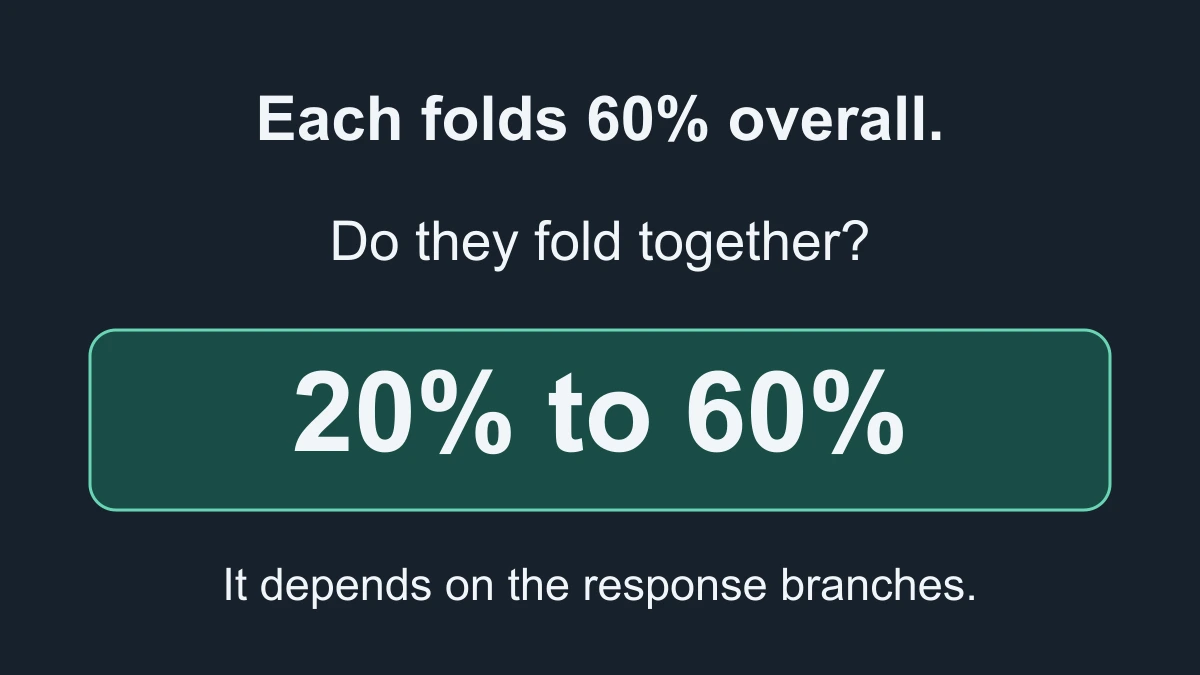
To calculate the chance that two opponents fold, multiply the first opponent’s fold probability by the second opponent’s fold probability after the first folds. Multiplying two overall fold rates assumes independence. Two overall 60% rates alone can correspond to a 20%, 36% or 60% chance of winning the pot without a call.
Here, “fold equity” refers to the probability that everyone facing the bet folds; we calculate its chip-EV consequence separately. This is an after-session calculation guide, extending the explicitly independent-fold example in our multiway strategy guide. Every response count below is constructed, not a player observation or solver strategy.
The second denominator is the branch you reach
Consider a three-way Hold’em river. Hero acts first and moves all-in for 50 chips into a 100-chip pot. Both opponents cover Hero. A responds first, then B. In this simplified model, each defender only folds or calls, and Hero receives nothing at showdown whenever either player calls. There is no rake, additional fee or later betting.
Write F_A for “A folds” and F_B for “B folds.” The conditional-probability multiplication rule gives:
P(both fold) = P(F_A) × P(F_B | F_A)The vertical bar means “given that.” If A folds in 60 of 100 probability-mass units and B folds in 36 of those 60, the calculation is (60/100) × (36/60) = 36/100. B’s second denominator is 60, not 100.
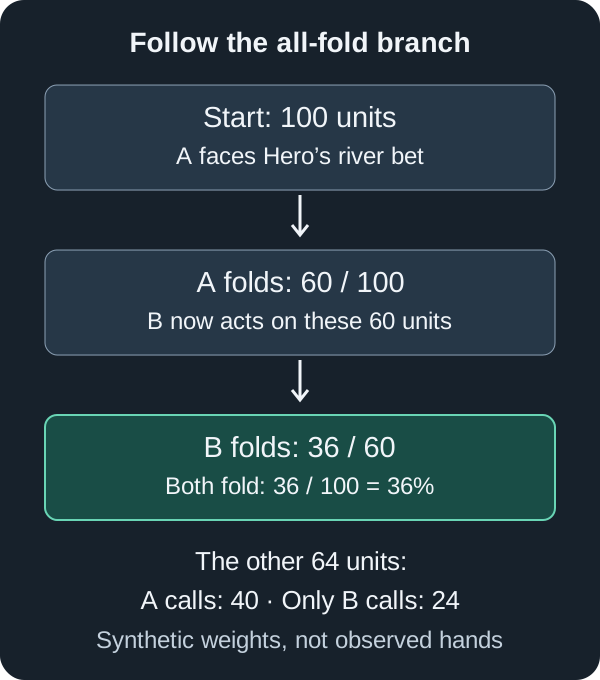
B’s overall fold rate mixes two different situations: responding after A folds and responding after A calls. Even the pot facing B changes: 150 chips after A folds, 200 after A calls, with 50 to call in either case. Those contexts need not produce the same response rate. This arithmetic does not tell us which response is strategically correct.
The same two 60% rates, three different answers
Read each column as a separate synthetic response model totaling 100 equally weighted units. These are convenient probability weights, not a sample of 100 played hands. “A folds, B calls” and “A calls, B folds” are different paths.
On a narrow screen, scroll the table to compare all three models.
| Ordered response | Low joint | Independent | High joint |
|---|---|---|---|
| A folds, B folds | 20 | 36 | 60 |
| A folds, B calls | 40 | 24 | 0 |
| A calls, B folds | 40 | 24 | 0 |
| A calls, B calls | 0 | 16 | 40 |
| A folds overall | 60/100 | 60/100 | 60/100 |
| B folds overall | 60/100 | 60/100 | 60/100 |
| B folds after A folds | 20/60 = 33⅓% | 36/60 = 60% | 60/60 = 100% |
In the low-joint model, B’s 60 folds include 40 that happen after A has already called. Those folds cannot win Hero the pot uncontested. Only the 20 folds following A’s fold count toward that outcome.
The endpoints are exact given these marginals. Two sets of 60 fold-units within a universe of 100 must overlap by at least 60 + 60 − 100 = 20; their overlap cannot exceed either set’s 60. Thus the all-fold probability can be anywhere from 20% to 60%. These are logical bounds, not confidence intervals or claims about how poker players usually behave.
What that changes in the bluff calculation
Let q be the chance that both fold. Relative to Hero’s stack immediately before the bet, the all-fold branch gains the existing 100-chip pot. Every called branch loses Hero’s 50-chip bet under our zero-showdown-payout assumption. Prior contributions to the pot are already spent.
EV(bet) = q × 100 − (1 − q) × 50
        = 150q − 50 chips
Break-even q = 50 / 150 = 1/3
These values apply only to the declared 100-chip pot and 50-chip river bet; scroll to compare the columns.
| Model | Both fold | Bet EV |
|---|---|---|
| Low joint | 20% | −20 chips |
| Independent | 36% | +4 chips |
| High joint | 60% | +40 chips |
If A folds 60%, B’s conditional break-even rate is (1/3) ÷ 0.60 = 5/9, about 55.56%; positive bet EV requires a rate above that exact threshold. That question is much more specific than “Does B fold 60% overall?” It asks how often B folds on the branch that still lets the bluff succeed.
Hero’s uncalled 50 chips are returned when both opponents fold, so that branch gains 100, not 150. The single-street pure-bluff calculation in GTO Wizard’s original analysis uses the same gain-on-fold, loss-on-call accounting.
A positive number here does not rank the available actions. We have not modeled checking, another bet size, hand ranges, card removal or opponents changing their responses. If Hero can win or tie when called, the called branches need their own payouts; this two-outcome formula is insufficient. Tournament prize-money EV also requires more than this chip accounting.
An after-session audit you can repeat
With three or more defenders, each later fold probability must be conditioned on all earlier defenders folding. Conditioning only on the immediately preceding player is insufficient. If the first defender never folds, the all-fold probability is zero; the next conditional rate on that unreachable branch is undefined.
- Freeze the scenario. Keep board, Hero’s cards or range, street, positions, pot, bet, stacks, players and prior action consistent. Card removal can change which opponent combinations remain. A general fold-to-bet percentage, or a rate averaged across Hero’s range, is not automatically a rate for this particular bluff.
- Name the response order. Record who faces the bet first, and the history under which the next defender acts.
- Preserve the branches. For B-after-A-fold, retain both the number of B folds and the number of times A folded and B faced the bet. Do not borrow B-after-A-call observations for that denominator.
- Calculate, then qualify. Multiply the matching branch rates. If you only have pooled rates, keep the result unresolved or state an independence assumption explicitly.
A completed note for the low-joint example reads: “A folds 60/100. B folds 20/60 after A folds; B’s other 40 folds followed an A call. Both fold 20/100. The zero-payout-when-called model gives −20 chips.” This makes the missing denominator visible to a reviewer.
With real observations, a correctly chosen denominator can still be small or unrepresentative. Our opportunity-count and uncertainty guide addresses that separate problem. No number of extra pooled observations removes the need to identify the relevant branch.
Practice the assumption, then return to the hand
For off-table practice against modeled opponent styles, we recommend Live Poker Trainer. It and GTO Gecko share the GTO Solutions team. Its drills provide action-frequency and EV feedback within modeled scenarios. These are a separate study activity: the response ledgers here do not come from the app and do not establish anyone’s actual multiway fold rate.
Sources and reproducible examples
Primary sources were checked September 6, 2026 (Europe/Oslo). The mathematical identity comes from MIT’s conditional probability and independence notes. All table counts and chip values are our constructed calculations, not measured player tendencies.
Download the exact results, 41-table sensitivity CSV, Python generator, independent verifier, method and reproduction instructions, response diagram and file manifest. The examples exhaust the integer joint counts from 20 to 60 for these marginals. No random simulation, real hand sample or poker solver was used.
Product source: official Live Poker Trainer listing. The article’s branch audit is an independent editorial explanation, not a claim that the product calculates these joint probabilities.