
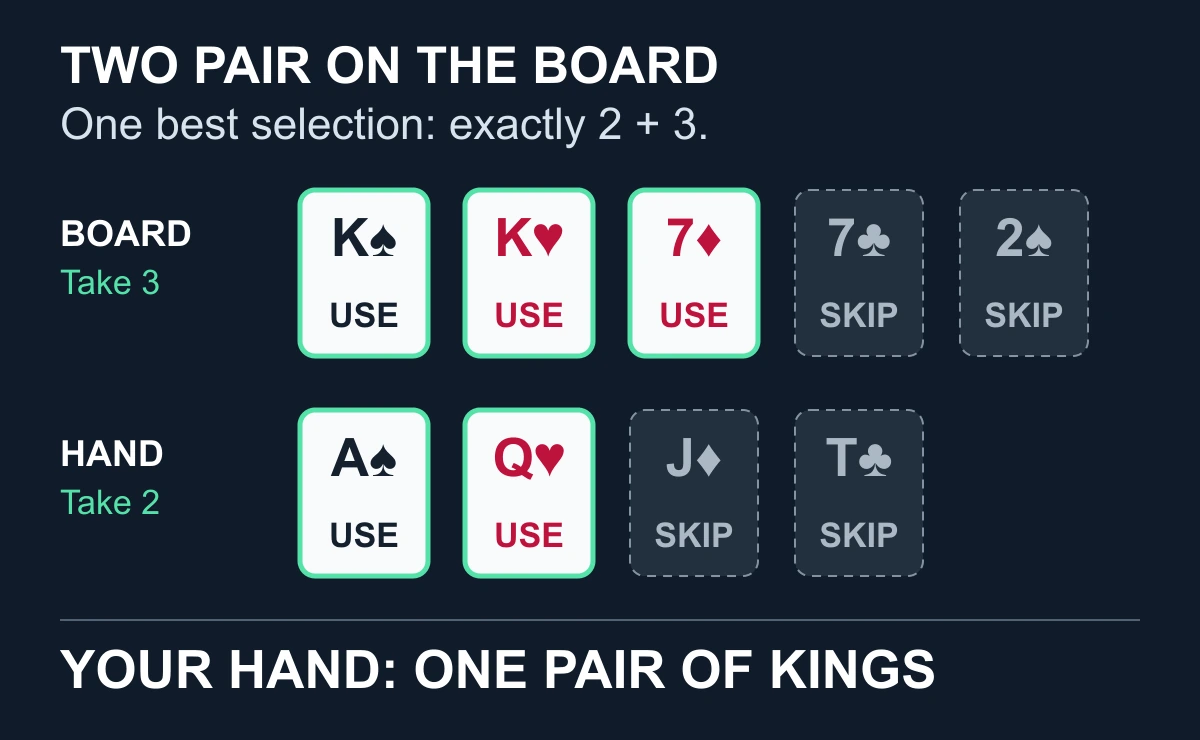
A paired board does not give every Omaha player the hand printed on the table. You must build your best five-card hand using exactly two hole cards and exactly three board cards. On a board with two pairs, you can finish with just one pair. Even four kings on the board do not give you four of a kind.
This reference works through eight constructed four-card PLO hands on completed boards. Each example names the five cards that count. Read the four hole cards first, choose your best hand, then check the two selected hole cards and three selected board cards. The examples are separate constructed deals, except for the compatible showdown comparison at the end. They use ordinary Omaha high and a standard 52-card deck; they are hand-reading examples, not betting recommendations.
Count the selected cards, not the pairs you can see
The PokerStars Omaha rules specify the two-hole-card, three-board-card construction. Christchurch Casino's poker rules independently describe the same requirement. You cannot play all five community cards or use one hole card with four board cards.
Once you have a legal five-card selection, apply the standard high-hand rankings. A full house needs three cards of one rank and two of another inside those five cards. Seeing those groups somewhere among your nine available cards is insufficient.
In the examples, hole identifies the two selected private cards and board identifies the three selected community cards. Other cards remain available when searching for a better selection, but they do not contribute to the displayed hand.
Two pairs on the board can leave you with one pair
Board: K♠ K♥ 7♦ 7♣ 2♠
Example 1: One pair: kings
Your four cards: A♠ Q♥ J♦ T♣
Select from your hand: A♠ Q♥
Select from the board: K♠ K♥ 7♦
Best five: K♠ K♥ A♠ Q♥ 7♦
You cannot keep both board pairs: K-K-7-7 would require four community cards. Your best legal selection keeps the kings and uses your ace and queen as kickers. The seven is the final kicker.
Example 2: Two pair: aces and kings
Your four cards: A♠ A♥ Q♦ J♣
Select from your hand: A♠ A♥
Select from the board: K♠ K♥ 7♦
Best five: A♠ A♥ K♠ K♥ 7♦
The pocket aces change the answer. Select both aces from your hand and K-K-7 from the board. The result is aces and kings with a seven kicker. Counting “three pairs” across the hole cards and board would miss the task: only the strongest legal five-card hand counts.
Matching one board rank is different from matching both
The same board: K♠ K♥ 7♦ 7♣ 2♠
Example 3: Three of a kind: kings
Your four cards: K♦ A♠ Q♥ J♣
Select from your hand: K♦ A♠
Select from the board: K♠ K♥ 7♦
Best five: K♠ K♥ K♦ A♠ 7♦
The king in your hand combines with both board kings for trips. Keeping K-7-7 from the board instead would give you only two pair, kings and sevens, with an ace kicker. Trips rank higher, so that tempting two-pair selection loses to your own better hand.
Example 4: Full house: kings full of sevens
Your four cards: K♦ 7♥ A♠ Q♣
Select from your hand: K♦ 7♥
Select from the board: K♠ K♥ 7♦
Best five: K♠ K♥ K♦ 7♦ 7♥
Now the selected hole cards supply both a king and a seven. K-K-7 from the board completes kings full of sevens. You can also construct sevens full of kings by taking K-7-7 from the board, but the kings-full version wins the comparison: a full house is ranked by its three-of-a-kind component first.
A full house on the board is not automatically your full house
Board: K♠ K♥ K♦ 7♣ 7♦
Example 5: Three of a kind: kings
Your four cards: A♠ Q♥ J♦ T♣
Select from your hand: A♠ Q♥
Select from the board: K♠ K♥ K♦
Best five: K♠ K♥ K♦ A♠ Q♥
Using K-K-K from the board and A-Q from your hand leaves trips with two kickers. The board's sevens cannot come along as a pair because all three board-card slots are already occupied.
Example 6: Full house: kings full of aces
Your four cards: A♠ A♥ Q♦ J♣
Select from your hand: A♠ A♥
Select from the board: K♠ K♥ K♦
Best five: K♠ K♥ K♦ A♠ A♥
With two aces in your hand, K-K-K plus A-A is legal. You have kings full of aces, not the kings full of sevens visible on the board. These examples use specific hole cards; “a pocket pair makes a full house” is not a universal maximum-hand rule. Holding the two remaining sevens on this board would let you make four sevens with a king kicker.
Four of a kind on the board still uses only three board slots
Board: K♠ K♥ K♦ K♣ 2♠
Example 7: Three of a kind: kings
Your four cards: A♠ Q♥ J♦ T♣
Select from your hand: A♠ Q♥
Select from the board: K♠ K♥ K♦
Best five: K♠ K♥ K♦ A♠ Q♥
All four kings are community cards. You can select only three, so this hand has three kings with ace-queen kickers. The fourth board king is excluded; it is not an extra card that upgrades trips to quads.
Example 8: Full house: kings full of aces
Your four cards: A♥ A♦ Q♣ J♠
Select from your hand: A♥ A♦
Select from the board: K♠ K♥ K♦
Best five: K♠ K♥ K♦ A♥ A♦
The pocket aces again provide the pair for a full house. The final two examples have no overlapping hole cards, so they can also be compared as one legal showdown. Against example 7 on this board, example 8 wins: kings full of aces beats three kings. A dramatic board does not make the pot an automatic split.
A short way to check your own selection
Start by naming the two hole cards you want to use, then the three board cards that complete the hand. Keep that selection visible while naming its rank: it prevents a discarded card from quietly re-entering your explanation. Check the category and all relevant kickers. Try the other hole-card pairs before declaring the maximum: finding a legal hand is only the first step.
Four hole cards offer six unordered pairs; a completed five-card board offers ten unordered triples. That gives 6 × 10 = 60 legal selections to compare. Several can tie for your best value, such as choosing which three of the four board kings to use in example 7. The displayed selection is one valid best hand, not necessarily the only one.
For an off-table exercise, cover the answers above and write “hole: two cards; board: three cards; final hand: five cards.” Then uncover the selection. If your answer differs, check whether you used too many board cards, chose a weaker legal hand, or missed a kicker. Our hand-rankings guide covers the broader category and tie-break rules.
Identifying your hand does not tell you an opponent's hand or what action to take. These examples do not model ranges, pot size, position, stack depth, rake, future cards or betting. A different question—whether a currently shared straight stays a split across future runouts—is covered in the PLO freeroll examples.
Check the examples and continue learning
The downloadable eight card configurations and results CSV preserve every displayed card and hand. The Python checker evaluates all 60 legal selections per case, checks the displayed selection, and tests whether relabeling every suit consistently preserves the result. The method and reproduction instructions explain the scope and commands. No random sampling is involved.
For structured follow-up, PLO Gecko includes lessons and quizzes on PLO versus Hold'em, as described in its current App Store listing. It is made by GTO Solutions, the team behind this site. The examples here are original editorial exercises; they are not app screenshots or a claim that these exact eight drills appear in the app. The PLO learning path places hand construction before starting-hand and strategy study.
Rules and product sources checked September 6, 2026. Scope: four-card Omaha high with a completed board, not Omaha Hi/Lo, Short Deck, or an assessment of profitable play.