
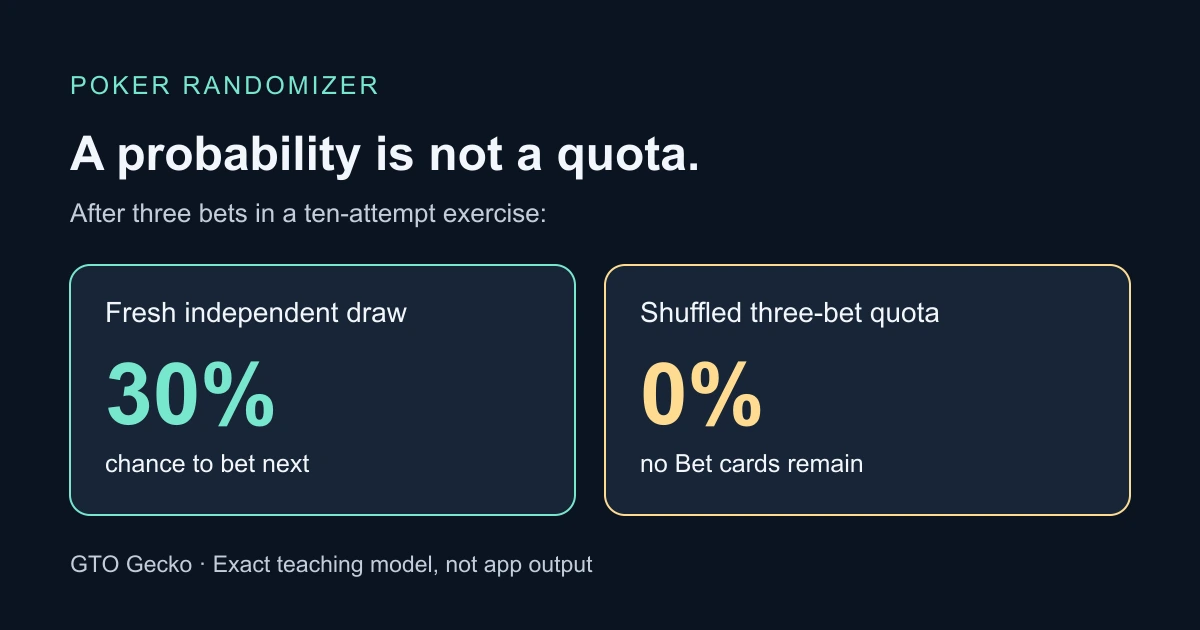
To execute a 30% betting frequency, give each eligible attempt a fresh 30% chance of betting. With a uniform random integer from 1 to 100, one valid rule is “bet on 1–30; check on 31–100.” Set the rule before drawing, use the first draw, and keep the same probabilities when the decision is unchanged.
That does not mean you must bet exactly three times in the next ten attempts. In our exact teaching calculation, independent 30% draws produce precisely three bets only 26.68% of the time. A shuffled pack containing three “Bet” cards and seven “Check” cards guarantees the count, but changes the chance of the next action as cards are used.
This guide is an off-table practice exercise: how to execute a frequency you have already chosen. A randomizer does not tell you whether that frequency is a good poker strategy.
First identify what the percentage describes
A solver frequency can describe an action for one exact hand at a particular decision point. It can also be an aggregate across a range. Those are different inputs. If a range bets 30% overall, some hands might bet every time and others never; you cannot assign 30% to every hand from that aggregate alone.
PioSOLVER’s official explanation of strategy and EV defines action probabilities for a particular hand at a node. Use our guide to reading solver output if you still need to identify the relevant hand, action or decision.
For the examples below, “another attempt” means another practice execution of the same supplied policy. The 30% number is synthetic; it is not a recommendation for a particular Omaha or Hold’em hand. A different board, hand, stack or action history may require a different policy. Updating for relevant poker information is different from increasing the betting chance because the last few random draws said “Check.”
Map the actions before you draw
A random number generator, or RNG, supplies a number. Your interval rule turns that number into an action. Poker training tools use this approach; for example, GTO Wizard’s trainer documentation describes RNG-based action selection. The mapping below is our own teaching convention, not a claim about any app’s default ordering.
All endpoints are inclusive. On a narrow screen, scroll the table horizontally if needed.
| Supplied policy | Integer interval | Action |
|---|---|---|
| 30% bet / 70% check | 1–30 | Bet |
| Same two-action policy | 31–100 | Check |
| 40% small / 35% large / 25% check | 1–40 | Bet small |
| Same three-action policy | 41–75 | Bet large |
| Same three-action policy | 76–100 | Check |
For the three-action example, 40 means small, 41 means large, 75 still means large, and 76 means check. Every possible integer belongs to exactly one action. You may reverse the ordering if you prefer; preserve the interval sizes and commit to the convention before seeing the number.
Synthetic completed practice entry: “My supplied policy is 40% small, 35% large, 25% check. I recorded the intervals above before drawing. My first number was 73, so I selected Bet large. Execution: correct, because 73 is in 41–75. Strategy review: still separate; this record does not show that the supplied policy was right for the spot.”
Check the generator’s endpoints. Integers 0–99 also give 100 outcomes, but inclusive integers 0–100 give 101. “Bet on 0–30” would select 31 of those 101 outcomes, about 30.69%, rather than 30%. A 1–100 integer map also has one-percentage-point steps: it cannot reproduce 33.3% exactly. A uniform 1–1,000 map can assign 333 outcomes to that number, but extra randomizer precision does not establish extra solver accuracy. If you round a displayed mix, record the rounded policy you are actually practicing.
The procedure assumes that each integer is equally likely and fresh draws are independent. Merely displaying a number does not establish either property. Avoid rerolling because you dislike the selected action or moving the cutoff after seeing the number; both change how actions are selected. A pure 100% action needs no random draw.
A short run does not owe you the target count
For ten independent attempts with a fixed 30% Bet probability, the expected count is three. “Expected” is a probability-weighted average across possible blocks, not a required result for each block. The NIST binomial formula gives the chance of exactly three:
120 × 0.3³ × 0.7⁷ = 0.266827932, or about 26.68%.
There are 120 placements for three bets among ten attempts. Each such sequence has three Bet factors of 0.3 and seven Check factors of 0.7. Adding them gives the result. Zero bets occurs with probability 0.7¹⁰, about 2.82%. These figures come from an exact model, not a test of a commercial randomizer.
If the first three draws all produce checks, the next draw still has a 30% Bet chance under this procedure. If they all produce bets, the next chance is also 30%. You do not need to “catch up” after checks or “save” remaining bets after a streak.
Review whether you followed the mapping on each attempt. A streak alone does not distinguish normal variation from a faulty generator or an execution error. For example, a recorded roll of 73 followed by Check under our three-action map is an execution error regardless of the recent action count. If your question is instead how much an observed opponent statistic tells you about an unknown tendency, see poker stat sample size.
Why a shuffled quota is a different procedure
Now make ten cards: three labeled Bet and seven labeled Check. Shuffle them uniformly and draw without replacement. Even this randomized quota has a 30% Bet chance at each numbered position before any cards are seen. However, once you observe earlier cards, its remaining composition matters.
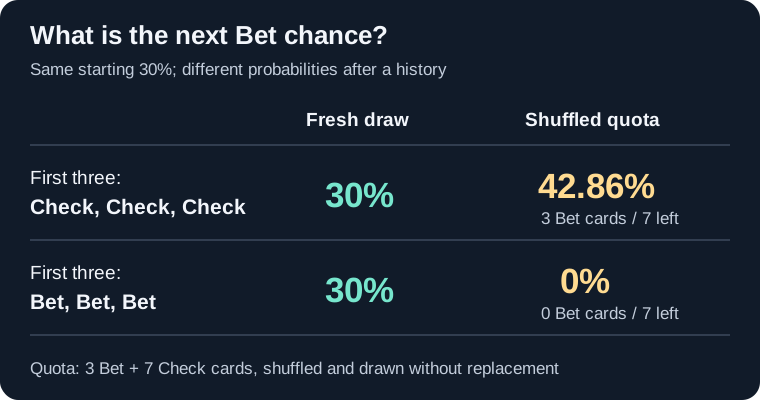
After three checks, all three Bet cards remain among seven cards: the next Bet chance is 3/7, about 42.86%. After three bets, no Bet cards remain: the next chance is zero. More generally, after t draws containing b bets, the remaining chance is (3 − b) / (10 − t), for a possible history with fewer than ten draws. The shuffle was random; the later draws are still dependent because the cards are not replaced.
The table compares the same two teaching policies after specified histories. “Previous attempts” are within the known ten-attempt block.
| Observed previous attempts | Fresh independent draw | Shuffled three-bet quota |
|---|---|---|
| None | 30% | 30% |
| First three all Check | 30% | 42.86% (3/7) |
| First three all Bet | 30% | 0% |
| First nine: two Bets, seven Checks | 30% | 100% |
| First nine: three Bets, six Checks | 30% | 0% |
Diagram: the first-three-action comparison from the table. Scroll horizontally on a narrow screen.
What an observer could predict in this toy exercise
Suppose an observer knows the policy, the block boundary and every previous action, but cannot see the next draw or the remaining shuffled order. The observer guesses whichever next action is more likely. For fresh 30% draws, guessing Check succeeds 70% of the time at every position. For the shuffled quota, that rule succeeds 74.67% on average across the ten positions; at the final position it succeeds 100%, because the remaining card is determined.
Our exact results contain the position-by-position calculation. This is action-prediction accuracy, not poker win rate, EV loss or measured exploitability. Real opponents do not usually observe your private hand or know which actions belonged to repeated eligible practice decisions. The exercise demonstrates conditional dependence, not a claim that someone can exploit a particular player for a measured amount.
A compact execution check for your next study session
- Record the input. Write the exact decision, the supplied action frequencies and any rounding. Keep range-wide percentages separate from the hand you are practicing.
- Audit the intervals. Confirm the endpoints, count each action’s integers and check for gaps or overlaps. The downloadable 100-row mapping sheet lists every outcome in our two examples.
- Draw once and follow the mapping. Log the number and the selected action. When reviewing execution, check the row that applied; do not grade it by whether your last ten actions look balanced.
- Review the strategy separately. If the chosen frequency seems wrong for the spot, revisit the solve or your assumptions. Correct execution of a poorly chosen policy is still poor strategy.
For off-table Omaha practice, PLO Gecko includes RNG dice for mixed-strategy training, as described in its official App Store listing. Use the app’s displayed action intervals when practicing there. PLO Gecko is part of GTO Solutions, the team publishing this article. Our model is not a measurement of the app’s random generator or a description of its rounding algorithm.
Method, downloads and limits
We enumerate all 1,024 binary sequences of length ten. Under the independent policy, a sequence with k Bets receives weight 0.3ᵏ × 0.7¹⁰⁻ᵏ. Under the quota policy, the 120 sequences with exactly three Bets each receive weight 1/120; all others receive zero. We sum exact rational weights, then round percentages only for display. There is no sampling seed or Monte Carlo error.
Download the reproduction instructions, complete weighted sequence CSV, JSON summaries, Python generator, independent Node verifier and file checksums. The verifier uses combinatorial formulas and checks the exported sequences and all 100 interval assignments. Philip Stark’s probability notes give the mathematical background for independent Bernoulli draws and sampling without replacement.
This calculation contains no dealt poker hands, betting tree, stack depth, position, rake, tournament payout or opponent response. It does not establish an equilibrium strategy, a cost of simplifying a solve, a product’s RNG quality, or a general requirement that every possible strategy implementation use independent draws. It checks this specific fresh-draw procedure against this specific finite quota.
Primary documentation and official product evidence checked September 5, 2026. Product features can change. This walkthrough concerns off-table study and makes no claim about permission to use outside tools during play.