

Being pot committed does not mean your earlier chips force you to continue. It means the current price and the remaining decision tree may make continuing better than folding. Judge the next continue-or-fold choice from the point where you are making it. Chips already in the pot affect its present size, but they do not earn an ownership bonus because you supplied them.
That does not make action history irrelevant. The line can change the range your opponent represents, the effective stack, who may still act, which pots you can win, the rake still to be taken, and whether you should measure chip EV or tournament prize EV. Those effects belong in the current state. “I already put in too much to fold” does not.
Scope: the reproducible examples below are constructed chip-EV models, not observed hands, solver output, or player-pool estimates. The main A/B/C comparison is a heads-up river call that closes action, has no remaining rake or ties, and awards Hero the whole eligible pot on a win. Exact range and equity estimates remain your responsibility.
What Does “Pot Committed” Mean in Poker?
“Pot committed” has no formal percentage or universal threshold. In common strategy talk, it is informal emphasis that folding looks clearly inferior under plausible current inputs—not a separate mathematical category. The formal rule is to compare the expected value of every legal continuation with folding from the current decision point. Continuing may dominate because the pot is large relative to the next call, your equity is sufficient against the conditional range, or little future action remains. It does not dominate merely because you have invested half a stack, and an ordinary profitable call does not need the label.
The emotional pull of a large earlier investment has a name outside poker. Arkes and Blumer's 1985 experiments described the sunk-cost effect: prior money, effort, or time can increase the tendency to continue. A later meta-analytic review reported significant heterogeneity and decision-type dependence. Neither source studied poker. They help name a decision hazard; they do not prove how a particular player thinks or plays.
The poker fix is mechanical: freeze the decision point, write down what can still change, and compare legal actions from there.
The Current-State Test
For a call that ends the betting, let P be every chip in the eligible pot before you act, including the opponent's current bet. Let C be the additional amount you must call now, and let q be your equity against the range that reached this exact action.
Closed-action call
final pot if you call = P + C
EV(call) = q × (P + C) − C
incremental EV(fold) = 0 after using folding as the comparison baseline
required equity = C / (P + C)
If ties are possible, include the appropriate fractional share in q—one half in a two-way tie, one third in a three-way tie, and so on. If you cannot win every chip in the middle, use only the pot for which you are eligible. This is the same price logic developed in our pot-odds guide; the new question here is which facts belong on each side of the decision point.
A practical current-state record has seven fields:
- Eligible pot now: the chips you can actually receive, including the current bet.
- Incremental price: the additional chips required for this action—not your total investment in the hand.
- Cards and conditional ranges: your equity against the range implied by this line, not against an opening range or one remembered hand.
- Effective stacks and future branches: whether more betting, folding, value, or reverse implied odds remain.
- Action rights: who may still act, whether action is reopened, and whether a raise is legal.
- Remaining charges: rake, drop, or other deductions not already removed.
- Objective: cash-game chip value or a tournament prize-value model such as ICM.
Earlier action matters only through facts like these and through your separate whole-hand review. It is not an eighth field called “my share of the pot.”
Two Different Histories, One Identical Call
Consider the fixed river board K♠9♠6♦3♣2♥. Hero holds K♦Q♦. The constructed A/B betting range contains seven legal ace-king combinations that beat Hero and three missed-spade bluffs—A♠Q♠, Q♠J♠, and J♠T♠—that Hero beats. With equal combination weights and no ties, Hero's exact equity is 3 / 10 = 30%.
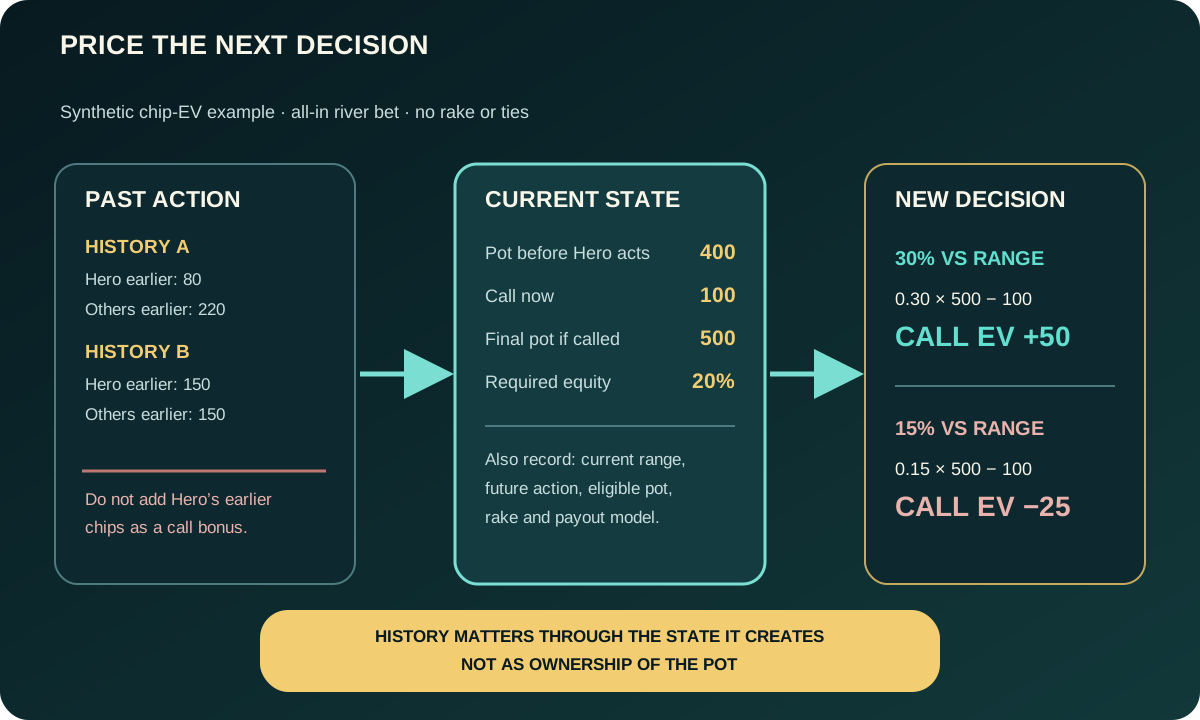
Both legal chip histories end at the same river state: Villain's 100-chip bet is all-in, the pot before Hero acts is 400, calling costs 100, the final pot would be 500, and Hero has 1,000 chips behind before deciding. The break-even threshold is 100 / 500 = 20%.
Narrow screen? Scroll the table horizontally to reach the pot, call, equity, and EV columns.
| History | Hero earlier | Others before current bet | Opponent bets now | Pot now | Call now | Equity | Incremental call EV | Expected whole-hand result if called |
|---|---|---|---|---|---|---|---|---|
| A: multiway dead money | 80 | 220 | 100 | 400 | 100 | 30% | +50 | −30 |
| B: heads-up contributions | 150 | 150 | 100 | 400 | 100 | 30% | +50 | −100 |
History A starts nine-handed at 10/20: all nine players contribute 20, Hero bets 60 on the flop, Villain calls, and seven players fold. History B starts heads-up at 25/50: Villain completes the small blind to 50 and Hero checks the big blind; Hero checks the flop, Villain bets 100, and Hero calls. Both turns check through; Hero checks the river; Villain uses the remaining 100 as the all-in bet. Different starting stacks leave Hero with the same 1,000-chip current stack. The public case file records every contribution and exact two-card combination.
In either history, the expected gross receipt after calling is 0.30 × 500 = 150. Subtract the new 100-chip call and the incremental call EV is +50. History A loses 80 by folding and expects to finish the whole hand down 30 after calling: the call improves the result by 50. History B loses 150 by folding and expects to finish down 100 after calling: again, the improvement is 50.
The whole-hand results differ because Hero invested different amounts earlier. The current choices do not differ because every decision-relevant input is now the same. A negative whole-hand result can still contain a positive current call; calling does not have to recover the hand to zero to beat folding.
Narrow screen? Scroll the diagram horizontally to view all three panels.
When History Really Does Change the Decision
Now keep the same cards, 400-chip visible pot, 100-chip call, and 1,000-chip current Hero stack, but change the prior line. In History C, Villain raises the small blind to 150 preflop and Hero calls from the big blind; the flop and turn check through, Hero checks the river, and Villain moves all-in for 100. The exercise assigns that line a more value-heavy twenty-combination betting range: eight ace-king combinations, all three combinations of each available set of nines, sixes, and threes, and the same three bluffs. With equal weights, Hero now wins 3 of 20 combinations, or 15%.
EV(call) = 0.15 × 500 − 100 = −25 chips
Folding is better in that model. History mattered because it changed the conditional range, which changed current equity. It did not matter because the pot remembered who contributed what.
This is the important distinction behind hand reading. Do not erase the earlier line. Translate it into current evidence: which value hands, bluffs, draws, and sizings remain plausible after each action? Then price the decision against that range. The 30% and 15% range equities sit on opposite sides of the same 20% threshold. The physical hands and equity counts are exact for the listed combinations, but the ranges and their equal weights are teaching assumptions—not claims about equilibrium or a player pool.
Why Current Pot Odds Can Still Be Incomplete
The compact formula works only when the call closes action and realizes the stated equity. On an earlier street, an open tree can change the value even when the immediate pot and price are identical.
Take another synthetic model. Hero checks a turn, and Villain bets 100 into 200. The pot is 300 before Hero acts, the call costs 100, and a call makes the pot 400. On the river, Hero checks. Villain checks back 40% of the time, against which Hero has 50% equity, and bets 200 the other 60%, against which Hero has 10% equity.
- One-step proxy: pooling the branch equities gives
0.40 × 0.50 + 0.60 × 0.10 = 26%. Treating that as fully realized would give0.26 × 400 − 100 = +4. - River bet branch: calling 200 would make an 800-chip final pot, so Hero needs 25% equity. With 10%, the river call EV is
0.10 × 800 − 200 = −120; Hero folds. - Declared call-then-check tree:
−100 + 0.40 × 0.50 × 400 + 0.60 × 0 = −20.
The proxy values the modeled turn call at +4; the declared call-then-check tree values that call at −20 against folding. It fixes Hero to call and then check, with only call or fold against one river bet; it does not evaluate a turn raise, river lead, or river raise, so it does not prove folding is best among every legal line. This is not a forecast or recommended strategy—the branch frequencies and conditional equities are constructed inputs. It shows why a pooled equity number can be misleading when future action selects different ranges and creates a new price.
Low SPR Is Evidence, Not an Automatic-Call Rule
A low stack-to-pot ratio (SPR) often makes decisions simpler because fewer chips and branches remain relative to the pot. It can widen profitable continuing ranges. It cannot turn zero equity into enough equity, make an ineligible side pot yours, or convert a poor prize-EV call into a good one.
There is no universal rule such as “below 1 SPR, never fold” or “once half your stack is in, call.” Even at very low SPR, a hand with too little equity against the current range should fold if folding is legal and has higher EV. At a higher SPR, a call can still be best when current equity, position, future realization, and the available branches support it.
Use SPR as a state variable that changes the tree, not as a label that decides the tree for you.
Five Cases That Need More Than the Simple Formula
- Future betting remains. Model plausible later bets, folds, raises, and realization instead of treating raw equity as guaranteed receipt.
- The pot is multiway or contains side pots. Count only chips Hero can win. Our side-pot EV guide shows the separate eligibility ledger and uses the same incremental decision baseline.
- Rake or a drop remains. Use the net eligible pot after any incremental charge under each action; do not subtract money already removed a second time.
- Tournament chips are not linear prize value. A positive chip-EV call can differ from the best prize-EV choice under ICM, especially near large payout changes.
- Action rights are unusual. An all-in, short raise, player behind, or reopening rule can add or remove branches. Record what is actually legal before doing the arithmetic.
In every case, keep the time boundary honest. In the closed-action chip model, we subtract the value of folding from both choices and call that incremental baseline zero; we do not claim the player's stack or tournament equity becomes worthless. Earlier losses still belong in session records and hand review, but they cancel when comparing actions that share the same past. Under ICM, compare the prize EV of calling with the prize EV of folding rather than importing the chip formula unchanged.
A Five-Question Pot-Commitment Audit
- Where is “now”? Mark the exact point before any new chips leave your stack.
- What can I receive? Record the eligible pot now, the incremental price, and the final pot if this action closes betting.
- What range reached this action? Convert the line, sizing, cards, and player evidence into a conditional range; then estimate equity against that range.
- What branches remain? Include players behind, legal raises, future streets, remaining stacks, rake, and possible folds before showdown.
- Which EV am I optimizing? Compare chip EV in an ordinary cash-game model or prize EV in a tournament model—do not slide between them.
For study, write the state before looking at an answer. Compute the closed-action threshold where it applies, then inspect the relevant range and branches. The current US Apple App Store and Google Play listings describe GTO Gecko as an educational product for reviewing precomputed preflop and postflop ranges and strategies, practicing simulated decisions with feedback, and reviewing study progress. Where a comparable library spot is available, use it for this drill; do not assume the product contains either constructed example or accepts an arbitrary custom node.
Disclosure: GTO Solutions AS publishes both this article and GTO Gecko. The examples demonstrate declared arithmetic, not an outcome promise or evidence that using a study product improves poker results.
Pot-Committed FAQ
- Does putting half my stack in mean I have to call?
- No. Your earlier contribution affects the pot and remaining stack, but the next call still needs to beat folding from the current point. Use the current price, eligible pot, range, equity, and remaining branches.
- Can I be pot committed and still expect to lose the hand?
- Yes. A call can be positive EV relative to folding even when it loses most of the time or leaves the whole hand negative in expectation. In History B, the modeled call improves the result by 50 chips while the expected whole-hand result remains −100.
- Is there an SPR number where folding is always wrong?
- No universal SPR cutoff decides every range, board, price, rake structure, action tree, or payout model. Low SPR is useful context, not a proof.
- Should I ignore how the hand was played?
- No. Use the earlier line to update conditional ranges, remaining stacks, action rights, eligible pots, and other current facts. Ignore only the idea that your own sunk chips deserve special protection.
- Are pot odds enough before the river?
- Not necessarily. When betting remains, implied value, reverse implied costs, future folds, range changes, and equity realization can make the complete tree differ from a closed-action shortcut.
Sources, Data, and Reproduction
- Hal R. Arkes and Catherine Blumer, “The Psychology of Sunk Cost”, Organizational Behavior and Human Decision Processes, 1985. Publisher record accessed September 4, 2026.
- Stefan Roth, Thomas Robbert, and Lennart Straus, “On the sunk-cost effect in economic decision-making: a meta-analytic review”, Business Research, 2015. Open publisher article accessed September 4, 2026.
- GTO Gecko: Poker Study on the Apple App Store and Google Play. Product descriptions accessed September 4, 2026.
- GTO Gecko, current-state cases, formulas, assumptions, and text equivalent (JSON), plus an independent standard-library verifier (Python). Generated September 4, 2026.
The Node generator recomputes the arithmetic and writes the public data and diagram. The independent Python verifier additionally checks card legality, enumerates every listed seven-card matchup, and recomputes the contribution ledgers, 20% threshold, +50/+50 paired-history result, −25 range-information counterexample, and +4-versus−20 future-tree reversal. Download both public data files into one folder and run python pot-committed-current-state-verifier.py. A pass confirms internal consistency with the declared inputs; it cannot estimate a real range, prove a solver strategy, or decide a live hand.