
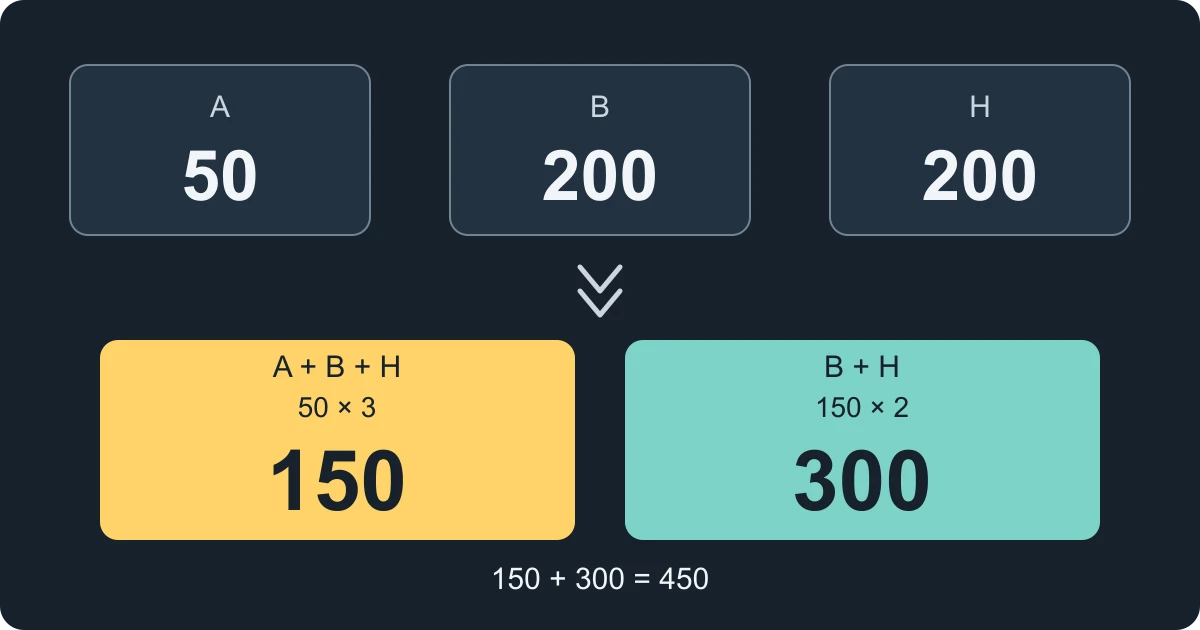
For every side pot, separate its size from the players eligible to win it. When reviewing a call, calculate equity (expected share) separately too. Multiplying the total pot by your chance of beating both opponents misses outcomes where you lose the main pot but win the side pot.
We first divide contributions of 50, 200 and 200 chips, then check every one of 42 possible rivers in a fully specified hand. This is an off-table study exercise. The examples are constructed to explain the accounting, not observed hand histories or player data.
If the disputed hand includes one or more incomplete all-ins, settle the action sequence before building pots. Our short-all-in reopening ledger tracks raise rights player by player; this page begins only after every action and contribution is known.
Disclosure: GTO Gecko publishes this article. Felted, discussed below, is also a GTO Solutions AS product. We calculated the results independently for this article; they are not app-performance or earnings data.
50, 200 and 200 Chips Make a 150 Main Pot and a 300 Side Pot
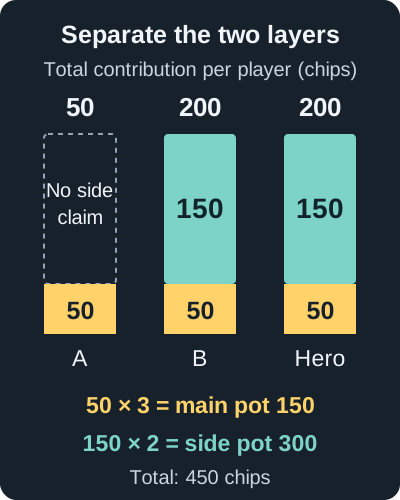
Suppose A contributes 50 chips to the whole hand, B contributes 200, and you contribute 200. A is all-in and nobody has folded. Assume no ante or rake. These totals include chips already posted or bet, including the blinds.
- Main pot: 50 × 3 players = 150 chips. A, B and you are eligible.
- Side pot: (200 − 50) × 2 players = 300 chips. Only B and you compete for it.
Even if A has the strongest hand, A can receive only the 150-chip main pot. Compare B's hand with yours for the other 300 chips. PokerStars' official explanation establishes contributor eligibility for a side pot. Zynga's Japanese help page provides another unequal-contribution example.
A Worksheet for Reconstructing a Hand
- Write each player's whole-hand contribution. This is not just the current street's bet or the remaining stack. Keep folded players' contributions.
- Sort the contribution levels, starting from zero: 0 → 50 → 200. Multiply each interval's height by the number of players who contributed at least its upper limit.
- List the eligible players for each pot. They contributed at least that interval's upper limit and have not folded.
- Return an unmatched top layer. An amount contributed by only one player is uncalled excess, not a contested pot.
- Reconcile the total. All pots plus all refunds must equal all original contributions.
With contributions of 50, 120 and 200, the layers are 50 × 3 = 150, then (120 − 50) × 2 = 140. The final 200 − 120 = 80 is returned. 150 + 140 + 80 = 370 chips, matching 50 + 120 + 200. After excluding uncalled returns, adjacent contested layers with the same eligible players can be combined.
To use this method on your own hand, copy the plain-text review worksheet and enter contributions, fold status and each pot's participants. Use this record for each pot:
Fields to record for every pot
Pot size → eligible players → your equity → pot size × equity
Record unmatched refunds and the extra call cost separately. Where an opponent's hand is unknown, also record the assumed range and why you chose it.
One Hand, Two Different Equities
Equity is your expected fraction of a particular pot after the remaining cards are dealt. It includes your share of ties, not just outright wins. Side pots change the set of hands you must beat.
A constructed turn example: No-Limit Hold'em, one board
Board: J♣ 7♦ 2♠ 4♥
A (SB): A♠ A♥
B (BB): Q♠ Q♥
You (BTN): K♠ K♥
A is already all-in for a total of 50 chips. B and you have each contributed 50 and each have 150 left. B shoves 150 on the turn; you face a 150-chip call. Calling closes all betting and creates the 150 main pot and 300 side pot.
This is a retrospective exercise with all hands known after the hand, not a claim that you can see AA and QQ when deciding. Ante and rake are zero; tournament payout equity is not modeled.
Six hole cards and four board cards are known. Excluding those ten known cards gives 52 − 6 − 4 = 42 possible river candidates. Both pots use that same set of cards.
On a narrow screen, scroll the tables horizontally.
| River | Cards | Main | Side | Chips you receive |
|---|---|---|---|---|
| K♣ or K♦ | 2 | You | You | 450 |
| Q♣ or Q♦ | 2 | B | B | 0 |
| Any other river | 38 | A | You | 300 |
A king makes your set win both pots; a queen makes B's set win both. On every other river, AA wins the main pot and KK beats QQ for the side pot. If you need to check the hand comparison, see our poker hand rankings reference.
Your main-pot equity is therefore 2 / 42 = 4.76%, while your side-pot equity is 40 / 42 = 95.24%. Being far behind in the main pot does not finish the calculation.
Call EV: Expected Receipts From Each Pot Minus the Extra Call
When calling ends the betting and fixes the pot sizes, add the expected receipts from each pot. The main- and side-pot outcomes do not need to be independent.
Expected chips received (including your contributed chips)
(2 / 42) × 150 + (40 / 42) × 300 = about 292.86 chips
Incremental call EV
292.86 − 150 = about +142.86 chips
Subtract the 150 chips you must pay now. Subtracting your earlier 50 again confuses the current call decision with the whole hand's net result. The current-state pot-commitment test isolates that distinction with two different histories that reach one identical call. The +142.86 here is incremental expected value relative to folding at this decision, not a guaranteed or literal payout.
If you fold, B's new 150 chips are uncalled and return to B. A and B contest the existing 150 main pot; your whole-hand net is −50 chips. If you call, your whole-hand expected net is 292.86 − 200 = about +92.86 chips. The difference, 92.86 − (−50) = about +142.86 chips, is the incremental value of calling now.
The incorrect shortcut uses your 4.76% chance of beating everyone for the whole 450-chip pot: (2 / 42) × 450 − 150 = about −128.57 chips. It omits all 38 rivers on which A beats you but you beat B and receive 300 chips.
Check the Side-Pot Break-Even Point
Holding main-pot equity at 2 / 42, zero call EV requires side-pot equity of (150 − (2 / 42) × 150) / 300 = 10 / 21 ≈ 47.62%. Subtract the expected main-pot receipts from the extra call, then divide by the side pot. The 40%, 50% and 60% rows below are hypothetical sensitivity inputs, not results for the actual hands above or solver output.
| Side-pot equity | Incremental call EV |
|---|---|
| 40% (hypothetical) | −22.86 chips |
| 50% (hypothetical) | +7.14 chips |
| 60% (hypothetical) | +37.14 chips |
| 40 / 42 ≈ 95.24% (worked hand) | +142.86 chips |
Folded Chips, Ties and Refunds
Folded Contributions Do Not Disappear
Add a player D who contributed 100 chips and then folded to the original 50/200/200 example. The main pot becomes 50 × 4 = 200 chips, and the remaining side pot is 350 chips. D's 100 stays in the pots, but D cannot win either. A player cannot fold just the side pot while retaining a live claim to the main pot.
Split Each Pot Independently
Consider a different showdown with the original 150/300 pots. If A is strongest and B and you have equally strong hands, A receives the main pot's 150, while B and you divide the 300 side pot into 150 each. Poker TDA Rule 21 requires separate side-pot splits. Physical odd chips follow the applicable event or house rule. Our odd-chip settlement example shows how the smallest denomination and button position can give tied winners different total receipts from separate pots. Fractions in an expected-value calculation do not mean physically dividing a chip into fractions.
Separate Uncalled Excess From Matched Chips
Only the uncalled excess is returned. Folding later does not refund chips already matched by another player. TDA Rules 15B and 65A distinguish these amounts.
Where This Model Stops
- Unknown opponents require ranges. A result against precisely AA and QQ is not a call instruction against an unknown opponent.
- Keep A's known cards out of the side-pot deck. Removing A from the eligible winners does not put A♠ and A♥ back into the deck. Simply deleting A from a heads-up calculator changes the conditions.
- Future betting needs a fuller model. Future costs, folds and paths that enlarge the pots are absent here. When no side pot exists yet and two live players can still bet, use our dry-side-pot decision tree to separate check, bet/fold and bet/call settlements.
- Chip EV is not prize EV. ICM, bounties and rake are not part of this calculation. Multiple boards require separate settlement rules; our exact run-it-twice EV and variance study isolates the simpler heads-up, one-pot case.
- Antes and unusual rulings need separate treatment. Do not enter a pooled payment such as a big-blind ante as an ordinary personal bet in this worksheet.
Practice Reconstructing Contributions From Felted's Hand History
The Japanese App Store listing for Felted describes Texas Hold'em against AI and hand history with full action logs. On August 28, 2026, the listed version was 1.6.0 and its Languages field listed English and Spanish. Its chips have no cash value and cannot be cashed out.
Choose a completed practice hand, write each player's total contribution, then separate the pots and eligible players. This is manual work alongside the history, not a claim that the app lets you enter this exact scenario or calculates this article's side-pot EV. Our guide to building poker practice drills covers the wider study routine.
Use calculation tools away from the table. Follow the event's rules; our guide to solvers and real-time assistance explains the study-versus-play distinction.
Method, Data and Sources
We placed each of the 42 remaining cards on the river and evaluated all 21 five-card subsets of each player's seven cards. We then awarded the main and side pots separately. This is complete enumeration, not random sampling. A separate Python implementation checks the results, including settlement fixtures for refunds, folded contributions and ties.
- Every river and its pot winners (CSV). H denotes Hero; c/d/h/s denote clubs/diamonds/hearts/spades.
- Hands, contributions, results and sensitivity inputs (JSON).
- PokerStars: side-pot eligibility — accessed August 28, 2026.
- Zynga's official Japanese side-pot explanation — accessed the same day.
- Poker TDA: currently published 2024 rules — accessed the same day. Actual disputes follow the event's or room's rules.
- Felted, Japanese App Store — accessed the same day. Listing verification is not a hands-on test of all app features or Japanese UI support.
For one pot contested by everyone, pot size times your equity gives expected receipts. With side pots, identify each pot's size, eligible players and expected share separately. Those inputs show which assumption changes the answer.