
A dry side pot does not make every bet pointless. In our fixed river model, one bet loses 90 chips as a dead bluff, while the same 150-chip bet against the same ten-combination response range makes 30 chips when Hero can beat the all-in player after the live opponent folds. A third case adds 60 chips over checking by getting called by worse. The deciding question is not simply “Is the side pot empty?” It is which pot Hero can win in each response branch.
This article begins one decision before our side-pot calculation and call-EV guide. That guide covers contribution layers and already-created pots after action closes. Here, the current side pot is exactly zero, two players still have chips, and a fold or call changes both eligibility and settlement. Every card, response, and payoff is published in a reproducible casebook.
Disclosure: GTO Solutions AS publishes GTO Gecko and this article. The casebook is a separate synthetic chip-EV study, not a GTO Gecko production solution, player-data study, or claim that the app contains this exact node.
The Short Answer: Empty Does Not Mean Irrelevant
A side pot is “dry” in this article when, at the decision point, the two players who still have chips have placed no matched extra chips beyond the main pot. If Hero bets and Villain folds, the unmatched bet returns; there is still no side pot. If Villain calls, their two 150-chip wagers create a 300-chip side pot that only those two players can win. For the return convention, 2026 WSOP Rule 108 states that an uncalled bet or raise is returned in its hand-protection context; room and event procedures control an actual ruling.
PokerStars' official rules page says a side pot is created when one player is all-in and the others continue betting, and only contributors can win it. Poker TDA's current published 2024 rules require each side pot to be split separately. Those are settlement rules, not a recommendation to bet or check.
Scope: The numbers below are river chip EV. On a payout-sensitive bubble or final table, ICM and bounty value can change the decision even when the chip settlement is identical; see the separate ICM strategy guide.
- A dead river bluff cannot improve EV in the special model below. If Hero loses to the all-in hand even after Villain folds, the fold does not award Hero the main pot.
- An isolation bet can have value. If Hero beats the all-in hand but loses to Villain, folding Villain can move the main pot to Hero.
- A value bet can have value for the ordinary reason. A worse live hand can call and fund a new side pot.
- Earlier streets are different. On the flop or turn, betting can change future equity and future action; a river-only slogan is not a complete model.
One River State, Three Complete Branches
Freeze this No-Limit Hold'em river state. The board is K♣ 9♦ 7♠ 4♥ 2♣. One player is all-in with A♠9♣. The main pot is 300 chips. Hero and Villain both have at least 150 chips behind, but their current side pot is zero. Hero may check or bet 150; Villain may fold or call. Raises, rake, bounty value, tournament payouts, future cards, and prior-chip recovery are excluded.
Information boundary: A♠9♣ is revealed to the reader for a retrospective, full-state calculation. It is not a claim that Hero sees the all-in cards while action remains: Poker TDA Rule 16 and WSOP Rule 70 call for all-in cards to be tabled once the other betting action is complete. For a live decision, replace the fixed hand with an all-in range unless the hand is actually exposed and known.
To separate all-in exposure timing from the order of showing at an ordinary showdown, see our showdown-order casebook. Its paired action records identify when later betting remains possible.
The solid check branch reaches a three-player main-pot showdown. After a bet, a fold returns Hero's unmatched wager and removes Villain from main-pot eligibility; a call leaves the main pot three-way and creates a 300-chip side pot between Hero and Villain. The payoff table immediately below gives the same information without relying on the image. Narrow screen? Scroll the diagram horizontally to read each branch.
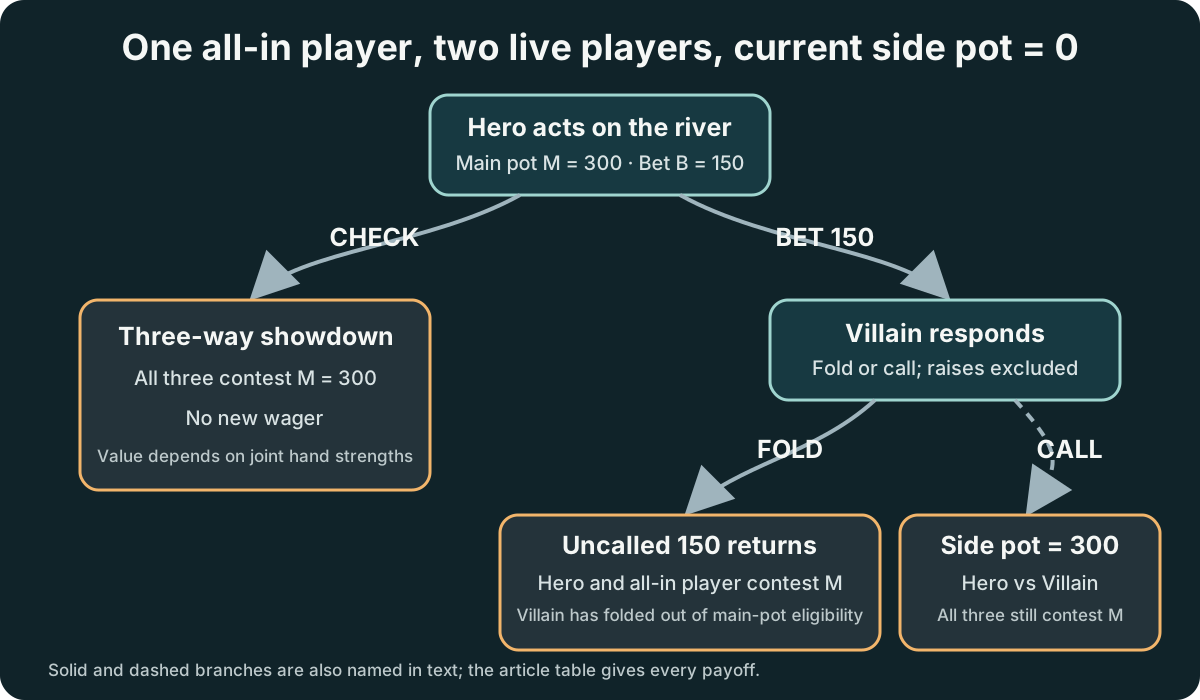
Narrow screen? Scroll horizontally to compare all three branches.
| Hero line | Current wager | Main-pot players | New side pot | Hero payoff counted |
|---|---|---|---|---|
| Check | 0 | Hero, Villain, all-in | 0 | Hero's share of 300 |
| Bet 150, Villain folds | 150 returns | Hero, all-in | 0 | Hero's share of 300 |
| Bet 150, Villain calls | 150 at risk | Hero, Villain, all-in | 300; Hero and Villain only | Main receipt + side receipt − 150 |
The payoff convention matters. A displayed +300 means Hero receives the 300-chip main pot from this decision onward. It is not whole-hand profit: Hero's earlier contribution helped build that pot and is already sunk. This is the same current-state discipline used in our pot-committed decision guide.
Case A: A Dead Bluff Loses 90 Chips
Give Hero Q♥J♥. Hero loses to the all-in player's pair of nines and to every Kx hand in Villain's ten-combination range. Villain calls the six KQ, KJ, and KT combinations and folds the four K8 and K6 combinations. Every combination has equal conditional weight. This response policy is a synthetic input, not a solver or population estimate.
Check: Villain's pair of kings wins the main pot in all ten branches. Hero receives 0.
Bet/fold, 4 of 10: Hero's 150 returns, but A♠9♣ still wins the main pot. Hero receives 0.
Bet/call, 6 of 10: Hero loses the main and side pots and loses the new 150-chip wager. Hero's payoff is −150.
Bet EV: (4 / 10 × 0) + (6 / 10 × −150) = −90 chips. Checking is better by 90.
The 40% fold rate does not make this bluff profitable. Folding Villain does not fold the all-in player, and Hero still cannot win the main pot. If Villain somehow folded 100%, betting would only tie checking because the wager would return and the all-in hand would still win.
Case B: The Same Fold Rate Makes 30 Chips
Change only Hero's hand to K♥5♥. Keep the board, all-in hand, Villain's exact ten combinations, 150-chip bet, and four-fold/six-call policy unchanged. Hero now beats the all-in pair of nines, but every Villain Kx combination has a higher kicker and still beats Hero.
Check: Villain wins the three-way main pot in all ten branches. Hero receives 0.
Bet/fold, 4 of 10: Hero's wager returns. With Villain gone, Hero beats the all-in hand and receives the 300-chip main pot.
Bet/call, 6 of 10: Villain beats Hero for both pots. Hero loses the new 150-chip wager.
Bet EV: (4 / 10 × 300) + (6 / 10 × −150) = 120 − 90 = +30 chips.
This is the controlled counterexample to “you can never bluff a dry side pot.” Hero's hand is not a conventional zero-showdown bluff: it has a live claim to the main pot once Villain folds. The bet buys a chance to isolate that claim. Whether the opponent really folds often enough is a separate range and strategy question.
The Break-Even Fold Formula
The paired cases generalize to a deliberately narrow formula. Assume Hero receives nothing after checking, loses every pot if called, and has expected share q of the main pot M conditional on Villain folding. Let f be the fold probability and B the bet:
EV(bet) = f × q × M − (1 − f) × B
Break-even fold frequency f* = B / (q × M + B), when q is greater than zero.
For Case B, q = 1, M = 300, and B = 150, so break-even is 150 / (300 + 150) = 33.33%. The declared 40% fold rate clears it. Case A has q = 0, so no fold rate below 100% can make the bet better than checking; at 100%, it merely ties. In a live information set, q is the expected fold-branch share against the all-in player's range, not a value read from concealed cards.
Narrow screen? Scroll horizontally to compare bet sizes and main-pot shares.
| Bet B | B / M | q = 25% | q = 50% | q = 75% | q = 100% |
|---|---|---|---|---|---|
| 75 | 1 / 4 pot | 50.00% | 33.33% | 25.00% | 20.00% |
| 150 | 1 / 2 pot | 66.67% | 50.00% | 40.00% | 33.33% |
| 300 | 1 pot | 80.00% | 66.67% | 57.14% | 50.00% |
Do not import this threshold into an unrelated hand. The formula assumes zero check value and zero called value, with q already conditional on the fold branch. If Hero sometimes wins when called, if checking has equity, or if the fold range changes Hero's main-pot share, use the full branch tree instead.
Case C: A Value Bet Adds 60 Chips
Give Hero K♥Q♥ and Villain ten weaker Kx combinations: KJ and KT call four times; K8, K6, and K3 fold six times. Hero beats the all-in hand and every Villain combination.
Check EV: Hero wins the 300-chip main pot in every branch: 300.
Bet/fold, 6 of 10: the wager returns and Hero wins the main pot: 300.
Bet/call, 4 of 10: Hero receives the 300 main pot plus the 300 side pot, less the 150 current wager: 450.
Bet EV: (6 / 10 × 300) + (4 / 10 × 450) = 360 chips, or +60 versus checking.
An empty side pot cannot contain value before the bet. It can contain value after a worse hand calls. That sounds elementary, but it is exactly why “dry means check” is too broad.
Turn Betting Needs a Future-Card Tree
The central casebook ends on the river so every branch settles immediately. On the flop or turn, a bet can fold out a live opponent's future equity, charge a draw, change the ranges that reach the next street, or create new bet and raise branches. The all-in player's cards also remain unavailable to the deck and can affect both live players' equity.
“Protection” is therefore not a free reason to bet; it is a request for a larger model. Record the remaining cards, range behind each action, future sizing, and joint main/side-pot settlement. Our multiway strategy guide explains why relative position and stronger continuing ranges already make multiway incentives different from heads-up poker.
Checking Down Is a Decision, Not a Deal
Two players may independently decide that checking is best. That is different from making an agreement to avoid betting against each other. The 2026 WSOP Official Tournament Rules describe poker as an individual game and treat soft play and collusion as sanctionable conduct. Poker TDA Rule 69 uses the same individual-play principle.
Checking itself is not proof of collusion, and these rulebooks do not solve the strategic decision. Act independently, do not coordinate a check-down, and follow the room or event's ruling. When uncertain during a live hand, ask the floor rather than using an off-table strategy tool.
A Five-Question Dry-Side-Pot Review
- Is the side pot actually zero now? Separate matched side-pot chips from an unmatched wager that would return.
- Who can win each pot after each response? A fold can remove one live opponent from the main pot; a call can create a side pot with different eligible players.
- What is Hero's conditional share? Evaluate against the all-in player's range after a fold—or the exposed hand, if actually known—and against the joint call range after a call. Do not add incompatible heads-up equities.
- What new chips are at risk? Earlier contributions are sunk. Count the current bet once and count returned unmatched chips correctly.
- What did the river model omit? Add future cards, raises, rake, bounty value, ICM, and room-specific rules before transferring the conclusion.
Study a Comparable Multiway Spot Off the Table
Use GTO Gecko off-table to review a comparable available precomputed scenario, including its available actions, mixed-action frequencies, EV estimates, and range composition. Its current US App Store listing describes available multiway sessions; the Google Play listing describes off-table range and frequency study. This article's dry-side-pot model is separate and does not claim the app contains this exact node or settles side pots.
For an available comparison, write down the pot, stacks, players, board, action sequence, and range assumption before reading any frequency. If the app's scenario does not match those fields, study the strategic contrast rather than copying a number. Do not use solvers, charts, or this casebook during a live hand.
Dry Side Pot FAQ
Can you bluff into a dry side pot?
Sometimes a bet that looks like a bluff can profit by folding out the live opponent when Hero can then win the main pot. A true river bluff with zero share against the all-in hand and zero value when called is never strictly better than checking in this model.
Who can win a newly created side pot?
Only the players who contribute to it and retain live hands. The all-in player remains eligible for the main pot but did not contribute to the later side pot.
Should players always check down against an all-in player?
No universal rule follows from the side pot being empty. Value, main-pot isolation, future equity, range composition, payout incentives, and rules can all matter. Players must make independent decisions under the applicable rules.
Method, Downloads, and Limits
The JavaScript generator and independent Python verifier each evaluate all 21 five-card subsets of every seven-card hand, then settle the check, bet/fold, and bet/call branches from the disclosed cards. The bundle contains three cases, 30 combination branches, and 12 break-even sensitivity rows. There is no sampling and no solver. Passing the verifier establishes internal agreement with the frozen assumptions, not optimal play or real-world response frequencies.
- README, reproduction commands, and scope
- Complete casebook (JSON)
- All 30 hand/response branches (CSV)
- Break-even sensitivity table (CSV)
- Deterministic JavaScript generator
- Independent Python verifier
- SHA-256 manifest
The fixed policies are constructed sensitivity inputs. They are not GTO, opponent reads, or population claims. The model excludes raises, ties in the fixed cases, side pots already in existence, future streets, rake, jackpot drops, bounties, prize payouts, and ICM. Actual pots and conduct follow the applicable room or event rules.
Sources
- PokerStars: poker terms and side-pot rules — accessed September 5, 2026. Used for side-pot creation and contributor eligibility.
- Poker TDA: 2024 Rules, Version 1.0 — accessed September 5, 2026. Used for all-in action, separate side pots, and individual-play boundaries; not strategy advice.
- 2026 WSOP Official Tournament Rules (PDF) — accessed September 5, 2026. Relevant sections include Rules 40, 70, 74, 108, and 118. Room and event rules control actual disputes.
- GTO Gecko dry-side-pot casebook — generated and independently checked September 5, 2026. Original synthetic analysis for this article.
- GTO Gecko, US App Store and Google Play — accessed September 5, 2026. Used only for the bounded off-table product description.