
Under Poker TDA 2026 v1.1 Rules 45 and 49, a short all-in does not create one table-wide “reopened” state. Check the player whose turn it is. An active player with chips behind who has not yet acted retains the option to raise. For a player who has acted, subtract the wager level after that player’s last action from the current wager. Betting is reopened for that player when the increase is at least the current full bet-or-raise increment. Equality is enough.
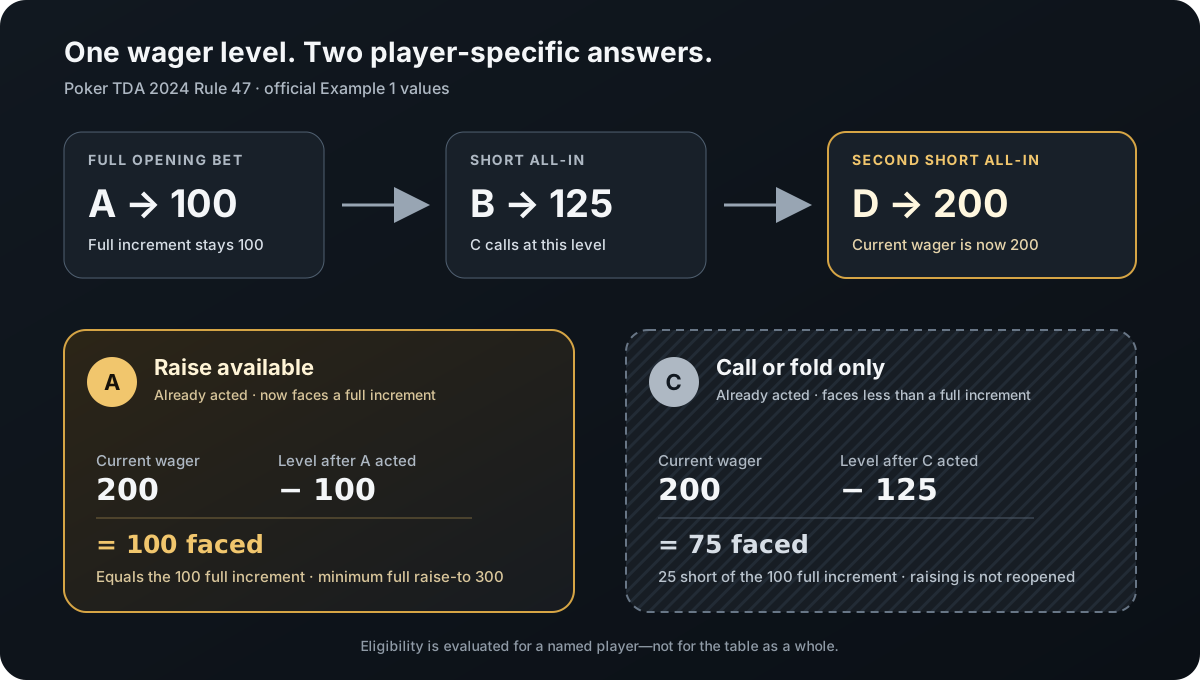
In the official 100 → 125 → 200 example, A last acted at 100 and later faces 200: 200 − 100 = 100, a full 100-chip increment, so A may raise. C acted at 125 and later faces the same 200: 200 − 125 = 75, so C may not raise. Same current wager; different action history; different answer.
Scope and disclosure: this article and calculator implement the cited Poker TDA 2026 Rules 45 and 49 no-limit/pot-limit examples for off-table review. The official 2026 rules package and version history identifies v1.1 as the current downloadable revision. These are editorial tools, not universal rules, live assistance, or a substitute for the event’s published rules and floor decision. GTO Solutions AS publishes this site and GTO Gecko; Poker TDA and WSOP are external rules sources.
Interactive · TDA 2026 v1.1 NL/PL profile · exact decimals
Short All-In Reopening Ledger
Evaluate one active player at one decision point. Enter wager levels, not how many chips that player personally put in.
JavaScript is required to enable the controls. The worked ledger below remains available.
Raise rights are available. Minimum full raise-to is 300.
Yes—raise rights are available. The wager level has increased by at least one full increment since this active player last acted.
200 − 100 = 100; compare with 100
- Increment now faced
- Reopening threshold
- Shortfall
- Minimum full raise-to
The raise-to amount is 200 + 100 = 300. It does not prove the player has enough chips or satisfy a pot-limit maximum.
Scope: one live player with chips behind under the cited Poker TDA 2026 v1.1 no-limit/pot-limit model. Confirm the event or cardroom rules and ask the floor for a live ruling. This ledger does not interpret chips or words, calculate stack sufficiency or a pot-limit maximum, resolve side pots, or cover fixed limit.
The Player-Specific Three-Number Test
Write down three wager amounts for the player being evaluated:
- Current wager (
W): the highest live total wager on this betting round. - Player’s reference level (
L): the wager level immediately after that player’s most recent voluntary action on this round. - Full increment (
R): the full bet-or-raise increment in force. Before any full opening bet, seedRwith the minimum opening bet for the street. A short all-in can moveWwithout replacingR.
If the player has already acted, calculate increase now faced = W − L. Under the TDA 2026 v1.1 profile, that player may raise when W − L ≥ R. If a standard raise is otherwise legal, minimum full raise-to = W + R. These are separate outputs: action can be reopened even when the player’s remaining stack cannot reach that raise-to, and pot-limit also imposes a separate maximum—use the pot-sized raise ceiling after checking raise rights.
Reset the ledger for each new betting round. A check is a voluntary action at the current wager level; a forced blind post is not. Also keep fold status and chips remaining outside the three-number test, because a folded or all-in player has no later option even if the arithmetic crosses the threshold.
Before calculating, name the actor.
Actor → already acted? → W − L versus R → may raise? → W + R
If the actor has not voluntarily acted, do not invent an L from a posted blind. The player still has an option when action first reaches them, subject to being active, having chips, and the normal betting rules.
An Opening All-In Can Be Smaller Than the Full Bet
R can legitimately be larger than W. Suppose the minimum opening bet is 100, A checks at a wager level of 0, and B is all-in for 50. When action returns, A has acted and faces only 50: 50 − 0 < 100, so the incomplete opening wager does not reopen a raise for A under TDA Rule 49.
An active C who has not acted still has a raising option. The minimum full raise-to is 150: the current 50 wager plus the 100 full increment. A historical TDA forum administrator example gives the same NL/PL construction—20 into a 100 minimum produces a 120 minimum raise-to—but is used here only as an implementation check. The 50/150 case is a constructed rule boundary, not a numbered TDA addendum example or a new governing rule. It is included because rejecting R > W would silently exclude a valid short-all-in state.
TDA Examples 1, 1-A and 1-B: Why A and C Differ
The Rule 49 Illustration Addendum starts post-flop in 50/100 no-limit hold’em. A opens for 100; B is all-in for 125 total; C calls 125; D is all-in for 200 total; and E calls 200. Neither B’s 25-chip increase nor D’s 75-chip increase is a full 100-chip raise on its own. Together, however, they make A face 100 more than the level after A’s action.
| Step | Action | Current wager | Full increment | What changed |
|---|---|---|---|---|
| 1 | A opens to 100 | 100 | 100 | Full opening bet |
| 2 | B all-in to 125 | 125 | 100 | Short increase of 25 |
| 3 | C calls 125 | 125 | 100 | C’s reference level becomes 125 |
| 4 | D all-in to 200 | 200 | 100 | Short increase of 75 |
| 5 | E calls 200 | 200 | 100 | Action returns toward A |
| Official example | Player checked | W − L | Compare with R | Result |
|---|---|---|---|---|
| 1 | A at 200 | 200 − 100 = 100 | 100 = 100 | May fold, call, or raise; minimum raise-to 300 |
| 1-A: A calls 200 | C at 200 | 200 − 125 = 75 | 75 < 100 | May fold or call 75; may not raise |
| 1-B: A raises to 300 | C at 300 | 300 − 125 = 175 | 175 > 100 | May fold, call, or re-raise; minimum raise-to 400 |
Example 1-B also shows why “the last amount I called” is not the test. C’s 125 chips already on the street help determine the call amount, but reopening depends on how far the table’s wager level has moved since C acted. For ordinary raise terminology, see what a 3-bet means; the procedural question here is whether that aggressive option is still available.
TDA Example 2: Short All-Ins Do Not Reset the Minimum Raise
In Example 2 of the same addendum, post-flop at 50/100, A opens for 300. B moves all-in to 500, C to 650, D to 800, and E calls 800. The increases are 200, 150, and 150. None is a full 300-chip raise, so the full increment remains 300. F has not acted and may fold, call 800, or raise to at least 1,100: 800 + 300.
This example separates two facts that are often collapsed. Cumulative movement can be enough to reopen action for an already-acted player, but short all-ins do not become the new full-raise increment. The minimum raise-to still comes from the last full valid bet or raise.
TDA Examples 3-A and 3-B: A Posted Blind Is Not an Action
In Examples 3-A and 3-B, at 2,000/4,000 preflop, A calls 4,000, B folds, and C is all-in for 7,500 total. After folds through the small blind, the big blind faces 3,500 more. The addendum says the big blind has not yet acted on the option: posting 4,000 did not consume the right to raise.
| Example | Player checked | History | Full increment | Result |
|---|---|---|---|---|
| 2 | F at 800 | F has not acted | 300 | May fold, call 800, or raise to at least 1,100 |
| 3-A | Big blind at 7,500 | Blind posted; no voluntary action | 4,000 | May fold, call 3,500, or raise to at least 11,500 |
| 3-A: BB calls | A at 7,500 | A acted at 4,000; now faces 3,500 | 4,000 | May fold or call; may not raise |
| 3-B: BB raises to 11,500 | A at 11,500 | A acted at 4,000; now faces 7,500 | 4,000 | May fold, call, or re-raise; minimum raise-to 15,500 |
Example 3-A is the implementation trap: using “chips already committed” as a proxy for “has acted” wrongly locks the big blind. Track voluntary action separately from forced posts. Example 3-B then shows that A’s rights change when the big blind makes a full raise, even though A could not raise after a smooth call.
The 50% Rule Does Not Reopen No-Limit Action
TDA Rule 45 uses 50% to interpret certain incomplete non-all-in raises in no-limit or pot-limit. For silent chip actions, apply the oversized-chip, multiple-chip and prior-chip rules first: a single oversized chip can be a call even when its value exceeds a minimum raise. Our one-chip and multiple-chip examples explain that classification. When the 50% test applies, an increase at least halfway to the required full raise must be completed; below halfway it is a call unless “raise” was declared first. All-ins are treated separately.
Reopening is Rule 49. In no-limit and pot-limit, a player who already acted must now face at least a full bet or raise. The half-bet reopening threshold belongs to fixed-limit poker under Rule 49-B. Therefore a short all-in equal to 50% of the full increment is not, by that fact alone, enough to let an already-acted player raise again in this NL/PL model.
WSOP 2026 Uses Its Own Wording
WSOP 2026 Rules 95–96 also use a full-raise baseline and say the half-size reopening rule is for limit poker only. Rule 96 then states an event-specific exception for two or more consecutive all-in wagers that exceed the minimum allowable bet or raise.
Its example has A bet 500, B raise to 1,000, C call 1,000, D move all-in to 1,300, and E move all-in to 1,700. If A calls or folds, B and C may raise. The last complete raise was 500, so their minimum raise is 500 more, to 2,200 total.
That is a useful comparison, not permission to relabel this TDA calculator as a WSOP ruling engine. The texts are not identical, and other operators may publish different procedures. Select the governing event rules before doing arithmetic.
What the Calculator Cannot Decide
- Physical or verbal intent: it cannot determine whether chips, words, timing, or gestures constituted a call, raise, or all-in.
- Accepted action and corrections: undercalls, incorrect counts, substantial action, and action out of turn require their own rules and facts.
- Stack and pot-limit bounds: “may raise” does not prove the player can fund a standard minimum, nor that a chosen pot-limit amount is below the maximum.
- Pot ownership: reopening rights do not determine contribution layers or who can win them. Use the separate side-pot calculation guide after the action has been established.
- A live ruling: Poker TDA is a voluntary trade association, Rule 1 makes floor decisions final, and the house or event may supplement or replace this profile.
If the input action history is disputed, stop. Record the exact sequence, call the floor, and apply the ruling before using any worksheet. The calculator answers only the declared numerical state it receives.
Download and Reproduce the Checks
The public bundle contains normalized TDA examples plus boundary fixtures for equality, one unit below the threshold, acted and unacted opening underbets, an unacted blind, a later full raise, a folded player, and an all-in player with no chips. Results are deterministic; no random sampling or private hand data is used.
- Inputs, ruleset labels, and expected outcomes (JSON)
- Player-by-player published results (CSV)
- Independent standard-library verifier (Python)
- Method, field definitions, commands, and limitations
Place the four files in one folder and run python short-all-in-reopening-verifier.py. The verifier reads the public fixtures and checks the expected actor-specific decisions without calling the browser calculator. Decimal amounts are preserved for boundary comparisons rather than rounded for display. This reproduces the published arithmetic, not the judgment required to reconstruct a disputed live action.
Where GTO Gecko Fits—and Where It Does Not
After the venue or floor determines the legal action sequence, GTO Gecko can be used off-table for decision study. Its current US Google Play listing describes precomputed solver output for preflop, flop, turn, and river spots plus guided practice.
The reopening calculator is not a GTO Gecko feature, and GTO Gecko is not a rules authority or live solver. It must not be used as live assistance. The listing does not establish support for incomplete raises, cumulative short all-ins, minimum-raise adjudication, side pots, or every operator’s action tree. Preserve the ruled action, stack, positions, and other inputs before off-table study; our solver study guide explains why accurate inputs matter.
Short All-In Reopening FAQ
- Do two short all-ins always reopen betting?
- No. Under this TDA profile, compare the cumulative increase with the full increment for the named player. A and C can receive different answers.
- Does exactly one full increment count?
- Yes. Example 1 gives A an increase of exactly 100 against a 100-chip threshold.
- Does posting the big blind mean that player already acted?
- No. TDA Example 3-A treats the big blind’s option as unacted when action first returns preflop.
- Is the next minimum raise based on the latest short all-in?
- No. Keep the last full valid increment. In Example 2, F faces 800 but must add the unchanged 300-chip increment, making 1,100 total.
Sources and Methodology
Rules, product wording, and the evidence-bundle source contract were checked on September 30, 2026.
- Poker Tournament Directors Association, 2026 rules view, Rules 45 and 49 and Illustration Addendum Examples 1, 1-A, 1-B, 2, 3-A, and 3-B. Used for the TDA calculation profile. Poker TDA is a voluntary association; event and floor rules control live decisions.
- Poker Tournament Directors Association, 2026 rules files and version history, identifying Version 1.1 as released September 21, 2026. Used to establish the current downloadable package; accessed September 30, 2026.
- Poker TDA discussion forum, “All in with less than BB”, administrator reply dated November 1, 2017. Used only as a historical implementation cross-check for an opening all-in below the minimum bet, not as the current rules authority.
- World Series of Poker, 2026 Tournament Rules, Rules 95–96. Used only for the separately labeled WSOP comparison.
- Google Play, GTO Gecko, US listing. Used only for the narrow, off-table product description and checked on the date above.
- GTO Gecko, short-all-in reopening fixtures, results, independent verifier, and method note. Source contract and verifier checked September 30, 2026.