
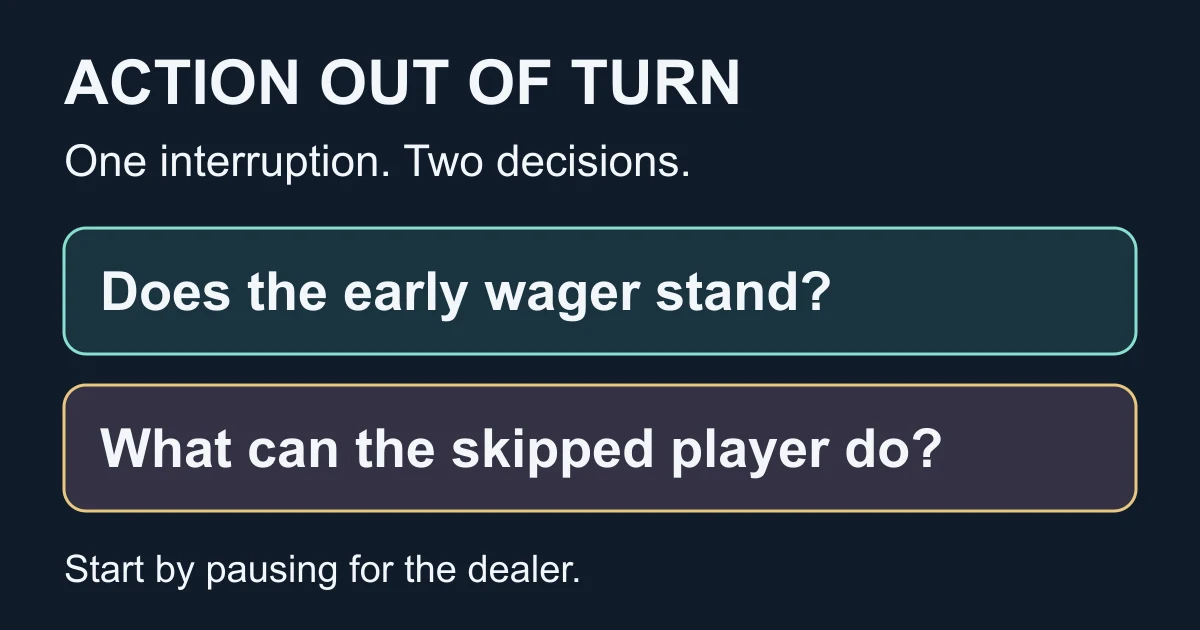
An out-of-turn bet can still stand. When the dealer corrects the error promptly, a check or call by the skipped player leaves the early wager binding under the Poker TDA profile used here. A new bet or raise can give the early bettor a fresh choice. An early fold has its own treatment.
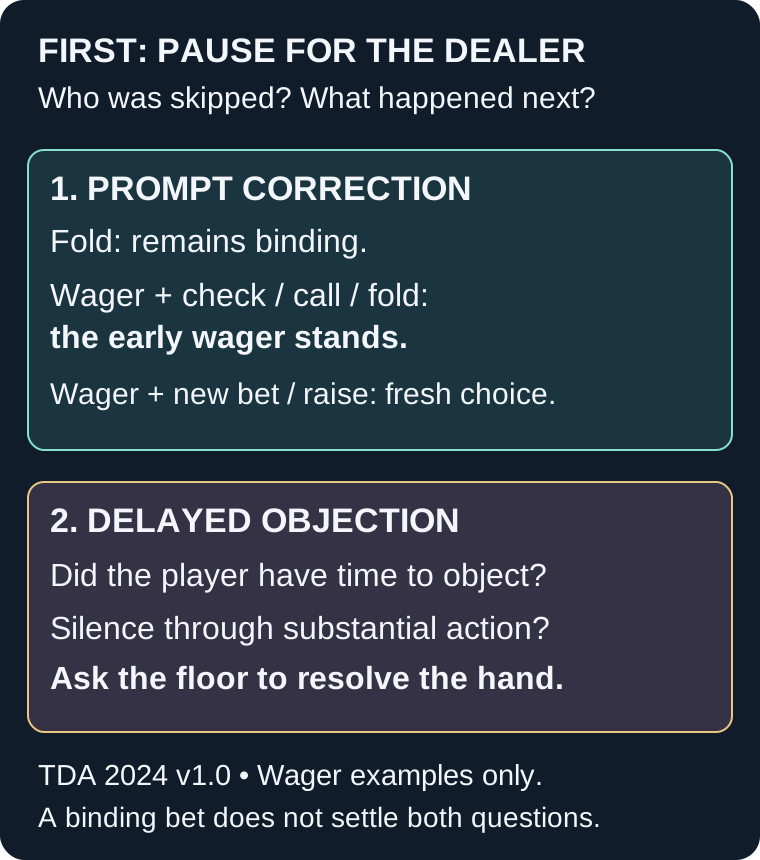
First stop the sequence and tell the dealer who has not acted. Then separate two questions: what happens to the early action, and what options remain for the skipped player? The answer to one does not settle the other.
Choose the rulebook before the ruling
This off-table casebook applies Poker TDA 2024 v1.0, Rules 53 and 58. Play returns to the proper actor. A fold by that actor also leaves the early wager binding. Penalties are a separate issue. The prompt-correction path in Cases 1–4 assumes no delayed-objection complication; Case 6 handles that separately.
The TDA website still displays that version while its 2026 announcement describes a forthcoming update. Check the event's adopted rules. A cash room or a different tournament series may use a different procedure.
The same early bet, two different outcomes
These are constructed no-limit Hold'em tournament examples. Blinds are 100/200; all cases occur after the flop. Players have enough chips for the stated actions, no one is all-in, declarations are clear, and the dealer catches the error promptly unless stated otherwise. Numbers are tournament chips, not currency. Cards, pot size, rake and antes do not decide the procedural question.
Case 1: A check leaves the 600 bet in place
On the turn, A should act before B. B says “bet 600” too early. The dealer returns action to A, who checks. B's 600 is binding. A's check did not create a different wager for B to face.
Case 2: A 300 bet gives B a new decision
Start again with the same early 600. This time A bets 300 when action is restored. B's early wager is no longer binding: B can call 300, make a legal raise or fold. The floor does not simply replace B's 600 with an automatic call.
The contrast is useful when recording a disputed hand. “Someone acted before B” is insufficient. Write the action itself: a check and a bet of 300 produce different cases.
A call is not a change of action
Now use three players in order A, B, C. A bets 300. B has not responded when C announces a raise to 900 total.
- B calls 300: C's raise to 900 remains binding. B added chips, but did not raise the wager C faces.
- B raises to 600 total: C's early raise is released. C gets a fresh legal choice against 600. This is different from being forced to repeat the original raise.
“Released” describes C's obligation, not the size C must choose next. In Case 4, C could still choose a legal raise to 900; C could also call 600 or fold. B's valid raise remains in place. Keep that distinction when correcting the hand history.
These examples keep every raise large enough to avoid another dispute. For the separate question of a short all-in and a player's right to raise again, use the betting-reopening guide. Resolving an out-of-turn error comes first. If a chip movement itself is unclear, the one-chip rule examples explain why declarations and timing matter.
Two cases that break the shortcut
Case 5: an early fold stays folded
Three players remain, in order A, B, C. B folds before A acts. With C still in the hand, A then bets 300. Under the stated TDA profile, B cannot use that changed action to reclaim the hand. A mnemonic saying “changed action cancels everything” fails this case.
Case 6: the skipped player stays silent
A has not acted. B bets 600, then C calls. A had reasonable time to object but remained silent until after those actions. This is not the prompt correction assumed in Cases 1–4.
TDA Rules 36 and 53B make the early action binding when the skipped player had reasonable time but failed to speak up before substantial action followed. The floor determines the skipped hand's treatment; it may restrict action or rule the hand dead. Do not infer an automatic fold from the wager's binding status.
In Case 6, the bet and call supply the substantial-action trigger. The 2026 WSOP rules, 88c and 90d, also distinguish substantial action from an ordinary change in wager. Two actions in order qualify if at least one commits chips; otherwise three actions in order qualify. TDA Rule 36 excludes posted blinds from this count. Whether A actually had reasonable time is a fact for staff to establish, not something this written example can prove about a real dispute.
Checking early needs an extra rulebook check
The 2026 WSOP tournament rules add a restriction for passive out-of-turn action in a betting round that began heads-up: absent accidental dealer prompting, that player is limited to passive action when reached, such as checking, calling or folding as applicable. Do not extend our early-bet examples to conclude that every early check permits a later raise. See Rule 90d (printed page 20) and the glossary (page 35).
Reconstruct the sequence before studying the hand
Use the printable casebook and blank correction record away from the table. Cover the answers, compare Cases 1–2 and 3–4, and identify the one intervening action that changes the result. Then explain why Case 5 cannot follow the same shortcut.
For an actual hand review, record:
- The event, adopted rules, street and players' action order.
- The last valid wager and the early player's exact words or chip motion.
- Each intervening action, in order, including total wager amounts.
- When the skipped player objected, what the dealer said and the floor's eventual ruling.
Keep the attempted action separate from the action staff accepted. A later strategy review needs the corrected legal sequence. A note that silently removes the early 600 loses the reason B received a fresh choice in Case 2. If the sequence remains unclear, retain that uncertainty in your hand notes.
For broader fundamentals study, River offers interactive poker lessons and questions. River and GTO Gecko share publisher GTO Solutions AS. The worksheet is a separate editorial exercise; it is not a River feature or a live ruling service.
Method and limits
We built six synthetic action sequences to isolate four distinctions: check versus bet, call versus raise, fold versus wager, and prompt correction versus a delayed objection. The case data preserve both the attempted sequence and expected treatment. The method note identifies the source profile and exclusions.
This is a learning reference, not an exhaustive adjudicator. It does not resolve unclear declarations, disputed timing, dealer errors, multiple overlapping errors, exposed cards or house exceptions. The cases do not recommend using another player's mistake to choose a poker strategy. Dealer and floor decisions govern the actual hand.
Sources checked September 7, 2026 (Europe/Oslo). Examples and diagrams are original. No observed player data, simulations or learning-outcome measurements are used.