
Record the hand you can support, including its gaps. Write the game, positions, stacks, exact cards and actions in order; attach the source and precision of each uncertain detail. If a missing fact changes the question you want to study, keep the alternatives separate or narrow the question.
A note saying “I had ace-queen, bet small, then faced a raise” can be enough to remind you which hand to revisit. It cannot identify one exact solver decision. The plain-text hand-note template and printable worksheet below help turn that reminder into a reviewable record.
Capture the state before writing the verdict
Keep the original note or permitted hand-history export. Make a separate review copy instead of polishing uncertainty out of the original. For a remembered hand, say that memory is the source. Write “about 200 before the hand” if that is what you recall, rather than silently upgrading it to an exact stack.
Record enough to reach your chosen decision. Later streets can stay in a separate result section; an incomplete hand does not need an invented ending. Start the review copy with these fields:
- Game and units: variant, cash or tournament, number dealt in, blinds, antes and straddles. State whether amounts are chips, currency or big blinds.
- Players and stacks: use positions instead of names; distinguish starting stacks before forced bets from chips remaining at the decision. In a multiway pot, keep each relevant stack.
- Cards: record both ranks and suits, with the flop, turn and river on separate lines. Mark the point you want to review.
- Actions: list the actor and action in sequence. For a raise, write the total committed on that street as “raise to,” plus the extra chips added if useful.
- Pot and conditions: label whether the pot includes the bet you face, and whether deductions are known. For a tournament decision, retain relevant payout or bounty context when available.
- Question and gaps: state the decision you want to understand, the missing facts and where you might verify them.
This field order reflects the distinction in the Poker Hand History specification between initial state and ordered actions. Our template is ordinary prose, not a PHH file or an import format.
Give each detail a status
Use four plain labels. Reported means the detail appears in a named source, which could be your own recollection; it does not certify that the detail is correct. Derived means calculated from listed inputs. Hypothetical means chosen for a separate study branch. Unknown means you have no supported value.
For example: “BB started with about 260 — reported from memory”; “flop pot 13 — derived from the listed contributions, assuming no deductions”; “100bb — hypothetical setting for a separate drill”; “turn suit — unknown.” Keep the status and source alongside the value, not in a footnote that will disappear when copied. A calculation inherits uncertainty in its inputs. It cannot turn an estimated starting stack into exact chips behind.
A read belongs on its own line: “I thought BB could bluff” is an interpretation. “BB checked, then raised” is an action report. Keep both if useful, with their different roles visible.
Why a balanced pot does not fix an ambiguous note
Consider a constructed six-handed no-limit Hold’em cash hand, with amounts in chips. Blinds are 1/2; there are no antes, straddles, rake or other deductions in this teaching example. Before posting, BTN has 200, SB has 300 and BB has 260. The other players fold without contributing. BTN raises to 6, SB folds and BB calls.
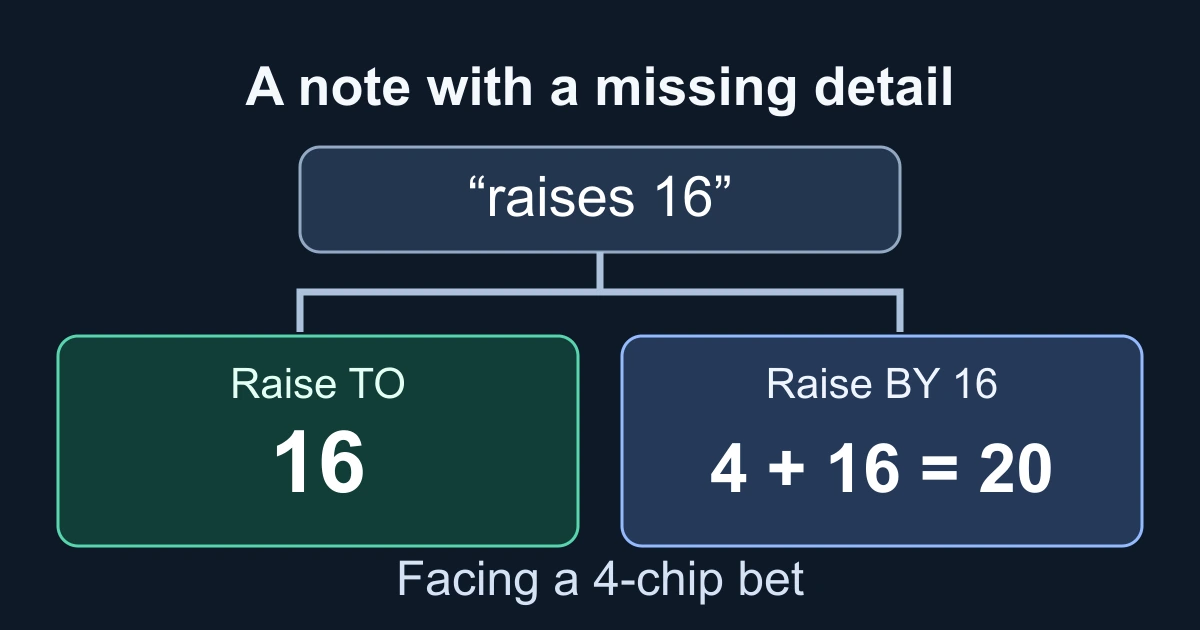
The flop pot is 13 = 6 + 1 + 6. BTN has 194 behind and BB 254. On K♠ 7♦ 2♣, BB checks, BTN bets 4, and the note says only: “BB raises 16.” BTN has not responded.
That shorthand leaves two possible reconstructions. They are hypotheses about the note, not rulings about an ambiguous live declaration.
On a narrow screen, scroll the table to read both interpretations.
| Quantity | Raise to 16 | Raise by 16, to 20 |
|---|---|---|
| BB’s total flop contribution | 16 | 20 |
| Pot including BB’s raise | 13 + 4 + 16 = 33 | 13 + 4 + 20 = 37 |
| BTN’s additional call amount | 16 − 4 = 12 | 20 − 4 = 16 |
| BTN / BB chips behind | 190 / 238 | 190 / 234 |
Both branches are affordable full raises, and both reconcile the chips. The folded SB still has 299. In the first branch, 33 + 190 + 238 + 299 = 760; in the second, 37 + 190 + 234 + 299 = 760. Each equals the three contributing players’ starting total.
Passing an arithmetic check does not tell you which branch happened. A reliable additional record—such as the exact total BB put in—could resolve it. Until then, label both branches or leave the call amount unknown. Do not pick the prettier pot merely because it matches a study preset.
If the note had instead recorded “BB raises to 16,” the remaining call is 12. That wording removes the to/by ambiguity in the written record; its accuracy still depends on the source. The pot-odds guide covers what to do with a supported call price; this exercise only reconstructs the price.
One missing suit can change the question
In a separate synthetic hand, Hero has A♠ Q♦ and the flop is K♠ 9♠ 4♦. The turn note says “a two,” with its suit unknown. We can still examine what that gap permits:
- If the turn was 2♠: Hero has four spades across the hole cards and board. A spade river completes an ace-high flush.
- If the turn was 2♥: Hero has only three spades available. One river card cannot complete Hero’s flush.
Hold’em uses the highest-ranking five-card hand from the player’s two cards and the five community cards, as PokerStars’ Hold’em rules explain. Counting the available suits establishes this difference without assuming an opponent’s range.
The two alternatives demonstrate the ambiguity; they do not assign equal probabilities to the turn suits. Nor does a possible flush prove that calling or betting is best. With the turn suit unresolved, ask a conditional question—“What changes if the turn is a spade?”—instead of claiming to have recovered the original hand.
Choose what the incomplete record can support
Verify when a permitted original history or another reliable record can settle a missing detail. Preserve both the old entry and the correction, with its source.
Branch when a small set of explicit alternatives is useful to study. Keep separate headings for “if the raise was to 16” and “if it was to 20.” A conclusion shared by those branches applies to those branches; it does not cover every other possibility. If you cannot justify a short list, keep a range or an unknown instead of selecting two convenient values.
Narrow or pause when the gap prevents the intended review. Missing starting stacks may still allow discussion of action order. If the chips remaining at your decision are independently known, however, you can record that current state without inventing a starting stack. Identify which quantity your comparison actually requires. Missing deductions prevent a precise net-pot calculation. An unknown opponent holding is different: do not invent it; any range used in analysis is a model assumption.
Keep the resulting record separate from grading the decision. Our result-blind review guide handles that later step. The Dwan–Schwimer analysis shows how source disagreements and model differences remain visible in a specific published hand study.
Take a supported question into study
For off-table follow-up, GTO Gecko offers study of available solved scenarios across formats, stack depths and positions. Compare the setup with your note before treating it as a match. If you choose a different stack or betting branch, write that change into the study copy.
GTO Solutions AS publishes this site and GTO Gecko. Product information was checked September 6, 2026. The downloads are standalone manual aids, not an app integration; they do not reconstruct a missing hand or provide a solver verdict.
Download the blank text template or the printable sheet with worked examples. Before sharing a real record, consider which identifying details the recipient needs; our hand-history privacy guide explains why removing names alone may be insufficient.
Method and checks
These are two invented teaching examples, not player data or measured memory research. The case data, standalone Python checker and reproduction notes preserve the inputs and checks. The checker verifies both chip ledgers and enumerates the 46 river cards consistent with Hero’s cards and the board for each specified turn. Other hidden cards are unspecified; the enumeration checks completion possibilities, not their probabilities. It does not estimate equity, validate arbitrary hand histories or choose an action.
The template makes missing information inspectable. No study here establishes that it improves memory, decision quality or poker results.