

A poker decision can be good and lose, or bad and win. Review it first with only the information available when the action was taken. Then reveal the runout and use any genuinely new evidence to improve future estimates. If win or loss is the only new information and neither the recorded inputs nor the reference analysis changed, the outcome—not the decision—moved your grade.
This separation keeps two judgments auditable. Outcome bias changes how good the choice seems because it succeeded or failed. Hindsight bias makes the finished hand feel more predictable than it was. A locked record lets you compare your later reaction with what you actually wrote.
Scope: the four cases below are constructed, heads-up cash-game chip-EV demonstrations. Villain is all-in, so call and fold are the only legal actions. The cases use no observed player data or solver output, and this is not a validated psychological test or a set of strategy recommendations. The models assume no ties, no remaining rake, and full equity realization. Their purpose is to isolate the logical difference between expected value and one realized result.
What Does “Results-Oriented” Mean in Poker?
Being results-oriented means using what happened after a poker choice as if it directly proved the quality of that earlier choice. A bluff is not automatically sound because it worked. A value bet is not automatically a mistake because it ran into the top of a range. A call with enough modeled equity does not become poor when the river or showdown loses.
Jonathan Baron and John Hershey studied this broader evaluation problem under the label outcome bias. Across five 1988 studies with University of Pennsylvania undergraduates using medical decisions and monetary gambles, favorable outcomes led participants to evaluate otherwise matched decisions more favorably. A 2023 preregistered replication and extension by Sriraj Aiyer and colleagues used online MTurk participants recruited through CloudResearch in a between-participants medical scenario and retained 692 participants after exclusions; it replicated the signal and direction of the original outcome effect. The researchers shared materials, data, and code on OSF.
Those studies support the general distinction between a decision and its outcome. They did not study poker players, train poker decisions, or validate the worksheet in this article. The poker application below is a transparent teaching construction, not a new behavioral finding.
Try the Result-Swap Exercise
Imagine a river decision where Villain is all-in and Hero may only call or fold. Folding has incremental EV of zero. The pot is 300 chips before Hero acts, including Villain's bet. Calling costs 100, so the final pot after a call is 400. Let q be Hero's equity against the range that made this exact bet.
Closed-action model
required equity = 100 / 400 = 25%
EV(call) = q × 400 − 100
A win realizes +300 chips from the decision point; a loss realizes −100.
This compact calculation is only the control surface for the result swap. The closed-action call-EV guide covers the full price formula and its assumptions.
Now give the call a model-based action grade in each profile while its two outcomes remain hidden. Use any stable scale you like—for example, −3 for clearly poor through +3 for clearly good—and write the number and criterion down before opening a reveal.
Profile G: 30% modeled equity
The declared range model gives Hero 30% equity. The call's expected value is 0.30 × 400 − 100 = +20 chips. Under these assumptions, calling is better than folding. Record one model-based action grade for both identical twins, G-win and G-loss.
Step 1: reveal only the two Profile G results
G-win returns the 400-chip final pot and realizes +300 from the decision point. G-loss returns nothing and realizes −100.
Before reading the interpretation, give G-win and G-loss separate snap grades. If either differs from your locked grade, record the direction and size of the change.
Step 2: compare the Profile G grades
Both twins had the same 30% model, price, legal options, and +20 call EV before the result. If G-win now seems better than G-loss, the result is the only changed field. Preserve the original model-based action grade and audit the reaction separately.
Profile H: 15% modeled equity
The declared range model gives Hero 15% equity. The call's expected value is 0.15 × 400 − 100 = −40 chips. Under these assumptions, folding is better than calling. Record one model-based action grade for both identical twins, H-win and H-loss.
Step 1: reveal only the two Profile H results
H-win realizes +300 from the decision point. H-loss realizes −100.
Before reading the interpretation, give H-win and H-loss separate snap grades. Record any change from the grade you locked above.
Step 2: compare the Profile H grades
Both twins had the same 15% model, price, legal options, and −40 call EV before the result. The winning H call remains model-negative under the declared inputs; the losing G call remains model-positive. Result and action grade occupy separate axes.
This result-swap exercise is a private consistency check, not a diagnostic instrument. The snap grades can record an outcome-aligned rating difference. Because the exercise is self-administered and uses a fixed order, it cannot isolate what caused that difference. It does not estimate a general bias or measure how you play.
The Four Boxes a Hand Review Must Keep Separate
Narrow screen? Scroll the table horizontally to reach the EV, outcome, and interpretation columns.
| Case | Equity model | Call EV before result | Action grade before result | Realized call result | Correct interpretation |
|---|---|---|---|---|---|
| G-win | 30% | +20 | Model-positive call | +300 | Sound under the model; favorable result |
| G-loss | 30% | +20 | Model-positive call | −100 | Sound under the model; unfavorable result |
| H-win | 15% | −40 | Model-negative call | +300 | Fold preferred in the model; favorable result |
| H-loss | 15% | −40 | Model-negative call | −100 | Fold preferred in the model; unfavorable result |
The table is deliberately repetitive. Within each pair, the information available before the action is identical. Only the stipulated outcome changes. Across rows, decision EV and realized payoff form separate axes: a positive-EV action can occupy either outcome column, and so can a negative-EV action.
The arithmetic also shows why “I won” is not a replacement for “my estimate was sound.” The 30% input is a declared model, not a fact discovered by losing. If the actual conditional range estimate was poor, improve the model in a separate audit. Do not silently swap in Villain's revealed holding and pretend you assigned it certainty before calling.
Outcome Bias and Hindsight Bias Are Not the Same
Outcome bias asks, “Did the result change how I rate the choice?” Hindsight bias asks, “Did knowing the result change how predictable I think it was?” They can occur together, but they are not interchangeable.
In Experiment 1 of Baruch Fischhoff's 1975 hindsight study, outcome knowledge increased postdicted likelihoods and changed which details participants saw as relevant. Baron and Hershey explicitly separated that route from the direct effect of an outcome on decision evaluation. In poker language:
- Outcome-bias statement: “The call lost, so the call was bad.”
- Hindsight-bias statement: “After seeing the value hand, it was obvious that this line was never bluffing.”
- Valid model criticism: “Before reveal, I omitted a public stack, sizing, or action-history fact that should have changed the conditional range.”
A written record creates an audit trail; it is not a proven treatment. In two experiments with 98 and 128 Iowa State undergraduates (226 total), Amy Bradfield and Gary Wells had participants predict the future of videotaped couples, then supplied randomly assigned feedback that confirmed or disconfirmed the prediction. Participants later distorted reports about their earlier certainty, evidential basis, timing, and related judgments even though the prediction itself had been recorded. In Experiment 2, private thought about the upcoming retrospective questions before the outcome feedback diminished those effects. This task was not poker, and it does not prove that a poker journal prevents bias or improves win rate.
When Should a Result Change Anything?
Expected value describes a distribution before the outcome is observed; a result is one realization from it. Profile G can lose and Profile H can win without contradicting either declared calculation. The useful question is not “Do results matter?” but “What is this result evidence about?”
Narrow screen? Scroll the table horizontally to reach the future-model column.
| Observation after the action | Change the old grade? | Update a future model? |
|---|---|---|
| Ordinary runout | No. It was unavailable at decision time. | No, unless it exposes a record error. |
| One revealed holding | No. It does not change the earlier information set. | Shows the combo occurred in this hand; weak evidence about its future frequency. |
| Corrected public fact or reference mismatch | Re-audit, naming the exact correction. | Yes, if it changes the relevant assumptions. |
| Prospectively collected comparable series | No retroactive rewrite. | Possibly; weight it under a declared sampling and comparison rule. |
Baron and Hershey described two narrower indirect uses: an outcome may affect an evaluator's beliefs about information the decision maker possessed, and a sequence of similar decisions can update probability beliefs. In self-review, hole cards revealed after the action are new evidence for future models, not recovered decision-time knowledge. A showdown establishes that one holding was possible in that hand; it does not establish a population frequency. Separately, if the audit uncovers a public fact or reference mismatch that belonged in the original information set, re-audit while naming that correction.
Keep three records: the model-based action grade, the quality of your reasoning and assumptions, and the realized outcome. A hand can contain a sound action under a weak model and a favorable result. Compressing all three into “played well” or “played badly” destroys the part you need to improve.
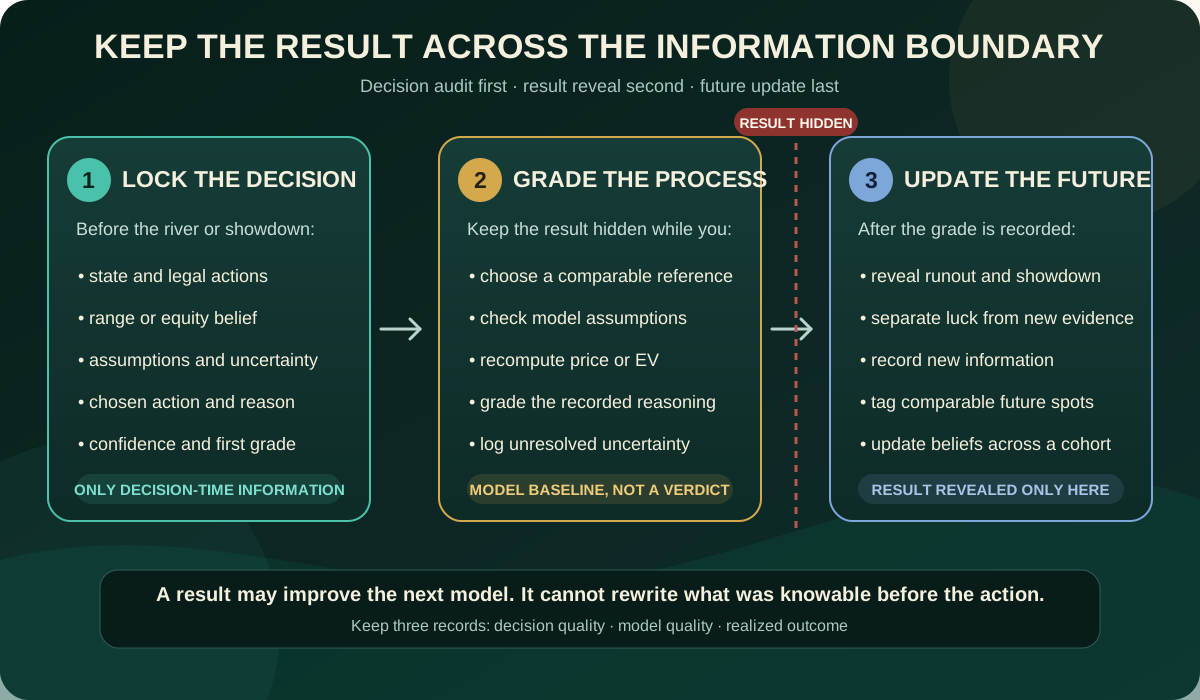
Narrow screen? Scroll the diagram horizontally to view all three stages.
Use a Two-Pass Check for Outcome Bias
The quick review card (CSV) has one header and one reusable twelve-field template row. Copy that row for each decision. It follows the only chronology this check needs:
- Lock the state and belief. While the result is hidden, record the available options, the range or equity belief you held, your action and reason, and confidence. Mark an unknown as unknown.
- Audit the model-based action grade. Name the calculation, retained solver node, coach review, or other reference; record any mismatch in stack, size, range, rake, or tree. Lock the grade before reveal.
- Reveal the raw result. Record what happened and a separate snap grade or change. Do not overwrite the locked fields.
- Update only the future. Name genuinely new evidence, the future belief it might change, and the next comparable sample needed to test it.
This card creates an audit trail; it is not an automatic score or validated test. A static CSV cannot hide the result or verify when you filled each field, so chronology is self-reported. It also cannot decide whether two spots are comparable, recover a belief you never recorded, or validate a range assumption. For scheduling, drilling, and the broader study loop, use the poker practice guide. The longer technical CSV in the reproduction bundle exists to test the four synthetic fixtures, not as the everyday reader worksheet.
Three Ways the Check Can Still Fail
1. Rebuilding the range around the revealed hand
A vivid showdown can make every earlier action look like a clue pointing to that exact holding. Preserve the pre-reveal range, then ask only whether the combo was inside it and what further sample would justify a frequency update. Our guide to thinking in ranges explains why one hand is not the whole distribution.
2. Reviewing only emotional hands
A sample of bad beats, hero calls, and huge bluffs was selected by outcome. Choose decisions prospectively—for example, the first eligible river call from each session—or review a complete tagged class. Use the EV-loss leak framework when the question is aggregate strategic cost.
3. Treating a reference as ground truth for a different spot
A solver output is conditional on its tree, stack, sizes, ranges, rake, and objective. A nearby node can challenge your reasoning without certifying the actual hand. Write down each mismatch before comparing actions.
Use a Study Tool After You Lock the Reasoning
When reviewing a session report, first reconcile its units: bb/100 and hourly cash results can have different signs at mixed stakes. Correct bookkeeping gives you a clearer record to keep separate from decision quality.
A practical order is: write the hand state and your reason, keep the result hidden, then consult an appropriate reference. The current US Apple App Store and Google Play listings describe GTO Gecko as an educational product for exploring precomputed poker scenarios, comparing available actions, frequencies, EV estimates, and range composition, and practicing simulated decisions with neutral feedback. Where an available library spot is genuinely comparable, it can provide a model baseline for the pre-reveal audit.
Do not treat that baseline as a verdict on an unmatched hand. The public listings do not describe a result-hiding mode, arbitrary hand-history import, live-table connection, or a guarantee that every configuration is available. Preserve any mismatch and grade your assumptions separately.
Disclosure: GTO Solutions AS publishes both this article and GTO Gecko. The constructed cases demonstrate declared arithmetic; they do not show that the product or review protocol improves player behavior, poker results, or profit.
Results-Oriented Poker FAQ
- Is a winning poker decision always good?
- No. A negative-EV action can realize a favorable result. Grade the action from the information, options, payoffs, objective, and beliefs available before the outcome.
- Can one revealed bluff update my range?
- It proves that the specific bluff was possible in that hand. It does not establish how often the player or population takes the line. Give frequency claims a defined set of comparable observations.
- What if review exposes a missing decision-time fact?
- If you omitted a public fact that was available when you acted, re-audit and name that exact correction. A holding revealed only at showdown does not rewrite the old information set; record it separately as evidence for a future belief. Keep the original entry so the reason for either update remains auditable.
Sources, Data, and Reproduction
- Jonathan Baron and John C. Hershey, “Outcome Bias in Decision Evaluation”, Journal of Personality and Social Psychology, 1988. Open paper accessed September 4, 2026.
- Sriraj Aiyer, Hoi Ching Kam, Ka Yuk Ng, Nathaniel A. Young, Jiaxin Shi, and Gilad Feldman, “Outcomes Affect Evaluations of Decision Quality: Replication and Extensions of Baron and Hershey's (1988) Outcome Bias Experiment 1”, International Review of Social Psychology, 2023. Article and linked OSF materials, data, and code accessed September 4, 2026.
- Baruch Fischhoff, “Hindsight Is Not Equal to Foresight: The Effect of Outcome Knowledge on Judgment Under Uncertainty”, Journal of Experimental Psychology: Human Perception and Performance, 1975. DOI record and open archived paper accessed September 4, 2026.
- Amy Bradfield and Gary L. Wells, “Not the Same Old Hindsight Bias: Outcome Information Distorts a Broad Range of Retrospective Judgments”, Memory & Cognition, 2005. PubMed record and open paper accessed September 4, 2026.
- GTO Gecko: Poker Study on the Apple App Store and Google Play. US product listings accessed September 4, 2026.
- GTO Gecko, quick reader review card (CSV), four constructed cases and assumptions (JSON), technical fixture card (CSV), method and limitations (Markdown), and separately implemented verifier (Python). Generated September 4, 2026.
The Node generator recomputes the four cases and writes both CSVs. A separately implemented standard-library Python verifier checks their schema, arithmetic, pair invariance, realized payoffs, and cells. Download the bundle into one folder and run python results-oriented-poker-verifier.py. A pass confirms internal consistency with the declared synthetic inputs and the fixtures embedded in that verifier version; it is not cryptographic proof of provenance. It cannot measure outcome bias in a person, validate the review protocol, estimate a real opponent's range, reproduce a solver, or recommend a wager.