
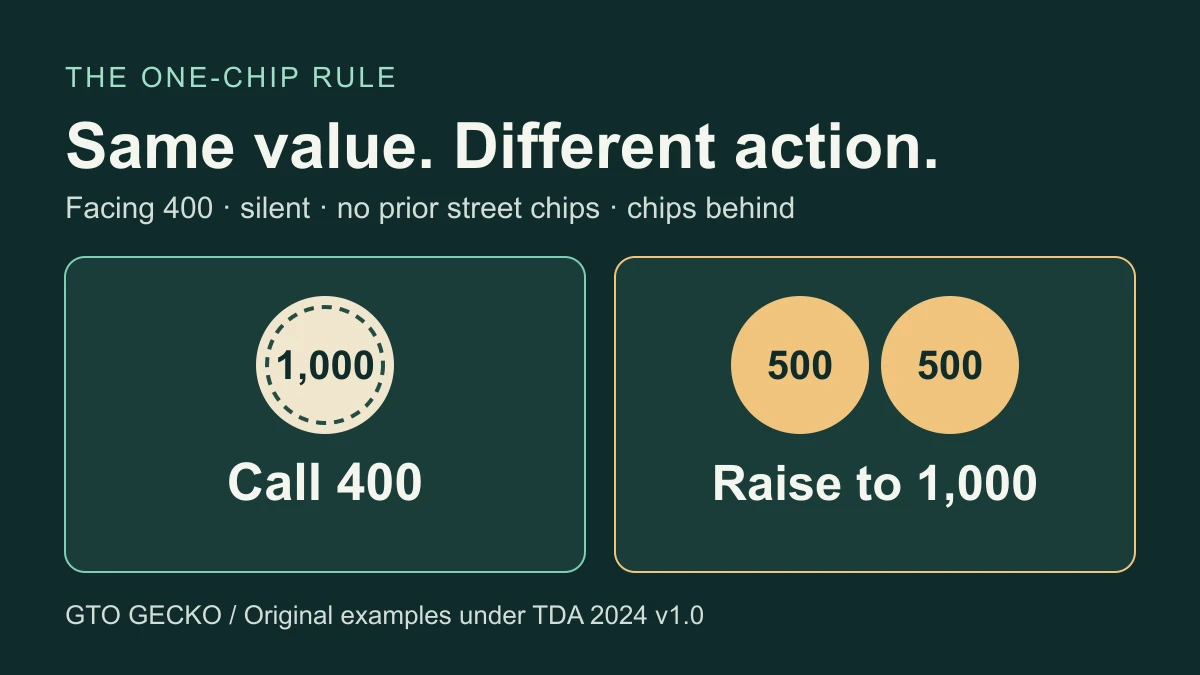
Facing a bet with no earlier chips in front of you, one oversized chip placed silently is a call under the Poker TDA one-chip rule. Two chips worth the same total can produce a raise. Read the action before doing the raise arithmetic: count the physical chips and establish what was said first.
To make your intended action clear, say “call” or state a legal raise total before moving the chips: for example, “Raise to 1,000.” The examples below show why silently relying on a large chip can communicate something different.
Rules checked September 6, 2026: this guide uses Poker TDA 2024, version 1.0, the currently published English rules. TDA has announced a planned mid-September release of its 2026 rules. Check the host’s adopted rules; these examples do not decide a live dispute.
TDA rules used by permission of the Poker TDA, Copyright 2026, http://www.pokertda.com, All rights reserved.
Same 1,000 total, different action
Imagine an in-turn postflop decision in a no-limit Hold’em tournament. The minimum bet is 200. Another player opens for 400; you have not acted and have no chips already committed on this street. You have 5,000 chips, can raise, and move the stated chips forward together without speaking.
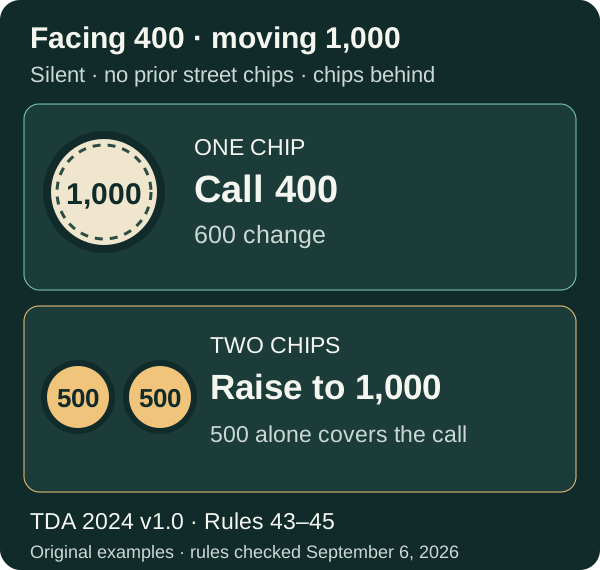
In the first case, the single 1,000 chip calls 400 and leaves 600 in change. In the second, the two 500 chips count as a raise to 1,000, an increase of 600 over the opening bet. That is large enough to be a full raise.
The single-chip case follows TDA Rule 44; the two-chip case follows Rules 45 and 43. Do not start by asking whether 1,000 is “big enough to raise.” First identify which chip-action rule applies.
With several chips, test the smallest one first
With no earlier chips on this street and no prior declaration, mentally subtract one smallest chip from the multiple-chip total moved. If the remainder is below the amount to call, the chips describe a call under Rule 45-A. This is a mental test, not an instruction to physically take back a chip.
Now change only the opening bet from 400 to 600. You still put forward two 500 chips. Removing one leaves 500, which is below 600: both chips are needed, so the action calls 600 and returns 400 in change.
All amounts are tournament chips. These constructed cases have no prior street chips, no declaration, full raise rights and chips behind. Scroll the table on a narrow screen.
| Opening bet faced | Chips moved | After removing one smallest chip | Action |
|---|---|---|---|
| 400 | One 1,000 | Single-chip rule applies | Call 400 |
| 400 | 500 + 500 | 500 covers 400 | Raise to 1,000 |
| 600 | 500 + 500 | 500 does not cover 600 | Call 600 |
Only then apply the 50% test
After the multiple-chip test, a surplus-chip action with chips behind reaches the incomplete-raise check. We keep the original 5,000-chip stack in both examples below, so completing a minimum raise is possible. In our 400-opening-bet example, the minimum full raise is another 400, for a total of 800. Half of that required increase is 200.
Compare two new silent actions:
- 500 + 100 = 600. Removing the 100 leaves enough to call. The attempted increase is 600 − 400 = 200, exactly half the required raise. Complete to 800 by adding 200.
- 500 + 25 = 525. Removing the 25 also leaves enough to call. But the increase is only 125, below the 200 threshold. With chips behind and no prior raise declaration, this calls 400; 125 is change.
Putting out extra chips to obtain convenient change is risky. TDA Rule 61 specifically addresses that mistake. Say “call” before moving chips if that is your intended action.
This 50% interpretation does not answer whether a short all-in reopens betting for a player who already acted. That separate question belongs to our player-by-player reopening guide. The single oversized chip above remains a call even though its value exceeds the minimum raise.
Your last chips are not automatically an all-in declaration
Return to the 400 opening bet, but make the single 1,000 chip your entire stack. Placing it silently still calls 400 under Rule 44. The 600 change remains yours; moving your last physical chip did not by itself declare a 1,000 all-in.
Likewise, facing 600 with exactly two 500 chips, a silent push calls 600 under Rule 45-A. Both chips were needed to cover the call, so you receive 400 change.
Now take the 500 + 25 example. With additional chips behind, it called 400. If those two chips are your entire stack, Rule 45-B makes the same motion an all-in to 525: removing the 25 still leaves enough to call, and there are no chips behind. This is a 125 increase, not a full 400 raise.
The order of the checks matters. “Last chips” does not override the single-chip or all-chips-needed call cases. Only when one chip could be removed and the rest still covers the call does having no chips behind change this result.
Two ways the single 1,000 chip can mean more
Declare first. In the original 400-facing case with 5,000 available, say “Raise to 1,000” clearly before moving the 1,000 chip. The result is a raise to 1,000. Under Rule 44, “raise” must precede the chip reaching the table surface; saying it afterward is not a dependable way to repair the action.
Face no bet. On a fresh postflop street with a 200 minimum and no wager to you, silently putting forward one 1,000 chip opens for 1,000. It cannot be a call of a wager that does not exist.
Neither example tells you whether raising or betting is strategically desirable. It establishes what the specified action communicates.
Stop if the action has missing facts
A description such as “I added a 1,000 chip” is incomplete if blind or earlier bet chips remain in front of the player. TDA Rule 46 treats prior-chip handling separately. Record what was left out, pulled back or replaced; do not apply our no-prior-chip table to that situation.
The printable off-table reference sheet pairs the ten examples with an answer key and a blank fact record. Before interpreting an unclear hand description, write down:
- The opening bet or latest full raise, current amount faced and whether the actor can raise.
- The exact words, their timing and whether the action was in turn.
- The number and denominations of chips moved, prior street chips and chips remaining.
Let the dealer or tournament director establish a disputed action before updating a hand history or using a reopening calculation. Unclear speech, multiple motions, prior chips, undercalls and house-specific procedures are outside these examples. A photo of the final pile alone may omit the fact that changes the ruling.
Practice the action, then continue the fundamentals
For a short off-table exercise, cover the answer column and explain which fact changes between each pair. Use two different chip denominations or paper tokens. Then repeat the intended action with a clear declaration before moving them. This is an editorial practice suggestion, not a tested learning intervention.
For further off-table fundamentals study, River offers short interactive poker lessons and questions. River and GTO Gecko are both published by GTO Solutions AS. The casebook is separate from River and does not adjudicate live actions.
Sources and reproducible examples
The ten constructed cases and CSV case table record inputs, expected actions, final wagers and change or additional chips. A standalone Python checker applies the stated restricted rules and compares them with independently reviewed expected answers. It does not interpret video, speech or arbitrary hand histories. See the method and instructions and file checksums.
- Poker TDA 2024 v1.0: Rules 40, 43–46 and 61; the governing profile for these cases.
- Poker TDA announcement: planned 2026 rules release; recheck before applying a later version.
- River’s official US App Store listing: product description and publisher, checked September 6, 2026.
Examples and illustrations are original. Sources accessed September 6, 2026. These are deterministic rule applications, not observed hands or a test of learning outcomes.