

To calculate a pot-sized raise in PLO, model a hypothetical call, then price a raise equal to the pot that would exist after that call. This is an arithmetic sequence, not an instruction to put calling chips forward before declaring a raise. Keep two outputs separate: the chips you add now and your final wager for the street. If you already committed chips, those numbers are not equal.
Use this ledger at one decision point. Let P be the rules-profiled sizing pot immediately before you act, including every wager already made on this street unless the governing rule supplies a deemed amount; W the rules-profiled amount to match; and S your own chips already committed this street. Under a full-blind normalization, W can be larger than the largest physical wager. Your call is C = W − S. Then:
Call: C = W − S
Sizing pot after the hypothetical call: P + C
Maximum raise increment: P + C
Chips added now: P + 2C
Final raise-to: S + P + 2C
The arithmetic is deterministic; the pot input is not always universal. Tournament and house rules decide which forced bets count, how dead or short blinds are treated, and how odd denominations are rounded. This article names the rules profile where that matters.
Scope and disclosure: this is an off-table arithmetic worksheet based on Poker TDA 2024 and the 2026 WSOP Tournament Rules. Those documents do not govern every game; the event or house rules and floor decision control. GTO Solutions AS publishes this site and PLO Gecko, which is mentioned later. The worksheet is not live-play assistance, a betting engine, or a ruling.
The Four-Line Pot-Raise Ledger
Write the calculation in this order instead of reaching for a shortcut:
- Record the pot before your action (
P). Include wagers still in front of players, not only chips already swept into the center. Do not remove your own prior chips from this count. - Find your call (
C). Subtract your current-street contribution from the rules-profiled amount you must match:C = W − S. - Build the sizing pot after the hypothetical call. Add the call once:
P + C. That result is also the largest amount you may raise on top of the call. - Name the output. Add
C + (P + C)chips now. Add your earlier contributionSonly when stating the final raise-to.
| Symbol | Meaning | Common counting error |
|---|---|---|
P | Rules-profiled pot before your action, including live street wagers | Counting only the chips in the center |
W | Rules-profiled amount the actor must match on this betting round | Substituting a smaller physical blind when the named rule assumes full blinds |
S | Your own contribution on this betting round | Forgetting a blind, bet, or earlier raise |
C | Amount you add to call: W − S | Calling the full W again |
If no one has bet on the street, C = 0: the maximum opening bet is simply the current pot. If you have nothing committed, S = 0: chips added and the final wager are equal. The distinction matters after you post a blind, bet, or raise earlier on the same street.
The $45 Repot: Why $540 and $585 Are Different Answers
Start a postflop street with $45 in the pot. Player A bets $45. Player B raises the pot to $180. Action returns to A. How large is A’s maximum repot?
Immediately before A acts again, the pot is P = 45 + 45 + 180 = 270. The live wager is W = 180, and A already has S = 45 on this street. The call is therefore C = 180 − 45 = 135.
| Line | Calculation | Result | What it means |
|---|---|---|---|
| Pot before action | 45 + 45 + 180 | $270 | All chips already committed to the pot |
| Call | 180 − 45 | $135 | What A still owes to match B |
| Sizing pot after hypothetical call | 270 + 135 | $405 | The maximum raise increment |
| Chips added now | 135 + 405 | $540 | What leaves A’s stack now |
| Final raise-to | 45 + 540 | $585 | A’s total wager on this street |
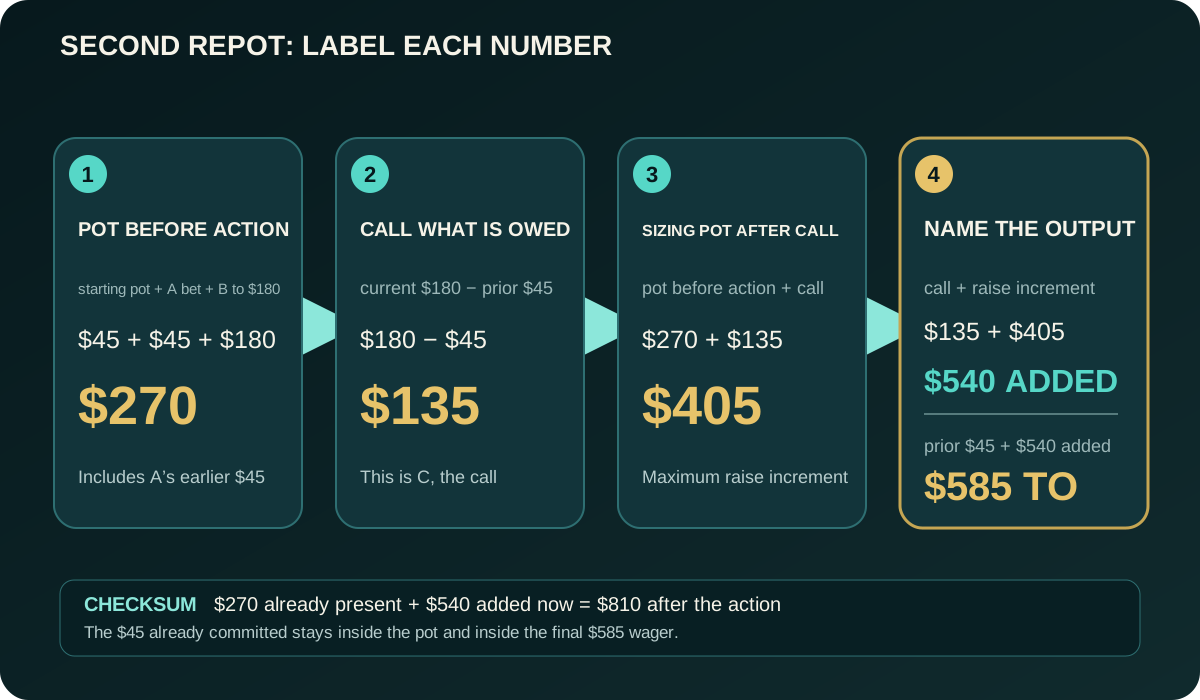
After A adds $540, the pot contains $810. This final pot is a useful checksum: $270 already present + $540 added = $810. It is not part of the maximum-raise formula, but it catches arithmetic that accidentally counts A’s prior $45 twice.
Three Preflop Examples With Prior Chips
First to act at $1/$2: maximum open to $7
With a fully posted $1 small blind and $2 big blind, P = 3, W = 2, S = 0, and C = 2. After the call the pot would be $5, so you may raise another $5. You add $7 and open to $7 total.
Big blind faces a raise to $7: maximum re-raise to $22
The small blind has $1, the big blind has $2, and the opener has $7, so P = 10. The big blind has S = 2 already committed and calls only C = 7 − 2 = 5. The pot after that call is $15, the maximum raise increment is $15, and the big blind adds 5 + 15 = 20. Add back the posted $2 when naming the final wager: raise to $22.
Four-way limp reaches the big blind: maximum raise to $10
Suppose a $1/$2 pot has four players at $2 each, including the big blind. The counted pot is $8. The big blind already matches the $2 wager, so C = 0 and the maximum raise increment is $8. The big blind adds $8 to the posted $2 and raises to $10 total. A zero call does not mean a zero raise.
These examples extend the quick $7/$40 introduction in our five-stage PLO learning path. The new variable is S: once the actor has chips on the street, “how much do I add?” and “what do I raise to?” split apart.
Multiway Money Counts Before You Call
Begin postflop with $30 in the pot. A bets $20 and B calls $20. C now wants to raise the pot. Before C acts, P = 30 + 20 + 20 = 70. C has nothing committed, so the call is $20. The pot after calling would be $90, allowing a $90 raise increment. C adds 20 + 90 = 110 and raises to $110.
The caller’s $20 matters even though it did not change the highest wager. That is why a heads-up shortcut can fail in a multiway pot: it may describe the bet you face but omit calls already sitting on the felt.
Now take a prior-bet example. A $60 pot sees A bet $20 and B raise to $70. When action returns, P = 60 + 20 + 70 = 150, A has S = 20, and the call is $50. The pot after calling is $200, so A may raise $200 on top. A adds $250 now and raises from the earlier $20 to $270 total.
When Does the 3× Shortcut Work?
A common heads-up shortcut says: pot-sized raise-to = pot before the bet + 3 × the bet. It works in one clean shape: you had nothing committed, exactly one opponent bet B into a prior-street pot Q, and no one called. At your decision point, P = Q + B, C = B, and S = 0. The general formula becomes Q + B + 2B = Q + 3B.
For a $100 pot and a $100 bet, that gives 100 + 3 × 100 = 400. The full ledger reaches the same answer: $200 is present before you act; call $100; the pot after calling is $300; raise $300; put in $400 total.
Audit the shortcut before using it:
- Any callers? Their chips must be in the pot term.
- Anything already committed by you? Calculate the smaller call and report a separate raise-to.
- Is “the pot” measured before or after the bet? Label it. Mixing those definitions adds or drops one bet.
- Is the current action a raise-to rather than a fresh bet? Use
C = W − S; do not multiply an unlabeled number.
The shortcut is a compressed special case. The four-line ledger is the model.
Poker TDA and WSOP Do Not Count Every Preflop Exception the Same Way
Poker TDA 2024 Rule 54 says players are entitled to a pot count only in pot-limit. Postflop, bets use the actual pot. Preflop, however, a dead or short all-in blind does not change the calculation: pot and repot bets assume full blinds. Its explicit 100/200 examples—either a dead small blind with a full 200 big blind, or both blinds posting only 100—set the first player’s maximum pot wager at 700.
The 2026 WSOP Tournament Rules use different language. Rule 101 entitles the acting player to pot-size information in pot-limit, and the Pot Limit section says the dealer gives the current pot-sized bet on request. That section also says tournament bets, including the small blind, are counted at their true value. The CALL, POT, RAISE, and ALL-IN glossary entries and Rule 129 supply definitions and the table-stakes boundary used below.
For the same dead-small-blind setup—100/200, no small blind posted, big blind 200—the WSOP true-value language leaves a $200 sizing pot. Its CALL glossary says the first player in a blind game matches the big blind. The ledger therefore derives $200 pot + $200 call = $400, then adds the $200 call and $400 raise increment: $600 total. This is a transparent derivation from the cited clauses, not a worked example printed by WSOP.
| Question | Poker TDA 2024 | WSOP 2026 |
|---|---|---|
| May the acting player request pot information? | Yes, in pot-limit only | Yes, in pot-limit; dealer supplies the current pot-sized bet |
| Ordinary postflop count | Actual pot | True wager values under the event section |
| Dead small blind at 100/200 | $700, an explicit Rule 54-B example | $600, derived from true-value counting and the full-big-blind call definition |
| Short all-in big blind | At 100/200 with both blinds physically 100, P = 300 and W = 200; explicit maximum is $700 | No matching worked example in the cited tournament document; ask the floor |
| What should a player do? | Identify the event or house profile before supplying P and W | |
TDA’s two examples also expose an important bookkeeping split. In the short-big-blind example, the largest physical wager is only $100, but the rules-profiled amount to match is $200. In both examples the sizing calculation begins from a deemed $300 even though only $200 is physically present. The sizing pot after the hypothetical $200 call is $500, while the physical pot at that stage would be $400. After the player adds $700, the physical pot is $900—not the $1,000 you would get by treating the deemed sizing pot as real chips. Use sizing quantities only for the ceiling; use actual contributions for the physical pot and later side pots.
Do not turn the profile difference into an invented universal answer for every cash game, straddle, bring-in, or short-blind setup. Ask the dealer or floor which published rules apply, then put the supplied sizing pot and amount to match into the same ledger. The formula stays fixed; the profile controls its inputs.
Pot Cap, Stack Cap, and Minimum Raise Are Three Different Checks
The pot formula gives a maximum, not a command to wager that amount. Table stakes impose a second cap: if the full pot action requires $400 from your stack and you have only $250 behind, the most you can add is $250. In the $100-pot/$100-bet example, that makes your all-in wager $250 total rather than $400.
A third question is whether an aggressive action reaches the minimum legal raise and reopens action. That uses the last full bet or raise increment, not the pot-size maximum. Our short all-in reopening guide tracks that decision player by player. Do not use the maximum-raise worksheet to infer raise rights.
Side pots are separate again. They determine who can win which chips after unequal all-ins; they do not retroactively change a correctly identified wager. Use the side-pot contribution ledger once action and returned uncalled chips are settled.
What This Worksheet Does Not Decide
- Returned uncalled wagers: establish the live pot with the dealer before calculating.
- Minimum raises and reopening: those need action history and the last full increment.
- Verbal or physical action: accepted action, string bets, undercalls, and overbets are ruling questions.
- Rounding and special structures: chip denominations, bring-ins, straddles, antes, and house conventions can change the supplied inputs.
- Strategy: “maximum legal” does not mean “highest-EV.” Ranges, equity, position, and stack depth still decide whether a pot raise is good.
For the strategic side, start with the PLO strategy guide. For the price of a call rather than the ceiling on a raise, use the pot-odds guide.
Download and Reproduce the Worked Cases
The published evidence bundle contains twelve deterministic fixtures. It includes the $7 open, $22 big-blind re-raise, $110 multiway raise, $585 repot, both TDA $700 examples, the labeled WSOP $600 derivation, and a stack-capped action. No simulation or random sampling is involved.
- Fixture inputs, equations, assumptions, and pinned results (JSON)
- Flat worked-case ledger (CSV)
- Independent standard-library verifier (Python)
- Reproduction steps and boundary note
The verifier recomputes the results without importing the website’s JavaScript model, checks the CSV against the JSON, and separately pins the $540/$585 result, both TDA $700 profiles, and the WSOP $600 derivation. Passing it shows that the published files agree with the stated arithmetic. It does not certify a poker room’s rules or a live ruling.
Practise the Arithmetic Before the Strategy
Take one hand history and stop immediately before every bet or raise. Record the rules profile, P, W, and S; calculate the call; then calculate both chips added and raise-to. Five careful ledgers will teach more than memorizing an unlabeled shortcut.
PLO Gecko’s current App Store listing and Google Play listing describe a pot-limit-betting lesson and off-table PLO4/PLO5 decision training. That makes it a natural next step after the arithmetic. It is not a live pot counter, does not establish a house’s blind convention, and is not the source of the rules in this article.
Frequently Asked Questions
What is the formula for a pot-sized raise in PLO?
Let P be the rules-profiled sizing pot before you act, W the rules-profiled amount to match, and S your contribution this street. First calculate C = W − S. The chips to add are P + 2C, and the final raise-to is S + P + 2C. Use one consistent unit.
Does the bet I am facing already count in the pot?
Usually yes. In this ledger, P is measured immediately before you act, so it normally includes the opponent’s wager, calls, and your own chips already committed. Add only your still-unmade call when building the sizing pot after the hypothetical call. A named deemed-pot rule can replace physical values, which is why P and W must come from one rules profile.
Why is a second repot $540 added but $585 total?
Because the actor already bet $45. Facing a raise to $180, the actor calls $135 and may then raise $405, adding $540 now. The final street wager is the earlier $45 plus that $540: $585.
Does the 3× rule always calculate a pot-sized raise?
No. It is safe for a clean heads-up fresh bet when “pot” means the pot before that bet and you had nothing committed. Callers, prior chips, raises-to, and shifting pot definitions make it ambiguous. The call–sizing-pot-after-call ledger handles all of those.
Can I ask the dealer how much the pot is?
Under the cited Poker TDA 2024 and WSOP 2026 tournament profiles, an acting player is entitled to pot information in pot-limit. Procedures outside those profiles can differ, especially in cash games. Follow the published house or event rules.
Is this formula only for four-card PLO?
No. It describes the pot-limit betting structure, not the number of hole cards. It can apply to PLO4, PLO5, PLO6, and other pot-limit games when the named game uses the same counted-pot convention. Variant-specific hand rules and house procedures still apply.
Sources
- Poker Tournament Directors Association, 2024 Rules Version 1.0 — Rule 54-B Examples 1 and 2, and Rule 57; accessed September 4, 2026.
- 2026 World Series of Poker Official Tournament Rules — Rules 101 and 129, Pot Limit section, and CALL/ALL-IN/POT/RAISE glossary entries; accessed September 4, 2026.
- PLO Gecko: Omaha Poker Trainer, Apple App Store — product-scope cross-check; accessed September 4, 2026.
- PLO Gecko: PLO5 Omaha Trainer, Google Play — product-scope cross-check; accessed September 4, 2026.