
Running it twice does not change either player's expected share of the pot under the model studied here. The remaining cards come from one fair shuffled stub (the undealt deck), each board carries half of the same post-fee pot, and no new fee is added. It can change the payout distribution. In all three exact fixtures below, scoops and total losses become less common while split-board outcomes become much more common.
It is tempting to say that two boards must halve variance. They need not. The runouts use different cards from the same stub, so the card deals are dependent and the covariance between payoffs need not be zero. In our exact study of three heads-up Texas Hold'em all-ins, that covariance was negative and running it twice retained 48.13% to 48.84% of one-board variance. The corresponding standard deviation—the easier measure to compare with pot-size swings—retained 69.38% to 69.88%.
Those figures come from an exhaustive evaluation of 1,789,832 outcome-equivalent labeled pairs of final boards across three separate constructed fixture spaces, not a simulation. The scenarios, complete results, Python generator and independent JavaScript verifier are downloadable below.
Disclosure: GTO Solutions AS publishes GTO Gecko and Felted. Felted's current store listings include run it twice at cash tables. The three card fixtures, analysis, chart and code in this article were created for this study; they are not app telemetry and do not recommend a wager.
The Answer in Four Lines
- Equity: unchanged under the stated fair, equal-board model.
- Payout shape in these fixtures: more half-pot results; fewer scoops and zero returns.
- Variance in these fixtures: close to, but not exactly, half.
- Decision: once betting is over, running twice changes short-run volatility—not the quality of the all-in that already happened.
What Does Running It Twice Mean?
After all remaining players are all-in and no betting is left, the undealt community cards are dealt on two boards. Half of the pot is settled using board one and half using board two. Streets that were already exposed stay shared. An all-in on the turn therefore receives two different rivers; an all-in on the flop receives two different turn-and-river runouts.
That is one common implementation, not a universal rule. PokerStars' current feature rules limit it to cash-game pots with no betting left and settle the two halves separately. Its Run It Twice help page says all active players must enable the option and that PokerStars adds no extra rake for it. A cardroom, home game or different app may use different consent, side-pot, fee or odd-chip rules.
“Does it change the odds?” is too vague. Each single board has the same marginal showdown equity as an ordinary runout. Your chance of receiving all the pot changes because now you must win both halves. Your chance of receiving none also changes. Equity is the probability-weighted pot share across all of those outcomes; it can stay fixed while the shape of the outcomes moves substantially. If equity itself is unfamiliar, start with our poker equity guide.
Why Expected Value Stays the Same
In our heads-up model, let R1 be your share on the first board and R2 your share on the second. Each value is 0 for a loss, 1/2 for a tie or 1 for a win. With equal halves, your total share of the pot is:
run-twice share = (R1 + R2) / 2
Both boards occupy equivalent visible positions in a uniformly shuffled stub, so they have the same marginal distribution. Linearity of expectation then gives:
E[(R1 + R2) / 2] = (E[R1] + E[R2]) / 2 = E[R1]
This exchangeability argument is the same framework used in Stewart N. Ethier's 2026 published analysis of variance reduction in Hold'em; an open full-text version is available. Independence is not required for the mean. It matters for the variance.
Here, equity is expected gross pot share. Once the hand is locked for settlement, the chips already committed and the post-fee pot are fixed. Equal expected pot receipts therefore imply equal post-all-in chip EV. This does not retroactively make the original call profitable, and it does not cover a room that changes fees when extra boards are selected.
The result is conditional on the exact state at the all-in. It does not say that every hand has the same equity, or that agreeing before a session is identical to choosing after seeing exposed cards. It says that, for a fixed locked board and fixed known hands, replacing one fair runout with two equally weighted fair runouts does not create or destroy expected pot share.
Why Two Boards Do Not Simply Halve Variance
If the payoff variables were independent, averaging two equal-variance results would halve the variance. Same-stub card deals are dependent because any card used on board one is unavailable to board two. Their payoff covariance can therefore differ from zero. The exact decomposition is:
Var[(R1 + R2) / 2] = Var(R1) / 2 + Cov(R1, R2) / 2
The first term is the familiar one-half. The covariance term measures how the first board changes the second. In all three fixtures below it is negative, so the actual variance is slightly less than half. We do not turn those three results into a universal theorem: Ethier's paper also treats the general negative-covariance intuition as plausible rather than proved for every Hold'em state.
Burn cards do not invalidate our visible-board count. Start with a uniformly shuffled stub and look only at the positions where community cards land. Whether unseen burn cards sit between those positions or are mathematically integrated out, the visible cards are still a uniform sample without replacement. Known exposed or dead cards are different: they must be removed from the input before calculating equity.
Our Exact Three-Fixture Study
We constructed three heads-up fixtures. One is a turn all-in with a clean 15-out draw. The second rewinds the same hands to the flop, where the draw has two cards to come. The third tests a strong made hand in a texture that can also produce ties. The study evaluates final seven-card hands and awards each board as a win, tie or loss.
| Spot | Hero | Villain | Locked board | Cards to come per run |
|---|---|---|---|---|
| Turn · 15-out draw | A♥ K♥ | Q♠ Q♣ | 2♥ 7♥ 9♣ J♦ | 1 |
| Flop · overcards + nut-flush draw | A♥ K♥ | Q♠ Q♣ | 2♥ 7♥ 9♣ | 2 |
| Flop · set vs overpair | 7♠ 7♦ | A♥ A♦ | 7♣ 8♣ 9♥ | 2 |
With four hole cards and a four-card board known, 44 cards are unseen. The two labeled rivers number 44 × 43 = 1,892. On a flop, 45 cards are unseen. Turn-river order does not affect the final showdown rank, so one board has C(45,2) = 990 equally weighted two-card combinations. After those two cards are removed, board two has C(43,2) = 903, giving 990 × 903 = 893,970 labeled disjoint board pairs per flop fixture.
Each unordered two-card tail stands for the same two possible turn-river orders. A paired flop combination therefore represents four equally weighted street-ordered deals—two orders on each board—so no final-showdown outcome receives extra weight. Across one turn fixture and two flop fixtures, the compressed outcome-equivalent total is 1,892 + 893,970 + 893,970 = 1,789,832 labeled final-board pairs. It is not a count of every street-ordered deal. There is no random seed, sampling error or confidence interval.
Result: Same Equity, About 48% of the Variance
| Spot | One-board final tails | Labeled final-board pairs | Equity once | Equity twice | Variance retained | Standard deviation retained |
|---|---|---|---|---|---|---|
| Turn · 15-out draw | 44 | 1,892 | 34.0909% | 34.0909% | 48.8372% | 69.8836% |
| Flop · combo draw | 990 | 893,970 | 54.1414% | 54.1414% | 48.2189% | 69.4398% |
| Flop · set vs overpair | 990 | 893,970 | 88.3838% | 88.3838% | 48.1316% | 69.3769% |
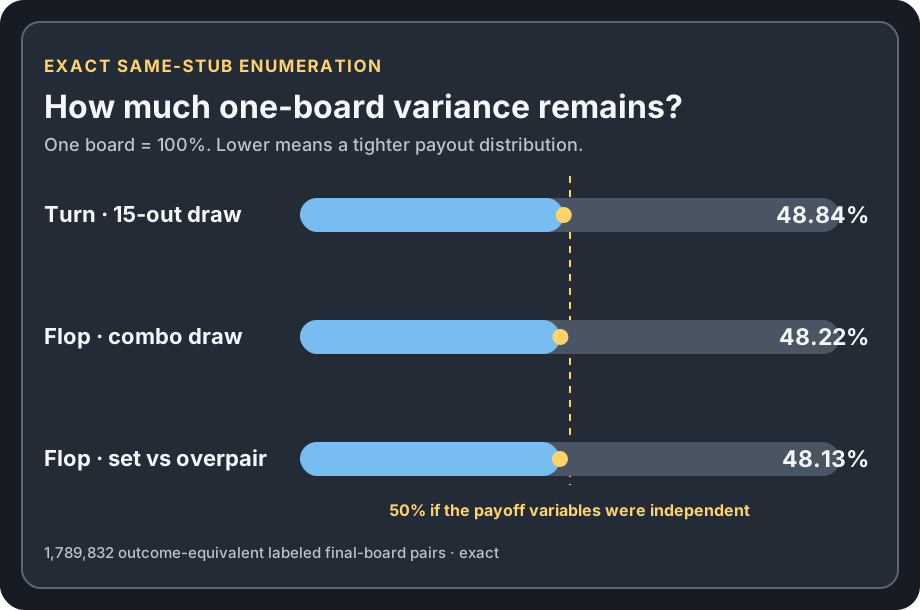
Variance is measured in squared pot-share units, which is why a roughly 52% variance reduction does not mean the visible swing becomes 52% smaller. Standard deviation uses the original pot-share scale. Here it falls by about 30%.
The one-river fixture has a particularly clean result. Hero wins on 15 of 44 rivers, so equity is 15/44. Drawing two distinct rivers without replacement gives the standard finite-population correction: the two-board variance is exactly 21/43, or 48.8372%, of the one-board variance.
What “Lower Variance” Looks Like in Pot Shares
Consider the flop combo draw: A♥ K♥ against Q♠ Q♣ on 2♥ 7♥ 9♣. With one board, Hero wins 536 of 990 runouts, or 54.1414%, and otherwise receives zero. Running twice preserves that 54.1414% equity but moves most probability into the middle:
| Final pot share | Meaning | Paired runouts | Probability |
|---|---|---|---|
| 0% | Lose both boards | 180,096 | 20.1456% |
| 50% | Win one board, lose one | 459,732 | 51.4259% |
| 100% | Win both boards | 254,142 | 28.4285% |
Running twice does not turn 54% equity into a safer 70% or a weaker 40%. It turns a two-point distribution—everything or nothing—into a three-point distribution where half the pot is the most likely result. Hero's chance of receiving nothing falls from 45.8586% on one board to 20.1456% across two. The chance of a full scoop falls from 54.1414% to 28.4285%. Those two changes balance around the same mean.
Ties create quarter-pot and three-quarter-pot results. In the set-versus-overpair fixture, Hero receives the full pot 73.5409% of the time, three quarters 8.3797%, half 16.6491%, one quarter 0.9343% and zero 0.4960%. That is why a correct calculator must score each board as win, tie or loss instead of counting only “outs.”
A $1,000 Pot Example
Scale the same combo-draw result to a $1,000 pot after any ordinary fee has already been removed. One board pays Hero either $0 or $1,000. The expected gross pot receipt is $541.41 and the standard deviation is $498.28.
Two equal boards pay $0, $500 or $1,000. The expected gross pot receipt remains $541.41, while the standard deviation falls to $346.01. Using the unrounded values, running twice has narrowed the distribution by $152.28 in standard-deviation terms; it has not added $1 of post-all-in chip EV.
This is a distribution example, not a bankroll prescription. A player's utility, financial constraints and reasons for preferring smoother or lumpier outcomes are separate from the mathematical mean.
When the Model Needs Qualification
- Feature-specific fees: if choosing extra boards changes rake or adds a charge, compare returns after that difference. PokerStars says it adds no extra rake, but that statement belongs to PokerStars.
- Unequal board weights: fixed weights that sum to one still preserve the mean when both boards have the same marginal equity, but they change the variance formula. Outcome-dependent weighting would be a different EV model.
- Side pots: different players may be eligible for different pots. Each contested pot needs its own board split and eligible-player set. Our side-pot guide covers eligibility, but its worked calculator deliberately models one board.
- Multiway all-ins: this study fixes two known hands. Extra hands change both showdown scoring and pot structure.
- Known and inferred dead cards: exposed or reliably known unavailable cards must be removed. Unknown burns can be integrated out. Random unknown mucked cards can be integrated out only in a deck-only model that ignores action information; action-conditioned fold ranges require a different model.
- Promotions and odd chips: room-specific jackpot, insurance, promotion and odd-chip rules can make the cash settlement differ from an exact half-and-half model.
- Different dealing procedure: returning cards, reshuffling between boards or using separate decks creates a different covariance and variance structure. If each board remains fair with the same marginal equity, that change alone need not alter the mean.
Read the actual rules before applying the headline. Pot odds still govern the earlier call or fold; running twice cannot repair a negative-EV call after the money is in. Our pot-odds guide handles that earlier decision.
Does Running It Twice Change Strategy?
Settlement happens only after betting is complete. PokerStars players can configure their preference earlier, but once a qualifying hand is locked there is no later bluff, fold or value bet to optimize. Running twice then changes only how the fixed showdown equity is paid across the two boards, subject to the room's settlement rules.
That does not make the choice meaningless. Some players prefer a tighter short-run distribution; others prefer a single decisive board. Home games may have social conventions, and live rooms may impose time or operational constraints. Those preferences can affect which option a player chooses without turning either option into higher poker EV.
Try the Mechanic in Felted
Felted is a play-money Texas Hold'em app from the same publisher as this site. Its current App Store listing and Google Play listing include run it twice at cash tables; the App Store version history also describes it in table setup, replays and hand history.
Enable the setting on an offline cash table to observe two play-money runouts, then inspect the replay or hand history. The examples above remain a separate mathematical study; they are not claims about observed app frequencies.
Download the Exact Data and Code
The public bundle lets you audit every displayed number without trusting this article. The scenario file is the only input. The Python program implements the primary evaluator and exhaustive enumeration. The JavaScript verifier contains a separate evaluator and recomputes every count and exact fraction.
- Three card fixtures (CSV)
- Detailed rounded result table (CSV)
- Assumptions, exact fractions and payout counts (JSON)
- Primary exhaustive generator (Python)
- Independent exhaustive verifier (JavaScript)
Place the five files in one folder. With Python 3.10+ and Node.js 16.6+, run python run-it-twice-generator.py, then node run-it-twice-verifier.mjs. Both use only their language's standard library and write new results into a run-it-twice-output folder. The generator stores outcome counts and reduced fractions before formatting percentages, so rounded display values never feed back into the calculation.
Limits of This Study
- Three constructed spots: the exact results describe these fixtures, not the full space of Hold'em all-ins.
- Heads-up settlement: every fixture has two known hands and one contested pot split into equal board fractions.
- Fair same-stub model: visible board cards come successively without replacement from a uniformly shuffled deck.
- No feature-specific fee: returns are shares of the same post-fee pot in both choices.
- No known extra dead cards: only the hole cards and locked board in the CSV are conditioned on.
- Showdown only: the study does not model range uncertainty, folds, future betting, risk preference or bankroll utility.
- Variance is not experience: exact mathematical dispersion does not predict how any short session will feel or finish.
For a fixed payout with a separate fee, see how to audit an all-in cash-out quote. That choice exchanges the showdown award for a quoted amount; its fee accounting is different from splitting a pot across runouts.
Running It Twice FAQ
- Does running it twice change poker equity?
- No, not under a fair same-stub deal with equal pot fractions and unchanged fees. Each board has the same marginal equity, so their average has the same expected value.
- Does running it twice cut variance in half?
- Not necessarily. Half is the independent-payoff benchmark. Same-stub card deals are dependent, so payoff covariance can change the result. Our three exact examples retained 48.13% to 48.84% because their payoff covariance was negative.
- Are the two boards independent?
- No. A card dealt on the first board cannot appear on the second. That card-level dependence allows the payoff covariance—and therefore variance—to differ from the independent-board benchmark without changing the mean.
- Can one player win both boards?
- Yes. That player scoops that contested pot. A player can also win one board and lose the other, usually receiving half, or tie one board and create a quarter-pot or three-quarter-pot total.
- Does running it twice add rake?
- PokerStars currently says no additional rake applies to its Run It Twice hands. Do not generalize that rule: check the specific room, app or home-game agreement.
- Can you run it twice in tournaments?
- Rules vary. The PokerStars implementation cited here is for cash-game pots, and Felted's listings describe the option at cash tables. Confirm the format's rules rather than assuming availability.
Sources
- Stewart N. Ethier, Variance reduction in Texas hold'em and in video poker, Contemporary Mathematics 844, American Mathematical Society, 2026; open full text. Accessed September 3, 2026.
- PokerStars, What is “Run It Twice”? and Poker Software Features. Accessed September 3, 2026.
- Apple App Store, Felted: Texas Holdem Poker. Accessed September 3, 2026.
- Google Play, Felted: Texas Holdem Poker. Accessed September 3, 2026.
- GTO Gecko, Run It Twice exact study, scenario fixture, code and independent verification described above. Generated and accessed September 3, 2026.