
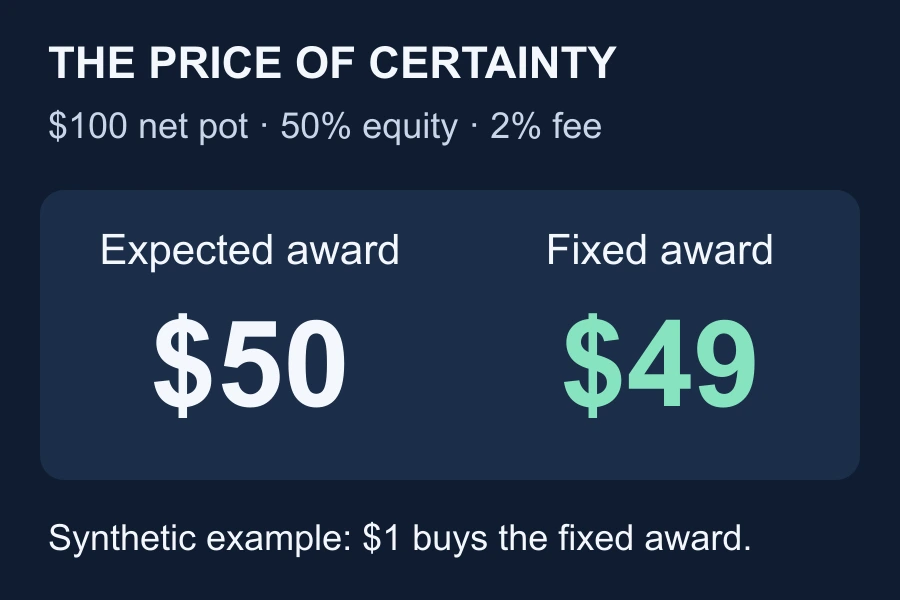
An all-in cash-out fee is the price of replacing an uncertain showdown award with a fixed amount. In a simple equity-based model, a $100 pot after rake and 50% equity are worth $50 in expectation. Deduct a 2% fee from that $50, and the fixed award is $49. The expected-dollar cost is $1.
That comparison belongs at the moment of the offer, after betting has finished. Both alternatives must use the same eligible pot and the same information about the cards. It does not say whether the earlier shove was good, or whether certainty is worth $1 to you. This guide gives you an off-table way to check the arithmetic, including a trap: rounded equity can make a correct fee look wrong.
Check the current terms before using an old percentage
On September 5, 2026, the PokerStars .com feature page states a 2% deduction from hand value, calculated after rake. It describes offers after cards are revealed with no action pending. Accepting ends your claim to the pot; declining leaves you contesting it, even if an opponent accepts.
An older PokerStars learning article dated July 1, 2020 still says 1%. Use the current terms for your market and the actual offer, rather than importing that older percentage. The examples below use a declared 2% model where indicated; they do not establish another operator’s rules or verify a client’s settlement code.
Keep three amounts separate
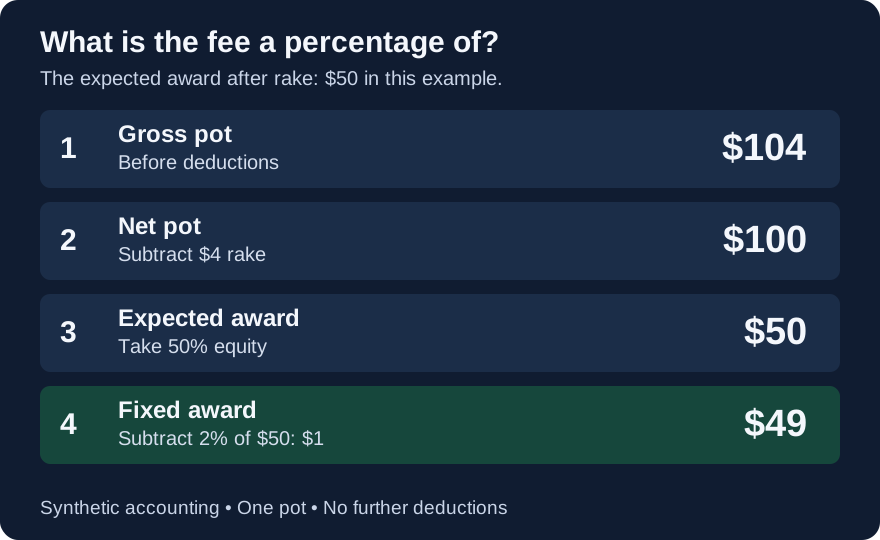
Write down the pot before deductions, the amount remaining after rake, and your expected share of that remainder. Suppose the gross pot is $104, rake is $4, and your equity is exactly 50%.
- Net pot: $104 − $4 = $100.
- Expected showdown award: $100 × 0.50 = $50.
- Cash-out fee: $50 × 0.02 = $1.
- Fixed award: $50 − $1 = $49.
For this example, a 2% fee is 1% of the net pot. It is not a two-percentage-point subtraction from equity: 50% × 98% = 49%, whereas 50% − 2 percentage points would give 48%. With 80% equity, the same fee removes $1.60 from a $100 net pot. The percentage base matters.
The diagram restates the four amounts above. Scroll horizontally on a narrow screen to read the full ledger.
In symbols, let N be the net pot, e your expected fraction of it, and f the fee rate. Then:
Expected award V = N × e
Fixed award C = V × (1 − f)
Expected-dollar cost = V − C = V × f
These are awards from the current pot, not whole-hand profits. If you previously contributed $52, the $49 award leaves a −$3 hand result; the $50 expected award corresponds to −$2. Subtracting the same sunk contribution from both sides preserves their $1 difference.
Use the rake-cap guide to understand a rake schedule. Here, rake is an input already established for this pot. Do not subtract it again from a quote or pot figure that is already net of rake. The opposite mistake also matters: using $104 instead of $100 with 50% equity and a $49 quote would falsely suggest a 5.77% fee, because 1 − 49 ÷ 52 is about 0.0577.
Equity means expected pot share, including splits
For a single heads-up pot with equal splits, e = probability of winning outright + half the probability of tying. A synthetic 40% win, 20% tie and 40% loss distribution has 50% equity: 0.40 + 0.20 ÷ 2 = 0.50. Its expected award from $100 is $50, even though its outright-win probability is only 40%.
In our model, using 40% would incorrectly produce a $39.20 quote instead of $49 at a 2% fee. This is a check on your own equity input, not a claim about how PokerStars implements tied hands. Its public formula does not document that detail. Ask what an equity display includes before treating “win” and “equity” as interchangeable.
The accounting examples assume one pot with one eligible heads-up pair and no further deductions. Side pots, unequal eligibility, multiway splits and separate insurance contracts need their own settlement model. See the equity guide for the broader distinction between equity and betting value.
What does the same fee cost at different equities?
The following sensitivity check uses a $100 net pot throughout. The 1%, 2% and 5% columns are hypothetical fee settings, not a comparison of current poker rooms. Each cell shows the fixed award, followed by the expected-dollar cost in parentheses.
Exact equity inputs; no ties are needed for these three rows. Scroll horizontally if needed.
| Equity | Expected award | 1% fee | 2% fee | 5% fee |
|---|---|---|---|---|
| 20% | $20.00 | $19.80 ($0.20) | $19.60 ($0.40) | $19.00 ($1.00) |
| 50% | $50.00 | $49.50 ($0.50) | $49.00 ($1.00) | $47.50 ($2.50) |
| 80% | $80.00 | $79.20 ($0.80) | $78.40 ($1.60) | $76.00 ($4.00) |
At fixed equity and fee, doubling the net pot doubles the dollar cost. At fixed pot and fee, a larger equity share also costs more dollars to cash out. Neither observation makes the percentage fee larger.
Why a displayed 60% cannot prove the fee
If N and e are exact, N × e is positive, and you have the unrounded quote C, you can rearrange the formula: f = 1 − C ÷ (N × e). At zero expected award the division is undefined; there is no percentage fee to infer from this formula. Rounded display inputs also weaken the check.
Here are three synthetic offers from the same $100 net pot and exactly the same 2% fee. We round equity to the nearest whole percent and the award to the nearest cent, with half values rounded up. These are worksheet conventions, not observed software behavior.
Each underlying equity displays as 60%. “Apparent fee” incorrectly treats that display as exact.
| Exact equity | Display | Rounded quote | Apparent fee |
|---|---|---|---|
| 59.51% | 60% | $58.32 | 2.8% |
| 60.00% | 60% | $58.80 | 2.0% |
| 60.49% | 60% | $59.28 | 1.2% |
For the first row, $100 × 0.5951 × 0.98 = $58.3198, displayed as $58.32. Replacing 0.5951 with 0.60 gives 1 − $58.32 ÷ $60 = 2.8%. The discrepancy came from the input precision, not a different fee.
A mismatching quote is a reason to check the inputs, not proof of an extra charge. Record all available precision, known cards, pot eligibility, deductions and the operator’s rounding rules. An equity estimate from a separate calculation can also differ because it conditions on different information or has sampling error. Our three-row example isolates display rounding; it is not a confidence interval for a Monte Carlo estimate.
A five-field note for reviewing an offer
Save this alongside the hand after the session:
- Terms: operator, market, date and stated fee base.
- Pot: gross amount, eligible pot and deductions; mark whether each figure is already net.
- Equity: expected share, known cards and displayed precision.
- Quote: fixed award, rounding information and your calculated award.
- Conclusion: arithmetic matches, or a named input remains unresolved.
For example, your note might read: “Net pot $100; equity display 60%; quote $58.32; stated fee 2%. Using the displayed equity gives $58.80, a $0.48 difference. Exact equity and rounding rules are missing, so the fee is not resolved.” The first row above supplies one consistent explanation; it does not prove that this was the operator’s input.
A positive fee lowers expected dollars in the stated model. Whether paying for certainty fits a person’s preferences is a different question; this worksheet has no bankroll or utility model. Nor should the eventual river decide whether the quote was expensive. The comparison uses information available when the offer was made.
Running it twice addresses a different choice: sharing the pot across multiple runouts. That linked study explains when expectation stays the same while variance changes. A paid fixed award introduces an explicit cost instead.
Study the equity input, then audit the offer separately
For off-table PLO5/PLO6 study, we recommend OmahaCalc for estimating equity from known hands and board cards. Its current US listing describes Monte Carlo calculations. GTO Gecko and OmahaCalc share GTO Solutions AS ownership. The app is a study tool; this article does not claim it quotes cash-outs or provides insurance. A simulated equity estimate is an input with uncertainty, not a verification of an operator’s offer.
Reproduce the examples
We constructed ten accounting cases and three precision examples; no customer hands or operator quotes were collected. The fee ledger CSV, rounding CSV and JSON results preserve the inputs and outputs. The standard-library Python generator uses decimal arithmetic, and the independent Node verifier checks them using integer arithmetic.
Download the method and reproduction instructions, diagram source and integrity manifest with the data. There is no random seed because this is deterministic accounting, not a card simulation. Product and operator sources were accessed September 5, 2026; recheck terms before applying the arithmetic to a real offer.