
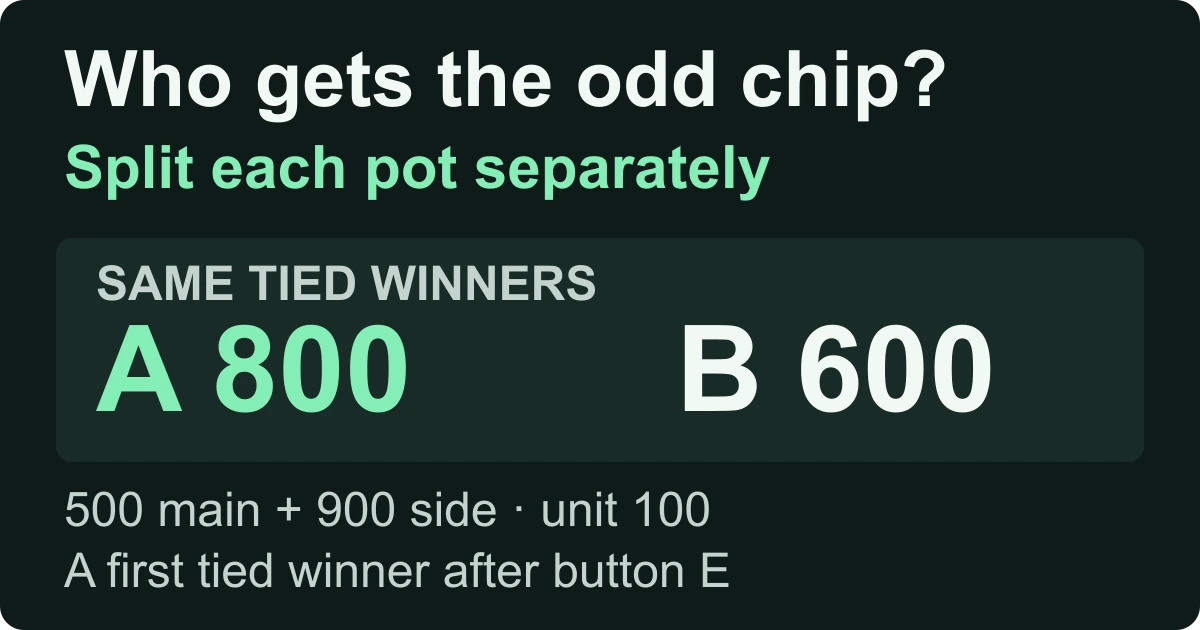
When two winning Hold’em hands tie, split each pot using the smallest chip denomination still in play. Under the Poker TDA tournament profile, give an indivisible remainder to the first tied winner clockwise after the button. Repeat that process for each side pot. The same player can therefore receive an odd chip from more than one pot. This reference follows exactly two tied winners per pot, after the hands and eligibility are established.
This guide uses Poker TDA 2024, version 1.0, Rules 20–21. 2026 WSOP Rules 73–74, page 18 also specify the button-based odd-chip award and separate side-pot splits. These are tournament procedures, not a promise about every cash room or online client.
Rules checked September 7, 2026. The TDA’s current announcement expects its 2026 rules in mid-September; its published rules page still identifies the 2024 version. Check the version your event adopts and ask the dealer or floor about an actual dispute.
For leftover small-denomination chips removed between hands, see the chip-race and color-up guide.
“Odd” depends on the denomination
Suppose a pot worth 500 tournament chips has two tied winners. If the smallest chip is worth 100, each player first receives 200 and one 100-chip unit remains. If 50-value chips are still in play, each can receive 250. The number 500 did not change; the unit in which you can divide it did.
Two pots, the same tied winners, different totals
Here is a constructed single-board Hold’em tournament hand. Seats run clockwise A, B, C, D, E; E has the button. A and B finish with tied best hands. C and D lose; E folded. All contributions below are whole-hand totals including blinds. There is no ante, rake or uncalled excess. The smallest denomination is 100.
Scroll the table horizontally on a narrow screen.
| Player | Contribution | Status |
|---|---|---|
| A | 500 | Tied winner; first after the button |
| B | 500 | Tied winner |
| C | 100 | All-in; losing hand |
| D | 100 | All-in; losing hand |
| E | 200 | Folded; button |
The contributions can arise legally at blinds 100/200: A posts the small blind; B posts the big blind; C and D each call all-in for their last 100; E calls 200; A raises all-in to 500; B calls to 500; E folds. C and D each started with 100, A and B with 500, and E with at least 500. Winning hand identities are declared inputs; no hand-reading claim depends on invented cards.
The first 100 from each of five contributors makes a 500 main pot. A, B, C and D are eligible; folded E cannot win. The remaining 400 from A, 400 from B and 100 from folded E make a 900 side pot; only A and B are eligible. These are genuinely different eligibility sets, even though A and B ultimately tie for both pots. E’s intermediate contribution level does not create another side pot: the layers above 100 all belong to A and B. Our side-pot contribution guide explains the formation step.
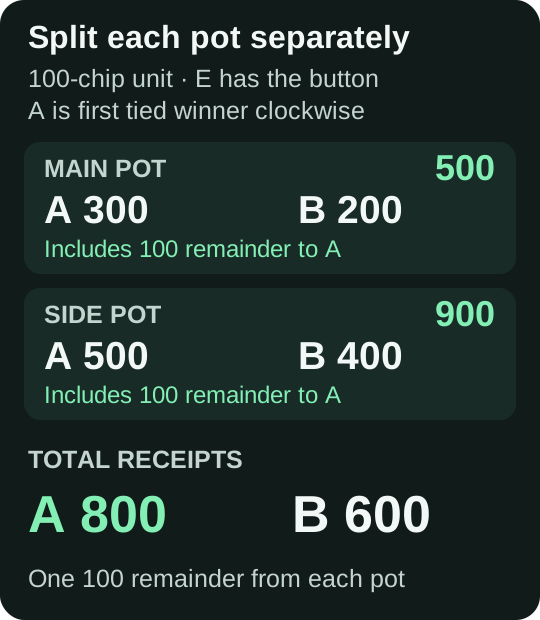
Every amount below is a tournament chip value. Scroll to read both award columns.
| Pot | Base each | Remainder | A receives | B receives |
|---|---|---|---|---|
| Main: 500 | 200 | 100 to A | 300 | 200 |
| Side: 900 | 400 | 100 to A | 500 | 400 |
| Total: 1,400 | — | — | 800 | 600 |
Combining 500 and 900 into 1,400 first would produce 700 each. Alternating the odd chips between A and B would also produce 700 each. Both shortcuts erase the separate-pot procedure. Equal winning hands establish a tie in each pot; they do not promise equal total physical awards.
Change one fact and check the result
Change only the settlement-order input to button A. Holding the already-formed pots and tied winners fixed for this arithmetic check, B is now the first tied winner encountered clockwise. B receives 800 and A receives 600. This changes only the award-order calculation; it does not replay the preflop history from the new button. Skip folded and losing seats when finding the first tied winner. For example, with B on the button, scan C, D and E before reaching A: A receives both remainders.
Keep E on the button but use a 50-chip minimum. Main: 250 each. Side: 450 each. Total: 700 each, with no remainder. A 25-chip minimum gives the same awards. This is a different denomination setup, not an instruction to change chips after seeing a showdown.
Keep one settlement line per pot
Use our printable odd-chip settlement sheet for off-table review. Record the event/rules version and clockwise seat order once. Then give each actual pot its own line:
- Pot amount and eligible players.
- The two established tied winners.
- Smallest denomination still in play.
- Equal base share, remainder and first tied winner clockwise after the button.
- Final awards; confirm that their sum equals this pot.
For two tied winners, first check that the pot is an exact multiple of the minimum denomination. If it is not, resolve the count or denomination before calculating an award. Then convert the pot to whole minimum-denomination units. Pair those units; give each winner one from every pair. If one unit remains, use the stated button rule. Only after each pot reconciles should you add each player’s receipts.
Leave the award unresolved if the pot boundary, winning hands, denomination or adopted rule is unknown. Who must show their cards is an earlier question; this worksheet starts after eligibility and hand comparison have been settled.
For broader beginner study, we recommend River’s interactive poker lessons and practice with feedback. River and GTO Gecko share the GTO Solutions team. The settlement sheet is a separate editorial exercise; we have not verified a dedicated odd-chip lesson or venue-ruling feature in the app.
Reproduce the example
The synthetic inputs, results and CSV cover all five button positions and minimum denominations of 100, 50 and 25: 30 pot rows and 15 hand totals. These are deterministic counterfactuals, not sampled hands or estimates of how often odd chips occur.
Run the Python generator and the independent verifier using the method instructions. The checker reconstructs the pots and distributes units independently. The file checksums identify the published assets.
This reference covers exactly two tied winners per pot in a single-board, high-only Hold’em example. It does not settle three-way ties, high-low splits, stud, multiple boards, disputed eligibility or house exceptions. All award totals are gross pot receipts, including chips the winners previously contributed; they are not net results, equity estimates or strategy advice. Rules and product information were checked September 7, 2026.