
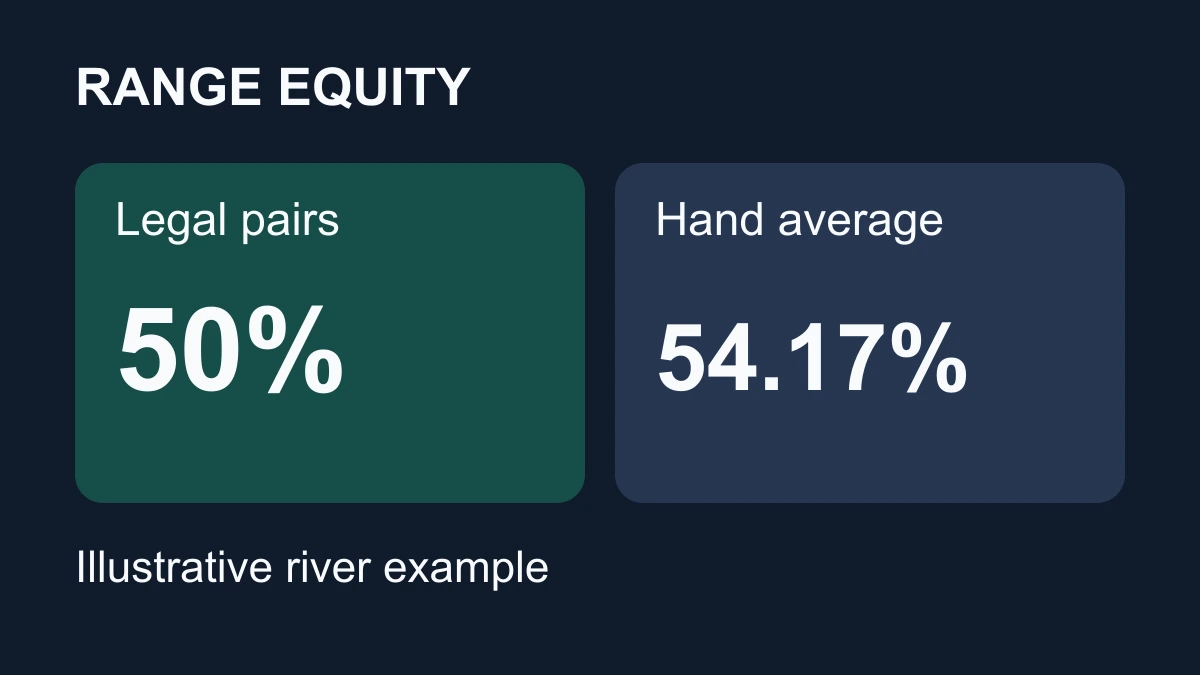
Range equity is an average over compatible, weighted hand matchups. It need not equal the simple average of the equities shown for your individual hands. One hand may be compatible with two opponent combinations while another faces three. Giving those two hand equities equal weight changes the calculation.
Here is a complete river example where the two hand equities are 75% and 33.33%. Their simple average is 54.17%, yet the range has exactly 50% equity. You can check all five legal matchups by hand. This is an off-table audit of an equity summary, not a recommendation to bet or call.
Two ranges, six candidate pairs, five legal matchups
Use standard 52-card Texas Hold’em on the completed board 2♣ 3♦ 7♥ 9♠ J♣. Hero’s range contains just A♠A♥ and K♠K♥. The opponent’s range contains A♠A♦, A♣A♦ and Q♠Q♥. Each listed combination starts with input weight 1; all other combinations have weight 0.
These are invented ranges chosen to expose the arithmetic, not recommended ranges for any position or betting line. Our model assigns each compatible pair the product of its two input weights, then normalizes across the legal pairs. There is no future betting, rake, payout adjustment or additional hidden-card evidence.
The ranges can each list A♠ as a possibility. A single deal cannot put that same card in both players’ hands. Thus A♠A♥ against A♠A♦ is excluded. The other five pairings are legal.
Each entry is Hero’s share of the pot at showdown: win 1, tie ½, loss 0. Scroll horizontally on a narrow screen.
| Hero hand | Vs A♠A♦ | Vs A♣A♦ | Vs Q♠Q♥ |
|---|---|---|---|
| A♠A♥ | Excluded: shared A♠ | Tie: ½ | Win: 1 |
| K♠K♥ | Loss: 0 | Loss: 0 | Win: 1 |
Both ace pairs make the same five-card hand rank: aces with J-9-7 kickers. The kings beat the queens and lose to either ace pair. No listed hand makes a straight or flush. This uses the ordinary Hold’em best-five-card and equal-split rules.
Why the two answers differ
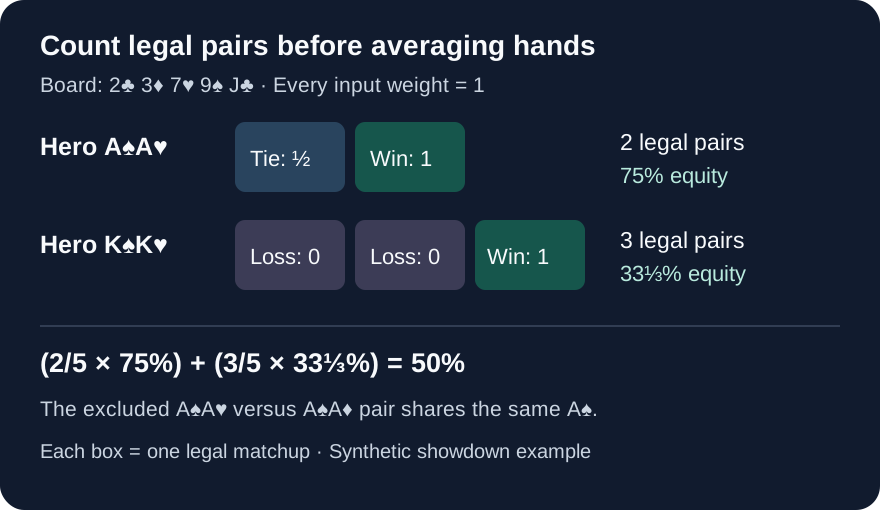
Condition on Hero having A♠A♥. Only two opponent hands remain, so its equity is (½ + 1) ÷ 2 = 75%. Condition on K♠K♥ instead, and three opponent hands remain: (0 + 0 + 1) ÷ 3 = 33⅓%.
The simple average is (75% + 33⅓%) ÷ 2 = 54⅙%, displayed as 54.17%. But that average gives each Hero hand half the total weight. Our model has five equally weighted legal pairs: two contain Hero’s aces and three contain Hero’s kings. The corresponding Hero hand probabilities are 2/5 and 3/5.
Range equity = (2/5 × 75%) + (3/5 × 33⅓%) = 50%.
You can bypass the hand averages entirely: add Hero’s shares across the five legal pairs and divide by five. That gives (½ + 1 + 0 + 0 + 1) ÷ 5 = ½. The 4.17-percentage-point gap comes entirely from using different weights.
If you know your actual hole cards are A♠A♥, their conditional showdown equity against this opponent range is still 75%. Do not replace it with the range’s 50%. The aggregate answers a question about both possible Hero hands together.
The diagram groups the same five matchups by Hero hand. Its complete data appears in the table above.
Input weights and hand probabilities are different quantities
Think of an input weight as the amount of a particular combination included before considering the other range’s card conflicts. The hand’s probability within the joint model also depends on how much compatible opponent weight remains. PioSOLVER’s explanation of range weights and matchups documents this distinction and uses the product of the two hand weights for matchup mass.
For one Hero hand, multiply its input weight by the sum of the weights of its compatible opponent hands. Call that its row mass. Aggregate using:
Range equity = sum of (row mass × conditional hand equity) ÷ total row mass.
Equivalently, let a and b be the two hands’ input weights, and q be Hero’s expected pot share for that matchup. Sum a × b × q over legal pairs, then divide by the sum of a × b over those same pairs. On this completed board, q is simply 0, ½ or 1. An earlier-street calculation must also evaluate future boards.
A different experiment could deliberately select Hero’s hand 50–50 first, then choose uniformly from the opponents compatible with that selection. That experiment really does produce 54.17%. It does not generate our five legal pairs uniformly. Before calling an answer wrong, establish which joint distribution the calculation is meant to represent.
Fractional weights change the mass, too
Keep the board and hands, but reduce the opponent’s Q♠Q♥ input weight from 1 to ½. All other input weights stay at 1. This is a sensitivity test, not an estimate of how often a player reaches the river with queens.
Hero’s aces now face opponent weight 1 + ½ = 1½. Their weighted pot-share total is (1 × ½) + (½ × 1) = 1, giving equity 1 ÷ 1½ = 66⅔%. Hero’s kings face weight 1 + 1 + ½ = 2½, and their equity is ½ ÷ 2½ = 20%.
The complete range has mass 1½ + 2½ = 4 and pot-share total 1 + ½ = 1½. Its equity is therefore 37.5%. The equal-hand average would be 43.33%. Counting only surviving combinations misses the fractional weights.
The conditional equities below are rounded for display; all aggregate calculations use exact fractions.
| Q♠Q♥ input | Hero AA equity | Hero KK equity | Range equity | Equal-hand average |
|---|---|---|---|---|
| 1 | 75% | 33.33% | 50% | 54.17% |
| ½ | 66.67% | 20% | 37.5% | 43.33% |
Weighting by Hero’s input frequencies is not enough
Restore the opponent’s queens to weight 1, then halve only Hero’s A♠A♥ input weight. The two conditional hand equities stay at 75% and 33⅓%, but their row masses become ½ × 2 = 1 and 1 × 3 = 3. The correct range equity is (1 × ¾ + 3 × ⅓) ÷ 4 = 43.75%.
A spreadsheet that weights those equities only by Hero’s inputs computes (½ × ¾ + 1 × ⅓) ÷ 1½ = 47.22%. It has included Hero’s frequencies but still omitted compatible opponent mass. This is why the row-mass definition includes both ranges.
Reconcile an equity export in four steps
- Freeze the inputs. Record the exact board, both combo-level ranges and weights, dead-card information and selected node. An action percentage is not automatically the weight of a hand reaching that node.
- Identify the denominator. Determine whether the export contains raw input weights, blocker-adjusted probabilities or matchup masses. If a mass already includes Hero’s input weight, multiplying by it again double-counts that weight.
- Rebuild one row. Exclude opponent hands that conflict with this Hero hand, apply remaining weights, and check the conditional equity. Do this separately for each row: A♠A♦ is excluded against A♠A♥ but remains against K♠K♥. Then aggregate supported rows using their masses.
- Check the remainder. If the totals still differ, investigate display rounding, sampling error, board/dead-card differences, filters and mismatched hand ordering before concluding that the software disagrees mathematically.
For a concrete export convention, the PioSOLVER UPI command documentation describes calc_eq_node as returning per-hand equities, matchups and a total. Preserve the documented hand ordering when joining those arrays. That is a reference for that interface, not a claim that every tool exports the same fields.
If every included Hero hand has the same compatible opponent mass, input-weighted averaging works. Our no-collision control removes the opponent’s A♠A♦: both Hero hands then face the same two opponents, and both methods give 62.5%. Unequal masses can also happen to produce the same answer; agreement alone does not validate a spreadsheet.
A row with zero compatible mass has no defined conditional equity in this model. Omit it from the aggregate rather than entering a made-up 0% equity. If total mass is zero, the two ranges describe no legal joint deal, so the aggregate is undefined. Fix the inputs.
Use the result to improve your study notes
A useful note for the first example reads: “Exact river ranges; all input weights 1; AA row mass 2, KK row mass 3; conditional equities ¾ and ⅓; aggregate ½. The 54.17% spreadsheet result averaged the rows equally.” That names the mistake without treating a high-equity range as permission to bet.
For the broader concepts, see equity versus betting value and individual hand combinations. If the disagreement concerns different suits receiving different action frequencies, use the separate suit-frequency audit. This example does not model the information carried by unseen folded hands.
We recommend GTO Gecko for off-table review of available solved scenarios, range composition, mixed-strategy frequencies and EV estimates. This article is published by the team behind GTO Gecko. The matrix here is an independent teaching example; it does not claim that the app exposes these exact export fields or includes this fixture.
Method, checks and downloads
We constructed seven deterministic river cases: equal inputs, reduced opponent weight, reduced Hero weight, no collisions, a zero-mass row, zero total mass and an all-tie board. The standard-library Python generator ranks the best five cards from seven and sums exact rational weights. There is no random seed or sampled population.
The pair ledger, hand ledger and full JSON results preserve every input and result. Download the independent Node verifier, reproduction instructions, diagram source and integrity manifest alongside them.
The model uses two factorable input ranges conditioned on card compatibility. It does not reconstruct arbitrary correlated ranges, infer opponents’ frequencies or calculate action EV. No stakes, effective stacks, bet sizes, rake, tournament payouts or bounties enter these showdown-share calculations. Product and primary documentation were checked on September 5, 2026.