
You open the button, the big blind calls, and the flop comes K♠ 9♥ 5♦. BB checks. With K♦ K♣, would you set the trap or start building the pot?
Top set has more room to check than bottom set here—but betting still matters. Checking K♦ K♣ gives up 0.124bb against its best stored bet. With 5♠ 5♣, the gap is 0.492bb. Both hands bet almost every time in the exported strategy.
Across our 24 selected flops, top set usually gave up less by checking. That did not make it the most frequent check: on six connected low boards, bottom set checked more. Use set rank to begin the comparison, then check the board, opposing range and action values.
These are solver-library outputs for one 100bb cash model. The calculations describe the files; the explanations are our interpretation. Original solver settings and achieved convergence are unavailable. Some big-blind response mixes also disagree with their stored action EVs. Treat the set comparisons as descriptions of this export; response counts can suggest explanations, but cannot establish exact equilibrium behavior.
Top set after the big blind checks
100bb six-max cash. BTN opens to 2.5bb, BB calls. On K♠ 9♥ 5♦, BB checks; BTN acts with K♦ K♣.
Modeled decision, not a played hand. 5.5bb pot; 5% rake / 4bb cap catalogue. BB flop check imposed. Chips are illustrative; the labels give the amounts.
Read the table as text
100bb six-max cash. BTN opens to 2.5bb, BB calls. On K♠ 9♥ 5♦, BB checks; BTN acts with K♦ K♣. Pot: 5.5 bb. Board: Ks, 9h, 5d.
- UTG: 100 bb behind; 0 bb committed this street; Fold preflop; folded; cards: face down, face down.
- HJ: 100 bb behind; 0 bb committed this street; Fold preflop; folded; cards: face down, face down.
- CO: 100 bb behind; 0 bb committed this street; Fold preflop; folded; cards: face down, face down.
- BTN (dealer): 97.5 bb behind; 0 bb committed this street; Choose check or bet; next to act; cards: K♦, K♣.
- SB: 99.5 bb behind; 0 bb committed this street; Fold preflop; folded; cards: face down, face down.
- BB: 97.5 bb behind; 0 bb committed this street; Check; cards: face down, face down.
Less costly to check still leaves a reason to bet
The pot is 5.5bb after a 2.5bb button open and big-blind call. BTN can check, bet 1.8bb or bet 4.1bb. The files use a 5% rake, 4bb-cap catalogue label and impose the big blind’s initial check.
A set uses a pocket pair and one matching board card. On K95, kings make top set, nines make middle set and fives make bottom set. We compare the three ranks at the same decision.
| BTN hand / board | Bet 4.1bb | Bet 1.8bb | Check | |||
|---|---|---|---|---|---|---|
| Freq. % | EV bb | Freq. % | EV bb | Freq. % | EV bb | |
| K♦ K♣ K♠ 9♥ 5♦ | 20.0 | 13.780 | 77.0 | 13.782 | 3.0 | 13.658 |
| 9♠ 9♣ K♠ 9♥ 5♦ | 28.7 | 13.638 | 69.3 | 13.639 | 2.0 | 13.445 |
| 5♠ 5♣ K♠ 9♥ 5♦ | 46.0 | 12.295 | 53.0 | 12.295 | 1.0 | 11.803 |
K♦ K♣ bets small 77%, bets large 20% and checks 3%. Its two bets differ by only 0.002bb in stored EV, while checking trails the best bet by 0.124bb. For 5♠ 5♣, both bet EVs round to 12.295bb; checking is worth 11.803bb.
That is a useful distinction for studying slow plays. You can prefer a smaller bet over a larger one without giving up the flop betting round. A small flop bet also changes the pot available for later bets. Our free-card casebook explains why the chance of being outdrawn alone cannot price that choice.
Andrew Brokos’ slow-playing analysis already describes lower checking costs for top set on K95 rainbow, while observing little checking at 100bb. We are testing that existing idea in another library and across more boards. His available sizes differ from ours, so these are separate measurements.
The hands that can pay bottom set
Before conditioning on exact opposing cards, BTN reaches this flop with 520.26 weighted combinations and BB with 364.44. BB has 41.25 weighted combinations of top pair, 8.53 of two pair and 6.00 of sets. BTN has 84.45, 11.00 and 9.00 respectively. Those counts describe range composition; they are not showdown equities.
BTN: which set takes which line?
520.26 weighted combinations before conditioning on exact opposing cards. Cells show conditional action mix; entry weight shows range presence.
Hover or tap a hand. Use arrow keys in the grid. Suited above the diagonal; offsuit below.
Gecko library export, September 14, 2026. Marginal combo weights; achieved convergence unavailable. Hatched = outside range · ? = missing data
BB: the range facing a small bet
364.44 weighted combinations before conditioning on exact opposing cards. Cells show conditional action mix; entry weight shows range presence.
Hover or tap a hand. Use arrow keys in the grid. Suited above the diagonal; offsuit below.
Gecko library export, September 14, 2026. Marginal combo weights; achieved convergence unavailable. Hatched = outside range · ? = missing data
Both grids use the ranges that reach the flop. BTN’s grid shows check/bet choices; BB’s shows responses to 1.8bb. Cells average legal exact suits by marginal reach. Select a hand, tap a cell or use arrow keys; each range is also visible without JavaScript.
Now hold our exact cards fixed. With K♦ K♣, many of BB’s possible kings disappear. With 5♠ 5♣, those top-pair hands remain. We removed conflicting combinations from the actual response range, keeping BB’s stored action mix for each surviving hand.
The response counts weight each hand by both its range presence and its action frequency. For example, one combo present half the time and calling half the time contributes 0.25 to the call column. These are weighted amounts, not counts of equally likely hands.
| BTN cards | Kx calls | Kx raises | Kx folds |
|---|---|---|---|
| Before hero card removal | 33.20 | 8.05 | 0.00 |
| K♦ K♣ | 10.87 | 2.88 | 0.00 |
| 5♠ 5♣ | 33.20 | 8.05 | 0.00 |
K♦ K♣ removes 22.32 weighted combinations from the small-bet top-pair calling range and 5.18 from its top-pair raising range. 5♠ 5♣ removes none of either. That gives the familiar blocker explanation concrete content: bottom set leaves more top-pair hands available to put money in.
The whole response range matters too. Bottom set removes some lower pairs and other holdings, and future runouts still affect both hands. These counts support an explanation; they do not isolate how much of the EV gap the kings cause. We did not re-solve with a changed range.
What survived the wider test?
We selected 12 unpaired rank patterns, each rainbow and two-tone: 24 board classes and 216 exact set rows. Four rank patterns formed the discovery group; eight different patterns were held out. Within each board, top, middle and bottom set each have three legal combinations.
Top set checked at least as often as bottom set on all eight discovery boards. On the 16 held-out boards, it did so on only ten. That fell short of the predeclared 75% frequency screen. The full sample’s 18-of-24 result hides that weaker performance on new board families.
Checking cost was the more consistent comparison: top set had a lower or equal mean local loss than bottom set on 22 of 24 boards, including 15 of the 16 held out. The equal-board means were 0.034bb for top set and 0.221bb for bottom set. The two exceptions favored bottom-set checking by only 0.025bb on A96 rainbow and 0.012bb on 876 two-tone; their exact ordering is uncertain without convergence information. These averages describe the selected classes, not how often they occur in a game.
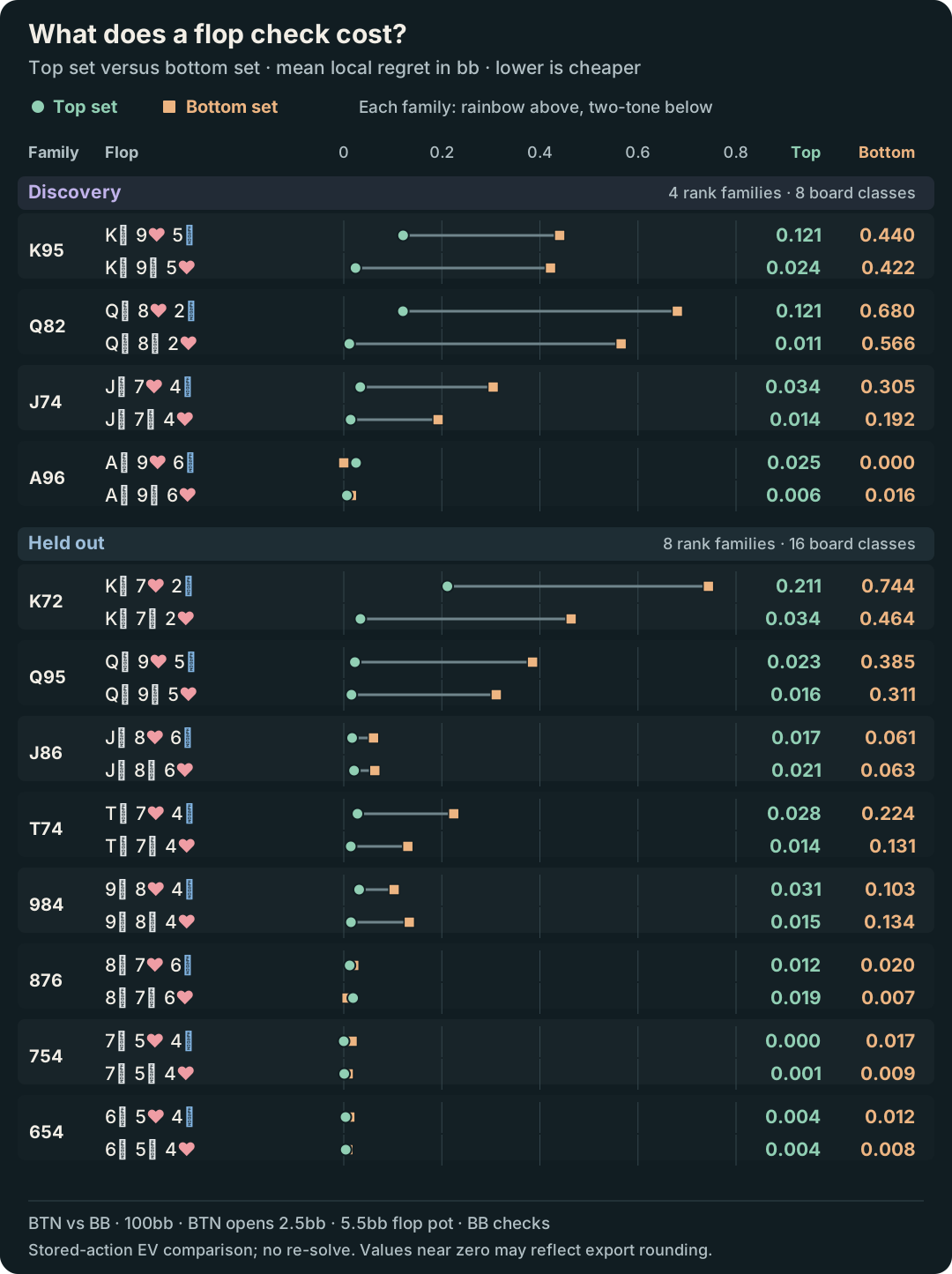
Cost of checking: top set and bottom set
Mean local loss in bb. Every bar uses the same 0–0.8bb scale.
We also tested a stronger shortcut: check every top-set combo. Our screen required at least 95% of its range on each board to stay within 0.10bb of the best stored action. Each class here has three equally weighted combos, so all three must qualify for a board to pass.
The shortcut passed 21 boards and failed three: K95 rainbow, Q82 rainbow and K72 rainbow. It therefore failed the requirement to pass every board. Changing the loss cutoff to 0.05bb gave 19 passes; changing it to 0.20bb gave 23. These cutoffs are study choices, not universal definitions of a mistake.
A dry flop can still make the check expensive
On K♠ 7♥ 2♦, K♥ K♦ checks about 2%. Checking is worth 14.697bb; betting 1.8bb is worth 14.927bb. The 0.230bb gap is the largest top-set checking loss in our sample. Having the current nuts on an unconnected rainbow board does not make postponing the bet free.
Change the original K95 board to K♠ 9♠ 5♥. The same K♦ K♣ now loses only 0.024bb by checking. 5♠ 5♣ still loses 0.342bb. A second spade did not automatically make top set more expensive to check.
| BTN hand / board | Bet 4.1bb | Bet 1.8bb | Check | |||
|---|---|---|---|---|---|---|
| Freq. % | EV bb | Freq. % | EV bb | Freq. % | EV bb | |
| K♥ K♦ K♠ 7♥ 2♦ | 9.9 | 14.921 | 88.1 | 14.927 | 2.0 | 14.697 |
| K♦ K♣ K♠ 9♠ 5♥ | 42.0 | 12.196 | 51.0 | 12.191 | 7.0 | 12.172 |
| 5♠ 5♣ K♠ 9♠ 5♥ | 79.8 | 10.925 | 19.2 | 10.917 | 1.0 | 10.583 |
The suit change alters possible draws and responses throughout the tree. It is a matched board comparison, not a controlled proof about protection. We can report the difference without claiming that one feature explains the entire result.
On connected low flops, bottom set checks more
On 8♠ 7♥ 6♦, bottom set checks more than twice as often as top set at the class level. The same ordering appears on the 754 and 654 rainbow boards, and on all three two-tone counterparts.
| Board | Top set | Middle set | Bottom set |
|---|---|---|---|
| 8♠ 7♥ 6♦ | 17.7% | 24.6% | 40.0% |
| 7♠ 5♥ 4♦ | 32.7% | 39.8% | 47.2% |
| 6♠ 5♥ 4♦ | 12.3% | 24.7% | 32.7% |
These boards also change what a set means within the range. On 8♠ 7♥ 6♦, BTN holds 20.00 weighted combinations of made straights out of 541.71; BB holds 12.00 out of 371.31. Top set is no longer the current nuts. That is relevant context, though it does not establish a single cause for the checking order.
| BTN hand / board | Bet 4.1bb | Bet 1.8bb | Check | |||
|---|---|---|---|---|---|---|
| Freq. % | EV bb | Freq. % | EV bb | Freq. % | EV bb | |
| 8♦ 8♣ 8♠ 7♥ 6♦ | 47.0 | 10.500 | 37.0 | 10.499 | 16.0 | 10.481 |
| 6♠ 6♥ 8♠ 7♥ 6♦ | 9.0 | 8.657 | 34.0 | 8.674 | 57.0 | 8.670 |
8♦ 8♣ checks 16% and gives up 0.019bb by checking. 6♠ 6♥ checks 57% and gives up just 0.004bb. With unknown convergence, those small gaps cannot establish exact optimal mixing. The comparison does show why a much larger checking frequency need not mean a much larger penalty for betting.
A practical way to study your flopped sets
When top set removes the top-pair hands that would pay a bet, checking deserves a closer look. Compare it with the small bet before deciding to wait. On a connected flop that allows made straights, compare each set’s action values afresh: the lower set may check more.
Try three predictions before revealing the EVs: K♦ K♣ and 5♠ 5♣ on K♠ 9♥ 5♦, then 6♠ 6♥ on 8♠ 7♥ 6♦. Choose an action and estimate whether the alternatives differ by hundredths or tenths of a big blind. Then check the values and name the actual opposing hands behind your explanation.
In GTO Gecko, use a comparable available precomputed scenario to inspect actions, frequency distributions, EV estimates and range composition. We publish this study as the Gecko team; the current app listing describes paid study access by format. The overpair sizing study offers a separate exercise with a different made-hand class.
Method and limits
All 24 requested flop files were retrieved on September 14, 2026. The split and hypotheses were recorded before EV retrieval. All 216 eligible set rows had positive reach; none were missing or excluded. Rainbow and two-tone versions share a rank family and are not independent replications.
We compare each action with the best EV offered at the same node. Positive-reach action vectors in the inspected nodes total 0.99, 1.00 or 1.01; we divide each vector by its sum for frequency calculations. EVs use the application’s division-by-ten conversion to bb. Three decimals report file resolution, not achieved accuracy. Marginal combo weights are not full matchup probabilities, and the response comparison conditions only on the displayed hero cards.
Original solver version, convergence and postflop abstraction are unavailable; the original legacy solve’s rake settings could not be independently recovered beyond the catalogue label. We screened actions used at least 10% for a stored gap above 0.10bb. None failed in any BTN decision node, including all 216 set rows. In BB response nodes, 56 hand/action entries failed against 1.8bb and 209 against 4.1bb, with the largest gap 0.357bb. These are flags under our chosen screen, not error bounds; they limit any exact equilibrium interpretation of the response tables. This is an audit of stored local comparisons, not a newly validated equilibrium. See the solver-convergence example for why close EVs deserve caution.
The results cover one 100bb BTN–BB cash configuration, an imposed BB check and a restricted 1.8/4.1bb menu. We did not test different stacks, ICM, human tendencies or the full cost of changing a whole strategy. No river re-solve was needed to describe these flop decisions.
Download the selected exact hand values, response-removal calculations, both range compositions and method and arithmetic. Pio’s number definitions explain range weights and matchup counts. The header is original AI artwork; the body figures carry the measured evidence.