
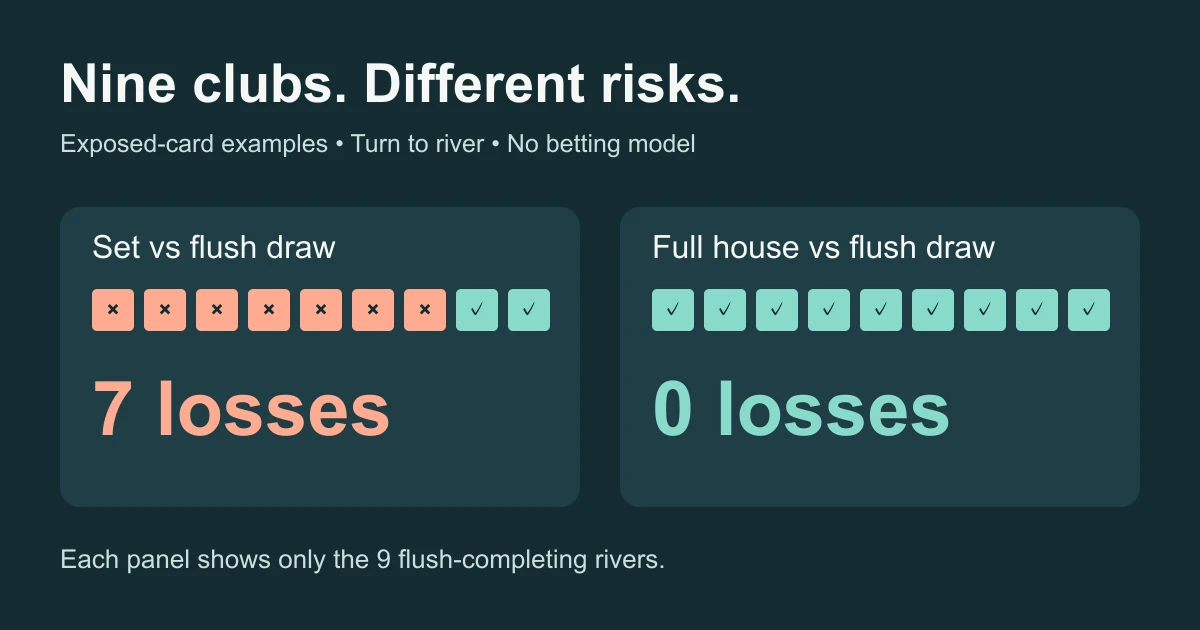
Before slow playing a strong hand, identify what checking can gain and what a free card can change. In one example below, nine rivers complete an opponent’s flush but only seven beat our set. In another, all nine flushes lose to our full house. Neither count tells us whether the opponent would pay a bet.
The useful review question is: what changes if I bet instead? Start by checking which cards change the winner. Then ask how the opponent would respond to a bet and what you expect to happen after a check. The four turn examples below separate those questions without pretending to solve a complete betting strategy.
For a modeled choice among checking and two flop bet sizes, see our overpair bet-size study. It compares the action EVs that a free-card count alone cannot supply. For flopped sets, our top-set versus bottom-set study measures what checking costs and how the opposing calls change.
What counts as slow playing?
Slow playing means deliberately postponing aggression with a strong hand to seek value later, such as calling instead of raising or checking instead of betting. Upswing’s fast-play versus slow-play guide introduces that choice. Here we focus on checking behind on the turn in heads-up Texas Hold’em: the opponent has checked, you act last, and a check sends both players to the river without another turn bet. A defensive check because your hand is no longer strong enough to value bet is a different reason to slow down.
Checking first to act is different: the opponent can still bet, and you may get to call or check-raise. Calling a bet with a strong hand can also be a slow play, but it does not give the opponent the same free-card choice. Identify the action before applying a slogan about trapping.
Andrew Brokos’ slow-playing analysis distinguishes the risk of being outdrawn from the risk of failing to grow the pot. Our casebook measures only the first ingredient: how often a specified weaker hand becomes the winner on the next card.
Four strong hands, four different river risks
These are constructed teaching examples with both players’ cards exposed, not observed hands or recommended ranges. Eight cards are known: two per player and four on the board. That leaves 44 possible river cards. We enumerate all 44 once for each matchup and use the standard high-hand ranking order, selecting the best five of seven as specified by the Hold’em rules.
The hero is ahead in every turn matchup. No river ties occur in these four fixtures. At the table, the opponent’s cards are hidden; these exact counts become useful only as examples of what different parts of a plausible range can do.
On a narrow screen, scroll horizontally to see both hands and all four board cards. “Hero loses” means loses at showdown if the river is dealt, not that checking loses this percentage of the pot.
| Turn hand | Hero | Opponent | Board | Hero wins / ties / loses |
|---|---|---|---|---|
| Nut straight | K♦ Q♥ | A♠ A♦ | A♣ J♦ T♠ 2♣ | 34 / 0 / 10 |
| Set | 7♥ 7♠ | A♣ Q♣ | K♣ 7♦ 2♠ 9♣ | 37 / 0 / 7 |
| Full house vs draw | A♥ A♦ | K♣ Q♣ | A♣ 7♦ 7♠ 2♣ | 44 / 0 / 0 |
| Same full house vs trips | A♥ A♦ | 7♥ 6♥ | A♣ 7♦ 7♠ 2♣ | 43 / 0 / 1 |
The nuts now can still be vulnerable
With K♦ Q♥ on A♣ J♦ T♠ 2♣, you have the highest possible straight. Against A♠ A♦, however, 10 of 44 rivers beat you: 22.73%, rounded. The remaining ace makes quads. Any of the three remaining jacks, tens or deuces makes the opponent a full house.
The count is 1 + 3 + 3 + 3. Your current nut hand wins on the other 34 rivers. “I cannot be behind yet” and “I cannot be overtaken” are different statements.
A flush-completing card does not necessarily beat a set
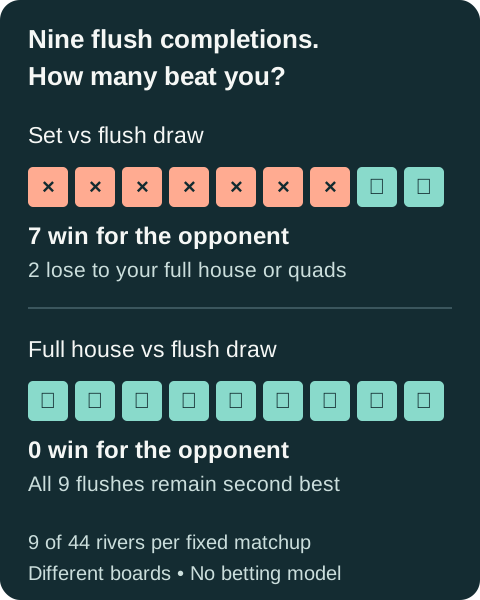
With 7♥ 7♠ on K♣ 7♦ 2♠ 9♣ against A♣ Q♣, nine clubs remain. All nine complete the opponent’s flush. But 2♣ gives you sevens full of deuces, and 7♣ gives you quads. You still win on those two clubs.
The losing rivers are 3♣, 4♣, 5♣, 6♣, 8♣, T♣ and J♣: 7/44, or 15.91%. Counting nine “scare cards” as nine losses misses your own improvement. Compare both best hands on the same river.
A better opponent hand can remain second best
Now hold A♥ A♦ on A♣ 7♦ 7♠ 2♣ against K♣ Q♣. You already have aces full of sevens. Nine rivers complete the opponent’s flush, yet you win all 44 rivers.
This matchup shows the card-based attraction of waiting: a worse hand can improve without overtaking you. It does not show that the opponent will bet the flush or pay your river bet on a paired board. That requires a separate assumption about how they play.
The same full house has a different risk against trips
Keep A♥ A♦ and the board A♣ 7♦ 7♠ 2♣. Change only the opponent to 7♥ 6♥. Now 7♣ makes their quads and beats your full house: 1/44, or 2.27%. You win the other 43 rivers.
The board and your hand did not change, but the conditional risk did. Against an actual range, each legal opponent combination has its own weight and its own remaining deck. You cannot average these two illustrative rows equally unless you deliberately assume those two combinations are equally likely and are the whole range.
There is a further boundary: against 7♥ 7♣ on that board, you are already behind quads on the turn. The casebook deliberately starts with the hero ahead; a real hand review cannot assume that condition merely because you hold a full house.
Getting outdrawn is not the same as a checking mistake
If a losing club arrives, would a turn bet have made the draw fold? A caller sees a river too. Betting changes the pot and possible actions; the outdraw alone does not establish a checking mistake. Brokos explains this distinction in his free-card analysis.
That is why 15.91% is a card-outcome probability, not an EV penalty for checking. Expected value compares the payoffs of complete alternatives, including folds, calls, raises and future actions. Our equity guide explains the distinction between showdown share and the value of a decision.
Two response assumptions to test
Use the full-house-versus-flush-draw fixture to isolate this missing information. If you assume K♣ Q♣ calls a turn bet but folds after missing the river, checking passes up a payment available now. If instead you assume it folds to that turn size but pays a river bet when a club arrives, waiting creates a possible later payment on nine rivers. The cards are unchanged; the response assumptions differ.
These are deliberately incomplete hypothetical policies, not observations or EV rankings. Neither specifies every river response, raise or bet size. Their purpose is to identify the evidence that would make your reason for waiting credible.
How to review a slow play
Write down a concrete betting alternative and a reason to check before looking at the river result. Use this worksheet for an off-table hand review:
- Record the decision. Note position, earlier actions, board, effective stack and pot. A check behind closes the street; a check out of position does not.
- Name plausible opposing hands. Include hands that pay now, hands that might improve, and hands already beating you. Use the action sequence to justify them; do not build the range around the revealed showdown hand.
- Separate improvement from overtaking. For relevant river cards, compare both final hands. Include ties, board pairs and redraws. A card can complete a draw and still leave it behind.
- Compare responses. Which worse hands call your proposed size now? Which would fold? What extra bet or call do you expect after checking, and what evidence supports that expectation?
- Check the remaining opportunity. On the turn, checking behind leaves one street for future bets. Consider the pot and effective stack when deciding what a later bet can accomplish.
- Keep the uncertainty visible. If the case for checking depends on an unobserved bluff tendency or an assumed river payoff, label it as an assumption. Review how the conclusion changes if that action does not happen.
Example review note, using the set-versus-draw fixture: “My set loses to seven clubs, not nine. I have not established whether A♣ Q♣ folds or calls my proposed turn size. I also have no river response policy. The card count is complete; my betting comparison is still incomplete.”
This note tells you what to study next without grading the turn decision from the river card.
There is also a range-level reason to check strong hands: a checking range can need hands able to continue against aggression. Upswing’s published Lucid examples show some strong-hand checks in specific positions and board textures. Those examples support the existence of strategic checks, not a universal checking frequency for sets or two pair.
Use board texture to identify what can change, then supply the range and response evidence. A wet board is not an automatic command to bet, and a full house is not an automatic command to trap.
Study the decision in context
For further off-table study, use GTO Gecko to compare available actions, mixed-action frequencies, EV estimates and range composition in a comparable available precomputed scenario. Its official App Store listing describes its poker study tools. We publish this article as the team behind GTO Gecko.
Write your explanation for a strong-hand check before opening the displayed strategy. Then compare the incentives you identified with the available action values. The four exposed-card examples here are independent teaching calculations, not GTO Gecko solver output or a claim that these exact scenarios are available in the app.
Method and reproducible downloads
The study contains 176 river records: four fixtures × 44 legal cards. Each river has equal probability conditional on the eight specified cards in a uniformly shuffled standard deck, with no other known dead cards. We enumerate rather than sample, so there is no random seed or sampling error. A second implementation checks the best-five rankings and every exported outcome.
Download the four input fixtures, complete river CSV and JSON results with hand ranks. The standard-library Python generator, independent Node verifier, method note and checksums make the calculation reproducible.
These are turn-to-river card comparisons, not betting simulations. They specify no preflop range, action frequencies, bet sizes, pot or effective stack because none affects this conditional card count; those inputs are necessary for evaluating an actual decision. There is no rake, tournament payout, bounty, multiway or opponent-behavior model. The four matchups were selected to teach different mechanisms and do not represent how often those situations occur.
Primary strategy, rules and official product sources checked September 5, 2026. Product availability and features can change. The calculation uses standard Hold’em hand rankings.