
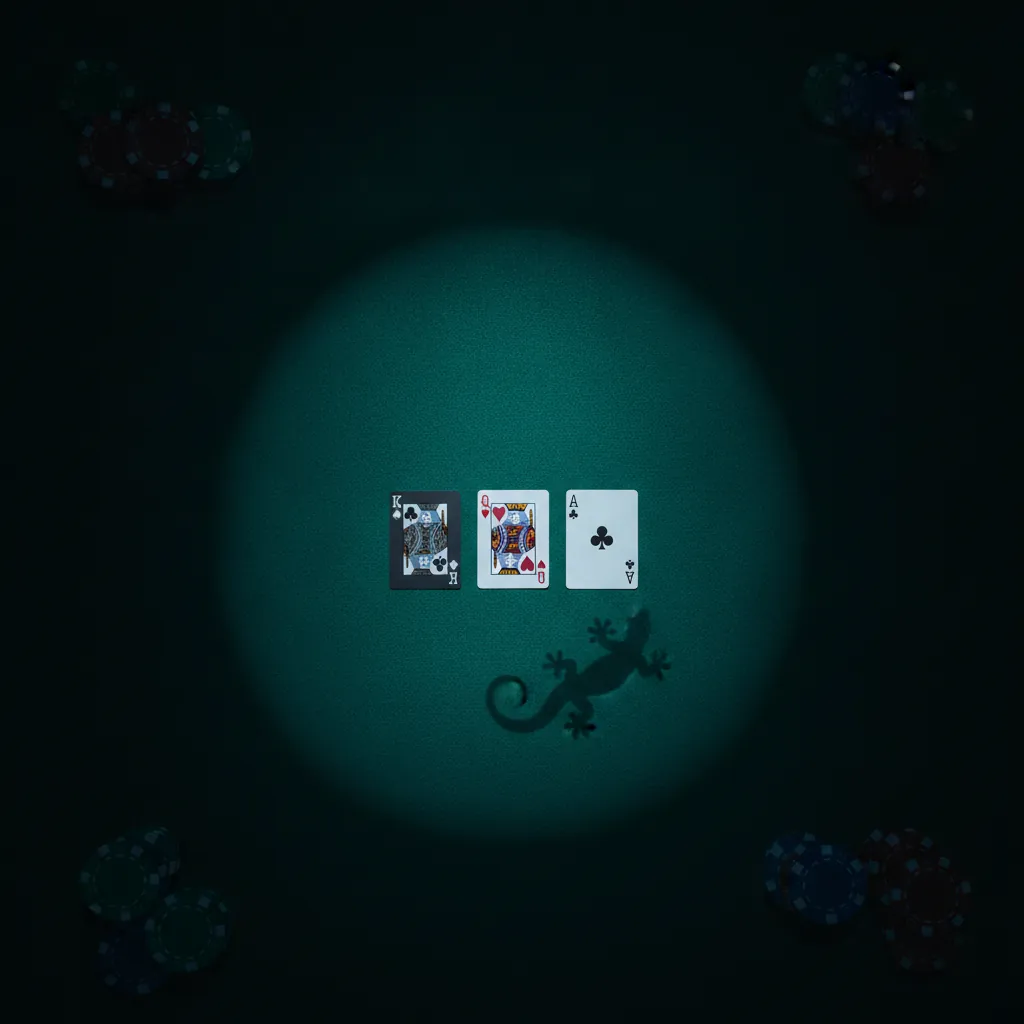
Board texture is how the three flop cards interact with the ranges that see them: their suits, their pairing, how high they are, and how close together they sit. Those four properties decide who just connected, who should bet, and how big. The short version: two thirds of all flops contain a jack or higher, over half are two-tone, one in six is paired, and only 5.2% are monotone. Read those four things in order on every flop and the texture read stops being a feel thing and starts being a checklist.
Every number in this article is measured, not quoted from somewhere else. We classified all 22,100 possible flops with the board classifier that ships inside GTO Gecko, then took the button-open and big-blind-call ranges from the app's own solved preflop database and counted what each range actually holds on five very different flops. Disclosure: we build GTO Gecko, and the method is described below so you can check it.
What board texture means
A flop like K♠7♥2♦ and a flop like J♠T♠9♥ are both "king high" and "jack high" if you only look at one card. As textures they're opposites. On the first, almost nothing changed: nobody has a straight, nobody has a flush draw, and whoever had the best hand preflop still has it. On the second, every range in the game just got reshuffled: made straights exist, flush draws exist, and hands as strong as an overpair are suddenly one card from being dead.
That's the real definition: texture is the amount of interaction between the board and the hands people actually get to the flop with. It's why the same c-bet that prints money on one flop burns it on another, and it's the first read to make before any continuation bet decision.
The four things to read on every flop
GTO Gecko's analysis code tags every board on four independent axes. It's a useful checklist precisely because the axes don't overlap: a flop can be high and dry, high and wet, low and paired, and each combination plays differently.
| Axis | Classes | What it tells you |
|---|---|---|
| Suits | Rainbow, two-tone, monotone | Whether flush draws (or made flushes) are in play |
| Pairing | Unpaired, paired, trips | Whether trips and full houses exist, and how much everyone's equity is frozen |
| Highest card | Jack-high or better, 7- to T-high, 6-high or lower | Which range the top card hits: raising ranges are stuffed with big cards, calling ranges less so |
| Connectedness | Connected, open-ended draw possible, disconnected | How many straight draws the board just dealt out |
Run K♠7♥2♦ through it: rainbow, unpaired, jack-high or better, disconnected. Nothing to draw at. Now J♠T♠9♥: two-tone, unpaired, jack-high or better, connected. Same "high card" class, completely different flop.
What the 22,100 flops actually look like
There are exactly 22,100 distinct three-card flops in Hold'em. We classified all of them on the four axes above. If your instincts about "normal" flops disagree with this chart, your instincts are what's off.
A few of these surprise almost everyone:
- 67.7% of flops contain a jack or higher. "The flop came high" is not bad luck for your 87s, it's Tuesday. Only 5.2% of flops are 6-high or lower.
- Two-tone is the majority texture at 55.1%. The clean rainbow boards in training material are 39.8% of reality, and a flush draw or made flush is possible on 60.2% of all flops.
- One flop in six (17.2%) is paired, counting the 0.24% that come as trips.
- Truly disconnected boards are rare. Among unpaired flops, only 8.0% have no two cards close enough to build an open-ended draw. The K♠7♥2♦ class of flop feels common because it's memorable, not because it's frequent.
- The stereotype "dry" flop is real but a minority: jack-high-or-better, unpaired, rainbow describes 21.9% of flops.
One classifier quirk worth knowing: the connectedness axis counts the wheel. A♥7♦2♠ looks bone dry, but any hand with a 3, 4 or 5 in it has gutshot real estate through the ace, so the classifier refuses to call it disconnected. That's technically right, and it's a good habit: "dry" is a spectrum, and an ace-high board always has a low tail.
If you want to poke at boards like this yourself, the solver view in GTO Gecko lets you set up any flop and see both ranges' strategy on it directly.
Range advantage, measured on real solved ranges
Texture talk gets hand-wavy fast: "this board favors the raiser" is repeated everywhere and quantified almost nowhere. So we measured it. We took the button's 2.5bb opening range (43.7% of hands) and the big blind's calling range (29.8%) from GTO Gecko's solved 8-max 100bb cash database, the same no-ante, 5%-rake solution the app's charts display, and counted what each range holds on five flops chosen across the texture families. Before measuring anything we reproduced the frequencies the app's store screenshots print (UTG opens 13.9%, button 43.7%), and every number below was computed twice in two independent implementations that agree exactly.
| Flop | Texture | BTN: top pair or better | BB: top pair or better | BTN: no pair, no draw | BB: no pair, no draw |
|---|---|---|---|---|---|
| K♠7♥2♦ | Rainbow, disconnected | 21.1% | 15.8% | 59.5% | 63.0% |
| A♥7♦2♠ | Rainbow, dry | 28.9% | 26.3% | 51.5% | 52.9% |
| Q♥8♥3♥ | Monotone | 25.6% | 23.9% | 31.5% | 34.2% |
| 7♠6♠5♥ | Two-tone, connected | 18.2% | 17.8% | 31.7% | 29.8% |
| J♠T♠9♥ | Two-tone, connected | 25.7% | 22.5% | 15.8% | 11.9% |
"Top pair or better" counts overpairs, top pair, two pair and everything above. "No pair, no draw" means no pair of your own, no flush draw, and not even a gutshot. Two findings in that table are worth the whole article.
On dry, high boards the caller is capped, not crushed
On K♠7♥2♦ the button holds top pair or better 21.1% of the time against the big blind's 15.8%. That gap matters, but the bigger asymmetry is in the hands above top pair: the big blind 3-bets 100% of its JJ+, AKs and AKo before the flop ever comes, so its calling range arrives with literally zero overpairs on this board. The strongest pocket pair that flat-calls at any real frequency is TT, about a third of the time. The button, meanwhile, still has every AA combo it opened. That's what "range advantage" physically is: one player's range contains a class of hands the other player's range cannot contain. It's also why the standard play here is a small bet at very high frequency, and why check-raising a board like this from the big blind is mostly theater.
The measured shape of "this board favors the raiser"
K♠7♥2♦, button opens 2.5bb, big blind calls. Button: 21.1% top pair or better, including every overpair in the game. Big blind: 15.8% top pair or better, zero overpairs, and 63.0% of its range has no pair and no draw at all. The in-app theory text for GTO Gecko's Board Texture Mastery module summarizes it in one line: dry boards favor the preflop raiser and support high c-bet frequencies.
Wet middle boards flip the script
Now look at J♠T♠9♥. The button still has slightly more top-pair-or-better (25.7% vs 22.5%), but the whiff column inverts: the raiser now misses more often than the caller, 15.8% total air against 11.9%. The big blind's calling range is built from exactly the middling, suited, connected cards this flop smashes; 88.1% of it flops a pair or a draw. The same inversion shows up on 7♠6♠5♥ (31.7% air vs 29.8%). On boards like these the "I raised preflop, so I bet the flop" reflex is exactly backwards, and the standard adjustment is the one in the strategy section below: check much more, and size up when you do bet.
The monotone board sits in between. On Q♥8♥3♥, 28.4% of the button's range has a flush draw (and another 9.1% already has two pair or better, flushes included). Almost nobody has nothing, which is why monotone strategy is small bets and a lot of caution: everyone has a piece, and the piece sizes are volatile.
Paired boards: the whiff-fest
K♥K♠7♦ deserves its own paragraph because the categories collapse there. Nobody has "top pair"; you either connected with the board's five remaining K and 7 cards, hold a pocket pair, or you have nothing. Measured on the same ranges: the button holds trips or better 13.7% of the time, the big blind 10.7%, and roughly two thirds of both ranges (66.3% and 67.3%) have no pair of their own and no draw. When both players miss this often, fold equity is cheap, which is why solvers bet paired boards frequently and small. SplitSuit's paired-board guide lands on the same two facts from the population side: trips-or-better is rare, totally missing is common, and the players who fold too often against those cheap bets are the ones paying for it.
From texture to strategy: frequency and size
You don't need to memorize per-flop strategies to use any of this. Two principles, stated cleanly in GTO Wizard's piece on c-bet mechanics and visible in every table above, carry most of the weight:
- Range advantage sets how often you bet. The wider the gap between your range and theirs on this texture, the more of your range gets to bet. K72 rainbow: bet a lot. JT9 two-tone: check a lot, whoever you are.
- Nut advantage sets how big you bet. When only you can hold the overpairs and sets, you can size up and put maximum pressure on capped ranges. When the caller holds the straights (765, JT9), your big-bet privileges are revoked.
GTO Gecko's own training module for this ships with the same two takeaways: on dry, disconnected boards, bet small and frequently; on wet, connected boards, bet larger but less often. Our numbers above are the reason those lines are true. If your c-bet uses one size on every board, your sizing is donating EV in both directions: too big on the boards where every worse hand folds anyway, too small on the boards where draws get a price.
The last texture skill is thinking a street ahead. Boards are static or dynamic: on a static A-9-3 rainbow, the hand that's best now is usually still best on the river; on a dynamic board, as Tournament Poker Edge puts it, equities are very likely to change on the next card. Measured across GTO Gecko's canonical flop set, the turn pairs the board 18.4% of the time and puts a third card of one suit out there 14.5% of the time, numbers we dug into in the probe betting article. A hand that's happy on the flop but hates half the deck on the turn should usually bet now, and that read is pure texture.
Does your study set match reality?
For a strong-hand decision on the next street, see what a free card risks when slow playing. Its four exposed-card examples distinguish an opponent completing a draw from actually overtaking you, then identify the betting-response information still needed.
One more measurement, because it answers a fair question about training tools: if you drill on a curated set of flops, are you seeing the real game or a designer's taste? GTO Gecko's trainer rotates through a canonical set of 109 flops. Here's that set against the full 22,100:
| Texture class | All 22,100 flops | The 109 training flops |
|---|---|---|
| Jack-high or better | 67.7% | 67.0% |
| 7- to T-high | 27.2% | 28.4% |
| 6-high or lower | 5.2% | 4.6% |
| Paired | 17.2% | 18.3% |
| Two-tone | 55.1% | 54.1% |
| Rainbow | 39.8% | 39.4% |
| Monotone | 5.2% | 6.4% |
| Connected | 28.8% | 31.2% |
| Open-ended draw possible | 57.6% | 53.2% |
| Disconnected | 13.6% | 15.6% |
Every class lands within 2.5 percentage points of the true distribution except open-ended-draw boards, which sit 4.4 points light. The deck you drill against is, to within a couple of points, the game you'll actually be dealt. We didn't know that number before running this analysis, and we were prepared to publish it either way.
Drilling board textures
Reading one article recalibrates your priors; it doesn't build the reflex. The reflex comes from seeing a flop, making the four reads, acting, and being told immediately whether you were right, a few hundred times.
GTO Gecko is a mobile GTO poker solver and trainer for iOS, Android and browser. Its cash postflop track includes a Board Texture Mastery module, described in-app as "master strategy across different board textures", which rotates the same spots across the flop families in this article, and the solver lets you set up any flop and see both ranges' full strategy on it. The postflop features guide walks through both. Postflop access comes with any active paid plan: the cash plan is $24.99 a month or $149.99 a year, and all four game types together are $39.99 a month or $239.99 a year. GTO Gecko is free to download on iOS and Android, and runs in a browser at play.gtogecko.com.
Still comparing tools? We priced the whole field in best poker solver apps, and how to use a poker solver covers the study workflow that makes texture work stick.
Frequently asked questions
What is board texture in poker?
Board texture is the character of the community cards: their suits, pairing, height and connectedness, and how those interact with the ranges of hands players get to the flop with. Texture decides which player's range the flop favors, and with it the correct betting frequency and size.
What is the difference between a dry board and a wet board?
A dry board offers few or no draws (K72 rainbow: no flush draw, no open-ended straight draw). A wet board offers many (JT9 two-tone: made straights, flush draws, open-enders everywhere). Measured across all 22,100 flops, genuinely dry boards are the minority: only 8.0% of unpaired flops are fully disconnected, and 39.8% of all flops are rainbow.
How often is the flop monotone?
5.2% of all flops, about one in 19. Two-tone flops are the most common suit texture at 55.1%, and rainbow flops make up the remaining 39.8%. So a flush draw is possible, or a flush already made, on just over 60% of flops.
How often does the flop come paired?
17.2% of the time, about one flop in six. That includes the 0.24% of flops that come as trips. On paired boards most of both ranges misses: on K-K-7 roughly two thirds of both a button opening range and a big blind calling range have no pair and no draw.
Which board textures favor the preflop raiser?
High, dry, unpaired boards. On K72 rainbow the button's opening range holds top pair or better 21.1% against the big blind's 15.8%, and the caller has zero overpairs because those hands 3-bet preflop. Middle connected boards are the caller's territory: on JT9 two-tone the raiser completely misses more often than the caller (15.8% vs 11.9%).
What is a static vs a dynamic board?
A static board is one where the best hand rarely changes on later streets (A93 rainbow); a dynamic board is one where equities swing card to card (765 two-tone). Dynamic boards reward betting your good-but-vulnerable hands now, both for protection and because the turn so often kills your action or your hand.
Sources
- GTO Gecko flop census — all 22,100 possible flops classified with the app's four-axis board classifier (suits, pairing, highest card, connectedness). Computed twice in independent implementations; measured August 28, 2026
- GTO Gecko solved preflop database — 8-max 100bb cash, no ante, 5% rake capped at 4bb, 2.5bb opens. Button opening range (43.7%) and big blind calling range (29.8%); validated by reproducing the app's published UTG 13.9% / BTN 43.7% frequencies before measurement. Measured August 28, 2026
- GTO Gecko canonical training flop set — 109 flops, compared class by class against the full flop distribution. Measured August 28, 2026
- GTO Wizard — The Mechanics of C-Bet Sizing
- GTO Wizard — Flop Heuristics: IP C-Betting in Cash Games
- SplitSuit — Paired Boards & Textures Strategy
- PokerStrategy — Poker Basics: Board Texture
- Tournament Poker Edge — Static and Dynamic Board Textures