
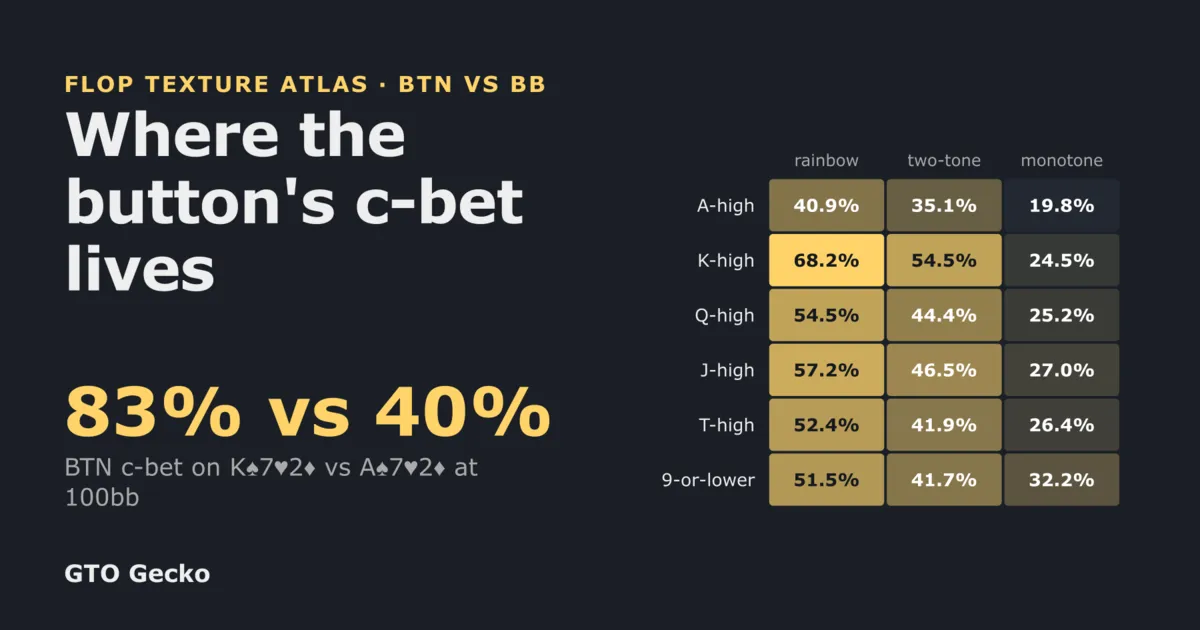
On K♠ 7♥ 2♦ the button c-bets 82.9% of its range against a big-blind call. Swap the king for an ace and the number falls to 40.0%. Across all 1,755 strategically distinct flops in our 100bb cash library, the button c-bets 46.6% of the time, and the board's texture decides most of the spread between 13.6% and 97.5%.
Key takeaways
- About half, not always: the button bets 46.6% of flops (27.8% with 33% pot, 18.9% with 75% pot) after the big blind checks.
- King-high rainbow is the high point at 68.2%. Ace-high rainbow is only 40.9%, and ace-high monotone 19.8%.
- Monotone flops cut the c-bet to 25.5%, and the 75% size nearly disappears (5.6%).
- Paired flops get bet small and often: 57.9% overall, 47.6% of it with the small size. Trips boards: 86.6%.
- Connected flops get checked more: 40.2% against 47.9% on disconnected flops.
This is the first report in the Flop Texture Atlas, a series that maps one spot at a time across every flop. If you want to know how often each texture comes up in the first place, our board texture breakdown of all 22,100 flops covers that; this report is about what the solver does once the flop is out.
Button opens, big blind calls, big blind checks
Six-max cash, 100bb, 5% rake capped at 4bb. BTN opens to 2.5bb, SB folds, BB calls and checks. BTN can check, bet 1.8bb (33% pot) or bet 4.1bb (75% pot).
Modeled spot from the GTO Gecko library, not a played hand.
Read the table as text
Six-max cash, 100bb, 5% rake capped at 4bb. BTN opens to 2.5bb, SB folds, BB calls and checks. BTN can check, bet 1.8bb (33% pot) or bet 4.1bb (75% pot). Pot: 5.5 bb. Board: Ks, 7h, 2d.
- UTG: 100 bb behind; Fold; cards: face down.
- HJ: 100 bb behind; Fold; cards: face down.
- CO: 100 bb behind; Fold; cards: face down.
- BTN (dealer): 97.5 bb behind; Check or bet; cards: face down.
- SB: 99.5 bb behind; Fold; cards: face down.
- BB: 97.5 bb behind; Check; cards: face down.
How often does the button c-bet against a big-blind call?
The button c-bets 46.6% of the time once you weight every flop by how often it comes. Counting each of the 1,755 flop classes once, the figure is 43.9%, because the boards that come most often (two-tone, unpaired) are slightly below average. Either way, the default is closer to a coin flip than to the "always c-bet as the raiser" rule many players learned. If the term is new, start with what a continuation bet is and why it exists.
The split between sizes matters as much as the frequency. The small bet (1.8bb into 5.5bb, a third of the pot) carries 27.8 of the 46.6 points. The 75% size carries 18.9, and it is concentrated on boards where the button's strongest hands need protection or where it holds a clear nut advantage.
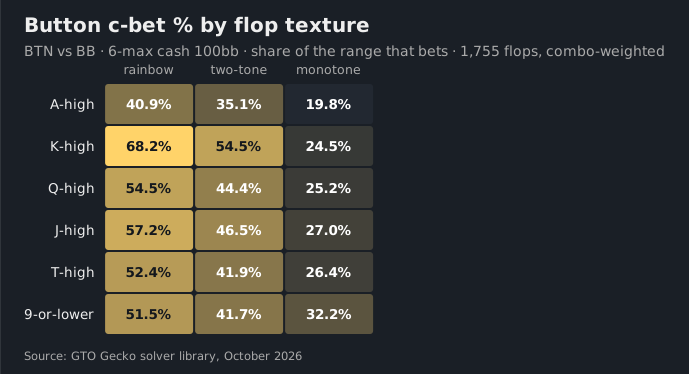
Read the map by column first. Every row loses about ten points from rainbow to two-tone and another twenty or more from two-tone to monotone. Then read by row: king-high leads every column except monotone, and ace-high trails every column.
Why do ace-high flops get c-bet less than king-high ones?
Because the big blind's calling range holds almost as many aces as the button's opening range, but far fewer kings. On A♠ 7♥ 2♦ 24.0% of the big blind's range contains an ace against 26.6% of the button's range, so top pair is shared almost evenly. On K♠ 7♥ 2♦ the button holds a king 18.4% of the time against the big blind's 13.7%, a lead of roughly a third. That gap is what lets the button bet so much of its range on the king-high board.
Button after the big blind checks: K♠ 7♥ 2♦
534.45 weighted combos. Full cells show the action mix; entry weight shows how much of each hand class is in the range.
Hover or tap a hand. Use arrow keys in the grid. Suited above the diagonal; offsuit below.
GTO Gecko solver library (6-max cash, 100bb, 5% rake capped at 4bb). Hand classes combine suits by range weight.
Read the range as text
Button after the big blind checks: K♠ 7♥ 2♦. Whole range: Bet 4.1bb (75% pot) 12.87%; Bet 1.8bb (33% pot) 70.05%; Check/Call 17.08%.
On the king-high board the button bets almost everything, and nearly all of it small: 70.0% of the range takes the 33% size and only 17.1% checks. Even hands with no pair join in, because the big blind has few strong kings and cannot punish a small bet often enough. A♥K♦ bets 88.1% of the time here.
Button after the big blind checks: A♠ 7♥ 2♦
521.25 weighted combos. Full cells show the action mix; entry weight shows how much of each hand class is in the range.
GTO Gecko solver library (6-max cash, 100bb, 5% rake capped at 4bb). Hand classes combine suits by range weight.
Read the range as text
Button after the big blind checks: A♠ 7♥ 2♦. Whole range: Bet 4.1bb (75% pot) 4.95%; Bet 1.8bb (33% pot) 35.04%; Check/Call 60.01%.
On the ace-high board the picture flips. The button checks 60.0% of its range, and the hands that bet are mostly aces and pairs that want value or protection. KK checks 95.3% of the time: it beats very little that will call and loses to every ace. Q♣J♣ checks 86%. AKo still bets, but 64.5% of the time instead of 88.1%.
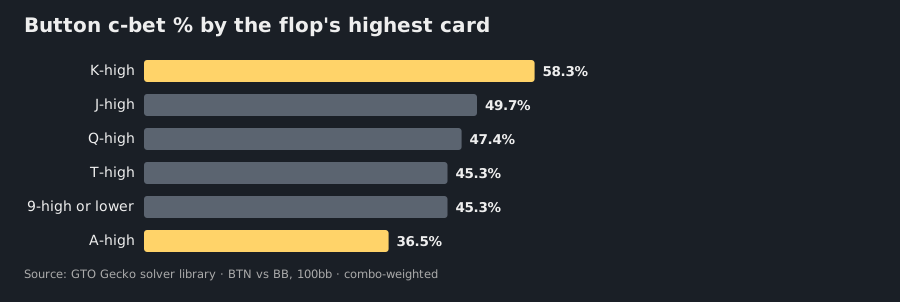
Across all flops grouped by their highest card, king-high boards are bet 58.3% of the time and ace-high boards 36.5%. Queen-, jack- and ten-high boards sit in between at 45% to 50%, and boards nine-high or lower land at 45.3%.
Monotone flops: the c-bet drops to 25.5%
When all three cards share a suit, the button bets only 25.5% of the time, and the 75% size almost vanishes (5.6%). On K♠ 8♠ 3♠ the button bets 27.7% and checks the rest. A flush on board removes much of the button's edge: the big blind called with many suited hands, so it holds flushes and flush draws in a similar proportion, and a big bet gets called mostly by hands that beat it.
The lowest c-bet frequencies in the whole library are all ace-high monotone boards: A♠9♠2♠ at 13.6%, A♠T♠2♠ at 14.0%, A♠4♠2♠ at 14.2%. Two disadvantages stack there: the shared aces from the previous section and the shared flushes from this one.
Paired flops: small and often
Paired boards are the opposite case. The button bets 57.9% of the time, and 47.6 of those 57.9 points use the small size. On 8♠ 8♥ 3♦ it bets 76.5%. Few hands connect with a paired flop at all, so a small bet wins the pot often enough on its own, and the big blind's calling range is the one more likely to have nothing.
Trips boards are the extreme: 86.6% on average, and 97.5% on 8-8-8, the highest frequency in the library. For how to defend the other side of these boards, see paired-flop check-raises.
Connected flops favour the caller
On flops where three different ranks sit within five ranks of each other (9-8-6, J-T-7), the button bets 40.2% of the time against 47.9% on disconnected flops. These boards hit the big blind's suited connectors and small pairs, so the button's range advantage shrinks and checking back protects its weaker hands.
Which size does the work?
The small bet is the default size on most textures; the big bet is a specialist. The table shows how the 46.6% splits by texture.
| Texture | Bet 33% pot | Bet 75% pot | Check |
|---|---|---|---|
| All flops | 27.8% | 18.9% | 53.4% |
| Rainbow | 32.8% | 20.7% | 46.5% |
| Two-tone | 24.8% | 18.8% | 56.3% |
| Monotone | 19.9% | 5.6% | 74.5% |
| Paired | 47.6% | 10.3% | 42.1% |
| Trips | 45.6% | 40.9% | 13.4% |
| Connected | 22.2% | 18.0% | 59.8% |
The big size shows up most on trips boards, where the button holds the quads and full houses and the big blind can't, and least on monotone boards. For the general logic behind choosing a size, see how solvers size their bets, and for the largest sizes, when solvers overbet.
Five rules you can use at the table
- Start from "about half". 46.6% is the baseline after the big blind checks. Adjust up or down from there, not down from "always".
- King-high dry boards are betting boards. Bet small with most of your range (K-high rainbow 68.2%). This breaks when the board is monotone (24.5%).
- Ace-high boards are checking boards. Check most hands without an ace or a strong pair (A-high rainbow 40.9%). Your second-best pairs, like KK, want to check.
- Monotone: check about three quarters, and bet small when you bet. The 75% size is close to zero.
- Paired: bet small and often. 57.9% overall, mostly at a third of the pot; trips boards almost always.
These hold for 100bb cash with this rake and these sizes. Shorter stacks, antes, other positions and population tendencies all move the numbers, and future atlas reports will show by how much.
Drill this spot
The postflop trainer deals you button-versus-big-blind flops like these and grades each decision against the solver. Open the postflop trainer in GTO Gecko
How we solved 1,755 flops for this report
All numbers come from GTO Gecko's precomputed postflop library: 6-max cash, 100bb, 5% rake capped at 4bb, button opens to 2.5bb, small blind folds, big blind calls, big blind checks. The button can check, bet 1.8bb (33% of the 5.5bb pot) or bet 4.1bb (75%). Solutions were computed with PioSolver on our own machines; how GTO Gecko's solutions are made describes the setup.
We aggregated all 1,755 strategically distinct flops, weighting each by the number of real flops it stands for (22,100 in total). We checked four boards (K♠7♥2♦, A♠7♥2♦, K♠8♠3♠, 8♠8♥3♦) a second way, from the full flop solution instead of the aggregate report, and they agree within 0.1 points. Range shares are counted from the reach-weighted ranges at the decision. We publish the aggregates and selected boards, not the solution files. Drafted with AI assistance from the solver export; every number was re-read from the source data on October 11, 2026.
Limits: one spot, one stack depth, one rake structure, two bet sizes. Frequencies are the share of the button's whole range that takes each action, not the chance a given hand bets. "Connected" means three different ranks within five ranks of each other.
Flop texture FAQ
How often should the button c-bet on a monotone flop?
About a quarter of the time at 100bb against a big-blind call: 25.5% across all monotone flops in our library, falling below 15% on ace-high monotone boards. When the button does bet, it uses the small size; the 75% bet is chosen only 5.6% of the time.
Is it right to c-bet small on dry king-high flops?
Yes, in this spot. On K♠7♥2♦ the button bets 82.9% of its range, and 70.0% of the range uses a third of the pot. The big blind holds few strong kings and no overpairs, so a cheap bet works with almost every hand.
Why does the solver check kings on an ace-high flop?
On A♠7♥2♦ a pair of kings beats little that will call a bet and loses to every ace, and the big blind holds an ace about as often as the button does. Checking keeps the pot small and lets the big blind's weaker hands bluff. KK checks 95.3% of the time there.
Sources accessed : GTO Gecko postflop library (aggregated flop report and four flop solutions, 6-max cash 100bb); PioSolver; for a different approach to the same spot family, GTO Wizard's flop heuristics for IP c-betting in cash games.