
You raise the button, the big blind calls, and the flop comes K♠ K♥ 2♦. You bet 1.8bb into 5.5bb. The big blind check-raises to 6.4bb. With A♣ Q♣, do you call the extra 4.6bb?
In the GTO Gecko library export, that hand calls 99%. Change the queen to a three and A♣ 3♣ folds 96%. Neither hand has a flush backdoor. “Ace-high” puts two very different decisions in the same bucket.
A paired flop does not make every unpaired hand a fold. Inspect the exact ranks, suit and hands that actually raised. A strong ace can call, a weak ace can fold, and some lower unpaired hands can continue too.
These are stored solver outputs for the specified cash model, retrieved September 7, 2026. The export does not include a solver version or achieved convergence, so the frequencies and EVs have no verified equilibrium error bound. The numerical comparisons are observations and calculations; the range explanations are our interpretation. The header is AI-generated editorial artwork.
Start with the price and the exact hand
The setup is six-max no-limit Hold’em, 100bb before posting, with a 2.5bb button open and a big-blind call. The folded small blind supplies 0.5bb of the 5.5bb flop pot. Rake is configured at 5%, capped at 4bb, with no ante.
The big blind can only check at the exported root. The button can check, bet 1.8bb or bet 4.1bb. We follow the 1.8bb bet and a raise to 6.4bb total. There is now 13.7bb in the pot; the button can fold, call 4.6bb or re-raise to 15.6bb total. Other sizes were not tested.
Your 4.6bb decision
100bb before posting. BTN opens to 2.5bb; BB calls. BB checks K♠ K♥ 2♦, BTN bets 1.8bb, and BB raises to 6.4bb total. BTN must call 4.6bb, fold, or re-raise.
Selected modeled situation, not a played hand history. Rake: 5%, capped at 4bb. No ante. Chips are illustrative; the labels are the amounts.
Read the table as text
100bb before posting. BTN opens to 2.5bb; BB calls. BB checks K♠ K♥ 2♦, BTN bets 1.8bb, and BB raises to 6.4bb total. BTN must call 4.6bb, fold, or re-raise. Pot: 13.7 bb. Board: Ks, Kh, 2d.
- UTG: 100 bb behind; 0 bb committed this street; Fold; folded; cards: face down, face down.
- HJ: 100 bb behind; 0 bb committed this street; Fold; folded; cards: face down, face down.
- CO: 100 bb behind; 0 bb committed this street; Fold; folded; cards: face down, face down.
- BTN (dealer): 95.7 bb behind; 1.8 bb committed this street; 4.6bb to call; next to act; cards: A♣, Q♣.
- SB: 99.5 bb behind; 0 bb committed this street; Fold; folded; cards: face down, face down.
- BB: 91.1 bb behind; 6.4 bb committed this street; Raise to 6.4bb; cards: face down, face down.
| Hand | Re-raise to 15.6bb | Call 4.6bb | Fold | |||
|---|---|---|---|---|---|---|
| Freq. (%) | EV (bb) | Freq. (%) | EV (bb) | Freq. (%) | EV (bb) | |
| A♣ Q♣ | 0.0 | 0.167 | 99.0 | 0.695 | 1.0 | 0.000 |
| A♣ 3♣ | 1.0 | -0.231 | 3.0 | -0.195 | 96.0 | 0.000 |
| Q♣ J♣ | 1.0 | 0.178 | 94.0 | 0.358 | 5.0 | 0.000 |
Calling with A♣ Q♣ returns 0.695bb, compared with 0 for folding. Calling with A♣ 3♣ returns −0.195bb. Even Q♣ J♣ calls 94% and has a reported call EV of +0.358bb. The highest card’s name alone does not order these decisions.
EV is measured from this decision; the earlier bet is already spent. Frequency is how the exported strategy distributes an action, not that action’s EV. We normalize the source’s rounded probability rows to 100%; displayed totals can differ by 0.1 percentage point. EV decimals preserve the source arithmetic, not a claim of solving accuracy.
Read the raising range before calling it a bluff
The button has already filtered its range by betting. The big blind has filtered its range by raising. Giving either player every hand from the start of the flop would describe a different situation.
On this board, the button reaches the decision with 455.37 weighted combinations. The reconstructed big-blind raising range contains 63.53. A hand appearing half as often contributes half a combination; these are marginal range weights, not probabilities of reaching this spot in a dealt hand.
BTN: responding to the raise
455.37 weighted combos at this line. The full cell is the conditional action mix. Entry weight includes the earlier 1.8bb c-bet. Suits can differ.
Hover or tap a hand. Use arrow keys in the grid. Suited above the diagonal; offsuit below.
Current library export, September 7, 2026. Solver convergence unavailable. Weights are marginal combo reach, not deal probabilities. Hatched = outside range · ? = missing data
BB: the hands that raised
63.53 weighted combos at this line. All filled cells have raised to 6.4bb. The entry weight shows the retained amount, not equity or a new decision.
Hover or tap a hand. Use arrow keys in the grid. Suited above the diagonal; offsuit below.
Current library export, September 7, 2026. Solver convergence unavailable. Weights are marginal combo reach, not deal probabilities. Hatched = outside range · ? = missing data
The button’s filled cells show fold/call/re-raise mixtures. Every filled big-blind cell has entered by raising; its bottom strip shows retained entry weight. Hover, tap or use the hand selector for exact class weights. Suits are combined in these grids and separated in the hand tables.
| Hand group | BTN mass | BTN share | BB mass | BB share |
|---|---|---|---|---|
| Trips or better | 62.67 | 13.8% | 15.75 | 24.8% |
| Pocket pair | 58.66 | 12.9% | 10.62 | 16.7% |
| Pairs the 2 | 10.93 | 2.4% | 2.13 | 3.3% |
| Unpaired, no direct draw | 323.11 | 71.0% | 35.03 | 55.1% |
The big blind’s raising range is 55.1% unpaired hands without a direct draw, alongside 24.8% trips or better and 20.1% pocket pairs or hands pairing the deuce. “Unpaired” does not mean worthless: some of those hands have an ace kicker, and others can improve on later streets.
| BTN hand | Compatible BB mass | Ahead now | Tied now | Behind now |
|---|---|---|---|---|
| A♣ Q♣ | 59.27 | 53.7% | 0.3% | 46.0% |
| A♣ 3♣ | 60.49 | 46.1% | 3.1% | 50.8% |
| A♠ 3♠ | 58.64 | 45.7% | 2.3% | 52.0% |
| A♦ 3♦ | 58.80 | 45.8% | 2.1% | 52.1% |
| Q♣ J♣ | 59.02 | 38.9% | 3.6% | 57.5% |
| 8♠ 7♠ | 59.88 | 7.8% | 0.5% | 91.7% |
After removing card conflicts, A♣ Q♣ is currently ahead of 53.7% of the compatible raising mass. A♣ 3♣ is ahead of 46.1%. The latter faces 4.26 weighted unpaired combinations with better kickers, including A4 and AQ. Those hands are part of the supposed “air” but already beat A3.
These percentages compare the five cards available on the flop. They are not showdown equity: later cards can reverse the result. The calling EVs also include future betting. This is evidence about the range composition, not a complete causal explanation of the EV difference.
How much does an automatic fold give up?
We tested a specific shortcut: fold every hand that has no personal pair and no direct straight or flush draw. A pocket pair or a hand matching either board rank is excluded. So are gutshots, open-ended draws and four-card flush draws. Backdoor draws stay in the sample. All hands still share the pair on the board.
The main test uses 18 selected paired flop classes: nine rank patterns, each in rainbow and two-tone form. Six board classes, covering three rank patterns, formed the discovery set. Twelve board classes from six other rank patterns were held out. There are 6,905 eligible exact-hand cases across those boards, not 6,905 independent poker situations.
Before the main analysis, we called the shortcut cheap only if at least 95% of eligible combo reach lost no more than 0.1bb by folding. It failed that screen: 23.2% exceeded 0.1bb in the equal-board average. The held-out result was 22.5%. Every tested board exceeded the allowed 5%.
Eligible reach losing more than 0.1bb by folding
Bars use a 0–50% scale. The tested ceiling was 5%.
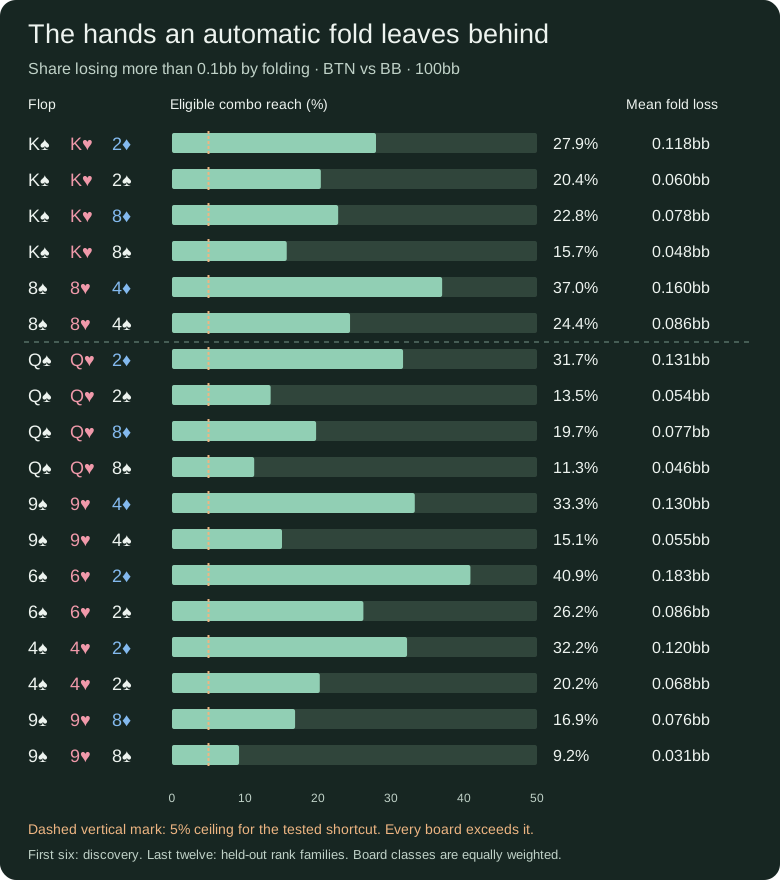
Exact results for all 18 boards
| Flop | Continue (%) | Fold loss >0.1bb (%) | Mean fold loss (bb) |
|---|---|---|---|
| K♠ K♥ 2♦ | 42.8 | 27.9 | 0.118 |
| K♠ K♥ 2♠ | 32.1 | 20.4 | 0.060 |
| K♠ K♥ 8♦ | 37.4 | 22.8 | 0.078 |
| K♠ K♥ 8♠ | 27.6 | 15.7 | 0.048 |
| 8♠ 8♥ 4♦ | 47.2 | 37.0 | 0.160 |
| 8♠ 8♥ 4♠ | 36.8 | 24.4 | 0.086 |
| Q♠ Q♥ 2♦ | 42.4 | 31.7 | 0.131 |
| Q♠ Q♥ 2♠ | 30.8 | 13.5 | 0.054 |
| Q♠ Q♥ 8♦ | 25.1 | 19.7 | 0.077 |
| Q♠ Q♥ 8♠ | 15.5 | 11.3 | 0.046 |
| 9♠ 9♥ 4♦ | 42.9 | 33.3 | 0.130 |
| 9♠ 9♥ 4♠ | 30.6 | 15.1 | 0.055 |
| 6♠ 6♥ 2♦ | 48.8 | 40.9 | 0.183 |
| 6♠ 6♥ 2♠ | 37.6 | 26.2 | 0.086 |
| 4♠ 4♥ 2♦ | 43.9 | 32.2 | 0.120 |
| 4♠ 4♥ 2♠ | 31.9 | 20.2 | 0.068 |
| 9♠ 9♥ 8♦ | 25.1 | 16.9 | 0.076 |
| 9♠ 9♥ 8♠ | 15.3 | 9.2 | 0.031 |
The mean local loss from folding is 0.089bb. The median is zero, while the 95th percentile is 0.525bb. Many folds are fine; the cost is concentrated in a smaller group of hands. The 0.1bb screen is an editorial tolerance, about 0.7% of the current pot, rather than a universal definition of a mistake.
The result also survives changing the loss screen: 31.5% of eligible reach exceeds 0.02bb, 15.9% exceeds 0.2bb and 5.4% exceeds 0.5bb. These are sensitivity checks on the same stored EVs, not confidence intervals.
The exported strategy still folds 65.9% of this eligible group, calls 32.5% and re-raises 1.6%. Reading the result as “continue with everything” would discard most of the information.
The suit can rescue a weak ace
| Hand | Re-raise to 15.6bb | Call 4.6bb | Fold | |||
|---|---|---|---|---|---|---|
| Freq. (%) | EV (bb) | Freq. (%) | EV (bb) | Freq. (%) | EV (bb) | |
| A♠ 3♠ | 1.0 | 0.104 | 92.1 | 0.279 | 6.9 | 0.000 |
| A♥ 3♥ | 1.0 | 0.104 | 92.1 | 0.279 | 6.9 | 0.000 |
| A♦ 3♦ | 1.0 | 0.179 | 92.9 | 0.288 | 6.1 | 0.000 |
| A♣ 3♣ | 1.0 | -0.231 | 3.0 | -0.195 | 96.0 | 0.000 |
The three board-suit versions of A3 have a backdoor flush route and call about 92–93% after normalization. Their call EVs are +0.279bb, +0.279bb and +0.288bb. The club version has no flush route and calls just 3%, with a negative call EV.
That is a useful suit comparison, but it changes card removal as well as the possible flush runouts. It does not isolate the causal value of a backdoor. Nor does a backdoor ensure a call: 8♠ 7♠ on the same board folds 92%, with call EV −0.044bb. That smaller gap deserves more caution because convergence is unknown.
For a larger boundary, return to A♣ 3♣: calling costs 0.195bb in the recorded model even though it is an ace-high hand. Neither “ace-high” nor “has a backdoor” is a complete defense rule.
Change the board or the opener
| Hand | Re-raise to 15.6bb | Call 4.6bb | Fold | |||
|---|---|---|---|---|---|---|
| Freq. (%) | EV (bb) | Freq. (%) | EV (bb) | Freq. (%) | EV (bb) | |
| A♣ Q♣ | 1.0 | 0.274 | 97.0 | 0.369 | 2.0 | 0.000 |
| A♣ 3♣ | 1.0 | -0.232 | 1.0 | -0.639 | 98.0 | 0.000 |
| A♦ K♦ | 7.0 | 1.163 | 93.0 | 1.172 | 0.0 | 0.000 |
| 9♣ 7♣ | 2.0 | 0.233 | 89.0 | 0.321 | 9.0 | 0.000 |
On 8♠ 8♥ 4♦, A♦ K♦ calls 93% and folding gives up 1.172bb relative to its highest reported action EV. The re-raise is close in reported EV, so the call frequency should not be mistaken for proof that raising is a large mistake.
There is another warning against a simple high-card ladder: 9♣ 7♣ calls 89% here, with +0.321bb call EV, despite having neither a direct draw nor a flush backdoor. The exact ranks and the board matter. The study rejects an automatic-fold shortcut; it does not establish that every higher kicker must continue more.
We also retrieved four matching cutoff-versus-big-blind boards with the same cash settings and available sizes. The shortcut failed there too: 25.7% of eligible reach exceeded 0.1bb in the equal-board mean. These are different opening and defending ranges, so this is a position check, not a controlled measurement of the value of position.
This cash catalog offers only 100bb for the tested configuration. We did not treat another rake structure, tournament model or missing size as an interchangeable stack test.
A useful way to study the next check-raise
Start by separating strong kickers from weak ones, then inspect the exact suit. Compare the best available continuation with folding and check whether the gap is substantial. Read the opponent’s filtered range beside your own; “unpaired” can include hands that already beat your kicker.
As an exercise, hide the first table and predict the order of A♣ Q♣, Q♣ J♣ and A♣ 3♣. Then change only A3’s suit. Explain both the strong calls and the fold before moving to a different board. You can use board-texture categories to organize that comparison.
GTO Gecko’s study views display precomputed action frequencies, EVs and range composition. Use the same line and exact hand when comparing those values; feature access requires a paid plan covering the relevant format. The current app listing describes the available study tools.
Method and limits
All 22 requested trees were retrieved during this run: 18 BTN boards and four CO comparisons. We measured local fold loss as max(legal action EVs) − fold EV. Within a board, exact combos use the acting player’s exported reach; across boards, each class receives equal weight. Percentiles use that equal-board mixture, not an average of each board’s percentiles.
Stored probabilities and reach weights are rounded to two decimals. Action rows totaling 0.99 or 1.01 were normalized. For the big blind’s current range, we multiplied its entering reach by its recorded raise probability and checked consistency with its next exported decision using rounding intervals. This produces an approximate reconstructed range, not additional solver precision.
The study evaluates one immediate decision against stored continuations. It does not re-solve the game, measure a complete simplified strategy, establish a win rate, evaluate human opponents or justify applying the frequencies to other raise sizes. Unknown convergence is a material limitation; source resolution is not an error bound.
Download the 22-board results, selected exact-hand values, range composition, current hand-rank comparison and method and arithmetic. These are selected study findings; complete proprietary trees remain private.
The study question was informed by GTO Wizard’s paired-flop defense analysis, which explicitly distinguishes raise sizes and stack depths. Our numbers come from this run’s Gecko exports. See also Pio’s definitions of range weights and matchup frequencies for why those denominators differ.