
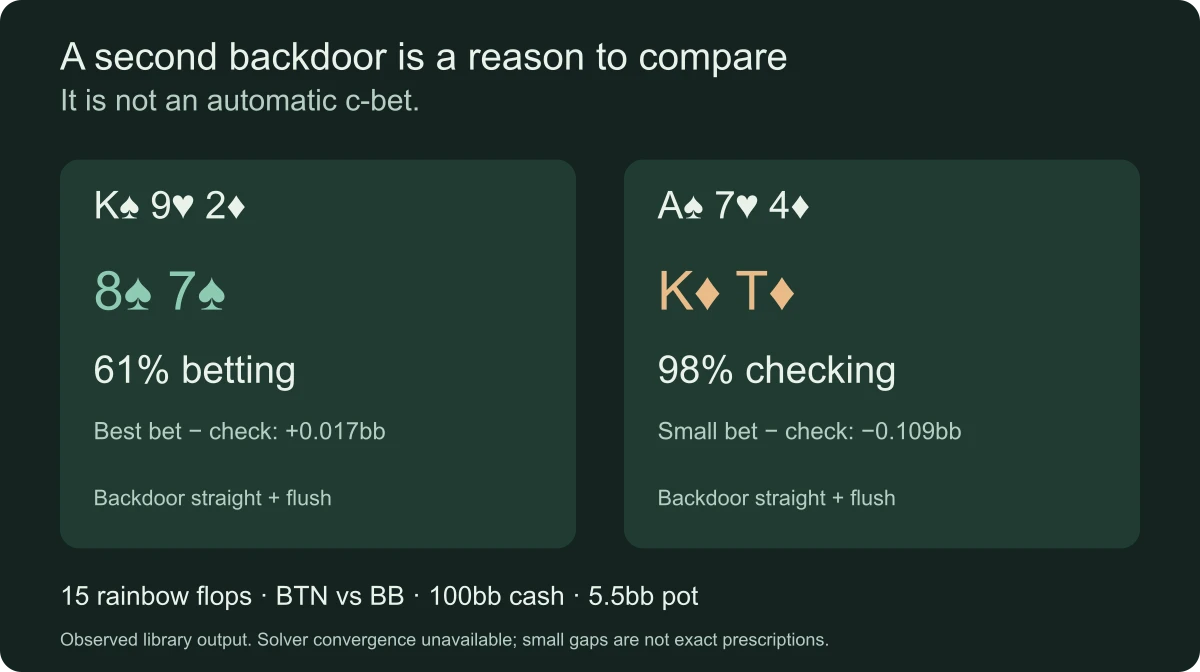
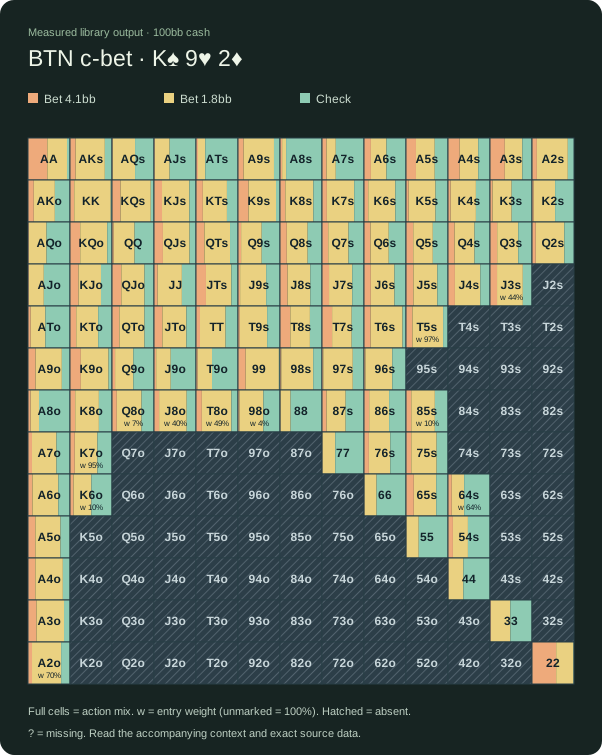
After your button raise and the big blind’s call, the flop comes K♠9♥2♦. The big blind checks. You have 8♠7♠: no pair, no immediate straight draw, but a backdoor straight route and a backdoor flush draw. Change your cards to 8♣7♣ and the flush route disappears. How much should that change your c-bet?
In the library output we inspected, 8♠7♠ bets 61.0% of the time; 8♣7♣ bets 46.5%. Yet the spade hand’s best bet leads checking by only 0.017bb. That is the useful distinction: these same-rank hands have substantially different betting mixes while each hand’s immediate choice remains close in reported EV.
Use double backdoors to identify hands worth comparing for a bluff. Check the value of checking and the available sizes before turning that cue into a bet. Below, K♦T♦ has both backdoors on A♠7♥4♦ and checks 98%. A second exception shows why “bet small with every double backdoor” loses information about sizing.
These are observed GTO Gecko library outputs for the model below, retrieved September 7, 2026. The export does not supply achieved convergence or a solver version. Neither frequencies nor EVs have a verified equilibrium error bound here. We treat them as descriptive readings, with particular caution around tiny EV gaps. Our explanations are interpretations of the displayed ranges and values.
The spot and the two backdoors
We used six-max no-limit Hold’em cash configurations at 100bb before posting: button opens to 2.5bb, small blind folds and big blind calls. The flop pot is 5.5bb, including the small blind’s 0.5bb, with 97.5bb behind for each remaining player. The configured rake is 5%, capped at 4bb; there is no ante or tournament utility.
The big blind has only a check at the exported flop root. The button then chooses check, bet 1.8bb, or bet 4.1bb: approximately 33% or 75% of the pot. This study cannot assess a flop donk bet or a missing c-bet size.
BTN faces a flop check
Modeled six-max cash setup. 100bb before posting. BTN raises to 2.5bb, BB calls; SB contributes 0.5bb and folds. BB checks. Wagers from preflop are now in the pot.
Observed 5.5bb root pot and current game configuration; selected study hand, not a played hand history. Chips are illustrative; the labels are the amounts.
Read the table as text
Modeled six-max cash setup. 100bb before posting. BTN raises to 2.5bb, BB calls; SB contributes 0.5bb and folds. BB checks. Wagers from preflop are now in the pot. Pot: 5.5 bb. Board: Ks, 9h, 2d.
- UTG: 100 bb behind; 0 bb committed this street; Fold; folded; cards: face down, face down.
- HJ: 100 bb behind; 0 bb committed this street; Fold; folded; cards: face down, face down.
- CO: 100 bb behind; 0 bb committed this street; Fold; folded; cards: face down, face down.
- BTN (dealer): 97.5 bb behind; 0 bb committed this street; Next to act; next to act; cards: 8♠, 7♠.
- SB: 99.5 bb behind; 0 bb committed this street; Fold; folded; cards: face down, face down.
- BB: 97.5 bb behind; 0 bb committed this street; Check; cards: face down, face down.
Here, “double backdoor” means a suited, unpaired hand with a runner-runner flush route and a runner-runner straight route using both hole cards. We excluded made straights, gutshots and open-ended draws. For 8♠7♠ on K♠9♥2♦, two more spades can make a flush; turn–river ranks 5–6, 6–T or T–J can make a straight. The club version retains those straight routes but cannot make a club flush.
The backdoor turn map explains those card counts. This article asks a different question: what do the available betting and checking actions return in a specified strategy model?
Same ranks, different betting mixes
| Hand | Bet 4.1bb frequency / EV | Bet 1.8bb frequency / EV | Check frequency / EV |
|---|---|---|---|
| 8♠ 7♠ | 11.0% / 1.542 | 50.0% / 1.570 | 39.0% / 1.553 |
| 8♥ 7♥ | 10.0% / 1.534 | 49.0% / 1.566 | 41.0% / 1.548 |
| 8♦ 7♦ | 11.0% / 1.504 | 48.0% / 1.531 | 41.0% / 1.522 |
| 8♣ 7♣ | 11.1% / 1.222 | 35.4% / 1.228 | 53.5% / 1.234 |
Percentages normalize the exported two-decimal probabilities to 100%; displayed rows can still differ by 0.1 point through rounding. EVs use the application’s big-blind conversion. Retained decimals show the arithmetic, not the accuracy of the underlying solution. Scroll wide tables horizontally on a phone.
For 8♠7♠, the 1.8bb bet returns 1.570bb and checking returns 1.553bb: a 0.017bb gap. With 8♣7♣, the best bet returns 1.228bb against 1.234bb for checking: a 0.006bb gap in the other direction. The much larger cross-hand EV difference is not the benefit of choosing to bet. Those are different cards, each with its own checking value.
This is a within-node suit comparison. The board and weighted ranges stay fixed, while the selected cards change. That changes card removal as well as flush possibilities, so it does not isolate the causal value of a backdoor flush draw. Our suit-frequency audit explains the distinction from renaming suits throughout the entire game.
The pattern across 15 rainbow flops
We specified 15 unpaired rainbow flop classes before the combo analysis. Six ace-high or king-high boards formed the discovery group; nine queen-high, jack-high or ten-high boards were held aside for validation. We kept the same eligibility rule throughout. The resulting sample contains 237 rank-matched groups and 948 exact-combination cases: three board-suit versions with a backdoor flush draw and one missing-suit version without it.
On every board, the eligible backdoor-flush versions have a higher average betting frequency. Giving each board equal weight, the figures are 55.4% with the flush backdoor versus 45.8% without, a 9.6-percentage-point difference. The held-out boards preserve that direction: 56.1% versus 46.2%.
The EV comparison is much less decisive. We calculated best available bet EV − check EV for each hand, then compared matching ranks. The flush-backdoor versions have a gap larger by just +0.0049bb on average across the 15 boards; the board means run from −0.0031bb to +0.0143bb. Two board means reverse sign. With convergence unknown, these small differences cannot support a precise rule about how much the feature is worth.
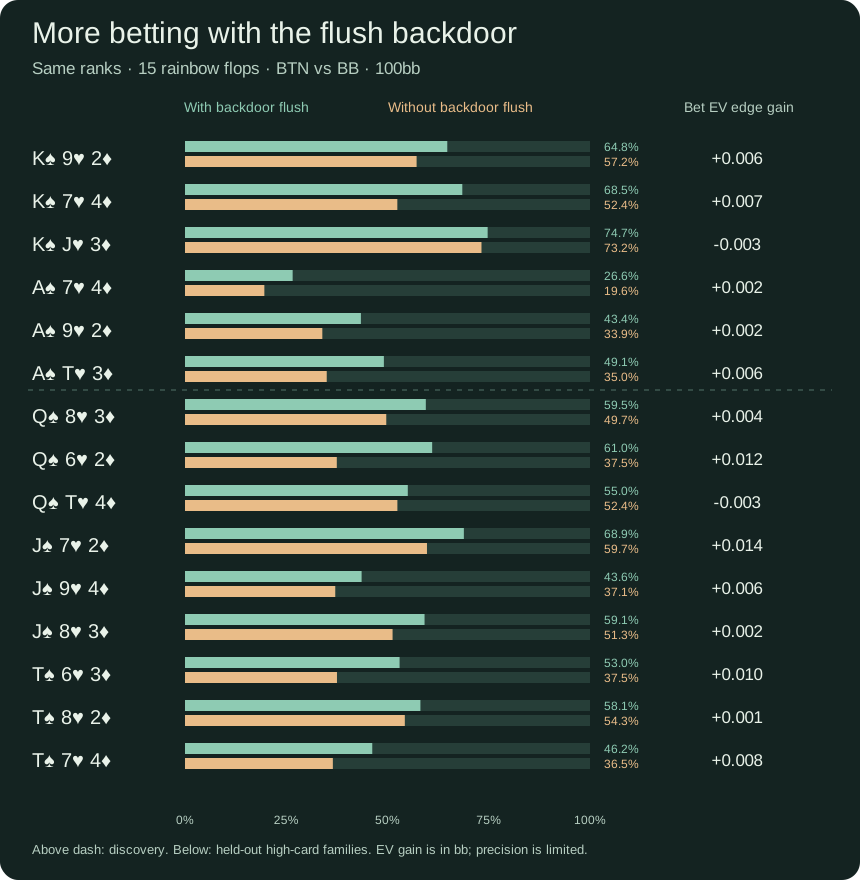
See all 15 board rows and denominators
| Flop | Groups | Bet with BDFD | Bet without BDFD | Change in bet−check gap (bb) |
|---|---|---|---|---|
| K♠ 9♥ 2♦ | 20 | 64.8% | 57.2% | +0.0062 |
| K♠ 7♥ 4♦ | 17 | 68.5% | 52.4% | +0.0075 |
| K♠ J♥ 3♦ | 14 | 74.7% | 73.2% | -0.0030 |
| A♠ 7♥ 4♦ | 13 | 26.6% | 19.6% | +0.0022 |
| A♠ 9♥ 2♦ | 19 | 43.4% | 33.9% | +0.0022 |
| A♠ T♥ 3♦ | 15 | 49.1% | 35.0% | +0.0061 |
| Q♠ 8♥ 3♦ | 19 | 59.5% | 49.7% | +0.0038 |
| Q♠ 6♥ 2♦ | 20 | 61.0% | 37.5% | +0.0115 |
| Q♠ T♥ 4♦ | 12 | 55.0% | 52.4% | -0.0031 |
| J♠ 7♥ 2♦ | 19 | 68.9% | 59.7% | +0.0143 |
| J♠ 9♥ 4♦ | 12 | 43.6% | 37.1% | +0.0056 |
| J♠ 8♥ 3♦ | 16 | 59.1% | 51.3% | +0.0017 |
| T♠ 6♥ 3♦ | 16 | 53.0% | 37.5% | +0.0098 |
| T♠ 8♥ 2♦ | 13 | 58.1% | 54.3% | +0.0007 |
| T♠ 7♥ 4♦ | 12 | 46.2% | 36.5% | +0.0077 |
Within a board, averages use the button’s exported combo reach weights among the eligible hands. Each matched group has equal reach across its four suits in this sample. Across boards, each class receives equal weight. These are descriptive range-composition averages, not the frequency with which these decisions occur in dealt poker hands. The 948 hand cases do not constitute 948 independent board tests.
Look at the big blind’s range before explaining the bet
On K♠9♥2♦, the current button range contains 526.23 weighted combinations and the big blind range 369.57. The big blind checked its entire exported root range; facing a c-bet, it still has that same entering range. The next table describes made-hand composition before the response, with each column using that player’s own range mass as its denominator.
| Range | Weighted combos | Two pair+ | Top pair / overpair | Other pairs | Unpaired |
|---|---|---|---|---|---|
| BTN | 526.23 | 3.8% | 17.2% | 23.5% | 55.5% |
| BB | 369.57 | 3.9% | 11.2% | 24.2% | 60.7% |
Open both range grids and exact hand-class inspectors
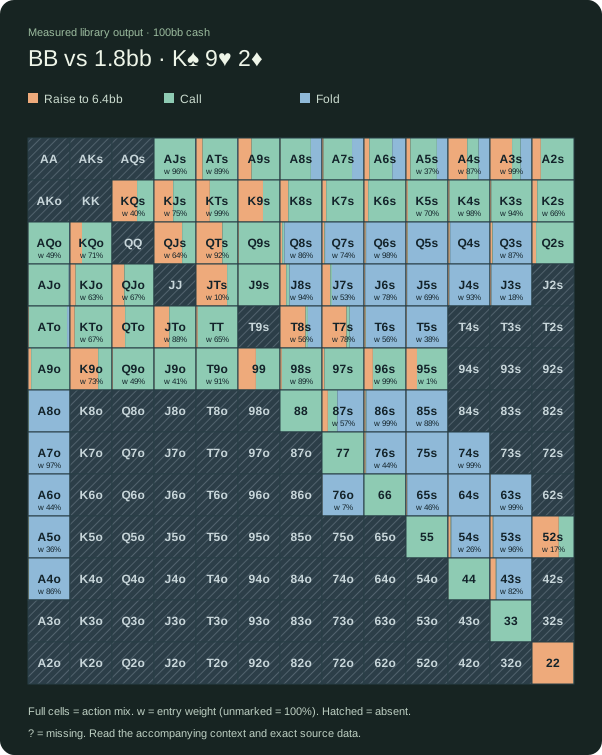
Against the 1.8bb bet, the big blind’s response mass splits into 126.52 weighted combos folding, 194.78 calling and 48.28 raising to 6.4bb. Almost all the folding mass is unpaired: 126.28 combos. But 70.73 unpaired combos also call, and 27.39 raise. “Unpaired” includes overcards and draws; it is not a synonym for a hand that gives up.
That response range matters to the interpretation. Betting 87 can end the hand or lead to a call or raise; a draw-completion count covers none of those choices. These composition figures do not measure showdown equity or establish a range advantage. Nor are they hero-specific fold probabilities: exact occurrence probabilities also require compatible opponent-card weighting.
The checking exception: K♦T♦ on A♠7♥4♦
K♦T♦ has the advertised ingredients. Two more diamonds can complete a flush, and Q–J can complete a straight using both hole cards. It nevertheless checks 98% in this output. Checking returns 1.532bb; betting 1.8bb returns 1.423bb. The small bet gives up 0.109bb relative to checking, while the 4.1bb bet gives up 0.344bb.
| Hand | Bet 4.1bb frequency / EV | Bet 1.8bb frequency / EV | Check frequency / EV |
|---|---|---|---|
| K♠ T♠ | 1.0% / 1.326 | 1.0% / 1.553 | 98.0% / 1.654 |
| K♥ T♥ | 1.0% / 1.191 | 1.0% / 1.434 | 98.0% / 1.535 |
| K♦ T♦ | 1.0% / 1.188 | 1.0% / 1.423 | 98.0% / 1.532 |
| K♣ T♣ | 1.0% / 0.802 | 2.0% / 1.086 | 97.0% / 1.160 |
All three board-suit KTs versions have higher reported checking EV than the club version. Checking preserves their flush possibility, but this comparison does not isolate its value. The same-rank club hand is also a frequent check. Compare the full situation before deciding that an extra way to improve must be spent on aggression.
| Range | Weighted combos | Two pair+ | Top pair / overpair | Other pairs | Unpaired |
|---|---|---|---|---|---|
| BTN | 518.01 | 5.2% | 22.6% | 20.6% | 51.6% |
| BB | 357.61 | 6.9% | 19.4% | 20.6% | 53.2% |
Open both range grids and exact hand-class inspectors
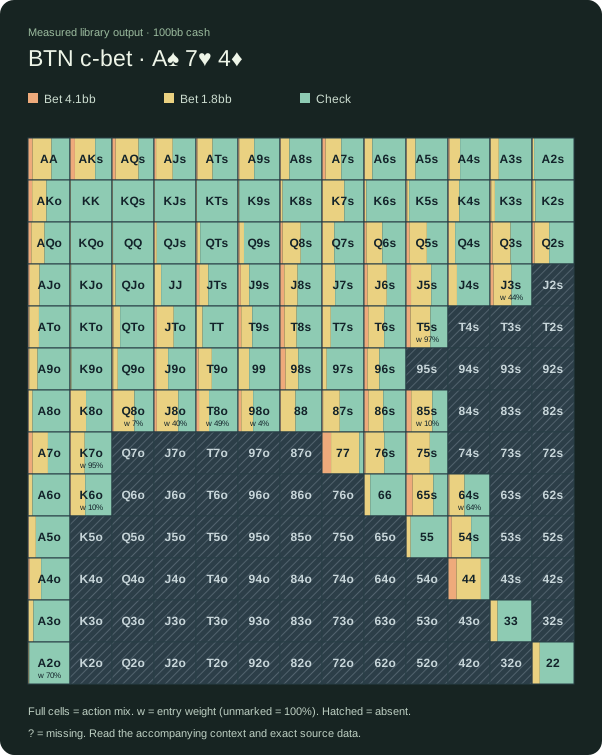
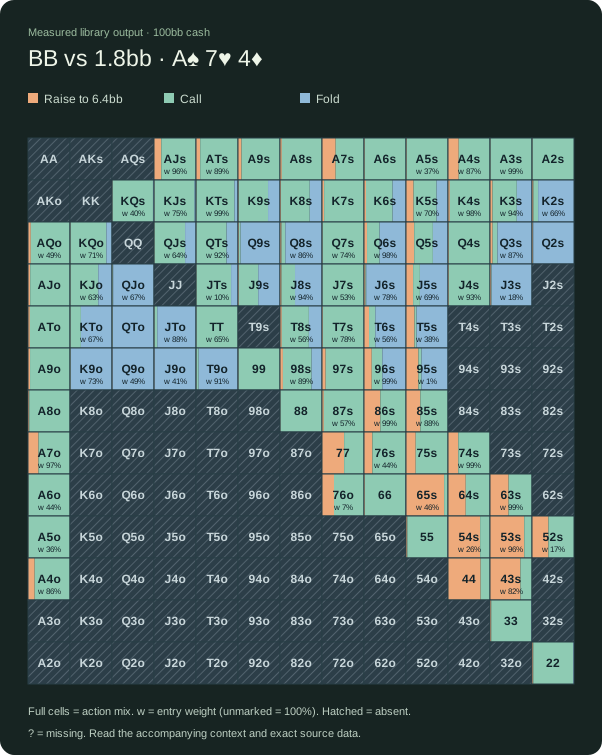
On this board, the big blind has 69.24 weighted combos of top pair and 24.53 of two pair or better. Against 1.8bb, its 357.61-combo entering range produces 112.98 folds, 211.08 calls and 33.55 raises. The button also checks 73.6% of its whole range here, compared with 35.1% on K♠9♥2♦. K♦T♦ belongs to a substantially different checking strategy.
Our interpretation is that the opportunity to check must be priced alongside draw potential. The output supports the checking choice here; the counts alone do not prove a unique mechanism. Upswing’s semi-bluff walkthrough also gives examples in which backdoor features support checking, including a proposed simplification for an out-of-position raiser. Its ranges and setting differ from ours, so it supplies context rather than a replication.
“Bet small” adds another assumption
On the held-out T♠7♥4♦ board, A♥2♥ has a flush backdoor and a runner-runner 3–5 straight route. It mostly checks. But the two bet sizes are far from interchangeable in the retained values.
| Hand | Bet 4.1bb frequency / EV | Bet 1.8bb frequency / EV | Check frequency / EV |
|---|---|---|---|
| A♥ 2♥ | 9.9% / 1.248 | 6.9% / 1.146 | 83.2% / 1.261 |
Checking returns 1.261bb, the 4.1bb bet 1.248bb, and the 1.8bb bet 1.146bb. The small-bet gap is 0.115bb; the larger bet’s gap is only 0.013bb. Recognizing a candidate and selecting its size are separate decisions.
To screen the shortcut “bet 1.8bb with every eligible double-backdoor hand,” we compared that action’s EV with the highest exported EV at each unchanged node. On the nine held-out boards, its mean local loss is 0.022bb, averaging the boards equally; the worst eligible case is the A♥2♥ example. Across the nine boards, the average share of eligible combo weight losing more than 0.05bb was 16.0%; the average share losing more than 0.10bb was 0.9%. The smaller mean does not remove the individual exceptions.
We set 0.05bb as a near-equal screening tolerance and 0.10bb as a material local gap before analysis, with sensitivity cutoffs at 0.02bb and 0.20bb. These are screening choices, not estimates of solver precision or universal definitions of good and bad play. The board table download includes the mean, upper-tail and sensitivity columns.
This calculation changes one decision against the retained continuations. It does not evaluate a whole simplified strategy or an opponent’s adaptation. Pio’s explanation of action EV is useful here: close actions in a mixed strategy do not license switching an entire range to one action without changing the game that follows.
A useful rule for your next review
In a comparable button-versus-big-blind rainbow-flop spot, use an extra backdoor flush draw as a cue to inspect a weak suited hand for betting. Then compare its exact action EVs, the size menu and the checking range. If checking is close, a large betting-frequency difference need not be your most costly study mistake. If checking clearly leads in the retained values, having both backdoors does not override that evidence.
For a short exercise, predict the actions for 8♠7♠ and 8♣7♣ on K♠9♥2♦ before reopening their table. Write down both frequency and EV gap. Next predict K♦T♦ on A♠7♥4♦, then A♥2♥ on T♠7♥4♦. Explain what changed in the decision without using “it has a backdoor” as the entire answer.
For off-table practice, use a comparable available scenario in GTO Gecko and inspect its exact combinations, action EVs and subsequent turns. The current official listing describes those study views and requires a paid plan for app features. GTO Solutions AS publishes both the product and this article.
What this study can and cannot establish
The source report exposed 1,755 flop classes; we retrieved all 15 trees in our predefined, deliberately varied rainbow sample and excluded none of those boards. The selection is not random or representative of all flops. We did not test other positions, stacks, rake settings, two-tone or paired boards, multiway pots, or tournament utility.
All 237 groups required four positive-reach suited versions, matching action arrays and available EVs. We checked legal cards, board blockers, ranges, probability totals, pot changes and the application’s units. Exported probabilities summing to 0.99 or 1.01 were normalized; this recovers a displayable mix, not extra solver precision. Independent calculations reproduced the group selection, key EV gaps and board means.
There was no fresh full-tree solve, convergence sweep, nodelock or river re-solve. We have not measured opponent mistakes, future-barrel quality or a policy’s win rate. The clearest finding is the frequency pattern in these retained outputs; the minute average EV shifts remain limited by missing convergence evidence.
Download the 15-board results, selected exact-hand values, range and response composition, and method and arithmetic. These selected study views are public; the complete proprietary tree exports are not included. The question was informed by GTO Wizard’s semi-bluff analysis, whose immediate-draw examples differ from the pure backdoor hands tested here.