
Short answer: the Rule of 3 and 6 is an excellent small-out shortcut, not a general probability formula. With five clean outs, outs × 6 gives 30.00%, almost identical to the exact 30.11% chance of improving by the river. With eight outs it says 48%, while the exact result is 45.59%. With fifteen outs it says 90%, overshooting the exact 74.19% by 15.81 percentage points.
We checked every one of the 465 possible unordered turn-river runouts for each out count from 1 through 20, then reproduced the calculation with a separate implementation. This page gives you the exact formula, a practical cutoff for the shortcut, and the cases where an “out” should not be counted at full value.
Disclosure: GTO Gecko and Short Deck Poker Trainer are both products from GTO Solutions AS. The probabilities below were calculated independently from the store copy, with the method and complete data included here. This is study material, not a promise of results.
The Rules Profile Behind the Numbers
Short Deck—also called 6+ Hold’em—removes every 2, 3, 4 and 5, leaving 36 cards. Under the current PokerStars 6+ rules and GGPoker Short Deck rules, a flush beats a full house and A-6-7-8-9 is a straight. Forced bets and some rankings can vary between rooms; PokerStars Learn, for example, notes that some versions rank three of a kind above a straight. Confirm the table’s house rules before applying a chart.
After the flop you can see five cards: your two hole cards and three community cards. That leaves:
The denominator that changes everything
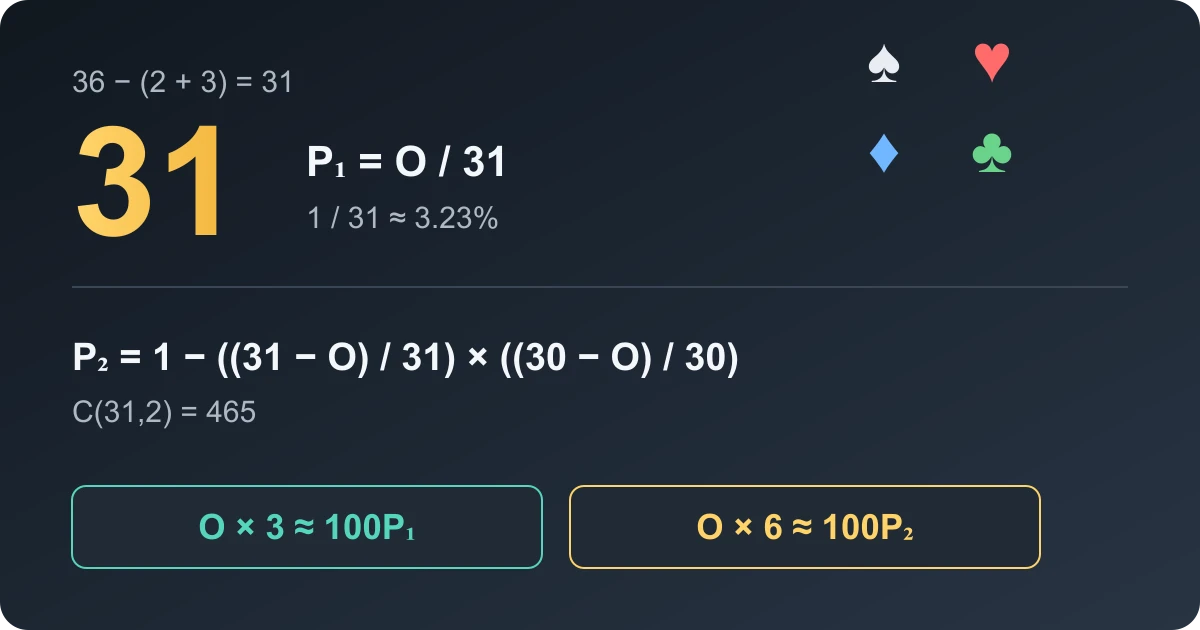
36 − 2 − 3 = 31 unseen cards
That is why the Hold’em Rule of 2 and 4 does not transfer. In Short Deck, each clean out is about 3.23% for the next card, not 2.13%.
The Exact Short Deck Outs Formula
Let O be the number of stable, clean outs. “Stable” means the same cards remain outs on both streets. “Clean” means hitting one produces the improvement you are counting without a known domination or redraw problem.
This model treats all 31 unseen cards as equally likely; it does not condition the card distribution on an opponent’s hand or range. It calculates the chance of drawing at least one card from a fixed set of outs, not the chance of winning at showdown.
From the flop
Next card: O / 31
By the river: 1 − ((31 − O) / 31) × ((30 − O) / 30)
Equivalent runout count: [C(31,2) − C(31 − O,2)] / C(31,2)
The last version makes the audit tangible. There are C(31,2) = 465 unordered turn-river pairs. Count the pairs containing at least one out, then divide by 465. You can download the complete 1–20 outs source table as CSV.
Where the Shortcut Stops Being Close
On narrow screens, scroll the table horizontally. Errors are percentage-point differences, not relative percentages.
| Clean outs | Exact next card | ×3 | Exact by river | ×6 | ×6 error |
|---|---|---|---|---|---|
| 1 | 3.23% | 3% | 6.45% | 6% | −0.45 points |
| 5 | 16.13% | 15% | 30.11% | 30% | −0.11 points |
| 8 | 25.81% | 24% | 45.59% | 48% | +2.41 points |
| 9 | 29.03% | 27% | 50.32% | 54% | +3.68 points |
| 13 | 41.94% | 39% | 67.10% | 78% | +10.90 points |
| 15 | 48.39% | 45% | 74.19% | 90% | +15.81 points |
| 17 | 54.84% | 51% | 80.43% | 102% | +21.57 points |

The practical boundary is easy to remember. From one through seven outs, the ×6 shortcut stays within 1.36 percentage points of the exact result. At eight outs it crosses a two-point error, then bends away quickly. At seventeen outs it returns an impossible 102%, which makes the shortcut's limit unambiguous. The ×3 shortcut always runs a little low because 1/31 is 3.2258%, not 3%.
Why ×6 Bends Upward
Multiplying by six adds two chances of approximately 3% per out. Two effects compete: rounding 1/31 down to 3% pushes the estimate low, while counting runouts containing two outs twice pushes it high. The rounding effect wins at small out counts; from six outs onward, overlap wins. “Complete by the river” is a yes-or-no event, so a runout that hits twice is still only one success.
Take eight clean outs. Of 465 possible turn-river pairs, C(23,2) = 253 miss both outs. The other 212 pairs hit at least one:
Eight-out check
(465 − 253) / 465 = 212 / 465 = 45.59%
The shortcut returns 8 × 6 = 48%, which is 2.41 points too high.
The overlap grows with the number of outs, which is why the error accelerates rather than staying constant.
Two Worked Short Deck Draws
A flush draw: usually five suit outs
A Short Deck suit contains nine cards. If your two hole cards and two flop cards share that suit, you can see four of the nine, leaving five unseen suit cards. If all five are clean:
- Next card: 5 / 31 = 16.13%
- By the river: 1 − (26 / 31) × (25 / 30) = 30.11%
- Shortcut: 5 × 3 = 15%; 5 × 6 = 30%
This is the shortcut’s sweet spot. Notice the counterintuitive comparison: a regular Hold’em flush draw has nine suit outs and completes by the river about 34.97% of the time. Short Deck has fewer unseen cards, but it also has fewer cards in each suit; the five-out flush draw lands at 30.11%.
A clean open-ended straight draw: eight outs
If two ranks complete your straight and all four suits of each rank are clean, you have eight outs. The smaller deck makes those eight cards much denser: 25.81% on the next card and 45.59% by the river. Here the ×6 shortcut is already generous by 2.41 points.
On the turn, one card has been removed from the unseen deck. If you miss and still have eight clean outs, the river probability is 8 / 30 = 26.67%. Recalculate rather than carrying the flop denominator forward.
Count Clean Short Deck Outs Before Calculating
The formula can be exact while the input is wrong. Before using it, audit the out count:
- Dirty outs: a card completes your draw but can leave an opponent with a stronger flush, full house or redraw. Exclude it from the clean-out formula; if it retains partial value, evaluate that value with an opponent-range equity model instead of inventing a fractional out.
- Duplicate routes: a card that completes both a pair and a straight is still one physical card, not two outs.
- Changing outs: a turn card can create or remove river outs. The stable-out formula does not model that branching tree.
- Known dead cards: subtract exposed dead cards from the unseen-card total. Reduce the out count too only when a dead card belongs to the out set.
- House rules: the target hand’s value can change if the room uses a different ranking profile.
For a broader foundation on identifying outs, see our poker outs and odds guide. The difference here is the 36-card denominator and the explicit clean-out audit.
Short Deck Completion Probability Is Not Equity
Three quantities are often collapsed into one, and they should not be:
- Draw-completion probability is the chance of hitting the specific cards you counted.
- Hand equity is your expected share of the pot against an opponent range. You can win without hitting, and you can hit and still lose.
- Required equity is the decision threshold implied by the pot and call size, before future action and rake are considered.
The Rule of 3 and 6 answers only the first question. Use the pot-odds framework and a credible opponent range before turning a draw percentage into a decision.
Appendix: Five-Card Frequency Behind the Short Deck Ranking
The deck reduction also changes hand-category rarity. We enumerated every unordered five-card set—not seven-card final Hold’em hands—to isolate the ranking ingredients:
| Five-card category | Short Deck count | Short Deck probability | 52-card count | 52-card probability |
|---|---|---|---|---|
| Flush, excluding straight flush | 480 | 0.1273% | 5,108 | 0.1965% |
| Full house | 1,728 | 0.4584% | 3,744 | 0.1441% |
In the 376,992 Short Deck five-card combinations, full houses occur 3.6 times as often as non-straight flushes. In the standard 52-card sample space the order reverses. This frequency comparison is consistent with the PokerStars and GGPoker ranking profile used here, but it does not claim to explain every room’s rule choice or the frequency of a player’s best final hand. For the full conventional ranking order, see the poker hand rankings guide.
A Reliable Table Routine
- Confirm the room’s deck, ranking and forced-bet rules.
- Count physical outs once, then exclude dirty cards from the exact clean-out formula.
- Use ×3/×6 for a quick estimate when the out count is small.
- At eight or more outs, check completion probability with the exact formula. For a close call decision, calculate equity against the opponent range separately.
- Keep completion probability separate from equity and required equity.
If you want to drill the format after learning the math, the US App Store listing for Short Deck Poker Trainer, checked August 27, 2026, describes a Short Deck Academy, probability material, an equity calculator and preflop study tools. The App Store’s “Languages” field lists English only. It is a study and simulation tool, not a real-money poker service.
Sources and Reproducibility
- PokerStars official 6+ Hold’em rules — accessed August 27, 2026.
- PokerStars Learn: rules and hand rankings in 6+ Hold’em — accessed August 27, 2026.
- GGPoker Short Deck rules — accessed August 27, 2026.
- Short Deck Poker Trainer, US App Store — accessed August 27, 2026.
Method: for each out count from 1 through 20, we labeled O of 31 unseen cards as outs and enumerated all 465 unordered two-card runouts. We counted a runout once when either card was an out, compared that fraction with the closed-form equation, and reproduced it in a separate Python implementation. No random sampling or private player data was used. The chart and CSV come directly from those results.