

Short answer: moving to Short Deck does not apply one universal multiplier to familiar starting hands. In our exact fixed-suit comparisons, A♠ A♥ against J♣ T♣ fell from 78.283% to 62.546%, while A♠ 9♠ against K♥ K♦ rose from 32.251% to 45.463%. Q♠ Q♥ against A♣ K♣ changed from a 53.786% favorite to a 45.723% underdog.
Those shifts do not all come from the same rule. We exhaustively enumerated four models so each matchup can move through three controlled steps: remove ranks 2–5, add A-6-7-8-9 as the low straight, then place a flush above a full house. That decomposition reveals both large changes and near-perfect cancellations.
Disclosure: GTO Solutions AS publishes both this site and Short Deck Poker Trainer. The results below come from open code and exhaustive board enumeration, not from product output or store copy. They are fixed-card showdown equities—not ranges, solver strategies, or promises of results.
The Exact Rules Profile
“Short Deck” is not enough to identify every house rule. This article uses the current PokerStars 6+ Hold’em rules, checked September 4, 2026: remove every 2, 3, 4, and 5; allow A-6-7-8-9 as the lowest straight; rank a flush above a full house; keep a straight above three of a kind. PokerStars also describes antes and a Button blind, but forced bets do not enter an all-in showdown-equity calculation.
Some rooms rank trips above a straight. These results do not transfer to that profile. Confirm the deck and hand-ranking order before using any Short Deck chart.
Four models, one ordered comparison
- 52-card standard: ordinary Hold’em deck, A-2-3-4-5 low straight, full house above flush.
- 36-card deck only: ranks 6–A, ordinary consecutive straights only, full house above flush.
- Add the low straight: the same 36-card boards, now A-6-7-8-9 also counts.
- Official profile: the same boards and low straight, now flush ranks above full house.
The order matters. These are sequential, arithmetic contributions under four declared models—not timeless causal shares or a story about how the game evolved.
12 Exact Starting-Hand Matchups
Each row fixes all four hole cards, including suits. “Equity” is the first hand’s share if both players are all-in and every legal board is equally likely. Values are exact before display rounding; the complete integer counts and unrounded results are published beside the article.
Narrow screen? Scroll the table horizontally to compare all four models.
| Fixed-suit matchup | Equity | Ordered change | ||||||
|---|---|---|---|---|---|---|---|---|
| 52-card standard | 36-card deck only | + A-6-7-8-9 | Official profile | Deck Δ | Low-straight Δ | Ranking Δ | Total Δ | |
| A♠ A♥ vs K♣ K♦ | 81.255% | 74.138% | 74.258% | 74.258% | −7.118 | +0.120 | 0.000 | −6.998 |
| A♠ A♥ vs J♣ T♣ | 78.283% | 63.685% | 63.685% | 62.546% | −14.598 | 0.000 | −1.139 | −15.737 |
| Q♠ Q♥ vs A♣ K♣ | 53.786% | 48.062% | 46.898% | 45.723% | −5.724 | −1.164 | −1.175 | −8.063 |
| Q♠ Q♥ vs A♣ K♦ | 57.165% | 50.009% | 48.734% | 48.504% | −7.156 | −1.275 | −0.230 | −8.661 |
| A♠ K♦ vs J♥ T♥ | 58.820% | 49.707% | 49.707% | 49.351% | −9.113 | −0.0002 | −0.356 | −9.469 |
| A♠ Q♦ vs Q♥ J♥ | 68.327% | 59.090% | 59.273% | 59.134% | −9.238 | +0.184 | −0.139 | −9.193 |
| A♣ K♣ vs Q♥ J♥ | 62.719% | 55.507% | 55.979% | 55.991% | −7.212 | +0.472 | +0.011 | −6.728 |
| A♣ K♣ vs Q♣ J♣ | 65.955% | 56.583% | 57.123% | 57.123% | −9.372 | +0.541 | 0.000 | −8.831 |
| 9♣ 8♣ vs A♥ K♦ | 40.383% | 42.882% | 45.790% | 46.193% | +2.498 | +2.908 | +0.403 | +5.810 |
| 7♣ 6♣ vs A♥ K♦ | 42.254% | 39.577% | 42.486% | 42.889% | −2.678 | +2.909 | +0.403 | +0.635 |
| A♠ 9♠ vs K♥ K♦ | 32.251% | 40.462% | 44.222% | 45.463% | +8.211 | +3.760 | +1.241 | +13.212 |
| A♣ 6♣ vs Q♥ Q♦ | 32.181% | 37.262% | 41.022% | 42.262% | +5.081 | +3.760 | +1.241 | +10.081 |
Suit boundary: these are exact suit realizations, not averages for labels such as “AKs” or “QQ.” Global suit names are interchangeable, but relative overlap is not. For example, two suited hands can share a suit or occupy different suits; those are different blocker topologies.
Narrow screen? Scroll the chart horizontally to inspect every matchup.
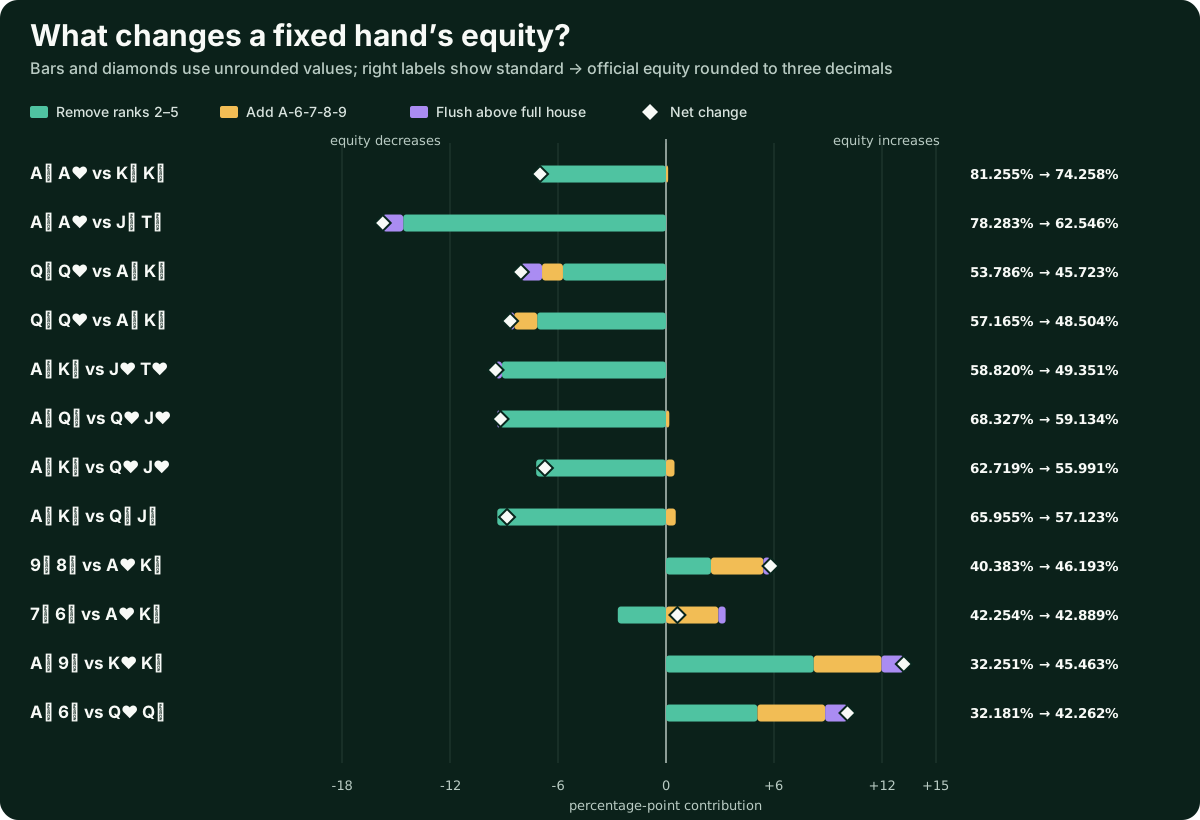
Finding 1: Two Familiar Favorites Flip
Q♠ Q♥ against A♣ K♣ starts as a 53.786% favorite in the selected 52-card deal. Merely deleting ranks 2–5 takes queens to 48.062%. The low-straight rule removes another 1.164 points, and the flush/full-house swap removes 1.175, leaving queens at 45.723%.
A♠ K♦ against J♥ T♥ also crosses 50%. Its 58.820% standard equity falls to 49.351% in the official profile, so the suited connector has 50.649%. Almost the entire change occurs at the deck-removal step: −9.113 points for ace-king, compared with effectively zero from adding A-6-7-8-9 and −0.356 from the category swap.
This is stronger than saying “suited connectors improve.” It identifies which rule moved each exact deal. It also warns against using the conclusion as a class-wide shortcut: suits and ranks remain fixed here.
Finding 2: A-9 and A-6 Gain Through Three Different Routes
A♠ 9♠ against K♥ K♦ rises 13.212 points overall, from 32.251% to 45.463%. The largest step is not the special straight: removing ranks 2–5 contributes +8.211 points. A-6-7-8-9 adds +3.760, and the flush ranking adds +1.241.
A♣ 6♣ against Q♥ Q♦ gains the same 3.760-point low-straight contribution and essentially the same 1.241-point ranking contribution. Its deck-removal contribution is smaller at +5.081, so the total gain is 10.081 points.
Neither suited ace becomes a favorite in these rows. “Gains equity” and “is favored” are different claims. The values also do not establish an opening, calling, or shoving range.
Finding 3: Similar-Looking Connectors Can Cancel Differently
Against the same A♥ K♦, 9♣ 8♣ gains 5.810 points overall. Every ordered step helps it: +2.498 from the compact deck, +2.908 from the low straight, and +0.403 from the ranking swap.
For 7♣ 6♣, the final change is only +0.635 points. Deck removal first costs 2.678 points; the low straight then returns 2.909, and the category swap adds 0.403. A slogan like “connectors gain in Short Deck” misses that cancellation.
Finding 4: A Net Zero Can Hide Changed Boards
The flush/full-house swap changes A♠ A♥ versus K♣ K♦ on 1,224 of the 201,376 Short Deck boards. Aces improve on 612 and worsen on 612, producing exactly 0.000 net equity points from that step. “No net change” therefore does not mean “no board changed.”
The same distinction appears elsewhere. A rule can reverse individual outcomes but have a small aggregate effect because gains, losses, and tie transitions offset. The downloadable JSON keeps those integer transition counts instead of publishing only rounded percentages.
How the Enumeration Works
Once four hole cards are fixed, standard Hold’em leaves 48 cards, so there are C(48,5) = 1,712,304 unordered boards. Short Deck leaves 32 cards, so there are C(32,5) = 201,376. The generator evaluates the highest-ranked five-card combination out of seven on every board, counts wins, ties, and losses, then calculates:
equity = (wins + ties ÷ 2) ÷ all legal boards
There is no random seed because there is no sampling. Each win/tie/loss partition sums to its complete board space. The twelve cases were selected to expose distinct mechanisms—pair compression, suitedness, domination, shared-suit blockers, connectors, and the low-straight endpoints. They are illustrative, not a representative sample of all C(36,2) × C(34,2) = 353,430 labeled two-player Short Deck deals.
The first counterfactual has a second interpretation check: its 201,376 boards are exactly the subset of the 52-card standard boards containing only ranks 6–A. That is 11.7605% of the standard board space. The generator reaches the subset directly rather than filtering 1.7 million boards after the fact.
Independent Checks and Evidence Bundle
The primary JavaScript generator and independent Python verifier do not import one another. The verifier separately parses cards, ranks hands, and enumerates all boards. It reproduced all 48 published win/tie/loss partitions—four models for twelve matchups—exactly.
We also checked the evaluator below the matchup level:
- Both implementations test A-6-7-8-9 as 9-high, ordinary 6-7-8-9-T as higher, and reject false wraparound straights.
- The Python checker classifies all 376,992 five-card Short Deck combinations under both straight conventions. With A-6-7-8-9 enabled, the mutually exclusive counts include 24 straight flushes, 6,120 non-flush straights, and 122,400 high-card hands; without it, those become 20, 5,100, and 123,420.
- A separate five-card evaluator tests adversarial seven-card fixtures by checking all 21 possible five-card subsets.
- Fixtures cover two trips forming the higher full house, three-pair resolution, board-playing ties, straight flush detection by suit, straight above trips, and a shared board where the control awards queens full while the official profile awards an ace-high flush.
Passing these checks is evidence that two implementations agree with the declared rules and combinatorial invariants. It is not peer review, an app certification, or validation of an action strategy.
- Method, data dictionary, reproduction commands, and limitations
- Complete results (JSON) and audit table (CSV)
- Primary JavaScript generator and independent Python verifier
- Frozen full-verification report and SHA-256 manifest
What These Numbers Do Not Tell You
- Not a hand ranking: twelve selected rows cannot rank every Short Deck starting hand.
- Not a range: each row conditions on four known cards; it does not average over an opponent range or over every suit realization.
- Not a decision: there are no positions, antes, blinds, stack depths, bet sizes, action history, fold equity, rake, or future betting.
- Not EV: showdown equity is one input to a decision model. It is not the expected value of raising, calling, or folding.
- Not every Short Deck game: a trips-over-straight room requires a different evaluator and new results.
For postflop draw-completion math rather than preflop head-to-head equity, use our separate Short Deck Rule of 3 and 6 study. For the conceptual difference between hand equity, pot equity, and EV, see poker equity explained.
How to Transfer the Result Into Study
- Lock the rule profile. Confirm the deck, A-6-7-8-9 convention, and whether flush or full house ranks higher.
- Use exact matchups as calibration, not charts. Ask which familiar favorite flipped and which rule caused most of the move.
- Move to ranges. Replace one opponent hand with a position- and action-specific range before drawing a strategic conclusion.
- Add the decision tree. Include forced bets, stacks, sizes, fold equity, future actions, and any fees before calling a play profitable.
The current Google Play and US App Store listings for Short Deck Poker Trainer, checked September 4, 2026, describe Short Deck study, preflop ranges, and equity tools. Use those tools for their stated study workflow; this article did not install the app, test its runtime, or use it to produce the table.
Frequently Asked Questions
- Do pocket aces still begin ahead in Short Deck?
- This study cannot answer a whole-game ranking question because it examines selected fixed opponents and suits. It shows that A♠ A♥ remains favored in two named matchups, while its margin shrinks substantially.
- Why does Q♠ Q♥ become an underdog to A♣ K♣?
- In this exact suit realization, deck removal costs queens 5.724 points, A-6-7-8-9 costs 1.164, and the flush/full-house swap costs 1.175. The result is 45.723% for queens. It is not a suit-averaged QQ-versus-AKs claim.
- Does a straight beat three of a kind in Short Deck?
- Yes in the PokerStars profile used here, because its page changes flush versus full house and says the other rankings remain the same. Other rooms can use trips above a straight, so check the house rule.
- Why are the suits written out?
- Because suit overlap changes flush blockers and shared-runout possibilities. “AKs versus QJs” has distinct same-suit and different-suit cases; hiding the suits would overstate the result’s scope.
- Can I use 46.193% for every 98s-versus-AKo decision?
- No. That number belongs to 9♣ 8♣ versus A♥ K♦ under the stated rules and an all-in showdown. Other suit patterns, ranges, and betting states require their own calculation.
The Practical Takeaway
Short Deck compresses some familiar advantages, strengthens some low-straight endpoints, and lets different rule effects cancel. The useful habit is not memorizing twelve decimals. It is separating the format into explicit changes, checking one matchup under one rules profile, and refusing to turn showdown equity into action advice before ranges and the betting tree are present.
For the app’s dated practice and saved-mistake review, see Daily Challenge versus Mistake Deck. That walkthrough explains which record each mode updates.
Sources
- PokerStars: 6+ Hold’em rules — current operator rules page, accessed September 4, 2026.
- PokerStars Learn: preflop strategy in 6+ Hold’em — operator educational context, accessed September 4, 2026.
- Short Deck Poker Trainer on Google Play and the US App Store — first-party product listings, accessed September 4, 2026.
- GTO Gecko method, code, complete results, validation record, and limitations — generated and checked September 4, 2026.