
You open the button to 2.5bb with A5s. The big blind makes it 12bb. You both started with 100bb. Is this the spot for the familiar suited-ace four-bet?
In this library model, calling is worth 0.333bb more than raising to 24bb. The four-bet itself has a positive stored EV of +0.081bb, but calling returns +0.414bb. A profitable bluff can still pass up a better option.
The useful cue is the value of the call you give up. Start with A5s as a candidate, then compare all available actions. At 50bb against a small-blind three-bet in this study, it instead folds 99.42%; at 100bb against a button three-bet, it can raise frequently.
These are solver-library outputs from twelve specified cash-game configurations, retrieved September 21, 2026. Our explanations are interpretations of those outputs. Original solver settings and achieved convergence are unavailable; a later-response consistency caveat is detailed below. Treat small gaps and precise mixing frequencies cautiously.
A5s faces a big-blind three-bet
Six-handed cash, 100bb starting stacks. BTN opens 2.5bb, SB folds, BB raises to 12bb. The decision is back on BTN.
Swipe or scroll sideways to see all seats and the button’s cards.
Modeled decision, not a played hand. No ante. Catalogued rake 5%, capped at 4bb. Exact suits illustrate a suited class. Pot includes all displayed wagers. Chips are illustrative; the labels are the amounts.
Read the table as text
Six-handed cash, 100bb starting stacks. BTN opens 2.5bb, SB folds, BB raises to 12bb. The decision is back on BTN. Pot: 15 bb.
- UTG: 100 bb behind; 0 bb committed this street; Fold; folded; cards: face down, face down.
- HJ: 100 bb behind; 0 bb committed this street; Fold; folded; cards: face down, face down.
- CO: 100 bb behind; 0 bb committed this street; Fold; folded; cards: face down, face down.
- BTN (dealer): 97.5 bb behind; 2.5 bb committed this street; 9.5bb more to call; next to act; cards: A♠, 5♠.
- SB: 99.5 bb behind; 0.5 bb committed this street; Fold; folded; cards: face down, face down.
- BB: 88 bb behind; 12 bb committed this street; Three-bet to 12bb; cards: face down, face down.
A positive four-bet is only half the comparison
Fold EV is zero at this decision: the 2.5bb opening raise is already committed. Calling adds 9.5bb. A raise to 24bb adds 21.5bb. The table also includes the available 100bb shove; it is a separate action with a very different price.
| Hand | Fold | Call to 12bb | 4-bet to 24bb | Jam to 100bb | ||||
|---|---|---|---|---|---|---|---|---|
| Freq. % | EV bb | Freq. % | EV bb | Freq. % | EV bb | Freq. % | EV bb | |
| A3s | 1.59 | +0.000 | 27.94 | +0.071 | 70.47 | +0.093 | 0.00 | -2.974 |
| A4s | 0.01 | +0.000 | 88.86 | +0.258 | 11.13 | +0.250 | 0.00 | -2.723 |
| A5s | 0.00 | +0.000 | 99.99 | +0.414 | 0.01 | +0.081 | 0.00 | -2.832 |
| A9s | 0.00 | +0.000 | 100.00 | +0.662 | 0.00 | +0.112 | 0.00 | -3.557 |
A3s four-bets 70.47% in this export, while A5s calls 99.99%. That does not make A3s the stronger hand. Its call is worth +0.071bb and its four-bet +0.093bb, a much closer choice than A5s faces. A4s sits near a call/raise tie: the stored difference is only 0.008bb.
For A5s, the calculation is 0.41413 − 0.08084 = 0.33329bb. This is a local comparison against the model’s stored continuations. It is not a win-rate estimate or the cost of changing an entire preflop strategy.
The two ranges behind the decision
The button’s opened range contains 595.69 weighted combinations. The big blind’s reached three-bet range contains 146.67. These are marginal range counts before removing the opponent’s exact cards; they are not probabilities of this hand occurring at a table.
BTN: the opened range responds to 12bb
595.69 weighted combinations before mutual card removal. Cells show action mix; entry weight gives opening reach.
Swipe or scroll sideways to see every hand. The hand selector also opens each class.
Hover or tap a hand. Use arrow keys in the grid. Suited above the diagonal; offsuit below.
Owned preflop library, retrieved September 21, 2026. Marginal ranges; achieved convergence unavailable. Hatched = outside range · ? = missing data
BB: the range that three-bet to 12bb
146.67 weighted combinations before mutual card removal. One color marks range membership. Select a hand to inspect its entry weight; it does not mean BB always raises again.
Swipe or scroll sideways to see every hand. The hand selector also opens each class.
Hover or tap a hand. Use arrow keys in the grid. Suited above the diagonal; offsuit below.
Owned preflop library, retrieved September 21, 2026. Marginal ranges; achieved convergence unavailable. Hatched = outside range · ? = missing data
BB’s range includes 26.10 weighted combinations of TT+ and 52.91 of unpaired broadways. The remaining mass spans suited and offsuit hands, with almost no smaller pairs in this particular three-bet range. Giving BB a generic “strong range” would miss those details.
Both grids preserve the actual earlier actions. Hero’s weights come from opening; villain’s weights come from three-betting. We checked each against a separately exported later node, rather than treating every starting hand as equally present.
The ace blocker is real; the action still needs a comparison
GTO Wizard’s blocker and unblocker discussion explains why suited low aces deserve consideration as bluffs. That is a candidate-selection idea, not a command to raise every time.
In our main BB range, holding either A♠ 5♠ or A♠ 9♠ reduces the AA/AK component from 22.00 to 15.00 weighted combinations. Both holdings remove essentially the same seven combinations from that component, yet their alternatives to four-betting differ.
| Hero cards | Compatible total | Folds | Calls | Jams |
|---|---|---|---|---|
| A♠ 5♠ | 127.65 | 59.87 (46.90%) | 37.44 (29.33%) | 30.34 (23.77%) |
| A♠ 9♠ | 127.24 | 59.29 (46.60%) | 37.60 (29.55%) | 30.34 (23.85%) |
The compatible fold shares are 46.90% and 46.60%, respectively. This small fixed-policy difference cannot explain the EV difference on their own: calls lead to postflop play, and the two hero hands have different outcomes there. We did not isolate a causal blocker effect or calculate a replacement strategy.
Where the familiar four-bet does appear
Move to a 100bb cutoff open facing a 7.5bb button three-bet. A5s now raises to 20.25bb 86.60% of the time. Even here, calling trails that raise by only 0.02039bb in the export. The frequency contrast is much larger than the EV gap.
| Hand | Fold | Call to 7.5bb | 4-bet to 20.25bb | Jam to 100bb | ||||
|---|---|---|---|---|---|---|---|---|
| Freq. % | EV bb | Freq. % | EV bb | Freq. % | EV bb | Freq. % | EV bb | |
| A2s | 100.00 | +0.000 | 0.00 | -0.284 | 0.00 | -0.275 | 0.00 | -6.474 |
| A4s | 3.63 | +0.000 | 52.34 | +0.038 | 44.03 | +0.024 | 0.00 | -5.999 |
| A5s | 0.02 | +0.000 | 13.38 | +0.186 | 86.60 | +0.206 | 0.00 | -5.846 |
A2s is not an interchangeable substitute. Its small four-bet has −0.275bb EV in this configuration. These two spots change position, price and the ranges together; they do not prove that one factor alone caused the difference.
The indifference principle supplies another boundary: a hand can mix several actions with nearly equal EV. Our study tests familiar suited-ace ideas across stored configurations; it does not claim to have discovered them.
The twelve-node test
Before reading these results, we selected six opener/three-bettor pairings at 50bb and 100bb. BTN versus BB and CO versus BTN were the four discovery nodes. The other eight were held out. We compared A2s–A5s, with A9s as a rival candidate and AA/AKs as reference hands.
A5s had lower four-bet regret than A9s in 11 of 12 stored comparisons, including seven of eight held out. One difference was just 0.00076bb, inside our near-tie band. The more useful reading is ten lower-cost A5s comparisons, one near-tie and one reversal. Among the eight held-out nodes, those counts are six, one and one. None of this makes the A5s raise automatically cheap.
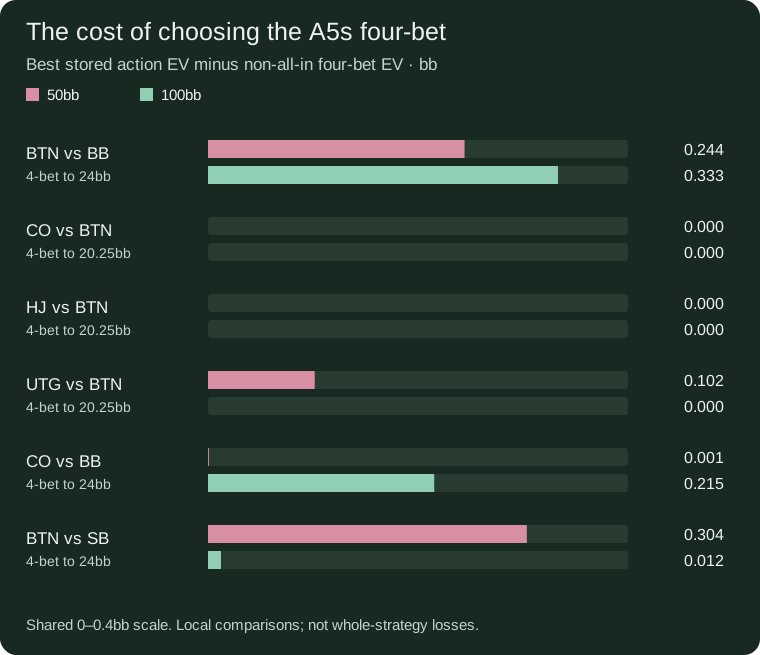
A5s: cost of the small four-bet
Shared 0–0.4bb scale; exact data follow below.
| Spot / stack | Split | 4-bet to | A5s freq. | A5s loss bb | A9s loss bb |
|---|---|---|---|---|---|
| BTN vs BB · 50bb | D | 24bb | 0.00% | 0.244 | 0.858 |
| CO vs BTN · 50bb | D | 20.25bb | 72.47% | 0.000 | 0.117 |
| HJ vs BTN · 50bb | H | 20.25bb | 77.46% | 0.000 | 0.210 |
| UTG vs BTN · 50bb | H | 20.25bb | 5.95% | 0.102 | 0.139 |
| CO vs BB · 50bb | H | 24bb | 38.24% | 0.001 | 0.209 |
| BTN vs SB · 50bb | H | 24bb | 0.22% | 0.304 | 0.409 |
| BTN vs BB · 100bb | D | 24bb | 0.01% | 0.333 | 0.550 |
| CO vs BTN · 100bb | D | 20.25bb | 86.60% | 0.000 | 0.232 |
| HJ vs BTN · 100bb | H | 20.25bb | 71.93% | 0.000 | 0.260 |
| UTG vs BTN · 100bb | H | 20.25bb | 60.39% | 0.000 | 0.188 |
| CO vs BB · 100bb | H | 24bb | 0.00% | 0.215 | 0.000 |
| BTN vs SB · 100bb | H | 24bb | 6.43% | 0.012 | 0.013 |
The A5s four-bet costs more than our 0.1bb screen in five nodes. One is borderline: 50bb UTG versus BTN is 0.10162bb. The other four exceed 0.2bb, so the failure of an automatic four-bet does not depend on that borderline case.
The ranking also reverses at 100bb CO versus BB. A9s has a near-tied call/four-bet choice and zero four-bet regret against its best stored action; A5s gives up 0.21544bb by raising. Treat the lower kicker as a starting clue, not a universal ranking.
A useful study habit
Before choosing the suited-ace bluff, price the call you would give up. A5s often survives the comparison better than A9s, but a valuable call can keep it out of the four-betting range. Do not replace it with another wheel ace without checking that hand’s own alternatives.
For a short exercise, hide the frequencies in the first table. Rank call, small four-bet and jam for A3s, A4s and A5s using EV alone. Then reveal the frequencies and separate the large strategic differences from the near-ties.
In GTO Gecko, use the study views described in the official listing to compare the actions, frequencies and EV estimates available for your chosen setup and plan. Keep stacks, rake, positions and sizes fixed while reading a node. For a related defense problem, see our suited-connector call study.
Method and limits
All twelve configurations are six-handed NLHE cash with equal starting stacks, no ante and a 2.5bb open. The catalog labels rake as 5%, capped at 4bb. BTN three-bets to 7.5bb; the blinds use 12bb. Hero can fold, call, make the listed small four-bet or shove. Original solver version, postflop abstraction and achieved convergence were not supplied.
All 48 primary wheel-ace hand/node rows have positive opening reach. Hand-class mass uses four combinations for suited hands, six for pairs and twelve for offsuit hands. No mutual card removal is applied to the range grids; the separate blocker table enumerates compatible exact combinations. Folded-player card bunching is not modeled by that calculation.
The audit found no positive-reach hero action played at least 10% with a stored EV more than 0.1bb below the best alternative. Six such discrepancies did occur in later villain responses across five configurations, with a largest gap of 0.2024bb. The displayed response counts describe those stored policies; they are not validated optimal responses. The result depends on that screen: lowering the frequency threshold to 5% also flags the borderline 50bb UTG–BTN A5s four-bet, played 5.95% with a 0.10162bb gap. A passed screen is not a convergence certificate.
We used 0.02bb to discuss near-ties and 0.05/0.1/0.2bb sensitivity screens. These are study conventions, not universal error categories. Twelve related nodes from two stack models are not twelve independent experiments. The results do not establish human tendencies, an exploit, or the performance of a complete changed policy.
See the methodology and selected data for exact values and denominators. The header is original AI-generated editorial artwork; all numerical figures are built from the saved exports.