
You open the button with 98s at 50bb. The big blind three-bets to 12bb. You have position, connected cards and a chance to make a flush. Is that enough to call another 9.5bb?
In this stored solution, calling loses 0.570bb compared with folding. Change 98s to JTs in the same spot and calling has the highest reported EV. Suited connectors need a more specific plan than “see a flop.”
Start with the size, stack and ranges that actually reached the decision. In our 12 cash-game configurations, the automatic call failed most clearly against the 12bb blind three-bets at 50bb. Deeper stacks helped many calls, but 98s still failed the test in the 100bb button-versus-big-blind spot.
These are solver-library outputs for the models below. Our explanations are an attempt to understand them. The original solver version and achieved convergence are unavailable, so treat the large comparisons as study leads and tiny EV differences cautiously. Some later response exports also show numerical inconsistencies, described in the method; this is a comparison of stored outputs, not a newly validated equilibrium.
98s faces a big-blind three-bet
Six-handed cash, 50bb stacks. Folds to BTN, who opens to 2.5bb. SB folds; BB raises to 12bb. BTN has 9.5bb more to call.
Modeled decision, not a played hand. No ante. 5% catalog-labelled rake, 4bb cap. Exact suits illustrate the suited class; no separate suit-specific strategy is claimed. Chips are illustrative; the labels are the amounts.
Read the table as text
Six-handed cash, 50bb stacks. Folds to BTN, who opens to 2.5bb. SB folds; BB raises to 12bb. BTN has 9.5bb more to call. Pot: 15 bb.
- UTG: 50 bb behind; 0 bb committed this street; Fold; folded; cards: face down, face down.
- HJ: 50 bb behind; 0 bb committed this street; Fold; folded; cards: face down, face down.
- CO: 50 bb behind; 0 bb committed this street; Fold; folded; cards: face down, face down.
- BTN (dealer): 47.5 bb behind; 2.5 bb committed this street; 9.5bb more to call; next to act; cards: 9♠, 8♠.
- SB: 49.5 bb behind; 0.5 bb committed this street; Fold; folded; cards: face down, face down.
- BB: 38 bb behind; 12 bb committed this street; Three-bet to 12bb; cards: face down, face down.
The same price buys two different calls
Ryan Fee's three-bet defense example includes suited connectors when BTN faces a BB raise to 9bb. Our opener faces 12bb at the depths below. A familiar hand recommendation needs its original configuration attached.
The modeled 9♠8♠ represents 98s, the suited rank class. The library does not distinguish a spade-spade response from ♥♥, ♦♦ or ♣♣ before the flop.
| Hand class | Fold | Call 9.5bb more | Raise to 24bb | Jam to 50bb | ||||
|---|---|---|---|---|---|---|---|---|
| Freq. (%) | EV (bb) | Freq. (%) | EV (bb) | Freq. (%) | EV (bb) | Freq. (%) | EV (bb) | |
| 98s | 100.0 | 0.000 | 0.0 | -0.570 | 0.0 | -1.906 | 0.0 | -3.307 |
| T9s | 89.8 | 0.000 | 10.2 | -0.075 | 0.0 | -0.826 | 0.0 | -2.272 |
| JTs | 0.0 | 0.000 | 60.1 | 0.756 | 39.9 | 0.748 | 0.0 | -0.691 |
For 98s, folding is worth 0 at this decision and calling is worth −0.570bb. The 2.5bb opening raise has already gone into the pot; folding does not recover it. The comparison asks what to do with the next decision.
JTs calls 60.1% and raises to 24bb 39.9%. Its call EV exceeds the smaller four-bet EV by only 0.008bb. That tiny gap does not justify treating one as the uniquely correct action. T9s, between the two hands by rank, mostly folds even though its call loss is a much smaller 0.075bb.
The three-bet range is part of the price
At the main 50bb spot, BTN's opening range contains 565.87 weighted combinations. BB's reached three-bet range contains 160.07. These are marginal combo totals, before adjusting for the cards the two players cannot share.
BTN: the opened range faces 12bb
565.87 weighted combinations before mutual card removal. Hero already opened; the 2.5bb is committed.
Hover or tap a hand. Use arrow keys in the grid. Suited above the diagonal; offsuit below.
Owned preflop library retrieved September 13, 2026. Marginal ranges; achieved convergence unavailable. Hatched = outside range · ? = missing data
BB: the range that three-bet to 12bb
160.07 weighted combinations before mutual card removal. Weights are the actual reached three-bet range, checked against a later response export. One color marks membership; select a hand to see its weight.
Hover or tap a hand. Use arrow keys in the grid. Suited above the diagonal; offsuit below.
Owned preflop library retrieved September 13, 2026. Marginal ranges; achieved convergence unavailable. Hatched = outside range · ? = missing data
| Hand group | BTN combos | BB combos |
|---|---|---|
| TT+ | 30.00 | 29.99 |
| Broadways (unpaired) | 160.00 | 40.94 |
| Other pairs | 48.00 | 6.30 |
| Other suited hands | 166.86 | 13.27 |
| Other offsuit hands | 161.01 | 69.57 |
Both ranges retain almost all 30 combinations of TT through AA. Those pairs make up 5.3% of BTN's marginal range and 18.7% of BB's. BB also has other hands, including offsuit hands outside the Broadway group. The three-bet is neither the whole starting range nor only premium pairs.
This is the opponent range the call must face. The composition is consistent with different prospects for 98s and JTs, but it does not isolate the reason for their EV gap. We have not measured a specific blocker effect, showdown-equity advantage or postflop realization mechanism here.
Where the automatic call breaks down
We tested seven suited connectors: 54s, 65s, 76s, 87s, 98s, T9s and JTs. Each setup starts with six equal stacks, no ante and a 2.5bb open. BTN three-bets to 7.5bb; the tested blind three-bets are to 12bb. Everyone else folds.
Before analyzing hand values, we set a practical screen: calling every connector that actually opened should lose no more than 0.1bb for at least 95% of that group's opening-range combo mass in each node. That threshold is a study choice, not a universal definition of a mistake.
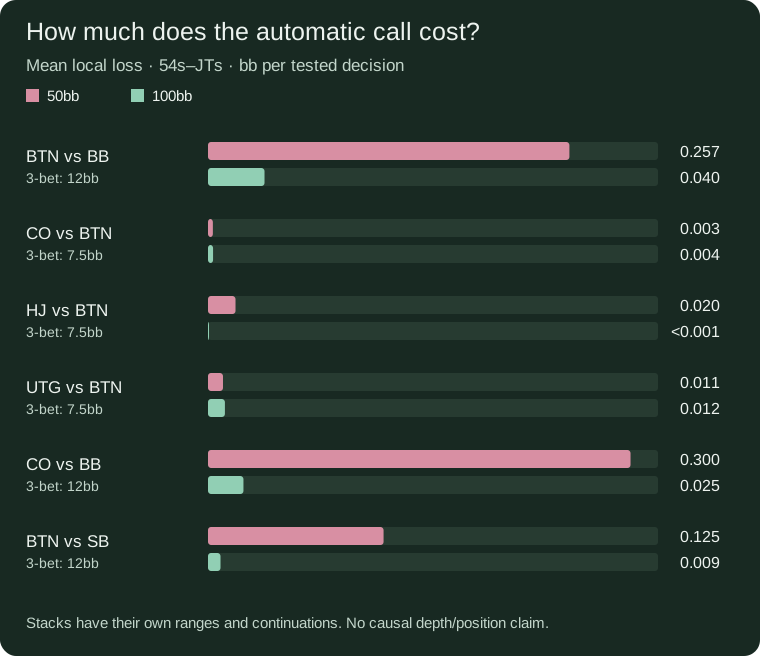
| Setup | 3-bet to | Call (%) | Mean loss (bb) | Within 0.1bb (%) |
|---|---|---|---|---|
| 50bb BTN vs BB | 12bb | 10.1 | 0.257 | 28.7 |
| 50bb CO vs BTN | 7.5bb | 27.0 | 0.003 | 100.0 |
| 50bb HJ vs BTN | 7.5bb | 32.3 | 0.020 | 100.0 |
| 50bb UTG vs BTN | 7.5bb | 31.5 | 0.011 | 100.0 |
| 50bb CO vs BB | 12bb | 0.9 | 0.300 | 11.4 |
| 50bb BTN vs SB | 12bb | 2.3 | 0.125 | 57.3 |
| 100bb BTN vs BB | 12bb | 48.6 | 0.040 | 85.7 |
| 100bb CO vs BTN | 7.5bb | 49.4 | 0.004 | 100.0 |
| 100bb HJ vs BTN | 7.5bb | 69.9 | <0.001 | 99.8 |
| 100bb UTG vs BTN | 7.5bb | 63.0 | 0.012 | 100.0 |
| 100bb CO vs BB | 12bb | 44.3 | 0.025 | 100.0 |
| 100bb BTN vs SB | 12bb | 47.8 | 0.009 | 100.0 |
Eight of the 12 nodes passed; four failed. The failures were 50bb BTN versus BB, CO versus BB and BTN versus SB, plus 100bb BTN versus BB. Two failures appeared in the eight held-out configurations, which were reserved before the hand analysis.
The mean loss at 50bb BTN versus BB was 0.257bb, with only 28.7% of the eligible mass within 0.1bb. Its 95th-percentile loss was 0.570bb. The smaller mean of 0.040bb in the 100bb counterpart still concealed a costly 98s call. Displayed percentages are rounded: a shown 100.0% need not mean every tiny-weight hand passed.
An aggregate can hide a rare hand too. At 100bb HJ versus BTN, the mean call loss is below 0.001bb, yet 98s loses 0.161bb by calling. It enters with only 0.53% of its starting class weight. The node passes because that hand contributes very little to the denominator.
Meanwhile, the six nodes facing BTN's 7.5bb three-bet all passed this local cost screen. Some of those hands still fold often in the stored strategy. Passing the screen means the tested call was close enough under the stated threshold; it is not an instruction to call the entire range in a new strategy.
What changes at 100bb
| Setup / hand | Fold | Call | Call loss (bb) | ||
|---|---|---|---|---|---|
| Freq. (%) | EV (bb) | Freq. (%) | EV (bb) | ||
| 50bb BTN vs BB 98s · 3-bet 12bb | 100.0 | 0.000 | 0.0 | -0.570 | 0.570 |
| 100bb BTN vs BB 98s · 3-bet 12bb | 99.9 | 0.000 | 0.0 | -0.219 | 0.219 |
| 50bb CO vs BB JTs · 3-bet 12bb | 99.5 | 0.000 | 0.5 | -0.214 | 0.214 |
| 100bb CO vs BB JTs · 3-bet 12bb | 0.7 | 0.000 | 99.3 | 0.032 | 0.000 |
| 50bb CO vs BTN 65s · 3-bet 7.5bb | 13.1 | 0.000 | 86.9 | 0.043 | 0.000 |
With 98s on the button against BB, moving from 50bb to 100bb reduces the call loss from 0.570bb to 0.219bb. It remains above the 0.1bb screen. The deeper stack does not rescue this particular call.
JTs supplies the other boundary. It continues in the opening example, yet at 50bb after a cutoff open and a BB three-bet to the same 12bb, calling loses 0.214bb. At 100bb in that CO-versus-BB setup it mostly calls. Neither “all suited connectors” nor “JTs always continues” survives these comparisons.
The smaller suited hands can also earn calls. At 50bb CO versus BTN's 7.5bb three-bet, 65s calls 86.9%, with a reported call EV of +0.043bb. It only opened with 23.63% of its starting weight, so this is a conditional defense of the part that reached the node, not permission to open every 65s.
Position, price and range construction change together across these examples. Our interpretation is that the whole configuration matters more than a suitedness label. This study cannot tell you how much of a difference came from position alone.
A useful way to study the next three-bet
Use this cue: when a blind makes a large three-bet at 50bb, audit the low and middle suited connectors individually before treating them as calls. Then check the nearest higher connector and the same matchup at 100bb. A low mean loss for the group can hide the one hand you actually hold.
For a short exercise, cover the EV columns and predict 98s, T9s and JTs in the 50bb button-versus-BB table. Reveal the values, then explain the cutoff JTs exception without using “it is suited” as the reason to continue.
In GTO Gecko, use the preflop study views to compare the available actions, frequencies and EVs in matching precomputed scenarios. Its current App Store listing describes those paid-plan study tools. Keep the opening range and the three-bettor's reached range beside the individual hand.
If the earlier decision is the problem, our 50bb versus 100bb cold-call study starts from facing an open. For terminology, see what a three-bet means.
Method, evidence and limits
We retrieved the current owned preflop catalog and the relevant opening, three-betting and response nodes on September 13, 2026. The cash entries are catalogued as 5% rake with a 4bb cap. That is the original app label; we could not independently inspect these legacy files' underlying rake settings. Stacks are 50bb or 100bb before blinds; there is no ante, ICM or bounty model. The original solve version, postflop abstraction and achieved convergence were not supplied.
Four discovery nodes covered BTN versus BB and CO versus BTN at both depths. Eight held-out nodes covered HJ versus BTN, UTG versus BTN, CO versus BB and BTN versus SB at both depths. Of 84 requested hand/node rows, 80 had positive opening reach and four were absent. We preserved tiny positive weights and excluded actual zero weights. These are 12 related configurations, not 80 independent solutions.
For each hand, local call loss is max(stored action EVs) − stored call EV. Means, percentiles and threshold shares use four combinations times that suited class's opening weight. They describe the selected marginal ranges, not how often the decisions occur in play; mutual card removal and folded-player card effects are not reconstructed.
The 0.05bb and 0.2bb sensitivity results, exact selected values and both explanatory ranges are in the study data and method. An independent decoder verified action order, frequencies, weights and the calculations. We checked both current ranges against the previous action that produced them.
A numerical check found no action used at least 10% with more than 0.1bb stored EV loss in the 80 eligible connector rows, or in any positive-weight hero response hand. It did find six such inconsistencies in later villain responses to four-bets, across five other configurations. Those continuation flags are a reason to validate a proposed shortcut with a known-convergence solve before treating the thresholds as precise.
These are local comparisons against the stored continuations. We did not evaluate a complete strategy that changes every call, re-solve an adapting opponent or estimate a win rate. Unknown convergence especially limits interpretation of close mixed actions. For the distinction, see our solver-convergence worked example.
Related explanations include GTO Wizard on indifference and Pio's range-weight and EV definitions. These explain the concepts; the measurements above come from this run's owned-library analysis. Header artwork is an original AI-generated illustration, separate from the numerical evidence.