
You have 4♠ 4♥ in the big blind. The button opens to 2.1bb, the small blind folds, and you started with 25bb available after antes. Calling costs just 1.1bb. The suits illustrate the hand; the export reports the 44 class rather than separate suit combinations.
In the studied solution, pocket fours shove 96.8% of the time. The reported EV is 1.579bb for shoving and 1.079bb for calling. That is a 0.500bb gap at this decision.
The useful cue is a small pair facing a button open at a medium tournament stack. Across our 20bb, 25bb and 30bb button comparisons, shoving has the highest reported EV for every pair from 22 through 66. Change the opener or depth, and the picture changes.
These are solver-library outputs for specified chip-EV models. Our explanations are attempts to understand them. The export does not include solver version, achieved convergence or its postflop abstraction, so treat the values as model results and be especially cautious with tiny gaps.
Pocket fours in the big blind
Six-handed MTT chip EV. BTN opens to 2.1bb; everyone else folds. BB can call 1.1bb, raise to 7.5bb, shove to 25bb or fold.
Modeled spot, not a played hand. 0.125bb ante per seat; 25bb bettable stacks after antes, before blinds. Pot includes 0.75bb total antes. No rake or ICM. Chips are illustrative; the labels are the amounts.
Read the table as text
Six-handed MTT chip EV. BTN opens to 2.1bb; everyone else folds. BB can call 1.1bb, raise to 7.5bb, shove to 25bb or fold. Pot: 4.35 bb.
- UTG: 25 bb behind; 0 bb committed this street; Fold; folded; cards: face down, face down.
- HJ: 25 bb behind; 0 bb committed this street; Fold; folded; cards: face down, face down.
- CO: 25 bb behind; 0 bb committed this street; Fold; folded; cards: face down, face down.
- BTN (dealer): 22.9 bb behind; 2.1 bb committed this street; Open to 2.1bb; cards: face down, face down.
- SB: 24.5 bb behind; 0.5 bb committed this street; Fold; folded; cards: face down, face down.
- BB: 24 bb behind; 1 bb committed this street; 1.1bb to call; next to act; cards: 4♠, 4♥.
A cheap call can leave EV behind
A call can be positive EV and still leave value behind. All five small pairs have positive call EV in the 25bb button spot. Each has higher shove EV. On narrow screens, swipe the table to compare all four actions.
| Pair | Shove to 25bb | Raise to 7.5bb | Call 1.1bb | Fold | ||||
|---|---|---|---|---|---|---|---|---|
| Freq. (%) | EV (bb) | Freq. (%) | EV (bb) | Freq. (%) | EV (bb) | Freq. (%) | EV (bb) | |
| 22 | 100.0 | 1.282 | 0.0 | 1.162 | 0.0 | 0.964 | 0.0 | 0.000 |
| 33 | 100.0 | 1.335 | 0.0 | 1.285 | 0.0 | 1.006 | 0.0 | 0.000 |
| 44 | 96.8 | 1.579 | 3.2 | 1.567 | 0.0 | 1.079 | 0.0 | 0.000 |
| 55 | 100.0 | 1.955 | 0.0 | 1.927 | 0.0 | 1.193 | 0.0 | 0.000 |
| 66 | 100.0 | 2.321 | 0.0 | 2.247 | 0.0 | 1.262 | 0.0 | 0.000 |
The table also keeps the smaller raise visible. With 44, raising to 7.5bb reports 1.567bb, just 0.012bb below shoving. That is a much smaller distinction than the half-blind gap to calling. A 96.8% shove frequency does not make every alternative equally costly.
The distinction between a profitable shove and the best available action is central to Upswing’s short-stack 3-betting analysis. Its small-blind example uses different positions, stacks and antes; it motivates this question rather than verifies these numbers.
The 20–30bb button pattern
We retrieved 24 BB decisions and retained the 16 spots at 15, 20, 25 and 30bb for this strategy comparison. The openers are UTG, HJ, CO and BTN. Every player between the opener and BB folds; there is no cold-caller. The eight deeper cases were excluded after a response-quality review, explained below.
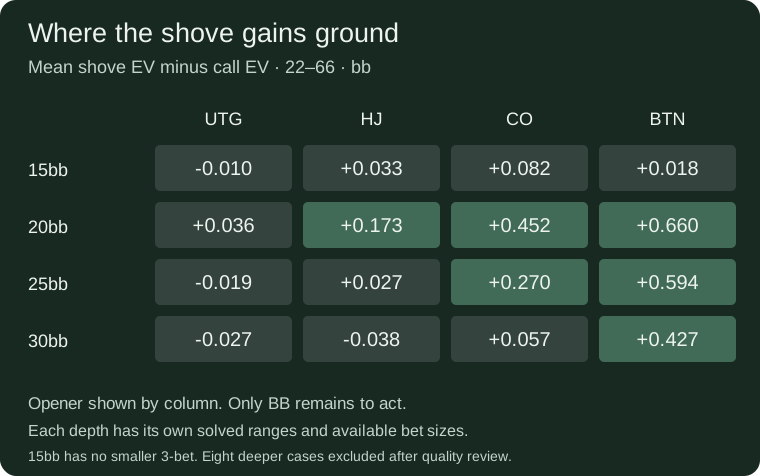
The pattern: the biggest shove gains appear against BTN at 20–30bb. Earlier-opener comparisons are mostly much closer. Read exact cell values below; the earlier-position 30bb cells need extra caution.
| Stack | UTG | HJ | CO | BTN |
|---|---|---|---|---|
| 15bb | -0.010 | +0.033 | +0.082 | +0.018 |
| 20bb | +0.036 | +0.173 | +0.452 | +0.660 |
| 25bb | -0.019 | +0.027 | +0.270 | +0.594 |
| 30bb | -0.027 | -0.038 | +0.057 | +0.427 |
Quality caution for the 30bb early-position cells: their stored responses are less internally consistent than BTN’s. In particular, UTG includes a materially inconsistent mixed response. These cells are exploratory context; they do not establish a precise action boundary.
Across 20bb, 25bb and 30bb against BTN, shoving has the highest reported EV in 15 of 15 pair/depth combinations.
The 25bb button spot was the exploratory example. The held-out 20bb and 30bb button spots also pass all 10 of 10 comparisons. Calling loses 0.133–0.930bb against shoving in those ten cases. These are selected model comparisons, not ten independent samples of real poker.
Look at the range that actually answers
The BB grid shows the full first-decision range. The button grid starts after its 2.1bb open and shows its response to a 25bb shove. Hands excluded by that opening action remain absent.
BB: choose the response
1326.00 weighted combos. BB has made no voluntary action.
Choose a hand or use arrow keys. Swipe the grid sideways on narrow screens. Suited above the diagonal; offsuit below.
Owned preflop library retrieved September 8, 2026. Marginal combo weights; solver convergence unavailable. Hatched = outside range · ? = missing data
BTN: respond to the BB shove
549.23 weighted combos. Only hands retained by the 2.1bb opening action enter this range.
Choose a hand or use arrow keys. Swipe the grid sideways on narrow screens. Suited above the diagonal; offsuit below.
Owned preflop library retrieved September 8, 2026. Marginal combo weights; solver convergence unavailable. Hatched = outside range · ? = missing data
At 25bb, BTN’s entering range contains 549.23 weighted combinations, about 41.4% of the 1,326 possible preflop combinations. Its stored response folds 66.8% of that marginal range mass. The calling range includes 44 and higher pairs, ATo, and KJs; KQo mixes. There is plenty besides an overpair in the hands that continue.
| Measure | BTN | UTG |
|---|---|---|
| Entering combo mass | 549.23 | 300.02 |
| Fold share (%) | 66.8 | 67.0 |
| Call combo mass | 182.16 | 98.95 |
| Pocket pairs among calls (%) | 36.2 | 48.5 |
The nearly identical fold shares are a useful warning against a one-number explanation. UTG begins with a much narrower range, and pairs form a larger share of its calls. Its 44 and 55 fold to the shove, while BTN’s call. The same BB hand faces different continuing hands even when the headline fold percentages look similar.
A called preflop shove takes the pair straight to showdown. A fold ends the hand immediately. Which hands take each route matters alongside the price of the shove.
The range comparison is consistent with the opener’s composition mattering. It does not isolate a causal value for “equity denial” or “playing badly postflop.” Nor is 66.8% the exact chance BTN folds against your specific 4♠ 4♥: that requires compatible opponent combinations and any folded-player card information the model uses.
Where the cue changes
Move the opener to UTG. At 25bb, 44 calls 79.5% and shoves 20.5%. Yet call and shove EV both round to 0.869bb. The exact stored difference is just 0.00030bb. Copying the frequency swing as a claim that shoving became a large mistake would misread the evidence.
| Pair | Shove to 25bb | Raise to 7.5bb | Call 1.1bb | Fold | ||||
|---|---|---|---|---|---|---|---|---|
| Freq. (%) | EV (bb) | Freq. (%) | EV (bb) | Freq. (%) | EV (bb) | Freq. (%) | EV (bb) | |
| 22 | 0.2 | 0.726 | 0.0 | 0.373 | 99.8 | 0.796 | 0.0 | 0.000 |
| 44 | 20.5 | 0.869 | 0.0 | 0.620 | 79.5 | 0.869 | 0.0 | 0.000 |
| 66 | 1.0 | 0.953 | 18.3 | 0.953 | 80.6 | 0.967 | 0.0 | 0.000 |
Move down to 15bb. Against BTN’s 2bb open, 22 calls 70.1%, and 66 calls 95.0%. Their reported shove losses are only 0.019bb and 0.015bb. This is a frequency reversal, not evidence that shoving became a large mistake. Shorter stacks do not produce a steadily increasing shove frequency in these examples. The 15bb tree also lacks a smaller 3-bet, so this is a changed decision menu as well as a changed stack.
Do not extend the button cue to every opener. At 30bb against HJ, 66 reports 1.160bb for calling and 1.053bb for shoving, a 0.107bb gap. That narrowly crosses our 0.1bb screen. With unknown convergence, the threshold crossing itself is not a precise strategic boundary; the useful contrast is how much smaller the shove incentive becomes outside the button examples.
Across all 80 retained pair/spot entries, 79 stay within 0.1bb of the highest reported action EV when shoved. The evidence therefore supports a clearer advantage over calling against BTN, rather than a sharp rule that shoving elsewhere is expensive.
Use the pattern as a study cue
In these 20–30bb, six-handed chip-EV models, start by checking the shove with BB’s 22–66 against a small BTN open. Compare it with both calling and the smaller raise. Recheck the decision when the opener moves earlier, the stack changes, or tournament utility includes payouts.
For an exercise, predict 44 at 25bb versus BTN, 44 at 25bb versus UTG, and 66 at 15bb versus BTN. Then write down two things for each: its most frequent action and the EV lost by your chosen alternative. Keeping both answers stops a near-tie from becoming a memorized emergency.
Calling is also more than buying a chance to flop a set. Our set-mining implied-odds model separates those payoff assumptions. Here, call EV comes from the stored continuation model, whose internal postflop abstraction was not available for inspection.
You can compare precomputed ranges, frequencies and EV estimates in GTO Gecko’s study tools. A paid plan is required; available study libraries depend on the plan. Use a matching game and action history rather than a superficially similar chart.
What was measured
The study retrieved 24 current preflop decision nodes on September 8, 2026, covering 120 positive-reach pair/spot entries. The retained comparison uses 80 entries in 16 spots; the eight 40–50bb spots remain excluded from strategic conclusions. All six players have equal bettable stacks. Each pays a 0.125bb individual ante, totaling 0.75bb; there is no rake, bounty model or ICM. Displayed stacks are after that ante and before blinds. At 25bb versus a 2.1bb open, the facing pot is 4.35bb.
For the retained comparisons, open sizes are 2bb at 15–20bb and 2.1bb at 25–30bb. The non-all-in BB raises are 6bb, 7.5bb and 8.2bb at 20, 25 and 30bb respectively. At 15bb the choices are fold, call and shove. Each depth uses its own solved ranges; this is not a fixed-range experiment.
Why exclude the deeper cases? After the planned analysis, a second audit found material inconsistencies in some 40–50bb responses to rare shoves: hands mixed into calls whose exported EV was substantially below folding. That makes those branches unsuitable for teaching a precise shove boundary. We excluded the entire deeper comparison rather than selecting its most dramatic numbers. This was a post-analysis quality decision, not a predeclared exclusion or a disproof of deep shoving.
The check compared each response hand’s frequency-weighted action EV with its highest exported action EV. The retained button cases have much smaller local inconsistencies, but this check cannot establish global solver accuracy. A preflop re-solve with known settings would be needed to validate the deeper comparison.
We decoded all action frequencies and EVs, verified action order against the game tree, and checked that the opener’s response range equals its opening reach. Table EVs are in big blinds relative to folding at the displayed node. Local action loss is the highest available action EV minus the selected action’s EV, against stored continuations. It does not evaluate a new full strategy or estimate bb/100 hands.
After the 25bb BTN pilot, we declared the main screen before analyzing the remaining cases: shoving 22–66 at 20–30bb versus BTN should stay within 0.1bb of the best action in at least 90% of the 15 hand/depth combinations. The main result also passes 0.02bb and 0.05bb screens because shoving has the highest reported EV in those 15 entries. Those thresholds are study choices, not numerical error bounds. Unknown convergence prevents treating the last decimal or exact mixing percentage as a strategic target.
Selected pair/action results, the 16-spot summary and the opening-range comparison preserve the public numbers. The header is generated editorial artwork; the tables, grids and chart carry the measured evidence.