
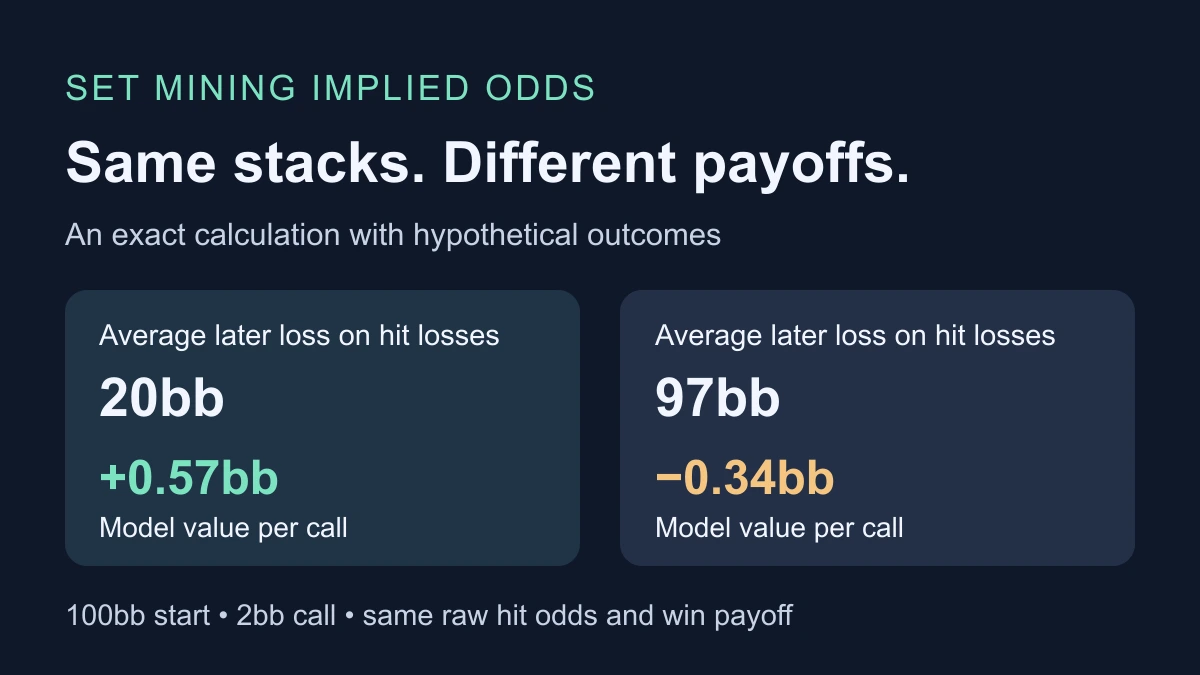
Set mining needs enough average payoff when you hit, not merely a large stack to play for. A rule such as “have 20 times the call behind” cannot tell you how often an opponent pays, how much they pay, or how much you lose after improving.
Set mining means calling with a pocket pair mainly to make a set on the flop and earn enough afterward to repay the misses.
The worked model below holds stack depth and flop-hit odds fixed. Changing only the assumed loss after hitting moves the estimated call value from +0.57bb to −0.34bb. These are synthetic assumptions for off-table study, not measured win rates or a recommendation to call a particular pair.
Two 100bb examples with the same chance to hit
Use a no-limit Hold'em cash-game chip snapshot: both active players started with 100 big blinds (bb), the button raised to 3bb, the small blind folded 0.5bb, and you are in the big blind with a pocket pair. You have already posted 1bb. Calling costs 2bb more and closes preflop action. There are no antes or fees in this model.
The pot is 4.5bb before your call and 6.5bb afterward. Both players then have 97bb left. That is capacity for future betting; it is not a forecast of what you collect.
For this benchmark, a hit means that the flop contains a card matching your pocket-pair rank. We use its unconditioned raw-deck probability, about 11.76%, and exclude ties. We assign every no-hit hand a net loss of 2bb, leaving any other continuation value out. On a hit, suppose you eventually win 90% of the time and collect an average of 20bb in additional opponent chips on those wins. The only change between A and B is your average later investment on the hit hands you lose:
| Assumption | A: smaller losses | B: full-stack losses |
|---|---|---|
| Assumed eventual win chance within hits | 90% | 90% |
| Opponent's later chips, per hit win | 20bb | 20bb |
| Your later chips, per hit loss | 20bb | 97bb |
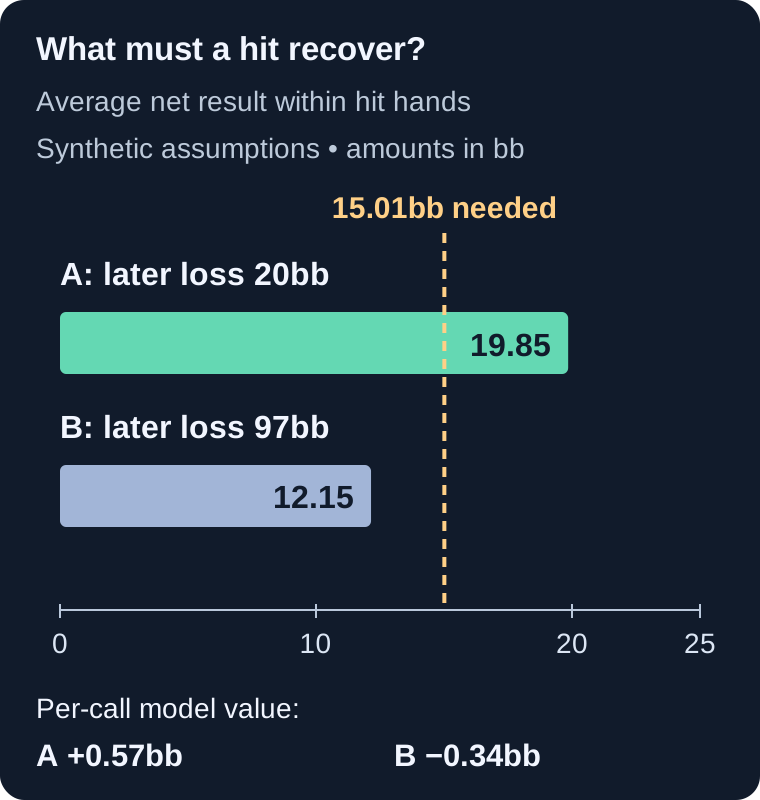
| Average net result per hit | +19.85bb | +12.15bb |
| Model value per preflop call | +0.57bb | −0.34bb |
On narrow screens, scroll the table horizontally. All net results start immediately before the extra 2bb call; they are not whole-hand profit figures.
Both assumptions fit within the same 97bb remaining capacity. Neither says which assumption describes an actual opponent. The comparison exposes an input a stack multiplier leaves unspecified: the cost of the occasions when improving still loses.
Define what “hit” means before using 11.76%
Here a hit means at least one of the two remaining cards of your pocket-pair rank appears on the flop. With only your two hole cards known and the remaining cards uniformly distributed, there are 19,600 possible three-card flops. Of those, 2,304 contain a rank match:
p = 1 − C(48, 3) / C(50, 3) = 2,304 / 19,600 ≈ 11.76%.
C(n, 3) counts unordered selections of three cards from n. The subtraction removes flops containing neither remaining rank match.
This includes flopping quads of your pocket rank and full houses that contain a rank match. It does not include a board such as K-K-K with 7-7 in your hand, even though your five cards make a full house. “Every possible set or better” would therefore be an imprecise label for this event.
The probability is exact for this raw-deck benchmark. It is not an exact probability conditioned on the button's raising range or the small blind's folding range. Information about hidden cards can change the distribution; the bunching-effect study explains that distinction. We use the chip snapshot to audit payments, not to claim a solved range model.
Keep the call, pot and later payments separate
The underlying idea is established: MIT's poker lecture on implied odds, PDF pages 22–23, distinguishes money available from money an opponent actually contributes. 888poker's set-mining explanation also discusses average winnings and losses after hitting. Our contribution is to separate those outcomes explicitly and publish a reproducible sensitivity table.
Let H be the average net result on hit hands, measured from the current decision. With hit probability p and call cost C, the restricted model is:
Call value = p × H − (1 − p) × C.
At the raw hit rate above, a 2bb call needs H = 2 × 1,081 / 144 = 15.013889bb to break even. This is an average net result across all hit hands, including those that lose. It is not the required final pot or the opponent's required stack.
To make H inspectable, use three assumptions:
- q: eventual win probability conditional on hitting.
- F: average additional opponent chips collected, conditional on hitting and winning.
- L: your average additional chips lost after the call, conditional on hitting and losing.
With P as the pot before the call, H = q(P + F) − (1 − q)(C + L). F and L count contributions retained in the pot; an uncalled bet returned to its owner is excluded. On a win, your call and matched later bets return to you, so they cancel out of the net result. On a loss, the call and later investment are gone.
For A: H = 0.9 × (4.5 + 20) − 0.1 × (2 + 20) = 19.85bb. For B, replace the last 20 with 97: H becomes 12.15bb. A full-stack loss is 99bb from this checkpoint, because the previously posted 1bb is already in the pot. The pot-odds guide covers the underlying call-versus-fold accounting.
How much must the winning hit hands collect?
Hold the 2bb call, 4.5bb pot and raw hit probability fixed. The table shows the average additional opponent chips F needed on hit wins for this model to break even. The column is your later loss L on hit losses.
| Win probability within hits | L = 0bb | L = 20bb | L = 97bb |
|---|---|---|---|
| 100% | 10.51bb | 10.51bb | 10.51bb |
| 90% | 12.40bb | 14.63bb | 23.18bb |
| 80% | 14.77bb | 19.77bb | 39.02bb |
Values are rounded to two decimals; download the threshold table for six decimals and exact fractions. When q is 100%, the loss branch has zero weight, so changing L does nothing. This boundary is an arithmetic check, not a claim that a flopped set cannot lose.
Read B across the 90% row: with a 97bb later loss on losing hit hands, winning hit hands need to collect an average of 23.18bb more from the opponent. B assumes only 20bb, so it falls short. A needs 14.63bb under its smaller-loss assumption, so the same 20bb clears its threshold.
Even if every hit won, collecting nothing further gives a model call value of −1.24bb here. Collecting an average of 20bb on each hit win raises it to +1.12bb. Having chips available and actually winning them remain separate conditions.
Use the unknowns to guide a hand review
The model is useful for asking what a set-mining argument assumes. It cannot fill those assumptions in for you.
- Do not substitute flop equity for q. q describes eventual outcomes under a continuation plan. Later folds, bets and runouts belong to that plan.
- Keep all hit losses in the accounting. Reviewing only the large pots won after making a set overstates the conditional average.
- Give no-hit play its proper value. This benchmark assigns every no-rank-match hand a −2bb result. Real pocket pairs can win without improving or take other continuations; the board-trips full house above is also outside our hit bucket. The benchmark is not an instruction to fold those hands.
- Match the action and game. This call closes preflop action. A cold call with players still to act needs further preflop branches. Upswing's set-mining guide discusses those squeeze and stack-depth considerations.
- Account for fees separately. Our examples have no rake. Apply the actual fee schedule to terminal outcomes before using a model for a raked game; the rake-cap explanation shows why a single percentage can mislead.
To value other no-hit continuations, replace their fixed loss with their average net result M: the general accounting becomes p × H + (1 − p) × M. Our table sets M to −2bb. A negative table result therefore does not prove that the complete call strategy loses value; its omitted continuations could change the answer. Nor does a positive table result prove the assumed payoffs are attainable.
In real play, q, F and L need not move independently. Freezing two while changing the third tests an assumption; it does not show that you can make that isolated change at the table. If you do not know the inputs, leave them unknown rather than converting “100bb deep” into a positive expected value.
For broader strategy study, use GTO Gecko's precomputed-range study and simulated decision practice. A paid plan is required and available libraries depend on the plan. GTO Solutions makes the app and publishes this site. This article's assumptions are independently constructed; they are not a Gecko solve or an in-app set-mining calculator. The 50bb versus 100bb cold-call study is a separate example of comparing ranges under specified solver assumptions.
Reproduce the arithmetic
Download the method and instructions, Python generator, independent verifier, exact results and four comparison cases. The study uses exact card counts and rational arithmetic, with no random sampling or empirical player data.
Sources and the US product listing were checked on . The published numbers validate the stated accounting model only; they do not establish a calling range, real-world win rate or measured learning effect.