
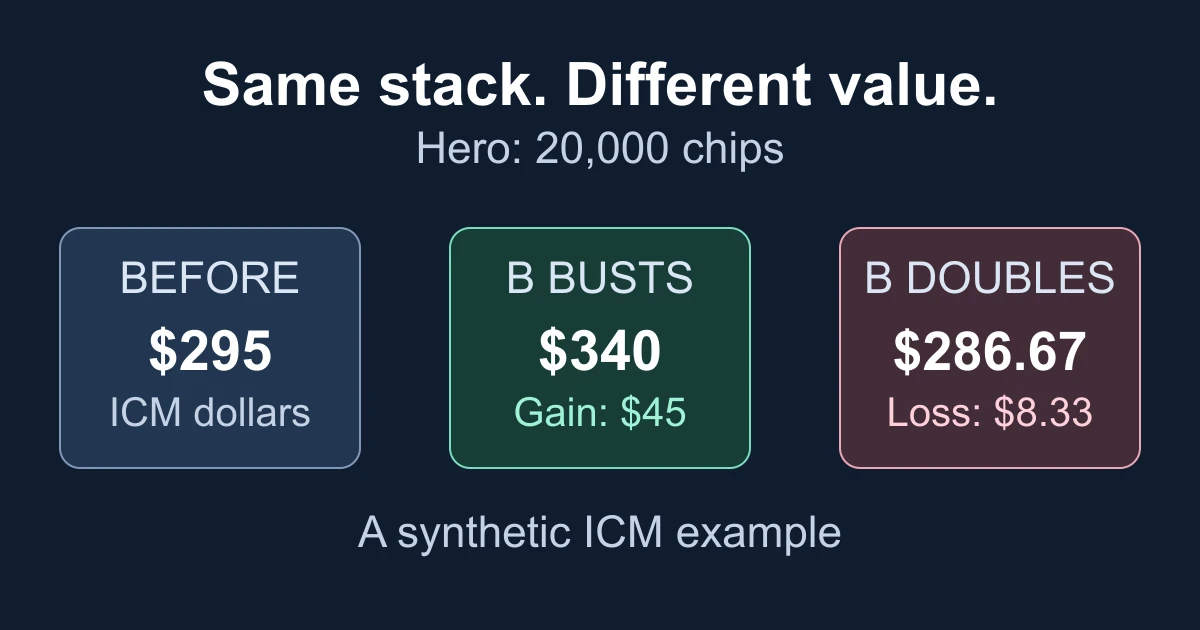
Yes. Your ICM equity can fall when two other players exchange chips, even if your own stack does not change. A short stack doubling through a larger stack can leave you with a smaller modeled share of the prizes. That does not contradict the result that spectators benefit on average from a fair two-player chip gamble. One observed outcome and an expectation over possible outcomes are different comparisons.
This after-session example answers a specific review question: “Why did my ICM number go down when I was not in the pot?” For the underlying model, start with our ICM introduction. The calculations below are constructed examples. They explain a change in valuation; they do not show that Hero should have folded a particular hand.
For an actual call-or-fold decision, our folded-stack ICM study compares the big blind’s response to a small-blind shove while the button’s stack changes.
If your question concerns the lobby’s chip average rather than prize value, see why average tournament stack does not reveal your rank.
One fixed stack, two different futures
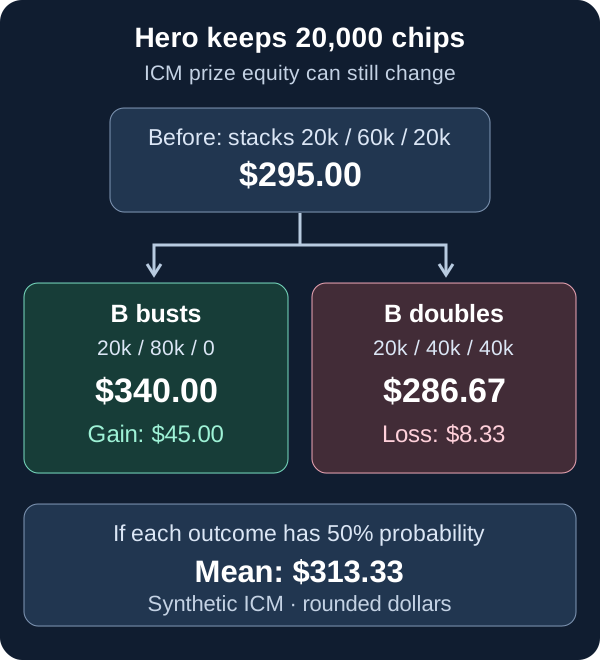
Three players remain, with prizes of $500, $300 and $200. Hero holds 20,000 chips, A holds 60,000, and B holds 20,000. We isolate a transfer between A and B: either A wins 20,000 chips from B, eliminating B, or B wins 20,000 from A and doubles. Hero’s stack stays at 20,000 throughout.
These are complete stack distributions before and after a synthetic transfer. No separate pot, blind or ante is added to them. We do not model cards, positions, betting decisions, fees, bounties or subsequent hands.
Amounts are modeled prize equity in dollars. On a narrow screen, scroll to compare all players.
| State | Stacks: Hero / A / B | Hero | A | B |
|---|---|---|---|---|
| Before | 20k / 60k / 20k | $295.00 | $410.00 | $295.00 |
| A wins; B busts | 20k / 80k / 0 | $340.00 | $460.00 | $200.00 paid |
| B wins; B doubles | 20k / 40k / 40k | $286.67 | $356.67 | $356.67 |
“k” means 1,000 chips. Displayed cents are rounded independently; the exact values in each row sum to $1,000.
When B doubles, Hero loses about $8.33 of ICM equity. Hero still has the same chips and the same guaranteed $200 minimum prize. The change is in the model’s estimate of the eventual payout, not money taken from an account. The distribution of the other 80,000 chips changes, so the model changes Hero’s chances of finishing second or third.
Why the short-stack double-up costs Hero equity
ICM assigns first-place probability in proportion to chips, then removes each possible winner’s chips to calculate the remaining places recursively. This is the model definition in George Gilbert’s paper on ICM, section 3. Hero owns 20% of the chips in every state, so Hero’s modeled first-place probability stays at 20%.
Before the transfer, Hero’s second-place probability is:
P(second) = P(A first) × P(Hero next | A first)
          + P(B first) × P(Hero next | B first)
          = 0.60 × (20 / 40) + 0.20 × (20 / 80)
          = 35%
Third place therefore has probability 45%. Hero’s value is 0.20 × $500 + 0.35 × $300 + 0.45 × $200 = $295.
After B doubles, second-place probability becomes 0.40 × (20/60) + 0.40 × (20/60) = 26⅔%. Third-place probability rises to 53⅓%. That moves 8⅓ percentage points from second to third, across a $100 prize difference, reducing Hero’s value by $8⅓.
After B busts, Hero has already secured at least $300. The two remaining prizes give 0.20 × $500 + 0.80 × $300 = $340. B’s paid $200 remains part of the original $1,000 pool; do not award it again to the survivors.
Why a fair clash still helps the spectator on average
Now assign each transfer outcome a 50% probability. Each participant wins or loses the same 20,000 chips, so each has zero expected chip change. Hero’s expected post-transfer ICM value is:
0.50 × $340 + 0.50 × $(860/3)
= $(940/3), about $313.33
Change from $295: +$18.33
This is consistent with Gilbert’s Theorem 2: under ICM, a spectator’s expected prize equity increases for a nontrivial, chip-fair wager between exactly two participants, with nonincreasing prizes and at least one remaining player receiving less than second-place money. “Fair” means zero expected chip change, not that both players chose good tournament actions.
The double-up branch still has an $8.33 decline in modeled value. It is outweighed, in the 50/50 average, by the $45 gain in the elimination branch. Our final-table strategy guide discusses the broader bystander benefit; this branch calculation shows why that benefit is not a promise about every result.
Do not silently assume the clash is fair
Let p be the probability that A wins this particular 20,000-chip transfer. Keeping both endpoint distributions fixed:
Hero’s expected ICM value = p × $340 + (1 − p) × $(860/3)
Equal to the $295 baseline when p = 5/32 = 15.625%
Above 15.625%, Hero gains in expectation; below it, Hero loses. For example, if A wins only 10% of the time, Hero’s expected value is $292, down $3. That transfer is not chip-fair, so it does not meet the theorem’s assumptions. The threshold belongs only to these stacks, prizes and two outcomes; it is not a calling threshold for anyone’s hand.
Each row changes one declared assumption. Scroll to compare the outcomes.
| Change to the example | Hero before | Hero expected after |
|---|---|---|
| Original prizes, fair 50/50 transfer | $295.00 | $313.33 |
| Original prizes, A wins only 10% | $295.00 | $292.00 |
| Winner takes $1,000; others $0 | $200.00 | $200.00 |
| Every player receives $300 ($900 total) | $300.00 | $300.00 |
A review note that keeps the comparisons separate
- Record the full state. Save every remaining stack and the complete payout ladder. An unchanged Hero stack is insufficient.
- Name the comparison. Are you explaining the result that occurred, or estimating the value before it occurred?
- For an expectation, keep every outcome and its probability. Do not replace a possible double-up with an assumed elimination. Include ties or other outcomes if the real hand permits them.
- Separate valuation from action selection. To evaluate folding, calling or raising, compare complete continuations from the same decision state. This isolated transfer does not value those actions.
A completed note reads: “Hero kept 20k. B doubled, so the state changed from 20/60/20 to 20/40/40. With prizes 500/300/200, Hero’s ICM value fell from $295 to $286.67. A hypothetical fair 50/50 transfer instead has mean $313.33.”
For structured off-table study, we recommend ICM Trainer, from the same GTO Solutions team as GTO Gecko. Its precomputed tournament scenarios provide stack and payout context for preflop study. The independent calculations here are not app output and do not claim that the app offers this spectator worksheet.
Method, sources and limits
Sources were checked September 6, 2026 (Europe/Oslo). We evaluated three synthetic stack states using exact rational arithmetic, then checked 101 values of A’s win probability with the original prizes and 21 transfer sizes under each of three payout profiles (63 transfer rows). An independent implementation enumerates finishing orders. The transfer checks include zero transfer and the full 20,000-chip transfer, plus winner-take-all and equal-prize controls. No simulation, seed or sample of real players was used.
Download the exact results, probability table, transfer and payout checks, Python generator, independent Python verifier, reproduction instructions and file manifest.
ICM is a valuation model, not a guarantee of future prizes. These calculations omit skill differences, future blind pressure and the actual hand’s strategy. The two-participant theorem cannot be carried over to every multiway transfer. For a negotiated payout, the separate ICM deal guide explains guaranteed money and prizes still left to play for.