
Three players remain. The button folds, the 40bb small blind puts your 20bb big blind all-in, and you have ace-jack offsuit. Does it matter whether the player who folded has 5bb or 10bb?
In these stored ICM solutions, AJo calls every time with the 10bb button and folds every time with the 5bb button. The blind stacks and call price match; the button stack, native ranges and one smaller raise option differ. The call changes across these two library models.
The useful cue is to check the folded player’s stack before carrying a final-table calling range into another spot. Across all seven matched stack pairs in this study, a shorter button meant a lower overall BB calling share. Some imported call mixes had substantial local EV regret; the two 5bb confrontations were much less sensitive.
These are solver-library outputs for specified models. The explanations below are our attempt to understand them. We can verify the exported frequencies and EVs, but the original solver version, achieved convergence and future-game settings are unavailable.
The button folded. Its stack still matters.
Stacks after the ante, before blinds: BTN 5bb, SB 40bb, BB 20bb. BTN folds; SB wagers an effective 20bb. BB has AJo and must call 19bb or fold. The illustrated suits represent the offsuit hand class.
Snapshot reconstructed from the stored action path. Pot uses the catalogue ante of 0.12bb per seat. Chips are illustrative; the labels are the amounts.
Read the table as text
Stacks after the ante, before blinds: BTN 5bb, SB 40bb, BB 20bb. BTN folds; SB wagers an effective 20bb. BB has AJo and must call 19bb or fold. The illustrated suits represent the offsuit hand class. Pot: 21.36 bb.
- BTN (dealer): 5 bb behind; 0 bb committed this street; Folded; folded; cards: face down, face down.
- SB: 20 bb behind; 20 bb committed this street; Effective shove to 20bb; cards: face down, face down.
- BB: 19 bb behind; 1 bb committed this street; Call 19bb or fold; next to act; cards: A♠, J♥.
Same call, different prize consequences
In the main comparison, SB has 40bb and BB has 20bb after each player’s 0.12bb ante, before posting blinds. SB’s wager is capped at an effective 20bb. BB already posted 1bb, so calling adds 19bb to a 21.36bb pot.
The remaining payouts are 15.19%, 10.96% and 7.94% of the original prize pool. Together they make 34.09%. The database measures EV in percentage points of those remaining prizes, with folding set to zero. This is tournament prize value, not big blinds.
For example, +0.270pp means a gain equal to 0.270% of the remaining prize total. If that total were $10,000, the modeled difference would be $27. The illustration changes the dollar scale, not the solve.
| BTN / hand | Fold | Call 19bb | ||
|---|---|---|---|---|
| Frequency (%) | EV (pp) | Frequency (%) | EV (pp) | |
| 10bb / AJo | 0.0 | 0.000 | 100.0 | +0.270 |
| 5bb / AJo | 100.0 | 0.000 | 0.0 | -0.268 |
| 10bb / ATo | 0.0 | 0.000 | 100.0 | +0.184 |
| 5bb / ATo | 100.0 | 0.000 | 0.0 | -0.402 |
| 10bb / 88 | 0.0 | 0.000 | 100.0 | +1.342 |
| 5bb / 88 | 0.0 | 0.000 | 100.0 | +0.122 |
| 10bb / 55 | 86.0 | 0.000 | 14.0 | -0.012 |
| 5bb / 55 | 100.0 | 0.000 | 0.0 | -1.132 |
| 10bb / KQo | 38.0 | 0.000 | 62.0 | +0.002 |
| 5bb / KQo | 100.0 | 0.000 | 0.0 | -0.644 |
AJo moves from +0.270pp to −0.268pp for the call. ATo changes sign too. But 88 still calls against the 5bb button: its call EV is +0.122pp. “Another short stack exists” does not mean that every hand must fold.
The close rows deserve a different reading. KQo calls 62% in the 10bb-button setup with only +0.002pp recorded for calling. That is one encoded EV step. The mixed 55 row has a −0.012pp call EV. Neither is a sound basis for a precise universal cutoff.
What folding preserves
A separate static-ICM calculation helps explain the direction. Using the catalogue stacks, 0.12bb antes and the three prizes, we value the BB’s outcomes after folding, winning the call or losing it. This calculation ignores tied pots and future hands; it does not reproduce the stored solver’s hand equities.
| BTN | Fold | Win | Lose | No-tie break-even win rate |
|---|---|---|---|---|
| 5bb | 34.125% | 39.289% | 23.291% | 67.7% |
| 10bb | 32.842% | 38.351% | 23.291% | 63.4% |
The break-even win probability is (fold value − lose value) / (win value − lose value). In the 5bb-button case, folding preserves more prize value relative to busting, so the required no-tie win rate is higher. A real hand also has a tie probability and faces the actual shove range. We have not substituted this threshold for the stored call EV.
The small blind shoves wider while the big blind calls less
With a 5bb button, SB’s effective shove contains 946.512 weighted combinations, or 71.4% of its 1,326-combination marginal range. With a 10bb button, that falls to 646.112 combinations, or 48.7%. Yet BB calls only 4.0% against the former, compared with 11.6% against the latter.
The grids show both sides of each decision. Cell color describes BB’s conditional action mix; in the SB views, one color marks membership in the range that actually chose the shove. Entry weights remain separate.
BB calling strategy · BTN 5bb
1326.000 weighted combinations before mutual or folded-card removal. BB has not acted; cell colors show call/fold mixes.
Hover or tap a hand. Use arrow keys in the grid. Suited above the diagonal; offsuit below.
Owned ICM library, retrieved September 16, 2026. Encoded frequencies in 0.4 percentage-point steps; convergence unavailable. Hatched = outside range · ? = missing data
SB effective-shove range · BTN 5bb
946.512 weighted combinations before mutual or folded-card removal. One color marks range membership; choose a hand to inspect its weight. The input includes SB folds, limps and a smaller raise before this shove is selected.
Hover or tap a hand. Use arrow keys in the grid. Suited above the diagonal; offsuit below.
Owned ICM library, retrieved September 16, 2026. Encoded frequencies in 0.4 percentage-point steps; convergence unavailable. Hatched = outside range · ? = missing data
BB calling strategy · BTN 10bb
1326.000 weighted combinations before mutual or folded-card removal. BB has not acted; cell colors show call/fold mixes.
Hover or tap a hand. Use arrow keys in the grid. Suited above the diagonal; offsuit below.
Owned ICM library, retrieved September 16, 2026. Encoded frequencies in 0.4 percentage-point steps; convergence unavailable. Hatched = outside range · ? = missing data
SB effective-shove range · BTN 10bb
646.112 weighted combinations before mutual or folded-card removal. One color marks range membership; choose a hand to inspect its weight. The input includes SB folds, limps and a smaller raise before this shove is selected.
Hover or tap a hand. Use arrow keys in the grid. Suited above the diagonal; offsuit below.
Owned ICM library, retrieved September 16, 2026. Encoded frequencies in 0.4 percentage-point steps; convergence unavailable. Hatched = outside range · ? = missing data
| SB hand group | BTN 5bb | BTN 10bb |
|---|---|---|
| TT+ | 0.000 | 0.000 |
| 22–99 | 28.992 | 23.040 |
| Unpaired aces | 133.664 | 70.848 |
| Other broadways | 84.160 | 8.192 |
| Other hands | 699.696 | 544.032 |
Neither shove range contains TT through AA in this export. Those hands use the smaller raise instead. SB also has a limp option; its non-all-in raise is to 3.5bb with the 5bb button and 2.5bb with the 10bb button. We therefore cannot credit the entire difference to the folded stack alone.
The pattern is consistent with a higher cost of busting before a smaller opponent. It also shows why “they shove more hands, so I can call more” needs a payout model at a final table. We have not measured a pure risk-premium effect by holding the opposing range fixed. GTO Wizard’s laddering examples explore the same general tension in different tournament setups.
Does the pattern survive the other stacks?
We found seven available three-player families with the same SB and BB stacks but two different button stacks. Two families were used for discovery; five were held out before their values were read. The shorter-button calling share was lower in all seven, including all five held-out pairs.
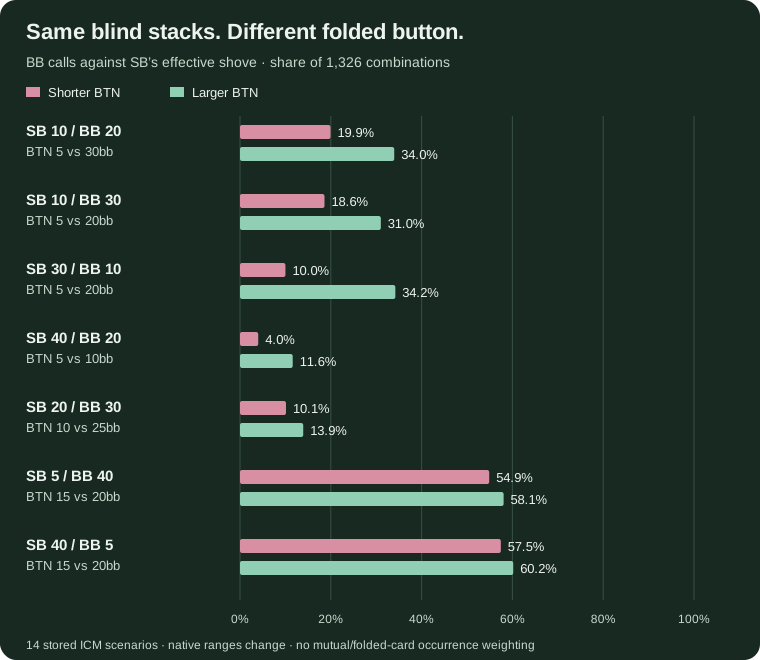
| SB / BB (bb) | BTN: short / large | Call: short / large (%) | Imported mix regret (pp) | 95th percentile (pp) |
|---|---|---|---|---|
| 10 / 20 | 5 / 30bb | 19.9 / 34.0 | 0.0396 | 0.374 |
| 10 / 30 | 5 / 20bb | 18.6 / 31.0 | 0.0221 | 0.216 |
| 30 / 10 | 5 / 20bb | 10.0 / 34.2 | 0.1390 | 0.862 |
| 40 / 20 | 5 / 10bb | 4.0 / 11.6 | 0.0295 | 0.268 |
| 20 / 30 | 10 / 25bb | 10.1 / 13.9 | 0.0108 | 0.015 |
| 5 / 40 | 15 / 20bb | 54.9 / 58.1 | <0.001 | 0.000 |
| 40 / 5 | 15 / 20bb | 57.5 / 60.2 | <0.001 | 0.000 |
To ask whether the change matters, we applied each larger-button call/fold mix to the matching shorter-button decision and valued it against that destination’s stored continuations. In the SB30/BB10 pair, the mean local regret was 0.139pp; the 95th-percentile loss was 0.862pp. A small overall mean can conceal a much more consequential hand.
For the main SB40/BB20 comparison, the mean regret was 0.0295pp across every BB combination; the 95th percentile was 0.268pp. The exported native mix has about 0.00001pp mean regret under the same calculation. The imported mix clearly fares worse here, but neither number estimates an entire tournament’s cost.
The boundary: a tighter range can cost almost nothing
In the SB40/BB5 family, reducing BTN from 20bb to 15bb lowers the BB calling share from 60.2% to 57.5%. The imported larger-button mix has less than 0.001pp mean local regret, with a maximum hand-level local regret of about 0.040pp. The mean is below one 0.002pp encoded EV step, so its exact decimal is not strategically reliable.
BB is the shortest stack here. It calls A5o, KJo, QTs and 22 at 100% in both stored strategies. With the 15bb button, A5o’s call EV is +0.708pp and 22’s is +0.236pp. Being covered by SB is not enough to recreate the tight 20bb BB range above.
The other 5bb confrontation, SB5/BB40, also has less than 0.001pp mean imported-mix regret. Both examples preserve the frequency direction while limiting its practical importance. A changed color in the matrix is a prompt to inspect EV, not proof of a large mistake.
Lower overall calling share does not mean every hand calls less. In SB5/BB40, 65s calls 91.2% with BTN15 versus 63.6% with BTN20, reversing the aggregate direction. Its BTN15 call EV is only +0.002pp, so this is a useful warning about reading mixed frequencies as firm hand boundaries.
A five-minute review exercise
Cover the EV columns in the first table. Predict AJo, 88 and 55 with each button stack. Then reveal the values and explain which result comes from the stored output and which part of your explanation remains an interpretation.
For your next final-table review, write down all remaining stacks, the payouts, the ante, the effective call and the opponent’s reached range. Use GTO Gecko to compare the available precomputed ICM ranges and action EV estimates for a matching configuration. Check the model before treating a nearby library spot as the same decision.
Our ICM introduction explains the valuation model. For the related question of how a player can gain or lose modeled prize equity while sitting out, see ICM equity without playing a hand.
Study method and limits
Retrieved September 16, 2026: the current ICM manifest, 14 matching scenario trees and their packed decision data. All 2,366 BB hand-class rows had positive weight; 1,690 belong to the ten held-out scenarios. The unit of replication is seven related stack families, not thousands of independent solves. These are three-player final-table scenarios from a 1,000-entry, 150-paid tournament model; only the three remaining prizes enter this comparison. No bounty is modeled.
Frequencies are encoded in 0.4-percentage-point steps and EVs in 0.002pp steps. BB means use each hand class’s weight times six pair, four suited or twelve offsuit combinations. SB shove weights multiply its entering weight by its own shove frequency. Mutual card conflicts and the folded player’s card effects are not reconstructed into a joint occurrence distribution.
Local imported-mix regret is the best destination action EV minus the EV of the imported call/fold mix. This changes one decision while keeping the destination continuations fixed. It is regret against the best stored action, not the extra damage versus the destination’s exported mixed strategy, which can itself have positive local regret. We did not re-solve the opponent, evaluate a coherent whole-tournament policy, or measure human results. Before the held-out analysis, we chose 0.1pp as a material-loss screen, with 0.05pp and 0.2pp sensitivities. The selected data and methods preserve those results and the exact plotted values.
The original solver version, achieved convergence and future-game settings are not available. Ten BB hand/action entries put positive frequency on an action more than 0.02pp below the best stored EV; the largest gap is 0.082pp. The export therefore does not justify calling every mix precisely indifferent. None of the headline AJo or 88 comparisons uses those flagged entries.
Static ICM values stacks without modeling every future blind and seat change. ICMIZER’s explanation of future-game simulation shows why that can matter, especially for short stacks. Treat this article as a conditional library study, with those settings still unverified. Header artwork is AI-generated editorial illustration; the figures and tables come from saved numerical data.