
You open a solver-library spot after defending the big blind against a button min-raise with 20bb. On 6♠ 5♥ 4♦, the grid leads 75% of the range. Before learning that mix, open the EV columns.
A frequency tells you how often an action appears in the output. Its alternatives need a separate comparison. Here the stored checking values average 0.020bb below the better available action. With 3♣ 2♣, the grid leads 88% and displays a 0.002bb gap.
Those figures let us inspect the file, but do not certify the true cost of checking. Our study found both larger exact-hand gaps and mixes that fail a consistency check. The useful skill is deciding which rows deserve further investigation before copying them.
We retrieved solver-library outputs for 36 specified tournament flop nodes on September 27, 2026. These are model outputs, and our explanations are interpretations. Original convergence is unavailable and our audit found frequency/EV inconsistencies. The article teaches how to read the stored evidence; it does not validate an all-check strategy.
BB chooses between leading and checking
Eight-handed MTT chip-EV model. BTN opens to 2bb, SB folds, BB calls. Flop 6♠ 5♥ 4♦. Each active player has 18bb behind.
Flop: 6♠ 5♥ 4♦. BB holds 3♣ 2♣.
Swipe the table sideways to see all eight seats.
Modeled study spot, not a played hand. No rake or ICM. Stacks are the library starting amounts before voluntary betting and net of any antes; total-table ante 1bb is already in the pot. Original per-seat ante allocation unavailable. Chips are illustrative; the labels are the amounts.
Read the table as text
Eight-handed MTT chip-EV model. BTN opens to 2bb, SB folds, BB calls. Flop 6♠ 5♥ 4♦. Each active player has 18bb behind. Pot: 5.5 bb. Board: 6s, 5h, 4d.
- UTG: 20 bb behind; 0 bb committed this street; Folded preflop; folded; cards: face down, face down.
- EP: 20 bb behind; 0 bb committed this street; Folded preflop; folded; cards: face down, face down.
- MP: 20 bb behind; 0 bb committed this street; Folded preflop; folded; cards: face down, face down.
- HJ: 20 bb behind; 0 bb committed this street; Folded preflop; folded; cards: face down, face down.
- CO: 20 bb behind; 0 bb committed this street; Folded preflop; folded; cards: face down, face down.
- BTN (dealer): 18 bb behind; 0 bb committed this street; Opened 2bb; cards: face down, face down.
- SB: 19.5 bb behind; 0 bb committed this street; Folded SB; folded; cards: face down, face down.
- BB: 18 bb behind; 0 bb committed this street; Lead 1.4bb or check; next to act; cards: 3♣, 2♣.
Read the EV columns beside the mix
A donk bet is a lead by the player who called the previous street’s bet. Here BB called preflop and acts first on the flop. The exported tree offers a 1.4bb lead into 5.5bb, or a check. It does not compare other flop lead sizes. “Better action” below always means better among these stored choices.
| Hand / spot | Lead | Check | Check shortfall bb | ||
|---|---|---|---|---|---|
| Freq. % | EV bb | Freq. % | EV bb | ||
| 3♣ 2♣20bb · 6♠ 5♥ 4♦ Lead 1.4bb | 88.0 | 11.997 | 12.0 | 11.995 | 0.002 |
| T♠ 9♠20bb · 6♠ 5♥ 4♦ Lead 1.4bb | 67.0 | 0.786 | 33.0 | 0.759 | 0.027 |
| 9♠ 8♠20bb · 6♠ 5♥ 4♦ Lead 1.4bb | 82.0 | 1.813 | 18.0 | 1.776 | 0.037 |
| Q♥ 9♥20bb · 6♠ 5♥ 4♦ Lead 1.4bb | 82.0 | 0.920 | 18.0 | 0.861 | 0.059 |
3♣ 2♣ has a straight. Its subtraction is 11.997 − 11.995 = 0.002bb. These EVs include stored later-street continuations, so they can exceed the current pot. The 0.002bb gap is a displayed subtraction; the file supplies no accuracy bound that resolves it.
In an exact equilibrium, actions played with positive frequency have equal EV against the specified opposing strategy. Approximate calculations and exports need more care. The indifference principle explains why learning an 88% frequency and learning the value of its alternative are different jobs.
Here is a different annotation to make in your notes. On 7♠ 5♠ 4♥ at 20bb, Q♠ 2♠ checks 10% even though its stored check EV trails leading by 0.137bb. That row fails our consistency screen. The cause could involve convergence or how strategies and EVs were exported; the flag alone does not identify a solver bug.
The two ranges behind that 75% lead
BB enters this flop with 783.91 weighted combinations; BTN has 419.01. These counts include each player’s own earlier action and remove the flop cards. They describe separate ranges, before removing a particular opponent holding.
BB: which hands lead on 6♠ 5♥ 4♦?
783.91 weighted combinations after flop-card removal. Cells average legal suits using their entry weights. BB acts first.
Swipe the grid sideways to see all 13 ranks, or choose a hand in the selector above.
Hover or tap a hand. Use arrow keys in the grid. Suited above the diagonal; offsuit below.
Owned solver library, retrieved September 27, 2026. Descriptive stored output; convergence unavailable. Hatched = outside range · ? = missing data
BTN: the response to the 1.4bb lead
419.01 weighted combinations after flop-card removal. Cells average legal suits using their entry weights. BTN has not acted on the flop yet; the lead changes its decision, not its marginal opening range.
Swipe the grid sideways to see all 13 ranks, or choose a hand in the selector above.
Hover or tap a hand. Use arrow keys in the grid. Suited above the diagonal; offsuit below.
Owned solver library, retrieved September 27, 2026. Descriptive stored output; convergence unavailable. Hatched = outside range · ? = missing data
| Made hand | BB combos | BB share | BTN combos | BTN share |
|---|---|---|---|---|
| Straights | 22.92 | 2.92% | 3.96 | 0.95% |
| Sets | 0.00 | 0.00% | 5.79 | 1.38% |
| Two pair | 27.00 | 3.44% | 1.42 | 0.34% |
There are no sets in BB’s exported 20bb flatting range on this flop. Adding every possible set would invent hands that are absent here. We have not retrieved their preflop branches, so this does not tell us which alternative action removed them. At the same time, its straight and two-pair shares exceed BTN’s. The comparison is more informative than assigning BB a generic “strong low-board range.”
Facing the small lead, BTN’s stored range calls 80.7%, raises to 4.7bb 15.9% and folds 3.5%. Those are marginal range-weighted figures, rounded separately. We have not calculated a range-equity lead, and these composition counts do not establish why any exact hand bets.
Published analysis of low-flop donk bets links leading to the two ranges and the raiser’s incentive to check behind. That is a useful explanation to investigate here. Our stored data alone do not isolate that mechanism.
The pattern across 24 nodes
We purposefully selected 654, 765, 876, 865, 754 and 543, each rainbow and two-tone at 20bb and 50bb. These 24 native nodes cover neighboring low-board families. Each board gets equal weight in the chart, rather than its probability of appearing in a dealt hand.
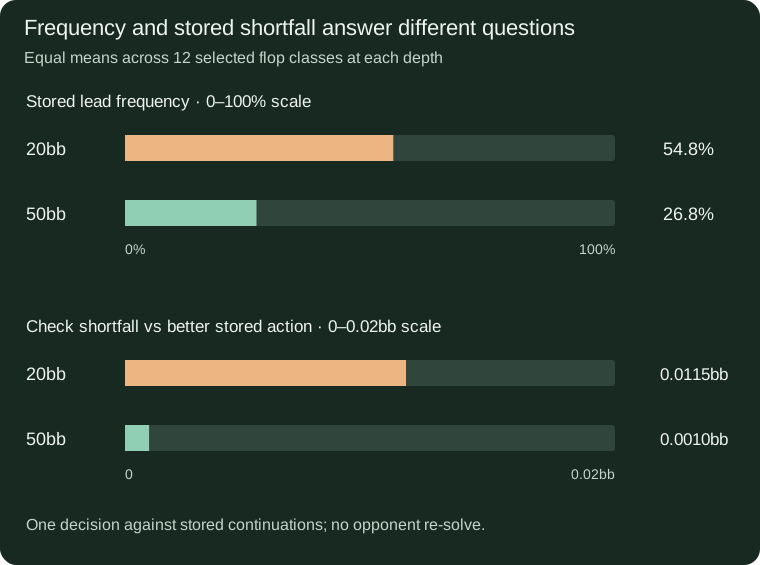
Frequency and stored check shortfall
Equal means across 12 flop classes per depth.
Lead frequency · scale 0–100%
Stored check shortfall · scale 0–0.02bb
| Flop / split | 20bb | 50bb | ||
|---|---|---|---|---|
| Lead % | Mean gap bb | Lead % | Mean gap bb | |
| 6♠ 5♥ 4♦ · D | 75.0 | 0.0204 | 47.8 | 0.0022 |
| 6♠ 5♠ 4♥ · D | 71.0 | 0.0197 | 38.1 | 0.0011 |
| 7♠ 6♥ 5♦ · D | 68.6 | 0.0185 | 26.1 | 0.0003 |
| 7♠ 6♠ 5♥ · D | 66.7 | 0.0176 | 21.7 | 0.0002 |
| 8♠ 7♥ 6♦ · H | 33.4 | 0.0012 | 5.6 | 0.0000 |
| 8♠ 7♠ 6♥ · H | 31.6 | 0.0014 | 5.8 | 0.0000 |
| 8♠ 6♥ 5♦ · H | 52.1 | 0.0044 | 16.0 | 0.0002 |
| 8♠ 6♠ 5♥ · H | 49.8 | 0.0062 | 14.0 | 0.0000 |
| 7♠ 5♥ 4♦ · H | 62.5 | 0.0147 | 39.7 | 0.0024 |
| 7♠ 5♠ 4♥ · H | 60.6 | 0.0154 | 32.6 | 0.0015 |
| 5♠ 4♥ 3♦ · H | 44.9 | 0.0100 | 40.8 | 0.0024 |
| 5♠ 4♠ 3♥ · H | 40.9 | 0.0081 | 33.9 | 0.0015 |
The displayed means are small throughout these selected files. They remain descriptions of the stored values: the consistency failures prevent turning them into an accuracy guarantee for a poker strategy.
The 50bb files show lower leads and smaller mean checking gaps. Their openings are 2.3bb, the pot is 6.1bb and the available lead is 2bb; the 20bb files use 2bb, 5.5bb and 1.4bb. Native ranges also change. This is a comparison of complete configurations, not an isolated stack-depth effect.
The flush draw hidden by the average
Keep the 654 ranks and give the flop two spades. T♠ 9♠ now has a flush draw. Its recorded check shortfall rises from 0.027bb to 0.195bb. The range means are 0.0204bb and 0.0197bb, respectively: the average alone hides this exact-hand difference.
| Hand / spot | Lead | Check | Check shortfall bb | ||
|---|---|---|---|---|---|
| Freq. % | EV bb | Freq. % | EV bb | ||
| T♠ 9♠20bb · 6♠ 5♥ 4♦ Lead 1.4bb | 67.0 | 0.786 | 33.0 | 0.759 | 0.027 |
| T♠ 9♠20bb · 6♠ 5♠ 4♥ Lead 1.4bb | 96.0 | 4.221 | 4.0 | 4.026 | 0.195 |
| 3♣ 2♣20bb · 6♠ 5♠ 4♥ Lead 1.4bb | 80.0 | 10.790 | 20.0 | 10.788 | 0.002 |
The 0.195bb is the largest stored check gap in our primary sample. It identifies a specific hand for further investigation under the accuracy limits already noted. The two-tone board changes both players’ legal combinations and future runouts; this comparison does not isolate one causal “flush-draw bonus.”
Leading every hand would be a different shortcut. On 8♠ 7♥ 6♦ at 50bb, 3♣ 2♣ has stored lead/check EVs of −0.447/+0.140bb: a 0.587bb shortfall from leading. The same hole-card ranks that made a straight on 654 do not justify a lead on every low board.
What stopped us calling this a safe simplification
Our audit flagged actions played at least 10% of the time while trailing the better stored action by more than 0.1bb. There are 54 such action rows across nine of the 24 primary BB nodes, plus 344 at BTN’s first responses after a lead or check. Both headline 654 rainbow configurations have response flags. Flagged root hands account for at most 1.25% of the entering range mass in any primary node; that small share does not establish convergence in their continuations.
As the earlier diagnostic example showed, Q♠ 2♠ on 7♠ 5♠ 4♥ at 20bb checks 10% while its stored check EV trails leading by 0.137bb. A nontrivial mix and a gap like that are a reason to check convergence and the export, rather than insist every decimal is an optimal instruction.
We also retained eight boundary nodes and four UTG comparisons. The 20bb A♠ 7♥ 2♦ boundary is especially problematic: 109 flagged root hands cover 11.32% of BB’s entering range mass. On 432 rainbow, the stored lead shares are 26.1% at 20bb and 17.5% at 50bb. We kept these secondary cases separate because they test the boundary of the selected low-flop family; they do not estimate uncertainty in the headline 654 results.
Finally, choosing check once against stored continuations is different from removing every lead and letting the opponent adapt. GTO Wizard’s published nodelock example on 654 rainbow shows the raiser’s strategy changing when BB is forced to check its range. We did not perform that full-tree re-solve.
A practical way to study the spot
When a low flop shows frequent donk bets, compare both action EVs before memorizing the mix. Then inspect the larger gaps, the suit-specific exceptions and any actions whose frequency conflicts with their EV. A small average is a prompt to investigate; it is not permission to ignore the rest of the tree.
Try this with the first table: hide the frequencies and rank the four hands by their stored check shortfall. Reveal the mixes, then compare T♠ 9♠ on the rainbow and two-tone boards. Write one of three notes beside each example: “tiny gap; accuracy unresolved,” “larger gap to investigate,” or “mix fails the consistency screen.” The 32 straight, T9 flush draw and Q2 diagnostic illustrate those three notes.
In GTO Gecko, compare the available actions, exact-combination frequencies and EV estimates in a matching study-library spot. Availability depends on the plan and library. This article inspects imperfect library rows before any policy change; the linked toy-game study evaluates changed policies in a fully specified game. For the next study step, see how earlier actions change a range and an exact toy-game test of changing a mixed strategy.
Method, data and limits
The 654 and 765 families formed eight discovery nodes; the other 16 were held out by rank family. The 24 primary nodes contain 21,036 positive-weight hand rows, including 14,058 held out. Hands from one board are not independent experiments.
Before inspecting the held-out boards, we set a screen: at least 95% of each node’s entering BB range mass must have a stored checking shortfall no greater than 0.1bb. All 24 nodes meet that arithmetic screen; the lowest share is 99.31%. The consistency audit described above is why this does not become a validated poker shortcut.
These are eight-handed NLHE tournament chip-EV models, with no rake, ICM or bounties. The configured total ante is 1bb. Stored root pots and remaining stacks imply 18bb behind after a 2bb open/call at 20bb, and 47.7bb after 2.3bb at 50bb. We use the library’s stack convention: the configured starting amounts precede voluntary betting, while the total ante is already in the pot. The original per-seat ante allocation, solver version, abstraction, stopping rule and achieved accuracy were not supplied.
For each positive-weight exact combination, check shortfall=max(lead EV, check EV)−check EV. We weight by its exported range weight within a node and use equal-node means across the selected boards. This is a local stored-action comparison, not exploitability, a full-policy loss or a win rate. Its benchmark is the better stored action, not the exported mixed strategy.
Frequencies exported to two decimals were normalized when their totals were 0.99 or 1.01. A sensitivity calculation accounting for compatible opponent cards changed primary lead shares by at most 0.358 percentage points; unknown folded-card effects still prevent calling them full-game occurrence frequencies. EVs were converted using the current application’s units. The export resolves 0.001bb; display resolution does not establish numerical accuracy. No absent hands were injected. Both ranges, arithmetic and all 36 node summaries were checked independently. Thresholds 0.02, 0.05, 0.1 and 0.2bb are study screens, not confidence bounds; unknown convergence limits all strategic conclusions.
Read the public methodology and audit summary, 36 node summaries and selected exact-hand values. The inline grids have their class-level source data. Full private trees are not part of the public bundle. Header artwork is AI-generated illustration; the tables and figures are built from the saved study data.