
You bet the flop and turn with 9♠ 8♠. The big blind calls twice. The river misses your flush, and BB checks again. Is this the easy give-up?
The board changes the answer. On A♠ T♠ 5♥ 2♦ 7♣, betting 15.2bb into 22.7bb returns 1.064bb in our conditional river solve; checking returns zero. On T♠ 7♠ 3♥ 2♦ 4♣, the same hand and bet size return −0.980bb, while checking again returns zero.
Across eight selected scenarios, most missed flush draws checked. Yet the shortcut “give up every missed draw” failed our cost screen on six of them. Start with the full hand and the range that reached the river before treating the missed suit as a decision.
These are fresh river solves conditioned on ranges from Gecko’s 100bb cash library. Their EVs describe those models; our explanations interpret the outputs. The river experiments add no rake. Their achieved convergence and the original full-tree settings are unavailable; some other hands also show frequency/EV inconsistencies. Use the sizeable, checked comparisons as study evidence, with caution around exact mixes and small gaps.
The flush missed. BB checks again.
BTN opens 2.5bb, BB calls. Flop A♠ T♠ 5♥: BB checks, BTN bets 1.8bb, BB calls. Turn 2♦: BB checks, BTN bets 6.8bb, BB calls. River 7♣: BB checks; BTN holds 9♠ 8♠.
Conditional river model with a 22.7bb pot and 88.9bb behind each active player; no added river rake. Starting 100bb cash ranges. Chips are illustrative; the labels are the amounts.
Read the table as text
BTN opens 2.5bb, BB calls. Flop A♠ T♠ 5♥: BB checks, BTN bets 1.8bb, BB calls. Turn 2♦: BB checks, BTN bets 6.8bb, BB calls. River 7♣: BB checks; BTN holds 9♠ 8♠. Pot: 22.7 bb. Board: As, Ts, 5h, 2d, 7c.
- UTG: 100 bb behind; 0 bb committed this street; Fold preflop; folded; cards: face down, face down.
- HJ: 100 bb behind; 0 bb committed this street; Fold preflop; folded; cards: face down, face down.
- CO: 100 bb behind; 0 bb committed this street; Fold preflop; folded; cards: face down, face down.
- BTN (dealer): 88.9 bb behind; 0 bb committed this street; Choose check or bet; next to act; cards: 9♠, 8♠.
- SB: 99.5 bb behind; 0 bb committed this street; Fold preflop; folded; cards: face down, face down.
- BB: 88.9 bb behind; 0 bb committed this street; Check; cards: face down, face down.
The same missed draw, three different choices
Every example follows the same prices: a 2.5bb button open, a big-blind call, a 1.8bb flop bet into 5.5bb, then a 6.8bb turn bet into 9.1bb. BB calls both bets and checks the river. The river pot is 22.7bb, with 88.9bb behind each player.
BTN can check or bet 9.1bb, 15.2bb, 28.4bb or 88.9bb. The last option is a shove. The three smaller choices are approximately 40%, 67% and 125% of the pot.
| BTN hand / board | Check | Bet 9.1bb | Bet 15.2bb | |||
|---|---|---|---|---|---|---|
| Freq. % | EV bb | Freq. % | EV bb | Freq. % | EV bb | |
| 8♠ 9♠ A♠ T♠ 5♥ 2♦ 7♣ | 0.0 | 0.000 | 0.0 | 0.641 | 100.0 | 1.064 |
| 8♠ 9♠ T♠ 7♠ 3♥ 2♦ 4♣ | 100.0 | 0.000 | 0.0 | -0.477 | 0.0 | -0.980 |
| 8♠ 9♠ K♠ J♠ 4♥ 2♦ 6♣ | 0.0 | 0.000 | 100.0 | 1.058 | 0.0 | 0.554 |
On the ace-high board, 9♠ 8♠ chooses 15.2bb throughout the rounded output. On the ten-high board it always checks. On K♠ J♠ 4♥ 2♦ 6♣, it uses 9.1bb throughout instead. There, checking gives up 1.058bb relative to that smaller bet.
This is a comparison of complete scenarios. The flop ranks, resulting ranges and river cards change together, so it does not isolate the effect of one card. It does show why “missed flush draw” is too broad a category to prescribe one action or size.
What the big blind can still fold
Follow the range through the calls and the final check. On A♠ T♠ 5♥ 2♦ 7♣, BTN’s entering range contains 23.4% high-card hands by marginal weight. BB’s checked range contains 7.1%. Those are made-hand categories, not equity estimates; ace-high can still beat another unpaired hand. The range-updating walkthrough explains the weighting step.
BTN: the hands that bet twice
7.21 weighted combinations before conditioning on the opponent’s exact cards. Colored segments show conditional actions; entry weight shows presence.
Hover or tap a hand. Use arrow keys in the grid. Suited above the diagonal; offsuit below.
Conditional river solve, September 15, 2026. Rounded inputs and output; achieved convergence unavailable. Hatched = outside range · ? = missing data
BB: the checked range facing 15.2bb
88.60 weighted combinations before conditioning on the opponent’s exact cards. Colored segments show conditional actions; entry weight shows presence.
Hover or tap a hand. Use arrow keys in the grid. Suited above the diagonal; offsuit below.
Conditional river solve, September 15, 2026. Rounded inputs and output; achieved convergence unavailable. Hatched = outside range · ? = missing data
The grids average suits within each hand class. The tables use exact 9♠ 8♠. After removing those two cards from BB’s checked range, its response to 15.2bb looks like this:
| Board | Fold % | Call % | Raise % |
|---|---|---|---|
| A♠ T♠ 5♥ 2♦ 7♣ | 42.9 | 44.4 | 12.7 |
| T♠ 7♠ 3♥ 2♦ 4♣ | 37.5 | 49.2 | 13.3 |
If a bluff has zero equity and gives up against raises, it needs 15.2÷(22.7+15.2)=40.1% folds to break even. The ace-high example clears that reference point; the ten-high example does not. Using the displayed fold rates gives approximately +1.04bb and −0.98bb. We also evaluated the featured hands through the full exported river response tree, including raises; the preferred actions survive. The output is rounded, and the two EV calculations differ slightly. We have not established the cause of every residual.
In the ace-high example, all positive-weight calls and raises beat nine-high. Of BB’s 34.53 compatible weighted folding combinations, 29.70 already have a pair or better. The bet gets folds from made hands as well as missed draws.
A suit blocker removes more than one kind of hand
One reason to give up is straightforward: holding spades removes some of the opponent’s missed spade draws, which might otherwise fold. But the same cards can remove hands that call or raise. We counted both against the actual response ranges:
| Board | Folds removed | Calls / raises removed |
|---|---|---|
| A♠ T♠ 5♥ 2♦ 7♣ | 2.78 | 5.26 |
| T♠ 7♠ 3♥ 2♦ 4♣ | 7.67 | 2.79 |
On the ace-high board, 9♠ 8♠ removes 2.78 weighted folds and 5.26 weighted continuations. On the ten-high board, it removes 7.67 folds and 2.79 continuations. These totals describe card removal with BB’s strategy held fixed. Their effect also depends on the remaining range; they do not establish that blockers alone cause the EV difference.
The published advice already has exceptions. Upswing’s missed-draw analysis gives a reason to be cautious after two barrels. GTO Wizard’s later examples show why the earlier line and available alternative bluffs can change that advice. Our test checks eight specified models, rather than settling every history.
The eight-scenario test
Before reviewing the six held-out flop families, we defined a cheap give-up as checking within 0.1bb of the best available action for at least 95% of eligible BTN range mass in each scenario. Eligible hands have two spades, no pair and no made straight or flush on the river. Ace-high is included. These are 169 hand/scenario rows, 127 of them held out. They come from eight scenarios, not 169 independent board tests.
Six of eight scenarios failed, including five of the six held out. The equally weighted mean checking frequency across scenarios was 81.1%. Popularity and cost tell different parts of the story: a few expensive give-ups can remain inside a range that mostly checks.
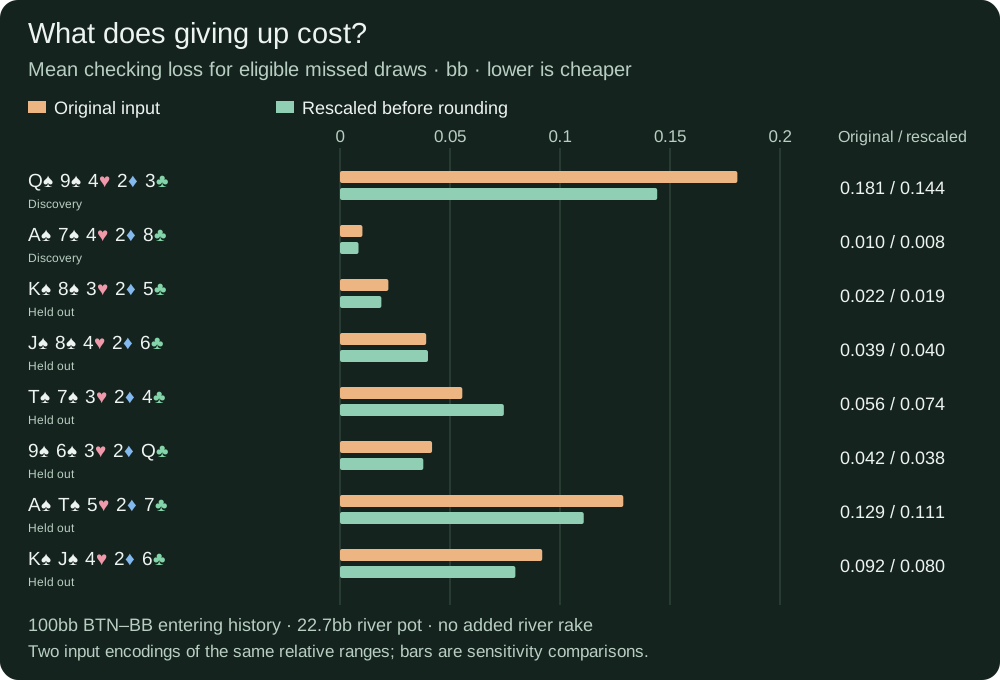
Mean cost of checking, in bb
Original input and rescaled input; shared 0–0.2bb scale.
| River board | Rows | Check % | Costly mass % | Screen |
|---|---|---|---|---|
| Q♠ 9♠ 4♥ 2♦ 3♣ | 22 | 79.1 | 18.7 | Fail |
| A♠ 7♠ 4♥ 2♦ 8♣ | 20 | 89.3 | 0.0 | Pass |
| K♠ 8♠ 3♥ 2♦ 5♣ | 23 | 85.9 | 1.2 | Pass |
| J♠ 8♠ 4♥ 2♦ 6♣ | 20 | 83.1 | 12.9 | Fail |
| T♠ 7♠ 3♥ 2♦ 4♣ | 24 | 75.1 | 15.3 | Fail |
| 9♠ 6♠ 3♥ 2♦ Q♣ | 21 | 78.1 | 13.8 | Fail |
| A♠ T♠ 5♥ 2♦ 7♣ | 19 | 80.4 | 21.8 | Fail |
| K♠ J♠ 4♥ 2♦ 6♣ | 20 | 77.3 | 18.3 | Fail |
The equal-scenario mean checking loss is 0.071bb. In every scenario, at least half the eligible range mass has zero listed checking loss. A smaller share carries the expensive give-ups. On Q♠ 9♠ 4♥ 2♦ 3♣, 7♠ 5♠ loses 1.715bb by checking; it is a rare entering hand with serialized weight 0.01. That example survives the more precise encoding at 1.650bb, but it is a poor basis for memorizing a universal river shove.
The give-ups are part of the result
Return to 9♠ 8♠ on T♠ 7♠ 3♥ 2♦ 4♣. Its check EV is zero, and all four bets have negative EV. Having no showdown value does not create a profitable bluff.
Other missed draws do retain showdown value. On Q♠ 9♠ 4♥ 2♦ 3♣, K♠ T♠ checks throughout the output for 0.921bb. Its best bet returns 0.705bb. On A♠ 7♠ 4♥ 2♦ 8♣, the same king-high draw checks for 0.557bb and every bet is negative. This river analysis develops the same useful distinction: compare a bluff with the value of checking your actual hand.
All five actions for the six featured hands
| BTN hand / board | Check | Bet 9.1bb | Bet 15.2bb | Bet 28.4bb | Jam 88.9bb | |||||
|---|---|---|---|---|---|---|---|---|---|---|
| Freq. % | EV bb | Freq. % | EV bb | Freq. % | EV bb | Freq. % | EV bb | Freq. % | EV bb | |
| 8♠ 9♠ A♠ T♠ 5♥ 2♦ 7♣ | 0.0 | 0.000 | 0.0 | 0.641 | 100.0 | 1.064 | 0.0 | 1.006 | 0.0 | 0.645 |
| 8♠ 9♠ T♠ 7♠ 3♥ 2♦ 4♣ | 100.0 | 0.000 | 0.0 | -0.477 | 0.0 | -0.980 | 0.0 | -0.980 | 0.0 | -0.855 |
| 8♠ 9♠ K♠ J♠ 4♥ 2♦ 6♣ | 0.0 | 0.000 | 100.0 | 1.058 | 0.0 | 0.554 | 0.0 | 0.361 | 0.0 | 0.508 |
| 5♠ 7♠ Q♠ 9♠ 4♥ 2♦ 3♣ | 0.0 | 0.000 | 0.0 | 1.391 | 0.0 | 1.336 | 0.0 | 1.221 | 100.0 | 1.715 |
| K♠ T♠ Q♠ 9♠ 4♥ 2♦ 3♣ | 100.0 | 0.921 | 0.0 | 0.615 | 0.0 | 0.645 | 0.0 | 0.705 | 0.0 | 0.324 |
| K♠ T♠ A♠ 7♠ 4♥ 2♦ 8♣ | 100.0 | 0.557 | 0.0 | -1.535 | 0.0 | -1.137 | 0.0 | -1.389 | 0.0 | -1.259 |
How much the input precision changes
The app’s river command accepts weights rounded to two decimals. After two barrels, some BTN weights are small enough to disappear. We retained that original encoding, then reran all eight scenarios after dividing each entire range by its own largest weight. Uniform scaling preserves the relative range before rounding; it gives the small entries more room in the two-decimal format.
The reruns contain 182 eligible rows. They fail the screen on seven boards, including all six held out. K♠ 8♠ 3♥ 2♦ 5♣ moves from a pass to a fail near the 0.1bb cutoff. Treat that cutoff as a study screen, not a stable poker boundary.
The main 9♠ 8♠ comparisons survive: betting 15.2bb on the ace-high board remains worth 0.950bb, and the 9.1bb bet on the king-jack board remains worth 1.052bb. The ten-high board still favors checking. The equal-scenario mean checking loss becomes 0.064bb. Input precision changes details without rescuing the automatic give-up.
A useful study rule
Before giving up a missed draw, compare the best available bet with checking, then inspect the range that folds to that size. Keep the complete betting history in the spot. Preserve the checks when every bet loses EV, including hands with no showdown value.
For practice, hide the first table’s EV columns and predict the action for 9♠ 8♠ on each board. Then name one reason your prediction might fail: a different reached range, lost showdown value, or a bet size that cannot get enough folds.
Use GTO Gecko to study available ranges and compare actions with their EV feedback. Rebuild the same positions, stacks and action history before comparing a nearby spot. For this exercise, record your predicted action, the displayed EV gap and the exception you would want to test next.
Method and limits
We retrieved fresh flop and turn trees on September 15, 2026. They are six-handed 100bb cash single-raised pots, with a catalogue label of 5% rake capped at 4bb and no ante. BB’s initial flop check is imposed. Each turn export supplies the entering ranges for that street; we multiply the actual turn action frequencies, remove river cards and serialize the remaining ranges. No absent hand is inserted or given a minimum weight.
The conditional river jobs use 22.7bb in the pot and 88.9bb effective stacks, the app’s permitted size preset, neutral action incentives, an accuracy setting of 0.05 (its units are not returned) and a 500-iteration ceiling. The response provides no solver version, achieved convergence or stopping reason. Its payoffs match no additional river rake. The river model therefore conditions on a cash-library history without re-solving that history or certifying the original rake treatment.
Frequencies and EVs arrive rounded. We normalize probability totals only within the error allowed by their two-decimal export. EVs are rebased so a decision-node fold is zero; each local loss is the highest available action EV minus the action being screened. This holds the returned continuations fixed. It does not evaluate a changed strategy across the whole game.
Some returned hands mix into actions whose listed EV is more than 0.1bb below their best action, including missed draws outside the featured three-board comparison. The largest such gap in the primary BTN results is 0.369bb. That limits equilibrium claims and makes exact frequencies unsuitable as precise targets. The substantive hand comparisons, input sensitivity and explicit model scope carry the conclusion.
See the public methodology and data index, original scenario summaries, input-sensitivity summaries and selected hand/action results. Pio’s number definitions explain the distinction between range weights and matchups; this study does not identify its engine as Pio. The header is generated editorial artwork; the tables and range grids carry the evidence.