
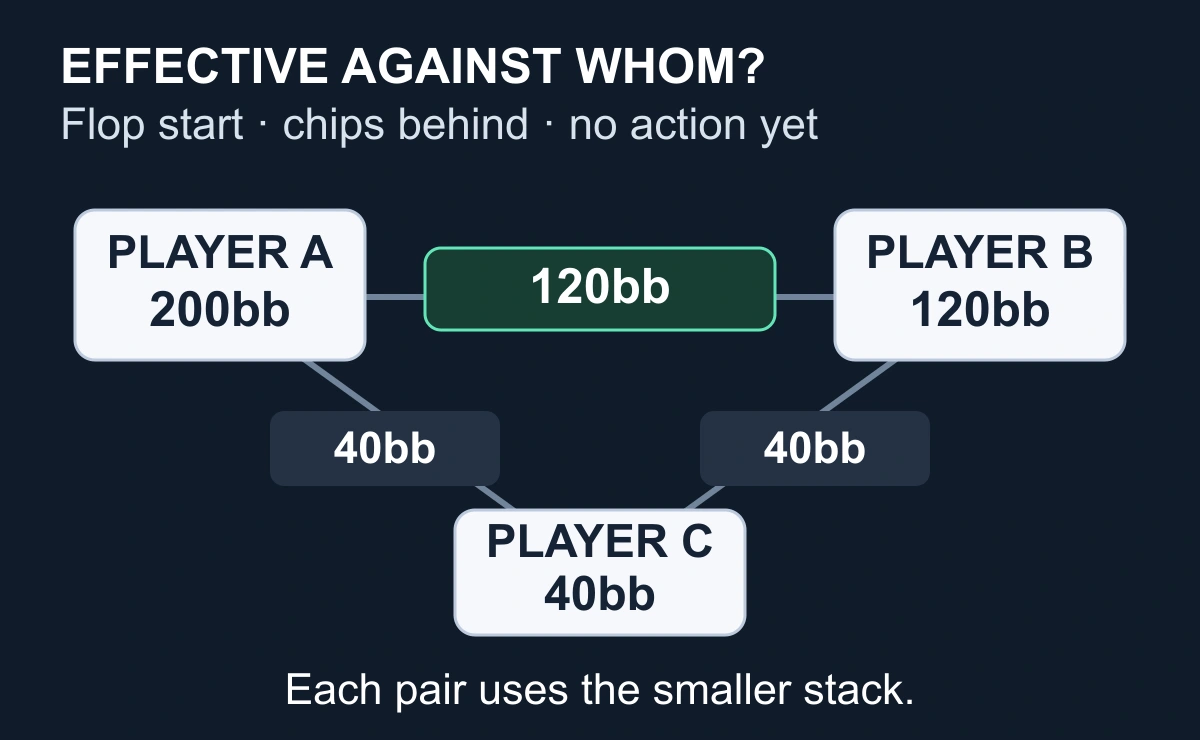
In a multiway poker hand, there may be several effective stacks. Before anyone acts on the flop, if you have 200 big blinds behind, one opponent has 120 and another has 40, you are 120bb effective against the first opponent and 40bb against the second. The 40bb player does not limit how much the two deeper players can put at risk against each other.
The useful question is: effective against whom, and at what point in the hand? At the start of a street, name both players and take the smaller stack. Once a bet has been made, keep the amount already committed too. The worked map below and the stack-map calculator for off-table review use that explicit boundary. The examples are constructed accounting exercises, not recommended betting lines.
First, fix the moment you are measuring
Heads-up, effective stack normally means the smaller of the two players' stacks. With more opponents, there is more than one pairing; GTO Wizard's glossary makes that distinction explicitly.
Our map uses a specific checkpoint: the start of a postflop betting round, before anyone acts. Record each player's chips still behind, in big blinds. All current-street contributions are zero. Chips from earlier streets are already in the pot and are recorded separately.
For two players who still have chips and have not folded, take the smaller remaining stack:
Pair's effective remaining stack = min(player A's remaining stack, player B's remaining stack).
This is the ceiling on the amount each can contribute from that checkpoint and have matched by the other. It is not the size of a pot, a price to call, or a command to commit those chips. A pot-limit or fixed-limit game's betting rules also restrict which wagers can be made now; our worked examples use no-limit Hold'em.
200bb, 120bb and 40bb produce three relationships
Suppose A, B and C reach the flop with 200bb, 120bb and 40bb behind respectively. Nobody has acted on the flop. There is one existing pot; its size does not change the following stack ceilings.
On narrow screens, scroll the table sideways. Keyboard users can focus the table region and use the arrow keys.
| Pair | Behind (bb) | Effective (bb) |
|---|---|---|
| A–B | 200 / 120 | 120 each |
| A–C | 200 / 40 | 40 each |
| B–C | 120 / 40 | 40 each |
A can match B for 120bb even though C has only 40bb. If C commits all-in for 40bb and A and B each contribute more, the excess they match belongs in a separate side pot that C cannot win. That is the role of the all-in and table-stakes rules described by PokerStars.
Do not add a player's pairwise ceilings. A's 120bb against B and 40bb against C do not create 160bb of separate stack commitments. The first 40bb that A contributes can be matched by both opponents; it is the same 40bb of A's stack. If both opponents commit everything, A can have at most 120bb of new contributions matched by someone. A's other 80bb has no opponent able to match it from this checkpoint.
These amounts describe new contributions, not net winnings or the existing pot. For the largest amount of one player's remaining stack that opponents could collectively match, use the smaller of that player's stack and the largest stack among opponents still able to bet. The table is a set of overlapping relationships, not independent heads-up pots. To divide actual final contributions and determine who can win each pot, use our side-pot calculation guide.
Keep the seat names when stacks change
Now swap B's and C's stacks: A still has 200bb, but B has 40bb and C has 120bb. The table's smallest stack is still 40bb. Yet A is now 40bb effective against B and 120bb against C.
A note saying only “three-way, 40bb effective” loses that distinction. Keep each player's position and stack together. The map does not say how different players will respond; it preserves the information needed to ask that question. Our multiway strategy guide examines the separate problem of playing against more than one range.
Folded and all-in mean different things. A folded player no longer belongs in the map of future opponents, regardless of the chips still in their stack. A player already all-in also has no chips left for future betting, but remains eligible for the pots their contribution permits. Removing either player from the future-betting map does not remove their chips from an existing pot. The official fold and all-in rules explain why these statuses must stay distinct.
After a bet, chips behind alone can give the wrong answer
Here is a separate heads-up example showing the boundary. At the start of the flop, A has 200bb behind and B has 120bb. A bets 30bb. A now has 170bb behind; B still has 120bb.
Taking min(170, 120) gives 120bb, but that is not the amount A can still add and have matched by B. A already has 30bb committed on this street. If B raises all-in to 120bb total, A needs another 90bb to match it: 120 − 30 = 90. B's initial price to call A's opening bet was 30bb. None of those amounts is interchangeable.
Preserve the street-start stacks and action history, or record both each player's current contribution and chips behind. Our calculator deliberately stops when any current-street contribution is nonzero. It does not reconstruct a wager, resolve raise rights, or turn an incomplete record into a reliable state. For uncertain inputs, use the hand-notes guide before calculating.
Use the map to choose a study spot
Before opening a saved solution, write down the players and positions, the game format, the relevant stack checkpoint, and each remaining stack. Keep the pot, previous action and current-street commitments alongside them. In a tournament, payouts and the other tournament stacks may matter to the strategic model as well.
A single “40bb” setting cannot by itself describe our 200/120/40 flop state. Nor does looking up one heads-up solution for each pair solve the three-player hand: the players share a pot and their decisions interact. Check what the study tool's depth field represents before substituting a number.
For off-table study, we recommend GTO Gecko's available solved scenarios when the format, positions and stack assumptions fit the question you are studying. Its current official listing describes poker training and strategy study. Compare the scenario's stated stack assumptions with your recorded checkpoint; a depth label alone does not establish a match. Read our solver study guide for interpreting a solution after matching the setup.
Disclosure: GTO Gecko is published by GTO Solutions AS. The stack map is a separate educational aid made for this article, not a claim that the app accepts arbitrary unequal-stack inputs or reconstructs a hand.
Use or check the stack map
Open the stack-map calculator to enter two to nine seats at the stated checkpoint. It lists each active pair, preserves folded and all-in labels, and shows why the pairwise amounts should not be added. It computes in your browser without sending the entered values to a server.
The example inputs and exact results, Python reference checker and method and reproduction instructions make the calculations inspectable. No random simulation or player data is involved. The checks cover the example, seat swaps, scaling, folded/all-in exclusions and invalid inputs.
The map counts possible matched future contributions at a deliberately narrow checkpoint. It does not measure hand equity, expected value, profitable bet sizes, tournament equity, or final payouts. Product and primary sources were checked on September 6, 2026.