
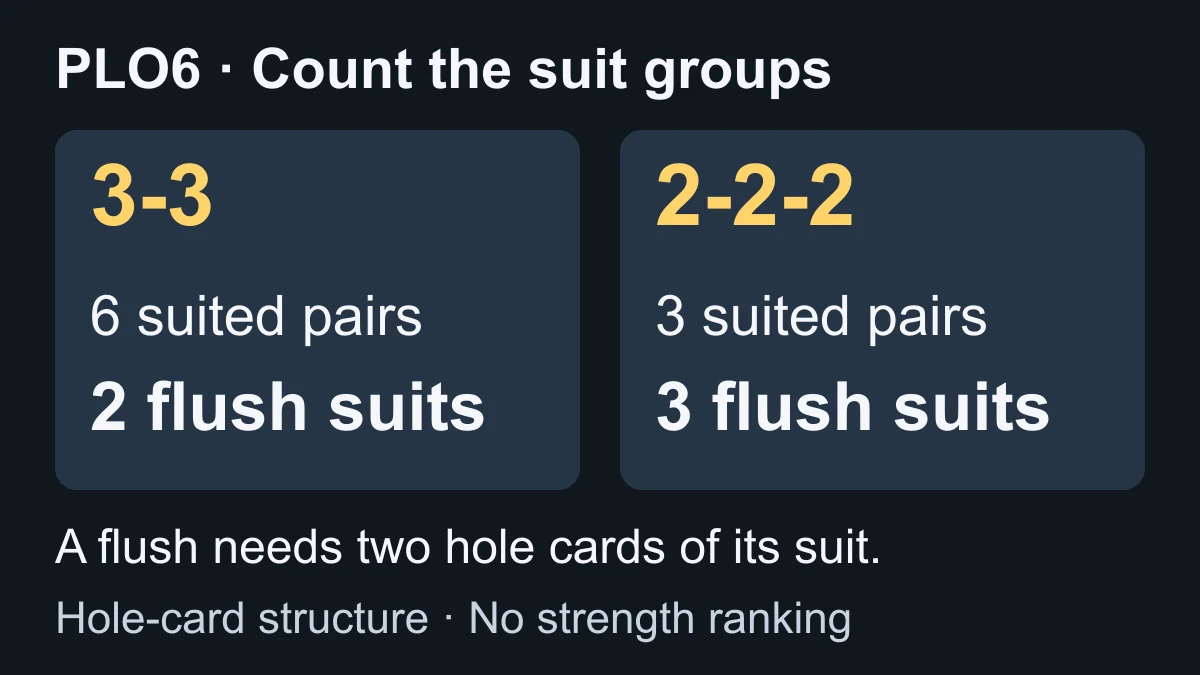
To describe the suits in a PLO6 hand, group its six cards by suit and write the group sizes. Then count groups containing at least two cards. Three spades plus three hearts form a 3-3 pattern: six same-suit card pairs, but only two suits that could make a flush. Two spades, two hearts and two diamonds form 2-2-2: three pairs and three possible flush suits.
That distinction describes the cards; it does not rank the hands. This reference gives a simple counting procedure, all nine six-card suit patterns, and exact deal frequencies you can reproduce. It also explains why the fifth and sixth cards make familiar four-card labels less informative.
Write the suit counts first
PokerStars' six-card Omaha rules require exactly two hole cards and exactly three board cards to make the final five-card hand. A flush therefore needs two hole cards of its suit. Having one card of a suit is insufficient, even if the board contains four or five of that suit.
- Group the hole cards by suit.
- Write the group sizes from largest to smallest, leaving out zeroes. Three spades, two hearts and one diamond become 3-2-1.
- Count groups of size two or more. Here there are two: spades and hearts.
We call these flush-capable suits: suits for which your hole cards meet the two-card requirement. The board must still supply three cards of that suit, and the resulting flush need not win. This is not a count of draws on the current board.
Six paired combinations can belong to only two suits
Two constructed six-card hands
A♠ K♠ Q♠ A♥ K♥ Q♥ has shape 3-3. Within spades you can select A♠K♠, A♠Q♠ or K♠Q♠; hearts supply the same three rank pairs. That is six same-suit pairs spread across two suits.
A♠ K♠ A♥ K♥ A♦ K♦ has shape 2-2-2. Its same-suit pairs are A♠K♠, A♥K♥ and A♦K♦: three pairs spread across three suits.
These are separate examples, not opponents in one deal: they share cards. Their pair counts establish no equity or strength ordering.
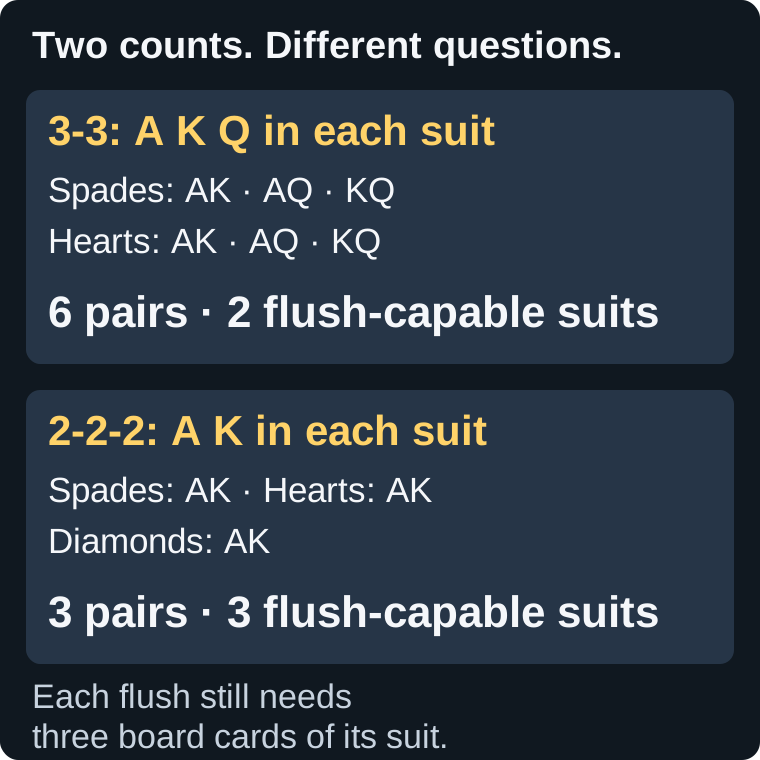
A group containing k cards has k(k − 1) / 2 possible two-card selections. Add that number across suits to count same-suit pairs. To count flush-capable suits, add one for each group containing at least two cards instead. On a single five-card board, at most one suit can appear three times, so these are alternative possible flush suits across different boards.
The extreme example makes the difference clear. Six spades contain 15 two-card selections, all spades. They give you one possible flush suit. Those 15 selections are not 15 separate chances to make a flush.
Why “double-suited” needs a card count
With four hole cards, two suits containing at least two cards force a 2-2 pattern. With five cards, both 2-2-1 and 3-2 satisfy that same condition. They contain two and four same-suit pairs respectively. The five-card Omaha hand-construction rule still uses exactly two hole cards.
With six cards, four different patterns have exactly two flush-capable suits: 2-2-1-1, 3-2-1, 3-3 and 4-2. Only 2-2-2 has three. Write the actual shape when comparing hands, and check what a tool means by its suitedness labels before treating a filter as an exact definition.
Even published deal percentages can use an inclusive label. Cardquant's six-card guide lists 79.5% as double-suited and separately gives 9.3% as triple-suited. Our exact census finds 79.51% with at least two flush-capable suits, including 9.32% with three; exactly two account for 70.19%. The published rounded figures are consistent with that inclusive interpretation. That is a reconciliation of counts, not evidence that every tool uses the same convention.
Our PLO5 strategy guide discusses hand selection. The reference here answers the narrower question of what suit structure you actually hold. Neither “two suits” nor “three suits” specifies the ranks, the action to take, or the strength of a flush on a particular board.
Every PLO6 suit pattern, with exact deal counts
These figures count one uniformly random, unordered six-card hand from a complete standard 52-card deck. All ranks are included. The denominator is 20,358,520 distinct hands. This is a combinatorial census, not measured player data or an opening range.
On narrow screens, scroll horizontally for the exact counts and percentages.
| Shape | Same-suit pairs | Flush-capable suits | Hands | Deal share |
|---|---|---|---|---|
| 2-2-1-1 | 2 | 2 | 6,169,176 | 30.30% |
| 2-2-2 | 3 | 3 | 1,898,208 | 9.32% |
| 3-1-1-1 | 3 | 1 | 2,513,368 | 12.35% |
| 3-2-1 | 4 | 2 | 6,960,096 | 34.19% |
| 3-3 | 6 | 2 | 490,776 | 2.41% |
| 4-1-1 | 6 | 1 | 1,450,020 | 7.12% |
| 4-2 | 7 | 2 | 669,240 | 3.29% |
| 5-1 | 10 | 1 | 200,772 | 0.99% |
| 6 | 15 | 1 | 6,864 | 0.03% |
Thus 2-2-2 occurs in about 9.32% of unconditioned six-card hands. That percentage is about being dealt the shape, not making a flush or winning a pot. Once you specify ranks, known cards or a range selected by betting action, this unconditional table no longer supplies the corresponding probabilities.
Reproduce the 2-2-2 row
Choose which three of the four suits appear: four choices. In each chosen suit, select two of its thirteen cards: C(13, 2) = 78 choices. Therefore the count is 4 × 78 × 78 × 78 = 1,898,208. Divide by C(52, 6) = 20,358,520 to get 9.323899…%.
For 3-3, choose two suits in six ways, then three cards from each: 6 × C(13, 3)2 = 6 × 2862 = 490,776. Each unordered hand belongs to exactly one row. The downloadable census also includes all five four-card patterns and all six five-card patterns.
A shape still leaves out the important cards
Compare these separate six-card examples, which have the same ranks and the same 2-2-1-1 shape:
- A♠ K♠ Q♥ J♥ T♦ 9♣: the ace belongs to a paired suit; the available spade pair is A♠K♠.
- A♠ K♥ Q♥ J♦ T♦ 9♣: the ace is the only spade. The available suited pairs are K♥Q♥ and J♦T♦. This hand cannot make a spade flush under Omaha's two-hole-card rule.
Both have two same-suit pairs and two flush-capable suits. A shape-only note loses which suits they are and where the ace sits. Preserve all ranks and suits in a study input; use the shape as a summary alongside them. The PLO best-five examples cover how to select the final cards on completed boards.
A usable study note
For the first hand, write: “PLO6; A♠ K♠ Q♥ J♥ T♦ 9♣; shape 2-2-1-1; suited pairs A♠K♠ and Q♥J♥.” That preserves enough information to reconstruct the suit structure. A note saying only “double-suited” does not.
When recording a percentage beside a suitedness label, also copy its inclusion rule: exactly two eligible suits, or at least two. Keep a raw-deal percentage separate from any number reported for a selected range. This prevents the 70.19% and 79.51% counts above from being treated as competing answers to the same question.
For a separate equity question, enter the full PLO5/PLO6 hand in OmahaCalc, keeping its ranks and suits exact. GTO Solutions AS makes both OmahaCalc and this site. Product information was checked September 6, 2026. This census was built independently; it is not an app benchmark, an app feature demonstration, or an equity comparison of the examples. Our PLO5/PLO6 calculator-accuracy study addresses estimation error when you move on to equity calculations.
Method and downloads
The generator enumerates all labeled counts for spades, hearts, diamonds and clubs that sum to four, five or six cards. A count vector receives weight C(13, spades) × C(13, hearts) × C(13, diamonds) × C(13, clubs). It then groups vectors with the same sorted shape. Integer counts are exact. The article table rounds percentages to two decimal places; the downloadable table uses six.
An independent checker instead enumerates ordered suit sequences, counting the remaining available cards for each next suit, then removes dealing order. It verifies all twenty shape rows, totals and the seven constructed examples. No random samples, seed, solver ranges or private hands are involved.
Download the complete suit-pattern table, seven full-card examples, exact results and pair witnesses, generator, independent checker, reproduction instructions and checksums.
The census describes standard-deck hole-card composition before conditioning on other information. It does not estimate board probabilities, opponent holdings, equity, winning-flush probability, strategy EV or a range to play. Suited pairs are combinations of cards, not independent outcomes.
- PokerStars, Six-card Omaha rules: exactly two hole cards and three board cards; accessed September 6, 2026.
- PokerStars, Five-card Omaha rules: the same final-hand construction; accessed September 6, 2026.
- Phil Rocquemore, Six-card PLO fundamentals, Cardquant: published suitedness percentages, reconciled with our explicit counts; accessed September 6, 2026.
- GTO Solutions AS, OmahaCalc, US App Store: PLO5/PLO6 equity study; accessed September 6, 2026.