
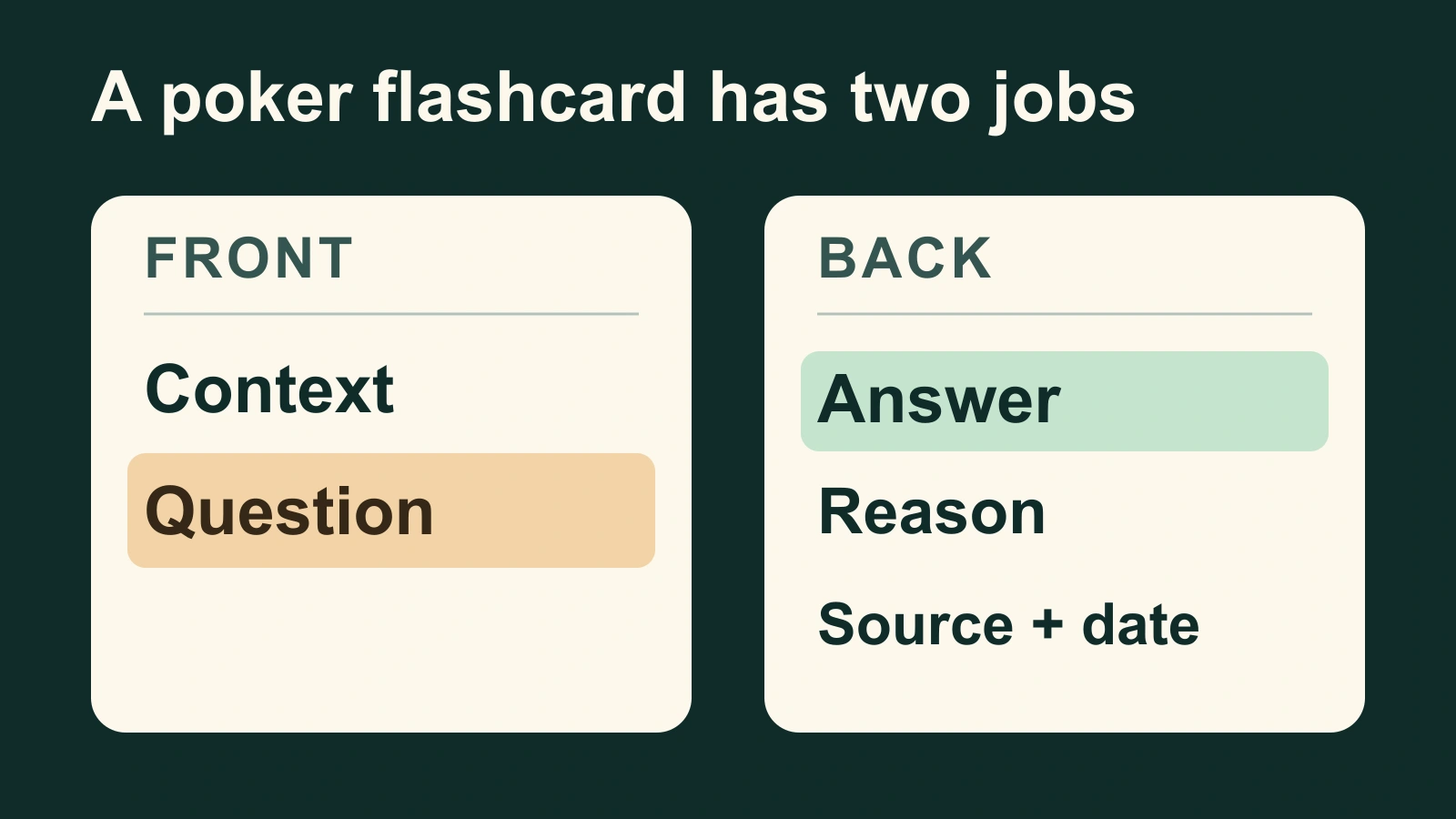
A useful poker flashcard puts the question and necessary context on the front, then the answer, reason and source on the back. Before adding another card, check two different problems: does the front give away what you meant to retrieve, or does it leave out information needed to answer?
“Why do I need 25% equity here?” can be a reasonable question about an explanation. It is a poor test of whether you can calculate 25%. “Should I bet ace-king?” has the opposite problem: hiding the answer does not make an underspecified strategy question useful.
This guide repairs those questions. Use the poker flashcard workshop and blank template for three constructed examples, answer notes and changed-condition checks. These are our editorial design examples, not a validated assessment or a tested claim about learning gains. For when and how often to study, use the separate poker practice guide.
Keep the context; remove accidental answers
The official Anki manual recommends simple cards and understanding the material before memorizing it. It also warns that predictable groupings can provide unintended clues. That is useful authoring guidance, not evidence that one poker card format beats another.
Start by writing the target on the back: calculate a price, identify an action, construct a hand or recall a particular reference output. Then check the front against that target. If it is a number, do not print that number in the title. If it is an action label, retain the action history that determines it. If it is a solver response, retain the modeled situation and identify the reference solution. A card that asks only for a definition does not need every input a solver would need.
A screenshot needs the same check. Crop or cover the highlighted action and frequency if those are the answers. Keep the board, exact hand, relevant amounts and action path readable. A file named “always-check-this-flop” also supplies a clue if that filename is visible during review.
Repair 1: ask for the calculation, then grade the denominator
Before: “Why do I need 25% equity against a half-pot bet?”
Repaired front
Heads-up no-limit Hold'em, river. The pot is 60 chips before your opponent moves all-in for 30. You can call the full 30. Ignore rake. What pot-share equity makes calling break even against folding? Show the denominator.
Back and grading note
25%. Calling makes the final pot 60 + 30 + 30 = 120 chips. The threshold is 30 / 120. An acceptable answer includes your call in that denominator.
This is a question about the price of calling. It does not provide your hand's equity against the opponent's range, so answering it does not tell you to call. The full pot-odds explanation belongs in your reference material rather than on the front of every card.
For a changed-condition check, keep the starting pot at 60 and make the opponent's all-in 60, with enough chips for you to call 60. The answer becomes 60 / 180, or one third, approximately 33.33%. That asks you to use the denominator again rather than recite the first answer.
Repair 2: preserve the action that determines the label
Before: “The button bets the flop. Is that a continuation bet?”
Repaired front
No-limit Hold'em. The button raises preflop, the small blind folds and the big blind calls. Heads-up on the flop, the big blind checks and the button bets. What is the standard name for the button's bet, and which earlier action determines the label?
Back and grading note
A continuation bet. The button was the final preflop raiser and then bet the flop. Name both the label and the relevant earlier action.
This follows PokerStars' continuation-bet definition. No hole cards or board are needed to classify this sequence. Those details matter if you instead ask whether the bet is a good strategy.
Change the opening flop action: after the same preflop history, the big blind bets first on the flop. That is a donk bet under PokerStars' action-order definition. The label changes because the prior caller leads into the prior aggressor. Neither label grades the quality of the bet.
Repair 3: put the game on the front
Before: “I hold the ace of spades and the board has four spades. Do I have a flush?”
Repaired front
Standard Texas Hold'em. Your hole cards are A♠ Q♦. The river board is K♠ 9♠ 5♠ 2♠ 7♥. Name your best five-card hand.
Back and grading note
An ace-high flush: A♠ K♠ 9♠ 5♠ 2♠. State the hand and its five cards. Hold'em allows one hole card with four board cards.
Now change the game to four-card Omaha high and your hole cards to A♠ Q♦ J♥ T♣. Keep the same board. You cannot make a flush: Omaha requires exactly two hole cards and three board cards, and your hand contains only one spade. Compare the official Hold'em and Omaha hand-construction rules.
“Texas Hold'em” is not an unwanted hint here. It is a rule needed to answer the question. Removing it would create ambiguity rather than a better memory test.
Split a bundle of questions into gradeable parts
Before: “Explain the pot odds, blockers and best action in this hand.”
You might remember the price, miss a blocker and guess the action. A single “correct” mark would conceal that mixture. Repair it by making the price one card, a specific blocker relationship another, and the reference strategy a third. Keep the relevant context on each front; keep the reasoning for each answer on its own back.
Write the grading note before reviewing: which fact, calculation or relationship must your response contain? Record a miss when that element is absent, even if the revealed answer feels familiar. A short explanation can still belong with an answer. “Name the bet and identify the prior aggressor” is one connected target. The point is to make a missed answer interpretable, not to force every card into a one-word response.
Suspend a solver card whose answer you cannot defend
Before: “A-K on K-7-2: bet or check?”
Do not repair that front by inventing a confident back. If the intended answer comes from a solution, record its format, positions, exact cards, street, prior actions, pot and stacks at a named point. Preserve the reference's ranges, rake or ante assumptions and available bet sizes as well. Keep a solution identifier and date so the answer can be checked later.
Then ask a bounded question such as “What actions and frequencies does this identified solution display for this exact hand?” The back should record that output and its source. Keep your own explanation separate from facts actually shown by the solution. If the context or reference is missing, set the card aside until you can restore it. Our solver study guide covers interpreting the resulting output.
A reusable front and back
- Front: one retrieval target; the rules and situation needed to answer; a neutral reference identifier if applicable.
- Back: answer; reason or calculation; what a satisfactory response must contain; a condition that limits or changes the answer; source and date checked.
The printable workshop keeps answers behind expandable sections and includes a blank template. The examples here show their answers because this page teaches card construction. Use your own notes or a flashcard system for repeated review; the workshop is a manual reference, not an app import package.
Use a changed-condition question to check the card's boundary. Keep its answer hidden until you have responded; avoid a visible heading that names the expected hand or action. Answering a familiar card and answering a related new question are different observations. Butler's 2010 experiments studied repeated testing and transfer using prose passages and later questions. His study included new inferential questions as well as repeated ones. Our changed-condition checks have not been tested in poker learners, and a correct response does not establish broad mastery or predict table performance.
Use guided material as the starting reference
For guided study, River offers short interactive poker lessons and questions. River and GTO Gecko are made by GTO Solutions. After studying a point, write a question about it in your own notes, check the answer against the material and use the front/back test above. The downloadable cards are an independent manual resource; this article does not describe a River flashcard feature.
Sources checked September 6, 2026. The workshop's questions, annotations and template are original constructed teaching material. Its calculation and hand-construction examples have independent arithmetic and card-selection checks; no learner study, mastery cutoff or improvement estimate was produced. Download the card text and source references and method and reproduction notes.